Bioinsecticides Market Overview
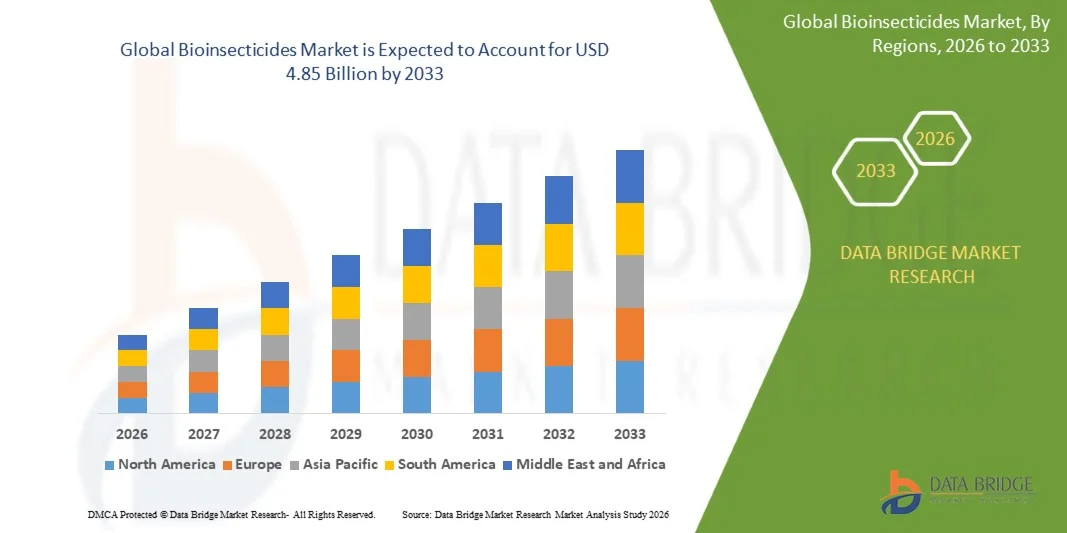
The Bioinsecticides Market was valued at USD 1.90 billion in 2025 and is projected to reach USD 4.85 billion by 2033, growing at a CAGR of 12.44% from 2026 to 2033. The Bioinsecticides Market is experiencing consistent growth driven by rising demand for sustainable pest management solutions, increasing adoption of organic farming practices, and growing concerns regarding the environmental impact of chemical insecticides.
The increasing focus on reducing chemical residues in food products, combined with stricter regulations on synthetic pesticide usage, is encouraging farmers, agricultural companies, and food producers to adopt biological pest control solutions. Microbial, botanical, and biochemical bioinsecticides are gaining traction as eco-friendly alternatives, offering effective pest control while supporting soil health, biodiversity, and sustainable agriculture practices. Growing investments in precision farming, integrated pest management (IPM), and organic crop production are further accelerating the adoption of bioinsecticides across developed and emerging agricultural markets.
Key Market Trends & Insights
- North America dominated the Bioinsecticides Market with the largest revenue share of 36.2% in 2025, supported by strong adoption of sustainable agricultural practices, increasing demand for organic food products, and favorable regulatory frameworks promoting biological crop protection solutions. The region’s advanced farming infrastructure, high awareness among growers, and rising investments in integrated pest management (IPM) programs are driving widespread adoption of bioinsecticides across commercial agriculture.
- The foliar spray segment dominated the market with a 49.2% share in 2025, due to its widespread adoption for direct insect control on crop surfaces.
- Asia-Pacific is expected to be the fastest-growing region at a CAGR of 9.1% from 2026 to 2033, fueled by increasing agricultural production, rising adoption of sustainable farming techniques, government initiatives supporting biological crop protection, and growing demand for residue-free food products. Countries including China, India, and Japan are witnessing increased deployment of bioinsecticides due to expanding organic agriculture and concerns regarding pesticide resistance.
- The pathogens segment is projected to register the fastest growth among type categories with a CAGR of 9.8% from 2026 to 2033, driven by increasing utilization of microbial-based solutions such as Bacillus thuringiensis (Bt), entomopathogenic fungi, and viruses for targeted pest control. Growing research and development activities, improved formulation technologies, and rising demand for species-specific pest management solutions are accelerating segment expansion.
Market Size & Forecast
- Global Market Value (2025): USD 1.90 Billion
- Expected Market Value (2033): USD 4.85 Billion
- Forecast CAGR (2026–2033): 12.44%
- Leading Region in 2025: North America
- Fastest Growing Region: Asia-Pacific
Report Scope and Bioinsecticides Market Segmentation
|
Attributes |
Bioinsecticides Key Market Insights |
|
Segments Covered |
|
|
Countries Covered |
North America · U.S. · Canada · Mexico Europe · Germany · France · U.K. · Netherlands · Switzerland · Belgium · Russia · Italy · Spain · Turkey · Rest of Europe Asia-Pacific · China · Japan · India · South Korea · Singapore · Malaysia · Australia · Thailand · Indonesia · Philippines · Rest of Asia-Pacific Middle East and Africa · Saudi Arabia · U.A.E. · South Africa · Egypt · Israel · Rest of Middle East and Africa South America · Brazil · Argentina · Rest of South America |
|
Key Market Players |
• BASF SE (Germany) |
|
Market Opportunities |
· Rising Adoption of Organic Farming and Sustainable Agriculture Practices · Development of Advanced Microbial and Biotechnological Insecticide Solutions · Integration of Bioinsecticides with Integrated Pest Management (IPM) Programs |
|
Value Added Data Infosets |
In addition to the insights on market scenarios such as market value, growth rate, segmentation, geographical coverage, and major players, the market reports curated by the Data Bridge Market Research also include in-depth expert analysis, geographically represented company-wise production and capacity, network layouts of distributors and partners, detailed and updated price trend analysis and deficit analysis of supply chain and demand. |
Bioinsecticides Market Trends
Trend: Rising Adoption of Sustainable Agriculture and Biological Pest Management Solutions
The Bioinsecticides Market is witnessing strong growth due to increasing adoption of sustainable farming practices, rising concerns regarding chemical pesticide residues, and growing demand for environmentally friendly crop protection solutions. Farmers and agricultural organizations are increasingly shifting toward biological pest management methods to improve soil health, protect beneficial insects, and comply with organic farming standards. Bioinsecticides based on microbial agents such as Bacillus thuringiensis (Bt), Beauveria bassiana, and plant-derived extracts are gaining popularity due to their targeted pest control capabilities and lower environmental impact. For instance, leading agricultural biotechnology companies are expanding their biological crop protection portfolios to support integrated pest management (IPM) programs across major agricultural regions. The increasing cultivation of high-value crops, expansion of organic farming, and regulatory restrictions on synthetic pesticides are further accelerating the adoption of bioinsecticide products globally.
Bioinsecticides Market Dynamics
Key Market Driver: Increasing Demand for Sustainable Crop Protection and Reduced Chemical Pesticide Dependency
The primary driver of the Bioinsecticides Market is the growing demand for sustainable agricultural practices and the need to reduce dependency on conventional chemical insecticides. Governments, farmers, and food producers are increasingly adopting biological crop protection solutions to address concerns related to pesticide resistance, environmental pollution, and food safety. The expansion of organic farming and integrated pest management programs is creating significant demand for bioinsecticides across fruits, vegetables, cereals, and oilseed crops. For example, regulatory initiatives in North America and Europe encouraging reduced chemical pesticide usage are supporting the adoption of biological alternatives. In addition, increasing investments by agrochemical companies in microbial and botanical insecticide development are improving product availability, formulation efficiency, and field performance. Growing global food demand and the need for sustainable agricultural productivity are further strengthening market growth.
Key Restraint/Challenge: Limited Awareness, Higher Product Costs, and Performance Variability Compared with Chemical Insecticide
A major challenge in the Bioinsecticides Market is the limited awareness among farmers regarding biological pest control solutions, along with higher production costs and variability in field performance compared with synthetic pesticides. Bioinsecticides often require specific storage conditions, application timing, and environmental conditions to achieve optimal effectiveness, which can create adoption barriers among small-scale farmers. In addition, microbial-based products may have shorter shelf life and slower action compared with conventional chemical insecticides, affecting farmer preference in certain markets. Developing economies with limited access to agricultural extension services and advanced farming technologies face additional challenges in adopting bioinsecticide solutions. These factors can restrict market penetration despite growing demand for sustainable agriculture practices.
Key Market Opportunity: Integration of Biotechnology, Microbial Innovations, and Precision Agriculture Solutions
The integration of advanced biotechnology, precision agriculture, and digital farming solutions presents significant growth opportunities for the Bioinsecticides market. Companies are increasingly investing in next-generation biological formulations with improved stability, longer shelf life, and enhanced pest-targeting capabilities. Advances in microbial discovery, genetic research, and fermentation technologies are enabling the development of more effective bioinsecticide products. For instance, agricultural biotechnology companies are focusing on improved strains of beneficial microorganisms and combination biological products to enhance crop protection performance. Furthermore, the adoption of precision farming technologies, including sensor-based monitoring and data-driven pest management systems, is creating opportunities for optimized bioinsecticide application. The expansion of organic agriculture, government support for sustainable farming, and increasing demand for residue-free food products across Asia-Pacific, Latin America, and emerging markets are expected to create strong growth opportunities for the Bioinsecticides Market.
Bioinsecticides Market Scope
The bioinsecticides market is segmented on the basis of type, crop type, applications, form, and insects.
- By Type
On the basis of type, the Bioinsecticides Market is segmented into Natural Insecticides, Pathogens, and Parasites. The natural insecticides segment dominated the market with a 45.6% share in 2025, owing to increasing preference for eco-friendly crop protection solutions derived from botanical and naturally occurring sources. Natural insecticides including neem extracts, plant-based compounds, and naturally derived active ingredients are gaining widespread adoption due to their low environmental impact and reduced chemical residue levels. Increasing regulatory restrictions on synthetic pesticides across North America, Europe, and Asia-Pacific are encouraging farmers to shift toward biological alternatives. The growing demand for organic farming practices and sustainable agricultural production systems is further supporting segment expansion. In addition, natural insecticides are increasingly integrated into integrated pest management (IPM) programs to improve pest control efficiency while maintaining soil and ecosystem health. Rising awareness among farmers regarding long-term benefits of biological crop protection solutions is strengthening adoption across commercial agriculture. Furthermore, increasing investments by agrochemical companies in developing advanced natural insecticide formulations are contributing to market growth. The availability of improved formulations with enhanced stability, longer shelf life, and better pest-targeting capability is further reinforcing the dominance of this segment.
The pathogens segment is expected to witness the fastest growth at a CAGR of 15.2% from 2026 to 2033, driven by increasing adoption of microbial-based insect control solutions such as Bacillus thuringiensis (Bt), entomopathogenic fungi, and insect-specific pathogens. Growing concerns regarding pesticide resistance among insects are encouraging farmers to adopt pathogen-based biological alternatives with targeted pest control capabilities. Advancements in biotechnology and microbial formulation technologies are improving product effectiveness, application efficiency, and field performance. Increasing research activities focused on developing next-generation microbial bioinsecticides with improved stability and wider pest coverage are accelerating segment growth. Government initiatives promoting sustainable agriculture and reduced chemical pesticide usage are creating favorable conditions for pathogen-based solutions. In addition, rising adoption of precision agriculture technologies is enabling more accurate application of microbial insect control products. Expanding organic farming areas and increasing demand for residue-free agricultural products are further supporting market penetration. The growing presence of biotechnology companies investing in biological crop protection research is expected to create significant growth opportunities for pathogen-based bioinsecticides.
- By Crop Type
On the basis of crop type, the Bioinsecticides Market is segmented into Oilseeds and Pulses, Fruits and Vegetables, and Grains and Cereals. The fruits and vegetables segment dominated the market with a 38.4% share in 2025, supported by increasing demand for high-quality fresh produce with minimal pesticide residues. Fruits and vegetables are highly vulnerable to insect attacks, creating strong demand for effective biological pest management solutions. Export-oriented agricultural markets are increasingly adopting bioinsecticides to meet international food safety standards and regulatory requirements. The growing popularity of organic fruits and vegetables among consumers is further accelerating the use of biological crop protection products. Farmers are increasingly using bioinsecticides as part of integrated pest management programs to improve crop quality and reduce chemical dependency. In addition, greenhouse farming and protected cultivation systems are increasing the adoption of biological insect control solutions due to their compatibility with controlled farming environments. Rising investments in sustainable horticulture practices across emerging economies are further strengthening demand. The increasing availability of specialized bioinsecticide formulations designed for vegetable and fruit crops is supporting continued market dominance.
The oilseeds and pulses segment is expected to witness the fastest growth at a CAGR of 14.8% from 2026 to 2033, driven by increasing cultivation of soybean, pulses, and other protein-rich crops globally. Growing demand for plant-based proteins is encouraging expansion of oilseed and pulse production, increasing the need for effective pest management solutions. Biological insecticides are gaining importance in these crops due to their ability to control pests while maintaining soil health and reducing chemical residues. Government programs supporting sustainable farming and improving pulse productivity are encouraging farmers to adopt biological inputs. Increasing awareness regarding environmental benefits and long-term soil fertility improvement is further supporting adoption. In addition, large-scale commercial farming operations are increasingly integrating bioinsecticides into crop protection programs to improve yield stability. Advancements in microbial and botanical formulations are enhancing effectiveness against major pests affecting oilseed and pulse crops. Rising demand from organic and sustainable agriculture sectors is expected to further accelerate segment growth during the forecast period.
- By Applications
On the basis of applications, the Bioinsecticides Market is segmented into seed treatment, soil treatment, and foliar spray. The foliar spray segment dominated the market with a 49.2% share in 2025, due to its widespread adoption for direct insect control on crop surfaces. Foliar application provides faster action against pest infestations and is widely used across fruits, vegetables, cereals, and commercial crops. Farmers prefer foliar spray solutions because they allow easy application using conventional agricultural spraying equipment. Increasing adoption of integrated pest management strategies is supporting the use of foliar bioinsecticides. Growing demand for reduced chemical pesticide usage and sustainable farming practices is further driving adoption. In addition, improvements in formulation technologies are enhancing the effectiveness and persistence of foliar biological products. Rising awareness among farmers regarding environmentally safe pest management methods is strengthening market penetration. The segment continues to benefit from increasing government support for biological agriculture and sustainable crop production.
The seed treatment segment is expected to witness the fastest growth at a CAGR of 16.1% from 2026 to 2033, driven by rising demand for preventive crop protection solutions. Seed treatment provides early-stage protection against insect damage and improves crop establishment by protecting seeds during germination. Increasing focus on improving agricultural productivity while reducing chemical inputs is encouraging adoption of biological seed treatment solutions. Farmers are increasingly adopting seed-applied bioinsecticides due to their cost efficiency and targeted pest control benefits. Expansion of commercial farming and precision agriculture practices is further supporting growth. In addition, improved formulation technologies are enhancing seed coating efficiency and product stability. Growing awareness about sustainable farming inputs and reduced environmental impact is expected to accelerate adoption of bioinsecticide-based seed treatments globally.
- By Form
On the basis of form, the Bioinsecticides Market is segmented into Dry and Liquid. The liquid segment dominated the market with a 62.7% share in 2025, owing to its widespread adoption due to ease of application and better crop coverage. Liquid bioinsecticides are preferred by farmers because they can be easily mixed with existing spraying systems and provide uniform distribution across crops. Increasing use of modern agricultural equipment is further supporting adoption of liquid formulations. The segment benefits from improved formulation technologies that enhance product stability and effectiveness under field conditions. Rising demand for convenient and efficient crop protection solutions is driving preference for liquid products. In addition, manufacturers are focusing on developing advanced liquid formulations with longer shelf life and improved performance. Increasing adoption across commercial farms and horticulture applications is reinforcing the leading position of liquid bioinsecticides.
The dry segment is expected to witness the fastest growth at a CAGR of 13.9% from 2026 to 2033, driven by advantages such as longer storage stability, easier transportation, and lower handling requirements. Dry formulations are gaining popularity in regions where storage infrastructure and transportation conditions are challenging. Powder and granular bioinsecticides offer improved shelf life and are suitable for large-scale agricultural operations. Increasing demand from emerging markets is supporting growth of dry biological crop protection products. Advancements in drying technologies are improving product quality and maintaining microbial activity. Growing adoption in developing agricultural regions is expected to create new opportunities for dry bioinsecticide manufacturers.
- By Insects
On the basis of insects, the Bioinsecticides Market is segmented into Insects and Mites, Caterpillars, and Soil Insects. The caterpillars segment dominated the market with a 42.3% share in 2025, due to significant crop damage caused by caterpillar pests such as armyworms, bollworms, and other lepidopteran insects. These pests affect major crops including cotton, vegetables, and cereals, creating strong demand for biological control solutions. Bioinsecticides based on Bacillus thuringiensis (Bt) are widely adopted due to their targeted action and environmental safety. Increasing resistance of pests toward conventional chemical pesticides is encouraging farmers to shift toward biological alternatives. Growing adoption of sustainable agriculture practices is further supporting demand for caterpillar control solutions. Rising investments in biological pest management research are improving product effectiveness and availability.
The soil insects segment is expected to witness the fastest growth at a CAGR of 15.6% from 2026 to 2033, driven by increasing focus on managing underground pests that impact root development and crop productivity. Soil insects such as larvae, grubs, and root-feeding pests create significant yield losses, increasing demand for effective biological solutions. Growing awareness regarding soil health preservation is encouraging adoption of microbial-based insect control products. Increasing use of sustainable farming techniques and integrated pest management systems is supporting segment expansion. Advancements in beneficial microorganism-based formulations are improving effectiveness against soil-dwelling insects. Rising adoption in commercial agriculture and organic farming systems is expected to accelerate growth during the forecast period.
Bioinsecticides Market Regional Analysis
North America dominated the Bioinsecticides Market and accounted for the largest revenue share of 36.2% in 2025, supported by strong adoption of sustainable agricultural practices, increasing demand for organic food products, and favorable regulatory frameworks promoting biological crop protection solutions. The region benefits from advanced farming infrastructure, high awareness among growers, and growing investments in integrated pest management (IPM) programs. Increasing concerns regarding chemical pesticide residues, environmental sustainability, and soil health are encouraging farmers to adopt bioinsecticides across fruits, vegetables, grains, and specialty crops. The presence of established biological crop protection companies and continuous innovation in microbial and natural insecticide formulations are further strengthening market growth across North America.
U.S. Bioinsecticides Market Insight
The U.S. bioinsecticides market is witnessing strong growth due to rising adoption of organic farming practices, increasing demand for residue-free agricultural products, and growing emphasis on sustainable pest management solutions. The country’s advanced agricultural sector, along with strong research and development activities in biological crop protection, is driving demand for microbial-based and natural insecticides. Increasing implementation of integrated pest management (IPM) programs among commercial growers and support from regulatory initiatives promoting reduced chemical pesticide usage are accelerating bioinsecticide adoption across major crop segments. Additionally, rising investments by agricultural biotechnology companies in innovative biological formulations are supporting market expansion in the U.S.
Europe Bioinsecticides Market Insight
The Europe bioinsecticides market remains a significant contributor to global revenue, driven by strict regulations on chemical pesticide usage, strong environmental sustainability initiatives, and increasing demand for organic food production. European farmers are increasingly adopting biological pest control solutions to comply with sustainable agriculture standards and reduce chemical residues in food products. Growing government support for eco-friendly farming practices, expansion of organic cultivation areas, and rising investments in agricultural biotechnology are supporting the adoption of bioinsecticides across the region. Countries across Europe are increasingly integrating biological solutions into crop protection strategies to improve agricultural sustainability.
U.K. Bioinsecticides Market Insight
The U.K. bioinsecticides market is experiencing steady growth, supported by increasing awareness regarding sustainable agriculture, rising demand for organic produce, and growing adoption of integrated pest management practices. Farmers and agricultural organizations are increasingly using biological insect control products to reduce dependency on synthetic pesticides while maintaining crop productivity. Government initiatives promoting environmentally friendly farming methods and increasing focus on biodiversity conservation are contributing to market growth. The expansion of sustainable food supply chains and demand for chemical-free agricultural products are further supporting bioinsecticide adoption in the U.K.
Germany Bioinsecticides Market Insight
The Germany bioinsecticides market is expanding steadily due to the country’s strong focus on sustainable farming, advanced agricultural research capabilities, and strict environmental regulations. German farmers are increasingly adopting biological pest management solutions to improve soil quality, reduce pesticide impact, and support organic farming practices. The country’s well-developed agricultural technology ecosystem and increasing investments in biotechnology-based crop protection products are strengthening market growth. Furthermore, rising demand for environmentally responsible food production and compliance with European agricultural standards are encouraging broader adoption of bioinsecticides.
Asia-Pacific Bioinsecticides Market Insight
The Asia-Pacific bioinsecticides market is expected to witness the fastest growth at a CAGR of 9.1% from 2026 to 2033, driven by increasing agricultural production, rising adoption of sustainable farming techniques, government initiatives supporting biological crop protection, and growing demand for residue-free food products. Countries including China, India, and Japan are experiencing increased deployment of bioinsecticides due to expanding organic agriculture, concerns regarding pesticide resistance, and growing awareness of environmentally friendly farming solutions. Rapid population growth, increasing food demand, and the need for sustainable agricultural productivity are further accelerating regional market expansion.
Japan Bioinsecticides Market Insight
The Japan bioinsecticides market is witnessing consistent growth due to rising investments in sustainable agriculture, advanced farming technologies, and environmentally friendly crop protection solutions. Japanese farmers are increasingly adopting biological insecticides to improve food safety, reduce chemical pesticide usage, and support high-quality agricultural production. Growing demand for organic and premium agricultural products, along with government initiatives promoting sustainable farming practices, is contributing to market growth. The integration of advanced agricultural technologies and precision farming practices is further enhancing the adoption of bioinsecticides in Japan.
China Bioinsecticides Market Insight
The China bioinsecticides market is growing rapidly, driven by increasing agricultural production, government support for sustainable farming, and rising concerns regarding pesticide residues and resistance. The country is witnessing greater adoption of microbial and natural insecticides across fruits, vegetables, grains, and commercial crops as farmers seek efficient and environmentally friendly pest management solutions. Expanding organic farming practices, increasing investments in agricultural biotechnology, and regulatory efforts to reduce chemical pesticide dependency are accelerating bioinsecticide adoption. China’s focus on improving agricultural sustainability and food safety is positioning it as one of the fastest-growing markets for bioinsecticides globally.
Bioinsecticides Market Share
The Bioinsecticides industry is primarily led by well-established companies, including:
- BASF SE (Germany)
- Bayer AG (Germany)
- Syngenta Group (Switzerland)
- Corteva Agriscience (U.S.)
- Novozymes A/S (Denmark)
- UPL Limited (India)
- Marrone Bio Innovations Inc. (U.S.)
- Valent BioSciences Corporation (U.S.)
- Koppert Biological Systems (Netherlands)
- Biobest Group NV (Belgium)
- Andermatt Biocontrol AG (Switzerland)
- Certis USA LLC (U.S.)
- FMC Corporation (U.S.)
- Isagro S.p.A. (Italy)
- Lallemand Inc. (Canada)
- Chr. Hansen Holding A/S (Denmark)
- Stockton Bio-AG (Israel)
- American Vanguard Corporation (U.S.)
- Som Phytopharma India Ltd. (India)
- AgriLife (India)
- Valent U.S.A. LLC (U.S.)
- Seipasa S.A. (Spain)
- BioWorks Inc. (U.S.)
- GreenLight Biosciences Inc. (U.S.)
- Futureco Bioscience S.L. (Spain)
- AgBiTech Pty Ltd. (Australia)
- Pro Farm Group Inc. (U.S.)
- Koppert Biological Systems India Pvt. Ltd. (India)
- IPL Biologicals Limited (India)
- Novonesis A/S (Denmark)
Latest Developments in Bioinsecticides Market
- In April 2022, BASF launched Exponus insecticide in India, introducing a new crop protection solution for controlling key insect pests. The product uses BASF’s Broflanilide active ingredient and was developed to provide effective pest management across oilseeds, pulses, and vegetable crops. The launch supported the company’s expansion of advanced insect-control solutions designed to address pest resistance challenges within integrated pest management programs
- In March 2024, BASF expanded the application scope of its Velifer® bioinsecticide/miticide by receiving approval for new application methods and additional crops. The updated registration allowed greenhouse growers to use Velifer in soil-directed sprays, dips, and drench applications, while also extending its use to crops including fruit and nut trees, vines, brambles, and bushberries. The product, based on a proprietary strain of Beauveria bassiana, supports integrated pest management (IPM) programs by targeting pests such as mites, thrips, aphids, and whiteflies with a biological mode of action
- In February 2025, BASF announced regulatory progress for its new insecticide active ingredient Prexio Active, designed for rice pest management in Asia-Pacific markets. The company submitted registration dossiers in key markets, including India, for an advanced insecticide technology targeting rice hopper species. The development highlights increasing industry focus on innovative pest-control solutions to address insect resistance and improve sustainable crop protection
- In May 2025, BioWorks launched PRINCIPLE WP, a biological insecticide based on the fungal strain Beauveria bassiana BW149. The new bioinsecticide was introduced in the U.S. market for indoor and outdoor agricultural applications, including foliar sprays, soil drenches, dipping, and aerial applications. PRINCIPLE WP was developed to provide biological control against pests such as thrips, aphids, and whiteflies across vegetables, fruits, ornamental crops, and nursery applications
- In November 2025, Corteva Agriscience announced the launch of Goltrevo, its first bioinsecticide in the company’s biological crop protection portfolio. The product is based on a novel strain of the entomopathogenic fungus Beauveria bassiana and is designed to control multiple sap-feeding and chewing insects, including whiteflies, aphids, leafhoppers, beetles, and caterpillars. The launch represents increasing investment by major agricultural companies in nature-based pest management solutions

- Interactive Data Analysis Dashboard
- Company Analysis Dashboard for high growth potential opportunities
- Research Analyst Access for customization & queries
- Competitor Analysis with Interactive dashboard
- Latest News, Updates & Trend analysis
- Harness the Power of Benchmark Analysis for Comprehensive Competitor Tracking
Data collection and base year analysis are done using data collection modules with large sample sizes. The stage includes obtaining market information or related data through various sources and strategies. It includes examining and planning all the data acquired from the past in advance. It likewise envelops the examination of information inconsistencies seen across different information sources. The market data is analysed and estimated using market statistical and coherent models. Also, market share analysis and key trend analysis are the major success factors in the market report. To know more, please request an analyst call or drop down your inquiry.
The key research methodology used by DBMR research team is data triangulation which involves data mining, analysis of the impact of data variables on the market and primary (industry expert) validation. Data models include Vendor Positioning Grid, Market Time Line Analysis, Market Overview and Guide, Company Positioning Grid, Patent Analysis, Pricing Analysis, Company Market Share Analysis, Standards of Measurement, Global versus Regional and Vendor Share Analysis. To know more about the research methodology, drop in an inquiry to speak to our industry experts.
Data Bridge Market Research is a leader in advanced formative research. We take pride in servicing our existing and new customers with data and analysis that match and suits their goal. The report can be customized to include price trend analysis of target brands understanding the market for additional countries (ask for the list of countries), clinical trial results data, literature review, refurbished market and product base analysis. Market analysis of target competitors can be analyzed from technology-based analysis to market portfolio strategies. We can add as many competitors that you require data about in the format and data style you are looking for. Our team of analysts can also provide you data in crude raw excel files pivot tables (Fact book) or can assist you in creating presentations from the data sets available in the report.