


Biologic Drug Substance Manufacturing Systems Market Overview
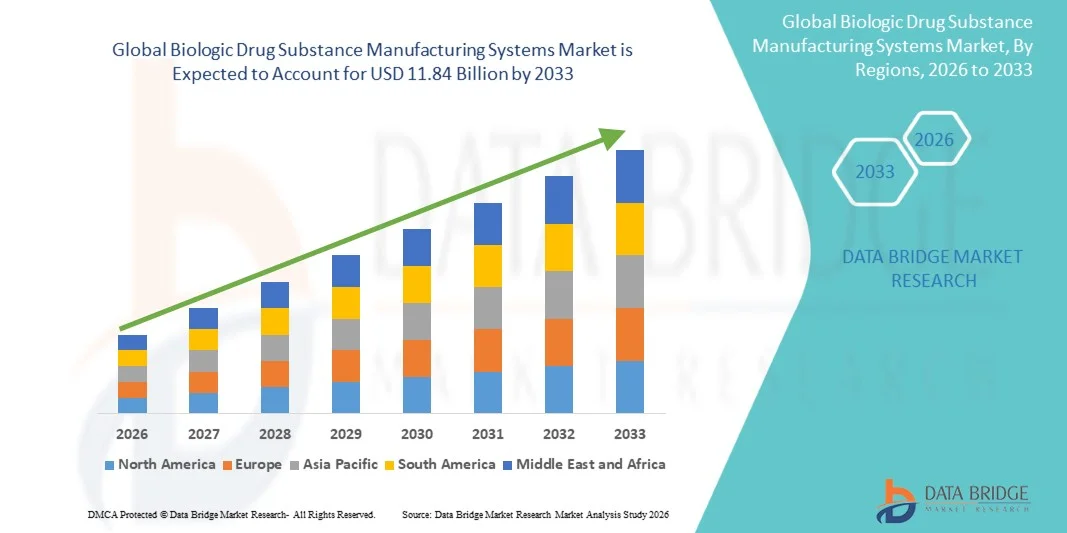
The Biologic Drug Substance Manufacturing Systems Market was valued at USD 4.21 billion in 2025 and is projected to reach USD 11.84 billion by 2033, growing at a CAGR of 13.80% from 2026 to 2033. The market is experiencing steady growth driven by rising demand for biologics and biosimilars, increasing complexity of large-molecule drug development, and expanding investments in advanced biopharmaceutical manufacturing infrastructure. The growing prevalence of chronic diseases such as cancer, diabetes, and autoimmune disorders is accelerating the need for scalable and high-quality biologic drug substance production systems.
The increasing adoption of single-use technologies, automated bioprocessing systems, and continuous manufacturing approaches is transforming traditional biologics production into more efficient, flexible, and cost-effective processes. Biopharmaceutical companies and CDMOs are increasingly investing in advanced bioreactors, upstream and downstream processing systems, and integrated manufacturing platforms to improve yield, ensure product consistency, and meet stringent regulatory requirements across global markets.
Key Market Trends & Insights
- North America dominated the Biologic Drug Substance Manufacturing Systems Market with the largest revenue share of 33.96% in 2025, supported by strong biopharmaceutical manufacturing infrastructure, high adoption of advanced bioprocessing technologies, and significant investment in biologics R&D and production capacity expansion across the region.
- The upstream processing systems segment dominated the market in 2025 with 55% due to its critical role in early-stage biologics manufacturing, including cell line development and cell culture expansion.
- Asia-Pacific is expected to be the fastest-growing region at a CAGR of 8.15% from 2026 to 2033, fueled by expanding biologics manufacturing capacity, rising outsourcing to CDMOs, and strong government support for biotechnology infrastructure development in China, India, South Korea, and Singapore.
- The bioreactors & fermentation systems segment is expected to register the fastest growth with a CAGR of 8.28% from 2026 to 2033, driven by increasing adoption of single-use bioreactors, rising demand for scalable production systems, and expansion of monoclonal antibody and vaccine manufacturing.
Market Size & Forecast
- Global Market Value (2025): USD 4.21 Billion
- Expected Market Value (2033): USD 11.84 Billion
- Forecast CAGR (2026–2033): 13.80%
- Leading Region in 2025: North America
- Fastest Growing Region: Asia-Pacific
Report Scope and Biologic Drug Substance Manufacturing Systems Market Segmentation
|
Attributes |
Biologic Drug Substance Manufacturing Systems Key Market Insights |
|
Segments Covered |
|
|
Countries Covered |
North America · U.S. · Canada · Mexico Europe · Germany · France · U.K. · Netherlands · Switzerland · Belgium · Russia · Italy · Spain · Turkey · Rest of Europe Asia-Pacific · China · Japan · India · South Korea · Singapore · Malaysia · Australia · Thailand · Indonesia · Philippines · Rest of Asia-Pacific Middle East and Africa · Saudi Arabia · U.A.E. · South Africa · Egypt · Israel · Rest of Middle East and Africa South America · Brazil · Argentina · Rest of South America |
|
Key Market Players |
• Thermo Fisher Scientific Inc. (U.S.) |
|
Market Opportunities |
· Expansion of Biologics, Biosimilars, and Advanced Therapies · Adoption of Single-Use Technologies and Flexible Manufacturing Systems · Growth of Outsourcing and CDMO-Led Manufacturing Expansion |
|
Value Added Data Infosets |
In addition to the insights on market scenarios such as market value, growth rate, segmentation, geographical coverage, and major players, the market reports curated by the Data Bridge Market Research also include in-depth expert analysis, geographically represented company-wise production and capacity, network layouts of distributors and partners, detailed and updated price trend analysis and deficit analysis of supply chain and demand. |
Biologic Drug Substance Manufacturing Systems Market Trends
Trend: Growth in Biologics Manufacturing Automation & Digital Bioprocessing
Biologic Drug Substance Manufacturing Systems are increasingly being integrated with automation, AI-driven process control, and digital twin technologies to improve yield efficiency, batch consistency, and scalability. Biopharmaceutical manufacturers are adopting advanced bioreactor monitoring systems and real-time analytics to optimize upstream and downstream processes, reducing production variability and accelerating biologics development timelines. For example, in May 2022, Sartorius introduced enhanced digital bioprocess solutions aimed at improving real-time monitoring and control of cell culture processes in biologics manufacturing. In July 2024, Merck KGaA expanded its digital bioprocessing portfolio to support continuous manufacturing workflows, reflecting the industry’s shift toward Industry 4.0-enabled biologics production systems.
Biologic Drug Substance Manufacturing Systems Market Dynamics
Key Market Driver: Expanding Demand for Monoclonal Antibodies, Vaccines & Cell and Gene Therapies
The rapid growth of monoclonal antibodies, recombinant proteins, vaccines, and cell and gene therapies is a major driver of biologic drug substance manufacturing systems. Increasing global disease burden and rising adoption of targeted biologics are pushing pharmaceutical companies to expand large-scale production capabilities. In March 2021, Lonza expanded its biologics manufacturing capacity in the United States to support increasing demand for antibody and vaccine production. Similarly, in September 2023, Thermo Fisher Scientific announced expansion of its bioproduction services to strengthen global supply of biologics and accelerate clinical-to-commercial manufacturing transitions. These investments highlight the growing reliance on advanced upstream and downstream systems for scalable biologics production.
Key Restraint/Challenge: High Capital Investment and Complex Manufacturing Requirements
A significant challenge in the biologic drug substance manufacturing systems market is the high capital investment required for establishing GMP-compliant facilities and deploying advanced bioprocessing equipment. Biologics production requires specialized infrastructure such as single-use bioreactors, chromatography systems, and high-end filtration units, leading to increased operational costs. In addition, process complexity, stringent regulatory compliance, and long validation timelines further increase barriers to entry for smaller manufacturers. Limited availability of skilled bioprocess engineers also impacts production efficiency. Variability in raw biological materials adds further process uncertainty. High maintenance and system integration costs restrict adoption among emerging market players. Supply chain disruptions for critical bioprocess components can delay production scaling. Regulatory approval cycles for biologics manufacturing facilities are also lengthy. These combined factors significantly increase total cost of ownership.
Key Market Opportunity: Expansion of CDMO-Led Biologics Manufacturing & Flexible Production Platforms
The growing outsourcing trend toward contract development and manufacturing organizations (CDMOs) is creating significant opportunities for biologic drug substance manufacturing systems. Pharmaceutical companies are increasingly relying on CDMOs for scalable, cost-efficient, and flexible production of biologics. In February 2022, WuXi Biologics expanded its global manufacturing footprint with new large-scale biomanufacturing facilities in Asia to meet rising global demand. In October 2024, Samsung Biologics announced additional capacity expansion for large-scale biologics production, strengthening its position as a global CDMO leader. These developments highlight the increasing role of modular and single-use manufacturing systems in supporting rapid scale-up, multi-product facilities, and accelerated biologics commercialization across global markets.
Biologic Drug Substance Manufacturing Systems Market Scope
The biologic drug substance manufacturing systems market is segmented on the basis of product type and end user
- By Product Type
On the basis of product type, the Biologic Drug Substance Manufacturing Systems Market is segmented into upstream processing systems, downstream processing systems, bioreactors & fermentation systems, and filtration & purification systems. The upstream processing systems segment dominated the market in 2025 with 55% due to its critical role in early-stage biologics manufacturing, including cell line development and cell culture expansion. It serves as the foundation of biologics production and directly influences yield, quality, and scalability of drug substances. Rising global demand for monoclonal antibodies, vaccines, and recombinant proteins is significantly strengthening upstream adoption. Continuous investments in large-scale biomanufacturing facilities are further reinforcing segment dominance. The increasing use of single-use technologies is improving operational efficiency and reducing contamination risks. Automation and advanced process control systems are enhancing consistency in bioprocessing operations. Integration of process analytical technologies (PAT) is enabling real-time monitoring and better production accuracy. Expanding biologics pipelines in oncology and autoimmune diseases are further increasing demand. Regulatory requirements for process standardization and reproducibility are also supporting adoption. Strong implementation across clinical and commercial manufacturing facilities is sustaining market leadership. Overall, upstream processing systems remain the backbone of global biologics manufacturing infrastructure.
The downstream processing systems segment is expected to witness the fastest growth CAGR of 6% during the forecast period. This growth is driven by increasing demand for highly purified and structurally complex biologic products. The rising use of monoclonal antibodies and biosimilars is significantly increasing purification complexity. Advanced chromatography, filtration, and separation technologies are improving yield and efficiency. Automation and continuous downstream processing are reducing production time and operational costs. Increasing regulatory scrutiny on product purity and safety is accelerating technology adoption. Biopharmaceutical companies are focusing on maximizing recovery rates while minimizing product loss. Integration of digital monitoring and real-time analytics is improving process control and decision-making. Growing outsourcing of manufacturing activities to CDMOs is further expanding downstream demand. Investments in flexible and modular manufacturing systems are supporting scalability. Advancements in resin chemistry and membrane filtration technologies are enhancing performance. Rising adoption across emerging markets is further accelerating segment growth. Overall, downstream processing is emerging as the fastest-evolving and most innovation-driven segment in the market.
- By End User
On the basis of end user, the Biologic Drug Substance Manufacturing Systems Market is segmented into pharmaceutical & biotechnology companies, contract development & manufacturing organizations (CDMOs), research & academic institutes, and others. The pharmaceutical and biotechnology companies segment dominated the market share of 67% in 2025 due to their strong involvement in biologics research, development, and large-scale production. These organizations maintain advanced manufacturing facilities to ensure product quality, consistency, and regulatory compliance. Rising global demand for monoclonal antibodies, vaccines, and advanced therapies is significantly driving system adoption. Strong R&D investments are expanding biologics pipelines across multiple therapeutic areas. Integration of advanced automation and digital biomanufacturing systems is improving efficiency and productivity. These companies benefit from large-scale production capabilities and economies of scale. Strict regulatory frameworks are further reinforcing the need for standardized manufacturing systems. Strategic partnerships with technology providers and CDMOs are enhancing operational flexibility. Expansion of manufacturing facilities in emerging markets is strengthening global capacity. Continuous innovation in process optimization is improving yield and reducing costs. Increasing focus on precision medicine is further supporting biologics expansion. Overall, pharmaceutical and biotechnology companies remain the primary drivers of market demand.
The CDMO segment is expected to witness the fastest growth CAGR of 7% during the forecast period. This growth is driven by increasing outsourcing trends among pharmaceutical and biotechnology companies. CDMOs provide flexible, scalable, and cost-efficient manufacturing solutions across different development stages. Rising complexity of biologic pipelines is increasing dependence on specialized external expertise. Demand for clinical trial materials and small-batch production is significantly boosting adoption. Technological advancements in CDMO facilities, including single-use systems, are improving operational agility. Expansion of global clinical trials is increasing cross-border manufacturing partnerships. Regulatory compliance expertise offered by CDMOs is a key growth driver. Investments in continuous manufacturing and advanced bioprocessing technologies are enhancing capabilities. Digital transformation and smart manufacturing integration are improving transparency and efficiency. Emerging-market CDMOs are expanding global competition and capacity. Increasing need for faster time-to-market is further supporting outsourcing models. Overall, CDMOs are emerging as a major growth engine in the biologics manufacturing ecosystem.
Biologic Drug Substance Manufacturing Systems Market Regional Analysis
North America dominated the Biologic Drug Substance Manufacturing Systems Market and accounted for the largest revenue share of 33.96% in 2025, supported by strong biopharmaceutical manufacturing infrastructure, high adoption of advanced bioprocessing technologies, and significant investment in biologics R&D and production capacity expansion across the region. The region benefits from a well-established ecosystem of pharmaceutical companies and CDMOs, along with rapid adoption of automation, single-use systems, and advanced upstream and downstream processing technologies that enhance production efficiency and scalability.
U.S. Biologic Drug Substance Manufacturing Systems Market Insight
The U.S. biologic drug substance manufacturing systems market is witnessing strong growth due to rising investments in biologics production, increasing adoption of advanced bioprocessing platforms, and expanding demand for monoclonal antibodies, vaccines, and cell & gene therapies. Strong presence of leading biopharma companies and CDMOs, along with continuous innovation in bioreactor design, purification systems, and process automation, is driving market expansion across the country.
Europe Biologic Drug Substance Manufacturing Systems Market Insight
The Europe biologic drug substance manufacturing systems market remains a major contributor to global revenue, driven by strong regulatory support, advanced biotechnology infrastructure, and increasing focus on biologics production. Pharmaceutical companies and CDMOs across the region are investing in high-efficiency upstream and downstream processing systems to support large-scale biologics manufacturing. Growing emphasis on biosimilars, sustainable production technologies, and process optimization is further strengthening market growth in Europe.
U.K. Biologic Drug Substance Manufacturing Systems Market Insight
The U.K. biologic drug substance manufacturing systems market is experiencing steady growth, supported by expanding biopharmaceutical research, increasing adoption of advanced manufacturing technologies, and strong academic-industry collaboration. Investments in biologics development, vaccine production capabilities, and process automation are enhancing manufacturing efficiency. The country’s focus on innovation and life sciences advancement is further supporting market development.
Germany Biologic Drug Substance Manufacturing Systems Market Insight
The Germany biologic drug substance manufacturing systems market is expanding steadily due to strong pharmaceutical manufacturing capabilities, advanced engineering expertise, and increasing adoption of bioprocessing technologies. German biopharma companies are investing in scalable upstream and downstream systems to improve yield, quality, and production efficiency. Continuous innovation in bioreactor systems and purification technologies is driving market growth.
Asia-Pacific Biologic Drug Substance Manufacturing Systems Market Insight
The Asia-Pacific biologic drug substance manufacturing systems market is expected to witness rapid growth at a CAGR of 8.15% from 2026 to 2033, fueled by expanding biologics manufacturing capacity, rising outsourcing to CDMOs, and strong government support for biotechnology infrastructure development in China, India, South Korea, and Singapore. Increasing investments in domestic biologics production and growing demand for affordable biosimilars are further accelerating regional market expansion.
Japan Biologic Drug Substance Manufacturing Systems Market Insight
The Japan biologic drug substance manufacturing systems market is witnessing consistent growth due to strong pharmaceutical innovation, increasing biologics production capabilities, and rising adoption of advanced bioprocessing systems. Japanese manufacturers are focusing on high-precision bioreactor systems, automation, and quality control technologies to support efficient and scalable biologics production.
China Biologic Drug Substance Manufacturing Systems Market Insight
The China biologic drug substance manufacturing systems market is growing rapidly, driven by expanding biopharmaceutical manufacturing capacity, strong government support for biotechnology development, and increasing adoption of advanced upstream and downstream processing technologies. Rising demand for biosimilars, monoclonal antibodies, and vaccines is further boosting investments in large-scale biologics production infrastructure across the country.
Biologic Drug Substance Manufacturing Systems Market Share
The Biologic Drug Substance Manufacturing Systems industry is primarily led by well-established companies, including:
- Thermo Fisher Scientific Inc. (U.S.)
- Sartorius AG (Germany)
- Merck KGaA (Germany)
- Danaher Corporation (U.S.)
- GE HealthCare (U.S.)
- Eppendorf SE (Germany)
- Lonza Group AG (Switzerland)
- F. Hoffmann-La Roche Ltd (Switzerland)
- Boehringer Ingelheim (Germany)
- Cytiva (U.S.)
- AGC Biologics (Denmark)
- Samsung Biologics (South Korea)
- WuXi Biologics (China)
- Baxter International Inc. (U.S.)
- Pall Corporation (U.S.)
- Miltenyi Biotec (Germany)
- Repligen Corporation (U.S.)
- Corning Incorporated (U.S.)
- Bio-Rad Laboratories (U.S.)
- Getinge AB (Sweden)
- Tofflon Science and Technology Group (China)
- Sino Biological Inc. (China)
- Hitachi High-Tech Corporation (Japan)
- Waters Corporation (U.S.)
- Charles River Laboratories (U.S.)
Latest Developments in Biologic Drug Substance Manufacturing Systems Market
- In April 2023, Cytiva, a global life sciences leader, launched its X-platform bioreactor system designed to simplify single-use upstream bioprocessing operations. The system supports scalable biomanufacturing of monoclonal antibodies, vaccines, and cell and gene therapies by improving process efficiency, reducing setup complexity, and enabling integrated automation. The launch reflects the industry’s shift toward flexible, modular, and single-use manufacturing systems to support next-generation biologics production
- In August 2023, Sartorius and Repligen Corporation introduced an integrated bioreactor system combining the Biostat STR platform with XCell ATF perfusion technology. This development enhances upstream processing by improving cell retention, enabling intensified seed train operations, and supporting continuous biomanufacturing workflows. The innovation demonstrates increasing adoption of process intensification and automation in biologics drug substance manufacturing
- In September 2023, Waters Corporation launched advanced walk-up bioprocessing solutions integrating its OneLab software with automated LC-MS and bioreactor workflows. This system enables automated sampling, real-time analytics, and streamlined upstream process development for biologics manufacturing. The development highlights growing integration of digitalization, process analytical technology (PAT), and automation in biopharmaceutical manufacturing systems
- In June 2024, WuXi Biologics expanded its drug substance manufacturing capacity by installing three 5,000L single-use bioreactors at its Hangzhou facility. This upgrade significantly increased production capacity and improved manufacturing efficiency for large-scale biologics production. The expansion underscores the growing adoption of single-use technologies and large-scale flexible manufacturing systems in global CDMO operations

- Interactive Data Analysis Dashboard
- Company Analysis Dashboard for high growth potential opportunities
- Research Analyst Access for customization & queries
- Competitor Analysis with Interactive dashboard
- Latest News, Updates & Trend analysis
- Harness the Power of Benchmark Analysis for Comprehensive Competitor Tracking
Data collection and base year analysis are done using data collection modules with large sample sizes. The stage includes obtaining market information or related data through various sources and strategies. It includes examining and planning all the data acquired from the past in advance. It likewise envelops the examination of information inconsistencies seen across different information sources. The market data is analysed and estimated using market statistical and coherent models. Also, market share analysis and key trend analysis are the major success factors in the market report. To know more, please request an analyst call or drop down your inquiry.
The key research methodology used by DBMR research team is data triangulation which involves data mining, analysis of the impact of data variables on the market and primary (industry expert) validation. Data models include Vendor Positioning Grid, Market Time Line Analysis, Market Overview and Guide, Company Positioning Grid, Patent Analysis, Pricing Analysis, Company Market Share Analysis, Standards of Measurement, Global versus Regional and Vendor Share Analysis. To know more about the research methodology, drop in an inquiry to speak to our industry experts.
Data Bridge Market Research is a leader in advanced formative research. We take pride in servicing our existing and new customers with data and analysis that match and suits their goal. The report can be customized to include price trend analysis of target brands understanding the market for additional countries (ask for the list of countries), clinical trial results data, literature review, refurbished market and product base analysis. Market analysis of target competitors can be analyzed from technology-based analysis to market portfolio strategies. We can add as many competitors that you require data about in the format and data style you are looking for. Our team of analysts can also provide you data in crude raw excel files pivot tables (Fact book) or can assist you in creating presentations from the data sets available in the report.













