


Biometric Automated Teller Machine (ATM) Market Size
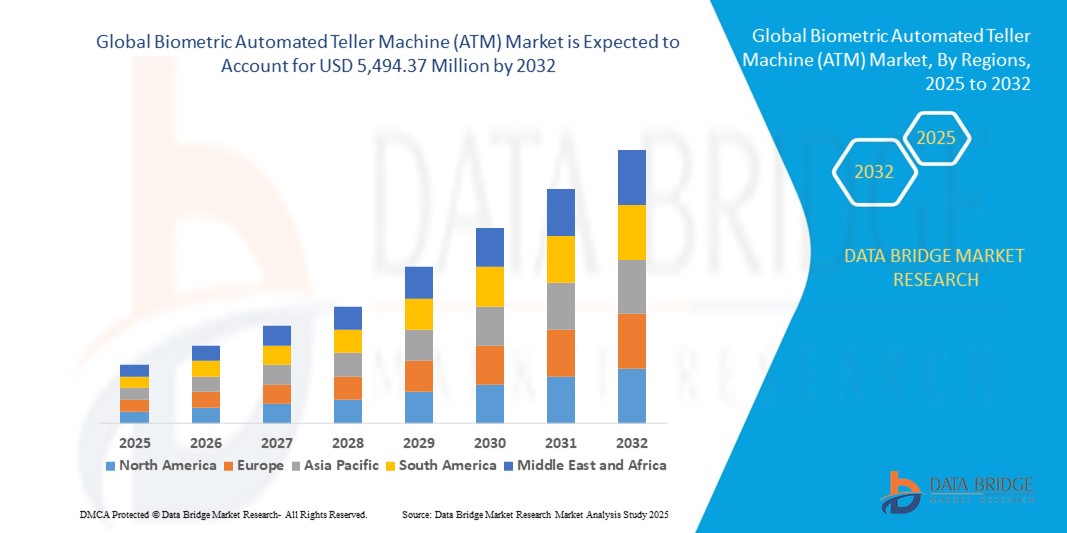
- The global biometric automated teller machine (ATM) market size was valued at USD 618.24 million in 2024 and is expected to reach USD 5,494.37 million by 2032, at a CAGR of 31.40% during the forecast period
- The market growth is primarily driven by increasing demand for secure, fraud-resistant banking transactions, rising adoption of multi-factor authentication, and growing compliance requirements in the financial sector
- Increasing consumer preference for contactless and convenient transactions, along with the integration of biometric technology for enhanced security, is accelerating market adoption across both retail and corporate banking environments
Biometric Automated Teller Machine (ATM) Market Analysis
- The biometric automated teller machine (ATM) market is experiencing robust growth as financial institutions increasingly deploy advanced authentication solutions to prevent identity theft, skimming, and unauthorized access
- Growing demand for multi-modal biometric authentication (such as combining fingerprint and facial recognition) is encouraging vendors to develop more sophisticated, AI-powered, and privacy-compliant automated teller machine (ATM) solutions
- Asia-Pacific dominated the biometric automated teller machine (ATM) market with the largest revenue share of 33.6% in 2024, driven by high financial inclusion initiatives, rapid adoption of digital banking, and large-scale automated teller machine (ATM) network upgrades in countries such as China, India, and Japan
- North America is expected to be the fastest-growing region during the forecast period, supported by a mature banking infrastructure, increasing cybersecurity concerns, and rapid integration of biometrics with AI-based fraud detection systems
- The hardware segment dominated the largest market revenue share of 32.81% in 2024, driven by the essential role of biometric scanners, cameras, and sensors in enabling secure authentication. Hardware advancements such as multi-modal biometric readers and liveness detection technologies have strengthened automated teller machine (ATM) security against spoofing attacks, boosting adoption across banks and financial institutions
Report Scope and Biometric Automated Teller Machine (ATM) Market Segmentation
|
Attributes |
Biometric Automated Teller Machine (ATM) Key Market Insights |
|
Segments Covered |
|
|
Countries Covered |
North America
Europe
Asia-Pacific
Middle East and Africa
South America
|
|
Key Market Players |
|
|
Market Opportunities |
|
|
Value Added Data Infosets |
In addition to the insights on market scenarios such as market value, growth rate, segmentation, geographical coverage, and major players, the market reports curated by the Data Bridge Market Research also include in-depth expert analysis, geographically represented company-wise production and capacity, network layouts of distributors and partners, detailed and updated price trend analysis and deficit analysis of supply chain and demand. |
Biometric Automated Teller Machine (ATM) Market Trends
Rising Adoption of Multimodal Biometric Authentication for Enhanced Security
- The Global Biometric ATM market is experiencing a growing trend toward the integration of multimodal biometric authentication methods such as fingerprint, palm, iris, facial, and voice recognition to enhance security and user convenience
- These advanced systems enable precise and rapid user identification, reducing the risk of fraud, identity theft, and unauthorized access
- Financial institutions are increasingly deploying biometric ATMs to improve transaction security, speed up authentication processes, and provide a more seamless customer experience
- For instance, several leading ATM manufacturers are developing AI-enhanced biometric solutions capable of detecting spoofing attempts, ensuring that only genuine biometric data is accepted
- This trend is also driven by the rising need for contactless authentication in the post-pandemic era, aligning with customer preferences for hygiene and convenience
- Multimodal biometric algorithms can simultaneously analyze multiple traits, increasing authentication accuracy and reducing false acceptance or rejection rates
Biometric Automated Teller Machine (ATM) Market Dynamics
Driver
Increasing Demand for Secure and Convenient Banking Transactions
- The growing concerns over automated teller machine (ATM) -related fraud, skimming, and identity theft are significantly driving the demand for biometric-enabled ATMs
- These systems offer a higher level of security compared to PIN-based authentication, making them highly attractive to banks, financial institutions, and government entities
- Rising consumer preference for quick, secure, and password-free transactions is accelerating the adoption of biometric automated teller machine (ATM) globally
- The proliferation of IoT-enabled banking devices and the development of AI-based fraud detection are further enhancing the capabilities of biometric automated teller machine (ATM) solutions
- The strong regulatory support for security enhancements and high consumer awareness of biometric technology benefits
Restraint/Challenge
High Installation Costs and Privacy Concerns
- The high cost of installing and integrating biometric authentication hardware such as fingerprint scanners, iris cameras, and facial recognition systems into automated teller machine (ATM) can be a major adoption barrier, particularly for small financial institutions and in cost-sensitive markets
- Upgrading legacy automated teller machine (ATM) infrastructure to support biometric authentication can involve significant technical challenges and expenses
- Concerns over the storage, transmission, and potential misuse of sensitive biometric data are hindering wider adoption
- Regulatory compliance with data privacy laws such as GDPR in Europe and similar frameworks in other regions adds operational complexity for global providers
- Public apprehension about biometric data security and the lack of standardized international regulations on biometric usage may slow down market penetration in certain areas
Biometric Automated Teller Machine (ATM) market Scope
The market is segmented on the basis of component, authentication type, deployment, and end-user.
- By Component
On the basis of component, the global biometric automated teller machine (ATM) market is segmented into hardware, software, and services. The hardware segment dominated the largest market revenue share of 32.81% in 2024, driven by the essential role of biometric scanners, cameras, and sensors in enabling secure authentication. Hardware advancements such as multi-modal biometric readers and liveness detection technologies have strengthened automated teller machine (ATM) security against spoofing attacks, boosting adoption across banks and financial institutions. The growing need for reliable and tamper-resistant equipment has further cemented hardware’s position as the primary revenue driver in this segment.
The software segment is expected to register the fastest growth rate from 2025 to 2032, as demand for advanced biometric algorithms, real-time authentication, and integration with core banking systems accelerates. Software solutions enable features such as AI-driven fraud detection, cloud-based identity verification, and cross-platform operability, making them vital for seamless ATM functionality. The services segment, including installation, maintenance, and managed biometric security services, is also gaining traction, particularly in emerging economies where financial institutions seek turnkey biometric ATM deployments.
- By Authentication Type
On the basis of authentication type, the market is categorized into fingerprint recognition, palm recognition, iris recognition, facial recognition, voice recognition, and others. The fingerprint recognition segment held the largest revenue share in 2024, owing to its proven reliability, speed, and cost-effectiveness. Fingerprint-based systems are widely deployed due to their ease of use and familiarity among customers, making them the default choice for many ATM networks.
The facial recognition segment is anticipated to grow at the fastest CAGR from 2025 to 2032, driven by advancements in AI-powered image processing and the increasing preference for touchless authentication in the post-pandemic era. Facial biometrics offer a balance of convenience and security, enabling quick identity verification without physical contact. Additionally, iris and palm recognition technologies are gaining interest in high-security applications, while voice recognition and other modalities are expected to expand in niche use cases such as accessibility for visually impaired users.
- By Deployment
On the basis of deployment, the market is divided into on-premises and cloud-based solutions. The on-premises segment accounted for the highest revenue share in 2024, as many financial institutions continue to prefer in-house control over sensitive biometric data and transaction infrastructure. On-premises deployments offer maximum data sovereignty and compliance with strict regional banking regulations, particularly in markets with conservative data policies.
The cloud-based segment is projected to witness the fastest growth from 2025 to 2032, supported by the scalability, cost-efficiency, and ease of remote management it offers. Cloud-enabled biometric ATMs facilitate centralized updates, AI-powered analytics, and integration with digital banking platforms, making them especially attractive to banks and service providers seeking rapid deployment across multiple locations without heavy upfront investment.
- By End-user
On the basis of end-user, the market is segmented into banks, financial institutions, government entities, retailers, and others. The banks segment held the largest revenue share in 2024, driven by the need to enhance automated teller machine (ATM) security, reduce fraud, and provide customers with convenient biometric-based transactions. With banking services increasingly moving toward omnichannel delivery, biometric ATMs have become a key differentiator in customer trust and loyalty.
The government entities segment is expected to record the fastest growth rate from 2025 to 2032, fueled by initiatives to integrate biometric authentication into public financial services, pension disbursements, and social welfare programs. Governments in developing economies are investing in biometric-enabled ATMs to promote financial inclusion, reduce identity fraud, and extend secure banking services to rural and underserved populations. Retailers and non-banking financial institutions are also emerging as active adopters, integrating biometric automated teller machine (ATM) to expand customer services and improve cash handling security.
Biometric Automated Teller Machine (ATM) Market Regional Analysis
- Asia-Pacific dominated the biometric automated teller machine (ATM) market with the largest revenue share of 33.6% in 2024, driven by high financial inclusion initiatives, rapid adoption of digital banking, and large-scale automated teller machine (ATM) network upgrades in countries such as China, India, and Japan
- Consumers prioritize biometric ATMs for enhanced security, convenience, and fraud prevention, particularly in high-population countries with expanding financial sectors
- Growth is supported by advancements in biometric technologies, including fingerprint and facial recognition, alongside rising adoption in both banking and retail segments
Japan Biometric Automated Teller Machine (ATM) Market Insight
Japan’s biometric automated teller machine (ATM) market is expected to witness a high growth rate due to strong consumer preference for high-quality, technologically advanced authentication solutions that enhance banking security and convenience. The presence of major ATM manufacturers and the integration of biometric technologies in banking infrastructure accelerate market penetration. Rising interest in secure retail transactions also contributes to growth.
China Biometric Automated Teller Machine (ATM) Market Insight
China holds the largest share of the Asia-Pacific biometric automated teller machine (ATM) market, propelled by rapid urbanization, rising banking penetration, and increasing demand for secure transaction solutions. The country’s growing middle class and focus on financial technology support the adoption of advanced biometric ATMs. Strong domestic manufacturing capabilities and competitive pricing enhance market accessibility, with fingerprint and facial recognition leading the authentication types.
North America Biometric Automated Teller Machine (ATM) Market Insight
North America is the fastest-growing region in the biometric automated teller machine (ATM) market, fuelled by strong demand for fraud-resistant authentication and increasing regulatory support for secure banking solutions. The U.S. dominated the region with the highest revenue share in 2024, driven by consumer awareness of biometric security benefits and the integration of advanced technologies in banking infrastructure. The trend toward contactless and secure transactions, coupled with innovations in sensor technology, further boosts market expansion. Financial institutions’ adoption of cloud-based deployments complements on-premises solutions, creating a diverse ecosystem.
Europe Biometric Automated Teller Machine (ATM) Market Insight
The Europe biometric automated teller machine (ATM) market is expected to witness significant growth, supported by regulatory emphasis on financial security and customer convenience. Consumers seek biometric solutions that enhance transaction security while offering seamless user experiences. The growth is prominent in both banking and government applications, with countries such as Germany and the U.K. showing significant uptake due to rising cybersecurity concerns and urban banking demands.
U.K. Biometric Automated Teller Machine (ATM) Market Insight
The U.K. market for biometric automated teller machine (ATM) is expected to witness a high growth rate, driven by demand for secure and efficient banking solutions in urban and suburban settings. Increased interest in fraud prevention and user convenience encourages adoption. Evolving regulations promoting secure authentication influence consumer choices, balancing biometric accuracy with compliance.
Germany Biometric Automated Teller Machine (ATM) Market Insight
Germany is expected to witness a high growth rate in the biometric automated teller machine (ATM) market, attributed to its advanced financial sector and strong consumer focus on security and efficiency. German consumers prefer technologically advanced biometric solutions, such as iris and facial recognition that enhance transaction security and streamline banking operations. The integration of these technologies in major banks and aftermarket services supports sustained market growth.
Biometric Automated Teller Machine (ATM) Market Share
The biometric automated teller machine (ATM) industry is primarily led by well-established companies, including:
- Diebold Nixdorf, Incorporated (U.S.)
- NCR Corporation (U.S.)
- GRG Banking Equipment Co., Ltd. (China)
- Hitachi, Ltd. (Japan)
- Fujitsu Limited (Japan)
- IDEMIA Group (France)
- Suprema Inc. (South Korea)
- ZKTeco Co., Ltd. (China)
- M2SYS Technology, LLC (U.S.)
- Iris ID Systems, Inc. (U.S.)
What are the Recent Developments in Global Biometric Automated Teller Machine (ATM) Market?
- In February 2024, Diebold Nixdorf launched its advanced DN Series ATMs featuring integrated palm vein scanners, delivering a touchless and hygienic biometric authentication experience. This innovation responds to growing consumer expectations for secure and health-conscious technology, especially in high-traffic banking environments. The palm vein recognition system enhances identity verification without physical contact, reducing contamination risks while maintaining robust security. Combined with the DN Series’ modular design, high-capacity cash handling, and seamless digital integration, these ATMs represent a forward-thinking solution for modern self-service banking

- Interactive Data Analysis Dashboard
- Company Analysis Dashboard for high growth potential opportunities
- Research Analyst Access for customization & queries
- Competitor Analysis with Interactive dashboard
- Latest News, Updates & Trend analysis
- Harness the Power of Benchmark Analysis for Comprehensive Competitor Tracking
Global Biometric Atm Market, Supply Chain Analysis and Ecosystem Framework
To support market growth and help clients navigate the impact of geopolitical shifts, DBMR has integrated in-depth supply chain analysis into its Global Biometric Atm Market research reports. This addition empowers clients to respond effectively to global changes affecting their industries. The supply chain analysis section includes detailed insights such as Global Biometric Atm Market consumption and production by country, price trend analysis, the impact of tariffs and geopolitical developments, and import and export trends by country and HSN code. It also highlights major suppliers with data on production capacity and company profiles, as well as key importers and exporters. In addition to research, DBMR offers specialized supply chain consulting services backed by over a decade of experience, providing solutions like supplier discovery, supplier risk assessment, price trend analysis, impact evaluation of inflation and trade route changes, and comprehensive market trend analysis.
Data collection and base year analysis are done using data collection modules with large sample sizes. The stage includes obtaining market information or related data through various sources and strategies. It includes examining and planning all the data acquired from the past in advance. It likewise envelops the examination of information inconsistencies seen across different information sources. The market data is analysed and estimated using market statistical and coherent models. Also, market share analysis and key trend analysis are the major success factors in the market report. To know more, please request an analyst call or drop down your inquiry.
The key research methodology used by DBMR research team is data triangulation which involves data mining, analysis of the impact of data variables on the market and primary (industry expert) validation. Data models include Vendor Positioning Grid, Market Time Line Analysis, Market Overview and Guide, Company Positioning Grid, Patent Analysis, Pricing Analysis, Company Market Share Analysis, Standards of Measurement, Global versus Regional and Vendor Share Analysis. To know more about the research methodology, drop in an inquiry to speak to our industry experts.
Data Bridge Market Research is a leader in advanced formative research. We take pride in servicing our existing and new customers with data and analysis that match and suits their goal. The report can be customized to include price trend analysis of target brands understanding the market for additional countries (ask for the list of countries), clinical trial results data, literature review, refurbished market and product base analysis. Market analysis of target competitors can be analyzed from technology-based analysis to market portfolio strategies. We can add as many competitors that you require data about in the format and data style you are looking for. Our team of analysts can also provide you data in crude raw excel files pivot tables (Fact book) or can assist you in creating presentations from the data sets available in the report.













