


What is Biometric Lockers Market Size and Growth Rate?
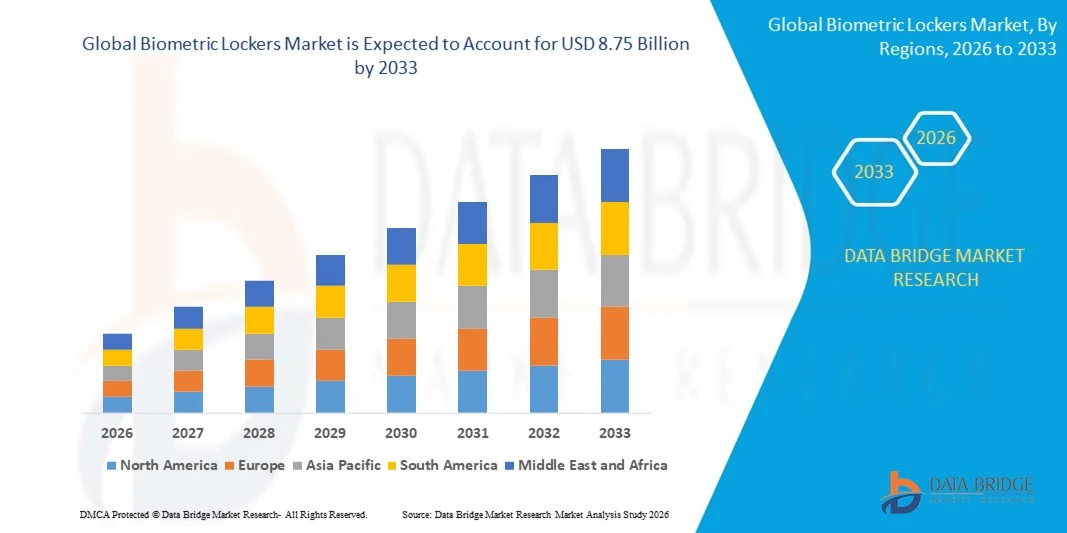
- As per Data Bridge Market Research Analysis the global biometric lockers market size was valued at USD 3.00 billion in 2025 and is expected to reach USD 8.75 billion by 2033, at a CAGR of 14.30% during the forecast period
- The market growth is largely driven by increasing demand for secure, efficient, and automated access control solutions across residential, commercial, and institutional environments. Growing concerns over unauthorized access, theft, and asset protection are pushing organizations and consumers to adopt biometric lockers for reliable identity-based access management
- Furthermore, technological advancements in biometric authentication methods, including facial recognition, fingerprint scanning, and iris recognition, are enhancing accuracy, reducing false positives, and improving user experience. These innovations, combined with integration capabilities with cloud platforms and enterprise security systems, are accelerating the adoption of biometric lockers globally
Market Size and Forecast:
- Market Size (2025): USD 3.00 Billion
- Projected Market Size (2033): USD 8.75 Billion
- CAGR (2026-2033): 14.30%
How Biometric Lockers Market Analysed?
- Biometric lockers, offering secure access through unique physiological or behavioral traits, are becoming essential for modern security infrastructure in offices, banks, educational institutions, hospitals, and public facilities. Their ability to provide controlled, personalized access ensures higher security and accountability compared to traditional locking mechanisms
- The rising adoption of smart facilities, digital identity management, and IoT-enabled access control systems is fueling demand for biometric lockers. Increased awareness about data protection, regulatory compliance, and the need for efficient, scalable storage solutions further strengthens the market’s growth trajectory
- North America dominated the biometric lockers market with a share of 43.70% in 2025, due to strong adoption of advanced security systems across BFSI, government facilities, and corporate offices
- Asia-Pacific is expected to be the fastest growing region in the biometric lockers market during the forecast period due to rapid urbanization, expanding commercial infrastructure, and increasing adoption of biometric technologies
- Hardware segment dominated the market with a market share of 46.5% in 2025, due to the mandatory requirement for physical biometric components such as scanners, sensors, and locking mechanisms in every installation. Hardware-based biometric lockers are widely adopted across banks, offices, educational institutions, and public infrastructure due to their durability, reliability, and direct role in secure access control
How Biometric Lockers Market Segmented?
|
Attributes |
Biometric Lockers Key Market Insights |
|
Segments Covered |
|
|
Countries Covered |
North America
Europe
Asia-Pacific
Middle East and Africa
South America
|
|
Key Market Players |
|
|
Market Opportunities |
|
|
Value Added Data Infosets |
In addition to the insights on market scenarios such as market value, growth rate, segmentation, geographical coverage, and major players, the market reports curated by the Data Bridge Market Research also include in-depth expert analysis, geographically represented company-wise production and capacity, network layouts of distributors and partners, detailed and updated price trend analysis and deficit analysis of supply chain and demand. |
What are Biometric Lockers Market Trends?
Increasing Adoption of Multi-Modal Biometric Authentication
- A significant trend in the biometric lockers market is the growing adoption of multi-modal biometric authentication solutions that combine facial recognition, fingerprint scanning, and iris recognition to improve security and accuracy. This trend is driven by the rising need for reliable and scalable access control systems in high-traffic environments such as corporate offices, airports, and educational institutions
- For instance, ZKTeco launched upgraded biometric lockers in 2024 integrating both facial recognition and fingerprint scanning to enhance security and reduce authentication errors in environments such as airports and retail stores. Such developments are setting new standards for safety, user convenience, and system reliability in the biometric lockers market
- The trend toward multi-modal authentication is further reinforced by integration with cloud-based monitoring platforms, mobile applications, and enterprise security systems, enabling centralized control and remote management. Organizations increasingly prefer these systems for high-value assets and sensitive data storage, positioning biometric lockers as a critical component of modern access control infrastructure
- Adoption is expanding in the BFSI sector where banks and financial institutions are deploying biometric lockers to secure cash, documents, and critical assets, ensuring compliance with regulatory requirements and enhancing operational security
- In the healthcare and pharmaceutical sectors, biometric lockers with multi-modal authentication are being used to manage controlled substances, patient records, and sensitive laboratory materials. These implementations underscore the growing need for secure, auditable, and traceable access solutions
- The education and government sectors are also contributing to this trend, with schools, universities, and public offices adopting multi-modal biometric lockers to ensure safe storage of personal belongings and confidential materials. The increasing awareness of security threats and the push for digital transformation are driving the overall uptake of advanced biometric locker solutions
What is Biometric Lockers Market Dynamics?
Driver
Rising Demand for Secure and Automated Access Control Solutions
- The growing need for secure, automated, and identity-based access solutions is a major driver of the biometric lockers market. Organizations and consumers are increasingly adopting biometric lockers to prevent unauthorized access, protect sensitive materials, and enhance operational efficiency
- For instance, Godrej & Boyce has strengthened its biometric locker offerings across commercial and residential segments in India, focusing on secure, tech-enabled storage systems. Such implementations demonstrate how demand for automated, reliable access control solutions is accelerating market growth
- The rising adoption of smart offices, co-working spaces, and institutional storage facilities is fueling deployment of biometric lockers that integrate with enterprise management systems, cloud monitoring, and mobile applications, providing scalable and flexible security solutions
- Biometric lockers are becoming essential in sectors handling high-value assets, including BFSI, healthcare, research laboratories, and IT data centers. The ability to maintain logs, monitor access in real time, and reduce human error enhances operational security and efficiency
- The overall increase in cyber-physical security awareness, regulatory compliance requirements, and the drive for digitization across industries continues to strengthen demand for advanced biometric locker solutions
Restraint/Challenge
High Implementation Costs and Integration Complexity
- The biometric lockers market faces challenges due to the high costs associated with advanced biometric hardware, software integration, and maintenance. Implementing multi-modal authentication systems often requires significant investment in sensors, controllers, and IT infrastructure
- For instance, integrating ZKTeco’s multi-modal biometric lockers with existing airport or corporate security systems requires specialized configuration, IT support, and staff training, which can increase overall project costs. Such complexities limit adoption among small-scale enterprises and cost-sensitive organizations
- The reliance on multiple biometric modalities, cloud-based monitoring, and real-time analytics increases system design and operational complexity, demanding skilled personnel for deployment and ongoing maintenance
- Manufacturers also face challenges in ensuring compatibility between diverse security systems, access control protocols, and legacy infrastructures. This integration complexity can slow adoption in environments with heterogeneous IT and security ecosystems
- Managing scalability while maintaining performance, reliability, and user convenience remains a critical hurdle for providers and end-users, reinforcing the need for optimized, cost-effective solutions in the biometric lockers market
What is Biometric Lockers Market Scope?
The market is segmented on the basis of type and technology.
- By Type
On the basis of type, the biometric lockers market is segmented into hardware, software, and service. The hardware segment dominated the market with the largest share of 46.5% in 2025, driven by the mandatory requirement for physical biometric components such as scanners, sensors, and locking mechanisms in every installation. Hardware-based biometric lockers are widely adopted across banks, offices, educational institutions, and public infrastructure due to their durability, reliability, and direct role in secure access control. Continuous upgrades in sensor accuracy and rugged design further strengthen demand for biometric locker hardware across high-usage environments.
The software segment is expected to witness the fastest growth from 2026 to 2033, supported by rising demand for centralized management, real-time monitoring, and analytics-driven access control. Software platforms enable integration with enterprise security systems, cloud dashboards, and audit trails, improving operational efficiency and compliance. Increasing adoption of smart facilities and digital identity management is accelerating investments in advanced biometric locker software solutions.
- By Technology
On the basis of technology, the biometric lockers market is segmented into face recognition, voice recognition, iris recognition, and others. The face recognition segment dominated the market in 2025, owing to its contactless operation, high user convenience, and rapid authentication capabilities. Face recognition technology is increasingly preferred in corporate offices, transport hubs, and public facilities where speed, hygiene, and seamless user experience are critical. Improvements in AI-based facial mapping and accuracy under varying lighting conditions continue to reinforce its market leadership.
The iris recognition segment is projected to grow at the fastest rate during the forecast period, driven by its superior accuracy and resistance to identity spoofing. Iris-based biometric lockers are gaining traction in high-security environments such as defense facilities, research centers, and financial institutions where error tolerance is minimal. Rising concerns around data security and unauthorized access are further pushing demand for advanced iris recognition-based locker systems.
Which Region Holds the Largest Share of the Biometric Lockers Market?
-
North America dominated the biometric lockers market with the largest revenue share of 43.70% in 2025, driven by strong adoption of advanced security systems across BFSI, government facilities, and corporate offices
-
Organizations in the region place high importance on data security, identity protection, and controlled access, encouraging the deployment of biometric locker systems across workplaces and public infrastructure
- This dominance is further supported by high digital maturity, early adoption of biometric technologies, and continuous investments in smart security infrastructure, positioning biometric lockers as a critical component of modern access control systems
U.S. Biometric Lockers Market Insight
The U.S. biometric lockers market captured the largest revenue share within North America in 2025, driven by widespread implementation of biometric authentication across federal buildings, banks, and enterprise campuses. Strong emphasis on regulatory compliance, cybersecurity, and secure asset storage continues to accelerate adoption. Increasing investments in smart offices and digital identity management further support market expansion across commercial and institutional environments.
Europe Biometric Lockers Market Insight
The Europe biometric lockers market is expected to grow at a substantial CAGR during the forecast period, supported by stringent data protection regulations and rising demand for secure access solutions. Growing digitization across enterprises, educational institutions, and public services is boosting the adoption of biometric lockers. The region’s focus on privacy-centric security technologies is further reinforcing market growth.
U.K. Biometric Lockers Market Insight
The U.K. biometric lockers market is anticipated to expand at a notable CAGR, driven by increasing deployment across corporate offices, universities, and transportation hubs. Rising concerns over unauthorized access and asset security are pushing organizations toward biometric-based locker solutions. The country’s advanced IT infrastructure and rapid digital transformation initiatives continue to support market development.
Germany Biometric Lockers Market Insight
The Germany biometric lockers market is projected to grow steadily during the forecast period, fueled by strong demand from manufacturing facilities, research centers, and government institutions. Germany’s emphasis on high-precision security systems and compliance-driven access control is accelerating adoption. The integration of biometric lockers within smart factory and Industry 4.0 environments further contributes to market expansion.
Asia-Pacific Biometric Lockers Market Insight
The Asia-Pacific biometric lockers market is expected to register the fastest CAGR during the forecast period of 2026 to 2033, driven by rapid urbanization, expanding commercial infrastructure, and increasing adoption of biometric technologies. Government-led digitalization initiatives and rising investments in smart buildings are accelerating market growth. The region’s large population base and growing focus on secure identity management continue to create strong demand for biometric locker solutions.
Japan Biometric Lockers Market Insight
The Japan biometric lockers market is gaining traction due to the country’s advanced technological ecosystem and strong emphasis on security and automation. High adoption across corporate offices, transport facilities, and public institutions is supporting growth. The demand for reliable, user-friendly biometric systems is further reinforced by Japan’s aging population and focus on efficient access solutions.
China Biometric Lockers Market Insight
The China biometric lockers market accounted for the largest revenue share in Asia-Pacific in 2025, supported by rapid digital infrastructure development and extensive adoption of biometric authentication. Strong government initiatives toward smart cities and secure public infrastructure are driving deployment across commercial and institutional sectors. The presence of domestic biometric technology providers and large-scale manufacturing capabilities further strengthens market growth in China.
What is Biometric Lockers Market Share?
The biometric lockers industry is primarily led by well-established companies, including:
- GANTNER Electronic GmbH (Germany)
- Godrej & Boyce Mfg Co. Private Limited (India)
- ASSA ABLOY AB (Sweden)
- Gunnebo AB (Sweden)
- Dormakaba Holding AG (Switzerland)
- Master Lock Company LLC (U.S.)
- TZ Limited (U.S.)
- Apex Supply Chain Technologies LLC (U.S.)
- Vecos BV (Netherlands)
- Smiota Inc. (U.S.)
- Locker & Lock Co. Ltd. (Japan)
- Hollman Inc. (U.S.)
- American Locker (U.S.)
- Shanghai YG Electronic Technology Co. Ltd. (China)
Which are Latest Developments in Global Biometric Lockers Market?
- In August 2025, Godrej Enterprises Group expanded its portfolio with the launch of premium, tech-enabled home lockers, reinforcing its leadership in Indore’s rapidly growing security solutions market. This development targets both consumer and institutional segments, enhancing adoption of biometric and digitally secured storage solutions. By focusing on Madhya Pradesh, a region experiencing fast urbanization and rising disposable incomes, the company is driving wider acceptance of advanced access control systems and contributing to the overall growth of the biometric lockers market in emerging urban hubs
- In March 2025, Dormakaba introduced an advanced biometric locker system integrated with cloud-based access management, enabling enterprises to centrally control and monitor access across multiple locations. This innovation enhances operational efficiency, reduces administrative overhead, and improves scalability for large offices, co-working spaces, and shared facilities. The integration of cloud analytics and remote management capabilities also strengthens the value proposition for organizations seeking secure, flexible, and technology-driven storage solutions, thereby accelerating the adoption of biometric lockers in corporate and commercial sectors
- In 2024, ZKTeco launched an upgraded biometric locker solution featuring multi-modal authentication that combines facial recognition and fingerprint scanning. This advancement improves security, minimizes false positives, and enhances authentication speed, making it particularly effective in high-traffic environments such as airports, retail stores, and large public venues. The development positions ZKTeco as a leader in delivering reliable, high-performance biometric solutions and encourages adoption of multi-factor biometric lockers across markets where safety, speed, and accuracy are paramount
- In January 2023, Suprema unveiled a next-generation biometric locker platform with AI-driven behavior analytics and real-time access alerts, enhancing both security and user convenience. This solution enables organizations to monitor unusual access patterns, prevent unauthorized usage, and improve overall operational safety. By integrating smart analytics with traditional biometric authentication, Suprema is driving adoption of intelligent locker systems across corporate, educational, and high-security institutional environments, reinforcing market growth in regions prioritizing advanced, proactive access control solutions
- In 2023, IDEMIA formed a strategic partnership with Gunnebo to create integrated biometric locker systems that combine IDEMIA’s advanced identity authentication with Gunnebo’s secure storage solutions. This collaboration strengthens the market presence in high-security sectors such as banking, government offices, and defense facilities, where compliance, reliability, and controlled access are critical. The combined expertise also facilitates deployment of turnkey solutions that improve operational security and streamline adoption of biometric lockers in sensitive environments

- Interactive Data Analysis Dashboard
- Company Analysis Dashboard for high growth potential opportunities
- Research Analyst Access for customization & queries
- Competitor Analysis with Interactive dashboard
- Latest News, Updates & Trend analysis
- Harness the Power of Benchmark Analysis for Comprehensive Competitor Tracking
Global Biometric Lockers Market, Supply Chain Analysis and Ecosystem Framework
To support market growth and help clients navigate the impact of geopolitical shifts, DBMR has integrated in-depth supply chain analysis into its Global Biometric Lockers Market research reports. This addition empowers clients to respond effectively to global changes affecting their industries. The supply chain analysis section includes detailed insights such as Global Biometric Lockers Market consumption and production by country, price trend analysis, the impact of tariffs and geopolitical developments, and import and export trends by country and HSN code. It also highlights major suppliers with data on production capacity and company profiles, as well as key importers and exporters. In addition to research, DBMR offers specialized supply chain consulting services backed by over a decade of experience, providing solutions like supplier discovery, supplier risk assessment, price trend analysis, impact evaluation of inflation and trade route changes, and comprehensive market trend analysis.
Data collection and base year analysis are done using data collection modules with large sample sizes. The stage includes obtaining market information or related data through various sources and strategies. It includes examining and planning all the data acquired from the past in advance. It likewise envelops the examination of information inconsistencies seen across different information sources. The market data is analysed and estimated using market statistical and coherent models. Also, market share analysis and key trend analysis are the major success factors in the market report. To know more, please request an analyst call or drop down your inquiry.
The key research methodology used by DBMR research team is data triangulation which involves data mining, analysis of the impact of data variables on the market and primary (industry expert) validation. Data models include Vendor Positioning Grid, Market Time Line Analysis, Market Overview and Guide, Company Positioning Grid, Patent Analysis, Pricing Analysis, Company Market Share Analysis, Standards of Measurement, Global versus Regional and Vendor Share Analysis. To know more about the research methodology, drop in an inquiry to speak to our industry experts.
Data Bridge Market Research is a leader in advanced formative research. We take pride in servicing our existing and new customers with data and analysis that match and suits their goal. The report can be customized to include price trend analysis of target brands understanding the market for additional countries (ask for the list of countries), clinical trial results data, literature review, refurbished market and product base analysis. Market analysis of target competitors can be analyzed from technology-based analysis to market portfolio strategies. We can add as many competitors that you require data about in the format and data style you are looking for. Our team of analysts can also provide you data in crude raw excel files pivot tables (Fact book) or can assist you in creating presentations from the data sets available in the report.













