


What is the Biometrics Infrared Light Emitting Diode (LED) Market Size and Growth Rate?
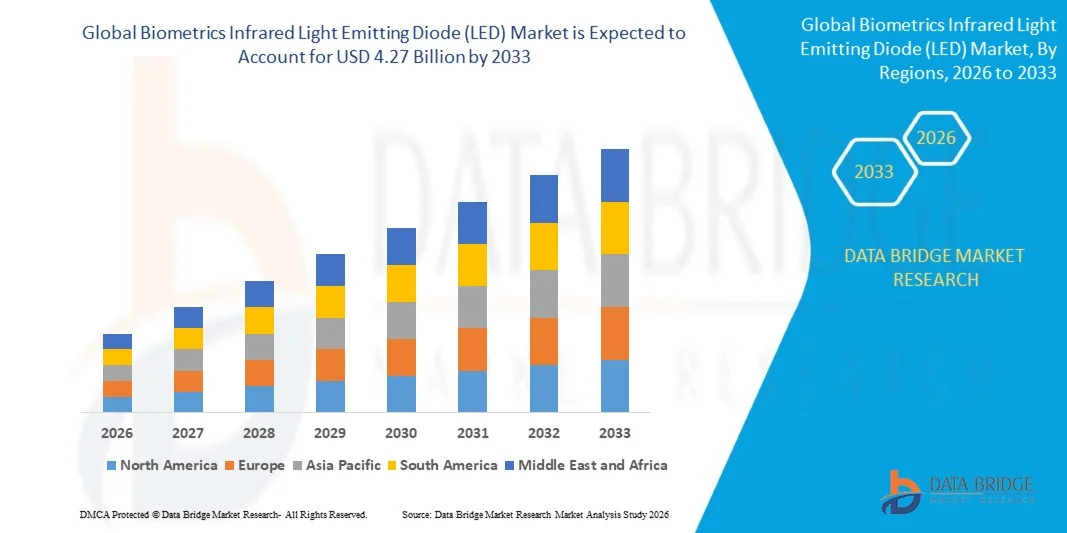
- As per Data Bridge Market Research analysis, the biometrics infrared light emitting diode (LED) market was valued at USD 1.29 billion in 2025 and is projected to reach USD 4.27 billion by 2033, growing at a CAGR of 16.16% from 2026 to 2033.
- The market is experiencing strong growth driven by rising adoption of biometric authentication, increasing demand for infrared sensing technologies, expanding applications in consumer electronics and automotive systems, and growing investments in advanced security and identification technologies.
- The increasing integration of biometric systems into smartphones, access-control solutions, government identification programs, and security infrastructure, combined with growing demand for accurate and contactless authentication, is encouraging the adoption of infrared LEDs. Infrared LED-based components provide reliable illumination for fingerprint, facial, iris, and other biometric sensing systems, supporting their expanding use across consumer electronics, automotive, healthcare, government and defense, retail, and BFSI applications.
Market Size & Forecast
- Global Market Value (2025): USD 1.29 Billion
- Expected Market Value (2033): USD 4.27 Billion
- Forecast CAGR (2026–2033): 16.16%
- Leading Region in 2025: North America
- Fastest Growing Region: Asia Pacific
What are the Major Takeaways of the Biometrics Infrared Light Emitting Diode (LED) Market?
- North America dominated the biometrics infrared light emitting diode (LED) market with the largest revenue share of 35.6% in 2025, supported by strong demand for consumer electronics, advanced biometric identification systems, and increasing adoption of infrared sensing technologies.
- Asia-Pacific is expected to be the fastest-growing region at a CAGR of 18% from 2026 to 2033, fueled by rising smartphone adoption, increasing deployment of biometric systems, rapid digitalization, and growing demand for secure authentication solutions across China, India, and Japan.
- The medium segment led the market with a 45% share in 2025, driven by its balance between optical output, energy consumption, thermal performance, and cost for biometric sensing systems.
- High are the fastest-growing power type, projected to register a CAGR of 18%, reflecting the surge in requirements for brighter infrared illumination, longer sensing distances, and improved performance in demanding environments.
- The emitters segment dominated the function category with a 42% revenue share in 2025, led by the active illumination required by many biometric imaging systems.
- 700nm–less than 1500nm accounted for 68% of the market share in 2025, preferred by the widespread suitability of near-infrared wavelengths for biometric imaging and recognition.
- The infrared LED package segment is the fastest-growing technology category, with a CAGR of 18.4%, driven by increasing demand for compact, integrated, and application-specific infrared illumination modules.
Report Scope and Biometrics Infrared Light Emitting Diode (LED) Market Segmentation
|
Attributes |
Biometrics Infrared Light Emitting Diode (LED) Key Market Insights |
|
Segments Covered |
|
|
Countries Covered |
North America
Europe
Asia-Pacific
Middle East and Africa
South America
|
|
Key Market Players |
|
|
Market Opportunities |
|
|
Value Added Data Infosets |
In addition to the insights on market scenarios such as market value, growth rate, segmentation, geographical coverage, and major players, the market reports curated by the Data Bridge Market Research also include in-depth expert analysis, geographically represented company-wise production and capacity, network layouts of distributors and partners, detailed and updated price trend analysis and deficit analysis of supply chain and demand. |
What is the Key Trend in the Biometrics Infrared Light Emitting Diode (LED) Market?
- Consumer electronics manufacturers are increasingly integrating infrared LEDs with advanced biometric sensing systems to enable secure facial and iris recognition, particularly in smartphones, spatial-computing devices, and other personal electronics requiring accurate authentication in low-light environments.
- For instance, in February 2024, Apple introduced Apple Vision Pro with Optic ID, which uses a system of LEDs and infrared cameras to capture detailed iris patterns for biometric authentication, demonstrating the increasing integration of infrared illumination into next-generation consumer electronics.
- Near-infrared illumination enables biometric sensors to capture consistent facial and iris information across different lighting conditions, improving recognition reliability while supporting compact device designs and low-power authentication architectures.
- Biometric technology developers are increasingly combining infrared illumination with artificial intelligence and machine-learning algorithms to improve recognition accuracy, liveness detection, and resistance to presentation attacks across security-sensitive applications.
- For instance, in March 2025, ams OSRAM highlighted its IR:6 infrared LED technology for facial recognition, reporting that the technology produces brighter and clearer images to improve facial-recognition accuracy and security-system performance, particularly in low-light conditions.
- As consumer electronics, enterprise security, financial services, and access-control systems increasingly prioritize contactless and reliable biometric authentication, demand for high-efficiency infrared LEDs with precise wavelength, optical output, and compact packaging is expected to accelerate, reinforcing infrared illumination as a critical component of next-generation biometric systems.
What are the Key Drivers of the Biometrics Infrared Light Emitting Diode (LED) Market?
- The rapid expansion of biometric authentication across consumer electronics, financial services, government identification, and enterprise security is significantly increasing demand for infrared LEDs capable of providing consistent illumination for facial, fingerprint, iris, and vascular recognition systems.
- For instance, in October 2024, ams OSRAM introduced its IR:6 infrared LED technology, which increased brightness by up to 35% and efficiency by up to 42%, specifically targeting biometric authentication systems in PCs and smart doorbells to enable improved image quality and faster, more accurate biometric recognition.
- Automotive manufacturers, security-system providers, and device makers are integrating infrared biometric sensing with artificial intelligence, three-dimensional imaging, and advanced cameras to deliver more reliable authentication across varying environmental and illumination conditions.
- For instance, in June 2025, ams OSRAM demonstrated a pre-integrated camera solution combining infrared LEDs, VCSEL technology, image sensors, and Ambarella vision processors for 2D/3D imaging and face authentication in security applications, highlighting the growing integration of infrared illumination with advanced biometric sensing systems.
- With biometric authentication becoming increasingly important for secure digital access, payments, connected devices, and physical security, the requirement for efficient infrared illumination components will continue to expand, supporting sustained demand for advanced infrared LED technologies across multiple end-use industries.
Which Factors are Challenging the Growth of the Biometrics Infrared Light Emitting Diode (LED) Market?
- Advanced biometric infrared LEDs require precise wavelength control, high optical efficiency, thermal stability, and stringent safety characteristics, increasing manufacturing complexity and component costs compared with conventional infrared illumination technologies.
- For instance, in May 2023, ams OSRAM introduced its TARA2000-AUT-SAFE infrared emitter with an integrated eye-safety mechanism after identifying that conventional photodiode-based protection could be affected by reflective objects and temperature variations, highlighting the technical complexity and safety requirements associated with high-performance infrared illumination systems.
- These technical requirements can increase development and qualification costs for manufacturers and device integrators, particularly when infrared LEDs must operate within tightly controlled optical and eye-safety specifications for biometric authentication systems.
- For instance, in October 2024, ams OSRAM launched its IR:6 infrared LED technology with new 850 nm, 920 nm, and 940 nm options, requiring specialized thin-film chip technology to achieve up to 35% higher brightness and 42% higher efficiency, illustrating the continuing technology and performance requirements that increase development complexity for biometric infrared LED suppliers.
- The need for specialized semiconductor materials, precision optical packaging, thermal management, and stringent reliability testing continues to create technical and cost barriers, particularly for suppliers attempting to scale high-performance infrared LED production for increasingly demanding biometric applications.
How is the Biometrics Infrared Light Emitting Diode (LED) Market Segmented?
The biometrics infrared light emitting diode (LED) market is segmented on the basis of power, function, photodiode spectral range, technology, and sector.
- By Power
On the basis of power, the biometrics infrared LED market is segmented into low, medium, and high. The medium-power segment dominated the market with 45% share in 2025, owing to its balance between optical output, energy consumption, thermal performance, and cost for biometric sensing systems. Medium-power infrared LEDs are suitable for facial, fingerprint, iris, and other sensing applications where consistent illumination is required without the higher energy requirements associated with high-power devices. They are particularly relevant for consumer electronics and access-control equipment requiring compact components. Increasing integration of biometric sensors into smartphones, laptops, smart locks, and security terminals is supporting demand for versatile medium-power solutions.
The high-power segment is projected to register the fastest growth at a CAGR of 18% during the forecast period, driven by increasing requirements for brighter infrared illumination, longer sensing distances, and improved performance in demanding environments. High-power infrared LEDs can support enhanced illumination for advanced facial recognition, surveillance, automotive sensing, and high-security identification systems. Increasing deployment of biometric technologies in automotive cabins and perimeter-security systems is creating additional requirements for higher optical intensity. Improvements in thermal management and LED efficiency are helping manufacturers deliver greater output while controlling energy consumption. High-power solutions are becoming increasingly relevant for applications requiring reliable operation under variable ambient-light conditions.
- By Function
On the basis of function, the market is segmented into emitters, receivers, transceivers, and detectors. The emitters segment dominated the market with 42% share in 2025, because infrared emitters provide the active illumination required by many biometric imaging systems. They are extensively used to illuminate faces, fingerprints, irises, and other biological features before reflected infrared signals are captured by sensors. Their relatively simple architecture and broad compatibility with biometric cameras support widespread deployment. Consumer electronics, access-control equipment, surveillance systems, and automotive sensing applications all require infrared illumination components. Increasing demand for reliable biometric performance in low-light conditions is further supporting emitter adoption.
The transceivers segment is projected to register the fastest growth at a CAGR of 17% during the forecast period, as integrated sensing architectures increasingly combine transmission and reception functions within compact modules. Transceiver-based solutions can reduce component count and system size while supporting sophisticated biometric sensing designs. Their integration potential is particularly relevant for space-constrained consumer electronics and smart security devices. Advances in optical packaging and semiconductor integration are improving their efficiency and reliability. Growing demand for compact biometric modules in smartphones, wearables, access-control terminals, and connected devices is creating additional opportunities.
- By Photodiode Spectral Range
On the basis of photodiode spectral range, the market is segmented into 700nm–less than 1500nm, 1500nm–1750nm, and above 1750nm. The 700nm–less than 1500nm segment dominated the market with 68% share in 2025, supported by the widespread suitability of near-infrared wavelengths for biometric imaging and recognition. These wavelengths are highly compatible with cameras and photodetectors used in facial, fingerprint, iris, and other biometric systems. The range also provides effective illumination while remaining largely invisible to the human eye, which is advantageous for discreet authentication. Established semiconductor manufacturing capabilities and broad availability of infrared components further support adoption. Consumer electronics and security applications represent important demand centers for LEDs operating within this spectral range.
The 1500nm–1750nm segment is projected to witness the fastest growth at a CAGR of 14% during the forecast period, as specialized biometric and sensing applications increasingly require deeper penetration and improved performance under challenging conditions. Longer infrared wavelengths can provide advantages for selected imaging and sensing applications where conventional near-infrared wavelengths may be less effective. Research into advanced semiconductor materials is supporting the development of components operating at longer wavelengths. Government, defense, healthcare, and specialized industrial applications can create opportunities for these higher-wavelength infrared technologies. Their ability to support specialized sensing requirements provides a pathway for premium applications.
- By Technology
On the basis of technology, the market is segmented into infrared light emitting diode (LED) chip and infrared light emitting diode (LED) package. The infrared LED chip segment dominated the market with 55% share in 2025, as the semiconductor chip is responsible for generating the infrared radiation used for biometric illumination. Chip-level improvements in efficiency, wavelength precision, output intensity, and thermal performance directly influence the performance of finished biometric modules. Manufacturers are continuously improving chip architectures to provide greater optical output while maintaining compact dimensions and lower power consumption. The technology is widely applicable across consumer electronics, automotive sensing, security, and industrial systems. Increasing demand for miniaturized biometric components is encouraging investment in smaller and more efficient LED chips.
The infrared LED package segment is projected to register the fastest growth at CAGR of 18.4% during the forecast period, as system manufacturers increasingly require compact, application-specific components that can be directly integrated into biometric modules. Packaging determines optical directionality, thermal management, mechanical protection, and reliability during operation. Advanced packaging technologies can improve light extraction efficiency while reducing the footprint of biometric sensing assemblies. Demand for integrated packages is particularly relevant to smartphones, smart locks, automotive systems, and security cameras. Improvements in surface-mount packaging and optical design are making packaged infrared LEDs easier to integrate into high-volume electronic products.
- By Sector
On the basis of sector, the market is segmented into consumer electronics, automotive, government and defense, residential, commercial offices, healthcare and hospitality, retail, industrial and manufacturing, education, and banking, financial services and insurance (BFSI). The consumer electronics segment dominated the market with 41% share in 2025, driven by widespread integration of biometric authentication into smartphones, laptops, tablets, wearable devices, and other personal electronics. Infrared LEDs enable reliable illumination for facial and iris recognition while supporting authentication under different lighting conditions. Continuous smartphone upgrades and increasing adoption of biometric security features provide a large recurring customer base. The segment also benefits from expanding integration of biometric technologies into connected consumer devices and smart-home products. Consumer acceptance of biometric authentication is further supporting widespread deployment.
The healthcare and hospitality segment is projected to be the fastest-growing sector at a CAGR of 16.2% during the forecast period, supported by increasing requirements for secure patient identification, employee authentication, and protection of sensitive information. Infrared LED-based systems can support contactless identification and access control across hospitals, laboratories, pharmacies, hotels, and other facilities. Growing adoption of electronic health records is increasing the need for secure authentication of healthcare professionals and patients. Digital healthcare services are also creating additional requirements for reliable identity verification. In hospitality, biometric access and contactless authentication can improve security and user convenience.
Which Region Holds the Largest Share of the Biometrics Infrared Light Emitting Diode (LED) Market?
- North America dominated the biometrics infrared light emitting diode (LED) market with the largest revenue share of 35.6% in 2025, supported by strong demand for consumer electronics, advanced biometric identification systems, and increasing adoption of infrared sensing technologies.
- The region also benefits from the presence of established technology companies, strong government and defense applications, advanced biometric authentication infrastructure, and increasing adoption of infrared-enabled facial and iris recognition systems. Growing demand for secure digital identification, smart devices, and advanced access-control solutions continues to strengthen North America's leadership position in the global market.
U.S. Biometrics Infrared Light Emitting Diode (LED) Market Insight
The U.S. biometrics infrared light emitting diode (LED) market is witnessing strong growth due to rising adoption of advanced biometric authentication, increasing demand for secure facial and iris recognition, and expanding use of infrared sensing technologies in consumer electronics. The country’s mature technology ecosystem, along with increasing integration of infrared LEDs into smartphones, laptops, smart-home devices, and security systems, is driving demand across multiple applications. In addition, growing emphasis on contactless authentication, identity security, and advanced access-control solutions is accelerating infrared LED adoption across commercial, government, and consumer applications.
Asia-Pacific Biometrics Infrared Light Emitting Diode (LED) Market Insight
The Asia-Pacific biometrics infrared light emitting diode (LED) market is expected to witness rapid growth, driven by increasing smartphone penetration, expanding digital identity programs, and rising investments in biometric security infrastructure across countries such as China, India, and Japan. Growing adoption of facial, fingerprint, and iris recognition technologies, along with increasing demand for secure authentication solutions, is supporting regional market expansion. In addition, the growing presence of consumer electronics manufacturers and semiconductor companies is accelerating the integration of infrared LEDs into smartphones, smart devices, automotive systems, and security applications.
Japan Biometrics Infrared Light Emitting Diode (LED) Market Insight
The Japan biometrics infrared light emitting diode (LED) market is witnessing consistent growth due to rising investments in advanced biometric authentication, consumer electronics, and automotive sensing technologies. Electronics manufacturers, automotive companies, and security-system providers are increasingly adopting infrared LED-based solutions for facial recognition, identity verification, and advanced sensing applications. Moreover, increasing integration of artificial intelligence, infrared imaging, and compact optical technologies, together with Japan’s focus on advanced electronics and secure digital infrastructure, is further contributing to market growth.
China Biometrics Infrared Light Emitting Diode (LED) Market Insight
The China biometrics infrared light emitting diode (LED) market is growing rapidly, driven by expanding consumer electronics production, widespread deployment of facial recognition technologies, and increasing investments in smart security infrastructure. Growing adoption of infrared-enabled biometric systems across smartphones, surveillance equipment, access-control systems, and automotive applications is significantly boosting market demand. In addition, strong domestic semiconductor manufacturing capabilities, rising digitalization, and increasing demand for contactless authentication are positioning China as one of the fastest-growing markets for biometrics infrared LED technologies globally.
U.K. Biometrics Infrared Light Emitting Diode (LED) Market Insight
The U.K. biometrics infrared light emitting diode (LED) market is experiencing steady growth, supported by rising adoption of biometric identification, advanced access-control systems, and infrared sensing technologies across commercial and government applications. Increasing investments in digital identity, security infrastructure, and smart-building technologies are contributing to market growth. Furthermore, integration of infrared illumination with artificial intelligence, facial recognition, and advanced imaging systems is improving authentication reliability and expanding the application potential of infrared LEDs across the U.K. market.
Germany Biometrics Infrared Light Emitting Diode (LED) Market Insight
The Germany biometrics infrared light emitting diode (LED) market is expanding steadily due to the country’s strong automotive manufacturing base, advanced electronics capabilities, and increasing adoption of biometric and infrared sensing technologies. Automotive manufacturers, industrial companies, security providers, and technology developers are increasingly utilizing infrared LEDs for driver monitoring, facial recognition, access control, and advanced sensing applications. Continuous advancements in infrared semiconductor efficiency, optical packaging, artificial intelligence, and automotive sensing, along with Germany’s focus on connected and secure mobility technologies, are further driving market growth.
Which are the Top Companies in Biometrics Infrared Light Emitting Diode (LED) Market?
The biometrics infrared light emitting diode (LED) industry is primarily led by well-established companies, including:
- ams-OSRAM AG (Germany)
- NICHIA CORPORATION (Japan)
- EVERLIGHT ELECTRONICS CO., LTD. (Taiwan)
- Excelitas Technologies Corp. (U.S.)
- Kingbright America, LLC (U.S.)
- Lextar Electronics Corporation (Taiwan)
- LITE-ON Technology Corporation (Taiwan)
- Lumileds Holding B.V. (Netherlands)
- Marktech Optoelectronics (U.S.)
- ROHM Co., Ltd. (Japan)
- Vishay Intertechnology, Inc. (U.S.)
- Ushio Inc. (Japan)
- TE Connectivity (Switzerland)
- Würth Elektronik eiSos GmbH & Co. KG (Germany)
- Hamamatsu Photonics K.K. (Japan)
- Stanley Electric Co., Ltd. (Japan)
- Toyoda Gosei Co., Ltd. (Japan)
- Samsung Electronics Co., Ltd. (South Korea)
- Broadcom Inc. (U.S.)
- Seoul Semiconductor Co., Ltd. (South Korea)
What are Latest Developments in Biometrics Infrared Light Emitting Diode (LED) Market?
- In November 2025, ams OSRAM introduced its new-generation FIREFLY SFH 4030B and SFH 4060B infrared LEDs for eye tracking in AR/VR headsets and smart glasses, using IR:6 thin-film chip technology to provide higher infrared illumination and efficiency. The products feature a fully black package for discreet integration and a new 930 nm wavelength designed to optimize camera sensitivity while reducing visible red glow. The company specifically positioned the solutions for biometric applications including eye tracking and iris scanning, highlighting the increasing convergence of infrared LEDs, biometric sensing, and wearable computing.
- In October 2024, ams OSRAM introduced its new IR:6 thin-film chip technology and launched infrared LED product versions based on the technology for security and biometric applications. The new technology was offered in 850 nm, 920 nm, and 940 nm versions and was designed to provide higher brightness and efficiency for applications including biometric authentication in PCs and smart doorbells. The company stated that the technology enables improved illumination and image quality while supporting faster and more accurate recognition of biometric markers.
- In December 2023, ams OSRAM highlighted its MIRA050 image sensor solution for facial recognition and biometric applications, combining high-sensitivity near-infrared imaging with infrared illumination from its OSLON Black and SYNIOS P2720 products. The solution was designed to improve biometric scan quality by reducing motion artifacts and enabling operation with low-power illumination. The company reported that combining MIRA050 with 920 nm IR illumination achieved high quantum efficiency in its internal testing, demonstrating the importance of coordinated infrared illumination and sensing for compact biometric systems.
- In June 2022, ams OSRAM and trinamiX announced a demonstration of an ultra-secure face-authentication system capable of operating behind an OLED smartphone display. The solution combined an ams OSRAM low-profile dot/flood infrared illuminator with trinamiX facial-authentication software and liveness detection technology. The system was designed to meet stringent biometric-security requirements for mobile payments and was certified against Android Biometric Class 3, IIFAA, and FIDO-related requirements.
- In May 2021, ams OSRAM launched the SFH 4171S and SFH 4181S infrared LEDs specifically for facial-recognition applications in laptops. The compact infrared LEDs were designed to enable facial recognition while supporting narrow-border and slim display designs. The products offered 850 nm and 940 nm wavelength options, with the 940 nm version helping reduce visible red glow. The launch demonstrated the increasing integration of dedicated infrared illumination components into consumer electronics for biometric authentication.

- Interactive Data Analysis Dashboard
- Company Analysis Dashboard for high growth potential opportunities
- Research Analyst Access for customization & queries
- Competitor Analysis with Interactive dashboard
- Latest News, Updates & Trend analysis
- Harness the Power of Benchmark Analysis for Comprehensive Competitor Tracking
Global Biometrics Infrared Led Market, Supply Chain Analysis and Ecosystem Framework
To support market growth and help clients navigate the impact of geopolitical shifts, DBMR has integrated in-depth supply chain analysis into its Global Biometrics Infrared Led Market research reports. This addition empowers clients to respond effectively to global changes affecting their industries. The supply chain analysis section includes detailed insights such as Global Biometrics Infrared Led Market consumption and production by country, price trend analysis, the impact of tariffs and geopolitical developments, and import and export trends by country and HSN code. It also highlights major suppliers with data on production capacity and company profiles, as well as key importers and exporters. In addition to research, DBMR offers specialized supply chain consulting services backed by over a decade of experience, providing solutions like supplier discovery, supplier risk assessment, price trend analysis, impact evaluation of inflation and trade route changes, and comprehensive market trend analysis.
Data collection and base year analysis are done using data collection modules with large sample sizes. The stage includes obtaining market information or related data through various sources and strategies. It includes examining and planning all the data acquired from the past in advance. It likewise envelops the examination of information inconsistencies seen across different information sources. The market data is analysed and estimated using market statistical and coherent models. Also, market share analysis and key trend analysis are the major success factors in the market report. To know more, please request an analyst call or drop down your inquiry.
The key research methodology used by DBMR research team is data triangulation which involves data mining, analysis of the impact of data variables on the market and primary (industry expert) validation. Data models include Vendor Positioning Grid, Market Time Line Analysis, Market Overview and Guide, Company Positioning Grid, Patent Analysis, Pricing Analysis, Company Market Share Analysis, Standards of Measurement, Global versus Regional and Vendor Share Analysis. To know more about the research methodology, drop in an inquiry to speak to our industry experts.
Data Bridge Market Research is a leader in advanced formative research. We take pride in servicing our existing and new customers with data and analysis that match and suits their goal. The report can be customized to include price trend analysis of target brands understanding the market for additional countries (ask for the list of countries), clinical trial results data, literature review, refurbished market and product base analysis. Market analysis of target competitors can be analyzed from technology-based analysis to market portfolio strategies. We can add as many competitors that you require data about in the format and data style you are looking for. Our team of analysts can also provide you data in crude raw excel files pivot tables (Fact book) or can assist you in creating presentations from the data sets available in the report.













