


Biomimetic Nanocarrier Drug Market Size
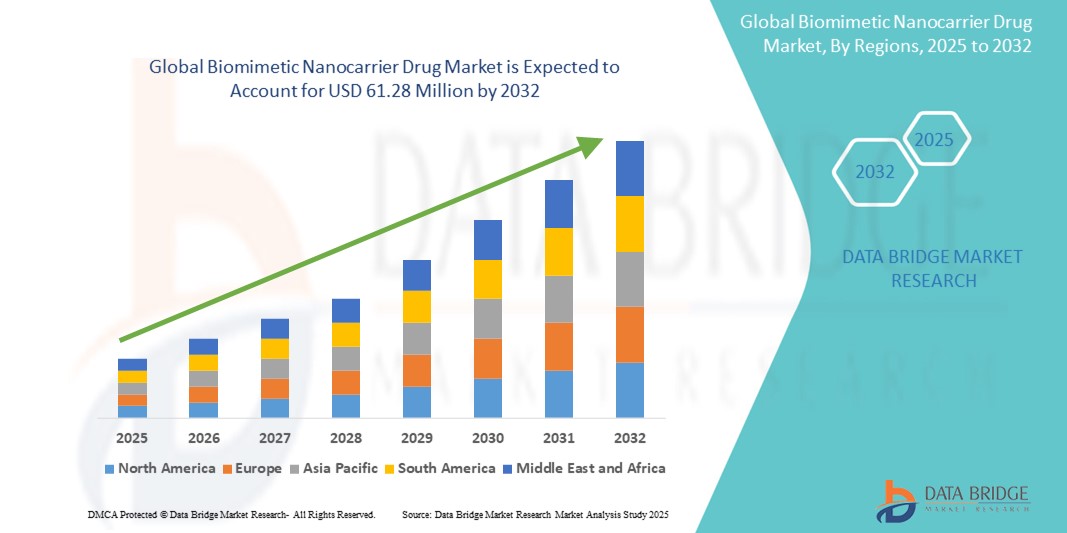
- The global biomimetic nanocarrier drug market size was valued at USD 42.12 million in 2024 and is expected to reach USD 61.28 million by 2032, at a CAGR of 4.80% during the forecast period
- The market growth is largely driven by the increasing prevalence of chronic and life-threatening diseases such as cancer and neurological disorders, which demand targeted and efficient drug delivery systems
- Furthermore, growing investments in nanomedicine R&D, coupled with the enhanced biocompatibility and precision offered by biomimetic nanocarriers, are positioning them as next-generation drug delivery solutions. These combined forces are accelerating the development and adoption of biomimetic nanocarrier drugs, significantly propelling market expansion
Biomimetic Nanocarrier Drug Market Analysis
- Biomimetic nanocarrier drugs, which mimic biological systems for precise and targeted drug delivery, are emerging as transformative solutions in modern therapeutics due to their enhanced biocompatibility, reduced immunogenicity, and superior targeting capabilities, particularly in treating complex diseases such as cancer, neurological disorders, and infections
- The accelerating demand for biomimetic nanocarriers is primarily driven by rising chronic disease incidence, growing limitations of conventional drug delivery systems, and increasing investments in nanomedicine research and personalized therapies
- North America dominated the biomimetic nanocarrier drug market with the largest revenue share of 39.1% in 2024, supported by robust R&D infrastructure, early adoption of advanced therapeutics, and significant funding from both public and private sectors, with the U.S. at the forefront owing to strong clinical pipelines and collaborations between academic institutions and biotech firms
- Asia-Pacific is expected to be the fastest growing region in the biomimetic nanocarrier drug market during the forecast period due to expanding healthcare infrastructure, rising pharmaceutical R&D activity, and growing awareness of advanced drug delivery systems
- The oncology segment dominated the biomimetic nanocarrier drug market with a market share of 47.2% in 2024, driven by the urgent need for highly targeted, less toxic cancer treatments and the increasing clinical application of nanocarriers in chemotherapy and immunotherapy regimens
Report Scope and Biomimetic Nanocarrier Drug Market Segmentation
|
Attributes |
Biomimetic Nanocarrier Drug Key Market Insights |
|
Segments Covered |
|
|
Countries Covered |
North America
Europe
Asia-Pacific
Middle East and Africa
South America
|
|
Key Market Players |
|
|
Market Opportunities |
|
|
Value Added Data Infosets |
In addition to the insights on market scenarios such as market value, growth rate, segmentation, geographical coverage, and major players, the market reports curated by the Data Bridge Market Research also include in-depth expert analysis, pricing analysis, brand share analysis, consumer survey, demography analysis, supply chain analysis, value chain analysis, raw material/consumables overview, vendor selection criteria, PESTLE Analysis, Porter Analysis, and regulatory framework. |
Biomimetic Nanocarrier Drug Market Trends
“Precision Therapeutics Through Bio-Inspired Delivery Systems”
- A significant and accelerating trend in the global biomimetic nanocarrier drug market is the evolution of advanced, bio-inspired delivery platforms that emulate natural biological processes to improve therapeutic efficacy and safety. These systems are revolutionizing drug delivery by enhancing targeting accuracy, minimizing off-target effects, and improving pharmacokinetics in complex diseases such as cancer and neurological disorders
- For instance, red blood cell (RBC)-mimicking nanocarriers are gaining traction due to their extended circulation times and ability to evade immune clearance. Similarly, platelet-inspired carriers are being explored for targeted delivery to tumor vasculature and sites of inflammation
- Biomimetic nanocarriers also enable active targeting by leveraging cell membrane-coated nanoparticles, which can recognize and bind to disease-specific markers, thereby enhancing drug accumulation at desired sites. For example, researchers are developing cancer cell membrane-coated nanoparticles to enable tumor-specific drug delivery and immune system evasion
- The integration of biomimicry into nanoparticle design supports multifunctionality—combining drug delivery, diagnostics, and immunomodulation in a single platform. Such “theranostic” systems are increasingly in demand for their ability to provide real-time treatment monitoring and personalized therapeutic responses
- This trend is fundamentally reshaping expectations in precision medicine, prompting pharmaceutical companies and research institutes to invest in biomimetic technologies. Companies and academic labs are working on scalable manufacturing methods and regulatory pathways to bring these next-generation nanocarriers to clinical application
- The demand for biomimetic nanocarriers that offer high specificity, improved biocompatibility, and targeted functionality is growing rapidly across oncology, neurology, and infectious disease treatment as healthcare shifts towards more personalized, efficient, and minimally invasive therapies
Biomimetic Nanocarrier Drug Market Dynamics
Driver
“Rising Demand for Targeted and Efficient Drug Delivery Systems”
- The increasing prevalence of chronic and life-threatening diseases such as cancer, neurological disorders, and autoimmune conditions is significantly driving the demand for advanced drug delivery platforms such as biomimetic nanocarriers
- For instance, in February 2024, a leading pharmaceutical collaboration between U.S. and European researchers advanced a cancer-targeting nanocarrier using tumor-derived exosome membranes, showing enhanced drug retention and minimal toxicity—demonstrating the commercial and clinical potential of biomimetic nanomedicine
- As traditional drug delivery systems face limitations in targeting precision and bioavailability, biomimetic nanocarriers provide an innovative alternative by mimicking natural biological pathways, reducing systemic toxicity, and improving therapeutic outcomes
- In addition, growing investments in nanomedicine R&D and increasing interest from biotech firms and academic institutions are accelerating product development. Government grants and regulatory support for innovative therapies are further encouraging market expansion
- The adaptability of these carriers to multiple administration routes and disease targets, combined with the ability to carry complex biologics such as siRNA, CRISPR agents, and peptides, enhances their appeal across therapeutic areas
Restraint/Challenge
“Manufacturing Complexity and Regulatory Hurdles”
- Despite their promise, biomimetic nanocarriers face challenges in large-scale production, quality control, and regulatory approval. The sophisticated nature of their design—often involving cell membranes or complex polymers—makes reproducibility and scalability difficult, posing barriers to clinical translation
- For instance, variations in source materials and membrane extraction techniques can lead to inconsistencies in particle functionality, which may delay or complicate regulatory approval
- Furthermore, existing regulatory frameworks for drug delivery systems are not fully equipped to address the unique characteristics of biomimetic nanocarriers, leading to uncertain timelines and added costs
- The high R&D investment required, along with limited clinical precedent for such technologies, increases risk for manufacturers and investors. In addition, intellectual property barriers and the need for interdisciplinary collaboration across biology, engineering, and pharmaceutical sciences can slow progress
- Overcoming these challenges through innovations in scalable synthesis, advanced characterization tools, and clearer regulatory pathways will be essential for unlocking the full commercial potential of biomimetic nanocarrier drugs
Biomimetic Nanocarrier Drug Market Scope
The market is segmented on the basis of nanocarrier type, route of administration, application, and end user.
- By Nanocarrier Type
On the basis of nanocarrier type, the biomimetic nanocarrier drug market is segmented into liposomes, polymeric nanoparticles, micelles, dendrimers, and inorganic nanostructures. The liposomes segment held the largest market revenue share in 2024, attributed to their biocompatibility, ability to encapsulate both hydrophilic and hydrophobic drugs, and widespread clinical use in oncology and infectious disease treatment. Liposomes mimic biological membranes, making them ideal for targeted and sustained drug delivery, with several FDA-approved formulations reinforcing their dominance in this space.
The polymeric nanoparticles segment is anticipated to witness the fastest growth rate from 2025 to 2032, driven by their versatility in drug loading, surface modification potential for targeted delivery, and controlled release capabilities. The emergence of stimuli-responsive polymeric nanocarriers is further driving their adoption in personalized and site-specific therapies.
- By Route of Administration
On the basis of route of administration, the biomimetic nanocarrier drug market is segmented into intravenous, oral, topical, inhalation, and transdermal. The intravenous segment accounted for the largest market share in 2024 due to its ability to ensure precise, systemic delivery and rapid therapeutic onset, particularly in oncology and critical care settings. Intravenous biomimetic nanocarriers are extensively used in clinical trials and commercial formulations owing to their enhanced circulation time and effective biodistribution.
The oral route is projected to grow at the fastest rate over the forecast period, as ongoing research aims to overcome traditional limitations such as enzymatic degradation and poor absorption. Advancements in mucoadhesive and pH-sensitive biomimetic nanocarriers are enhancing the viability of oral delivery for biologics and small molecules.
- By Application
On the basis of application, the biomimetic nanocarrier drug market is segmented into oncology, neurological disorders, infectious diseases, cardiovascular diseases, autoimmune diseases, gene therapy, and diagnostic imaging. The oncology segment dominated the market with the largest revenue share of 47.2% in 2024, fueled by the need for precise, tumor-targeted drug delivery systems with reduced systemic toxicity. Biomimetic nanocarriers are increasingly used in chemotherapy and immunotherapy to improve therapeutic outcomes and reduce side effects.
The neurological disorders segment is expected to grow at the highest CAGR from 2025 to 2032, driven by the ability of certain biomimetic nanocarriers to cross the blood-brain barrier (BBB). Innovative carriers that mimic neuronal or endothelial membranes are showing promise in delivering drugs for Alzheimer’s, Parkinson’s, and glioblastoma treatments.
- By End User
On the basis of end user, the biomimetic nanocarrier drug market is segmented into hospitals & clinics, biopharmaceutical companies, research institutes, and specialty pharmacies. The biopharmaceutical companies segment led the market in 2024, supported by growing investment in nanomedicine pipelines, drug development partnerships, and strategic licensing agreements. These companies are at the forefront of clinical translation and commercialization of biomimetic nanocarrier technologies.
The research institutes segment is anticipated to witness the highest growth rate during the forecast period, as academic collaborations and government-funded research projects continue to explore novel biomimetic strategies for targeted drug delivery. Increasing preclinical research into cell membrane-coated nanocarriers is also expanding the role of research institutions in the market.
Biomimetic Nanocarrier Drug Market Regional Analysis
- North America dominated the biomimetic nanocarrier drug market with the largest revenue share of 39.1% in 2024, supported by robust R&D infrastructure, early adoption of advanced therapeutics, and significant funding from both public and private sectors
- The region’s healthcare ecosystem places high value on advanced, targeted drug delivery systems that offer improved therapeutic outcomes and reduced side effects, making biomimetic nanocarriers a critical component in the evolution of precision medicine
- This leadership position is further reinforced by substantial government and private funding for innovative drug development, a high rate of clinical trial activity, and increasing collaborations between academic institutions and industry players, positioning North America as a key hub for innovation and commercialization in the biomimetic nanocarrier drug market
U.S. Biomimetic Nanocarrier Drug Market Insight
The U.S. biomimetic nanocarrier drug market captured the largest revenue share of 79.4% in 2024 within North America, driven by strong clinical trial activity, robust government and private R&D funding, and a well-established biopharmaceutical industry. The country’s early adoption of nanomedicine and focus on targeted therapies for cancer and neurological disorders have positioned it as a global leader in biomimetic drug delivery innovation. In addition, collaborations between top universities, research institutions, and industry players continue to advance the clinical translation and commercialization of biomimetic nanocarriers.
Europe Biomimetic Nanocarrier Drug Market Insight
The Europe biomimetic nanocarrier drug market is projected to expand at a substantial CAGR throughout the forecast period, supported by increasing investment in advanced therapeutics and strict regulatory focus on safety and efficacy. The region is witnessing rising demand for precision medicine, especially in oncology and neurology, driving the adoption of biomimetic drug delivery systems. In addition, government initiatives promoting nanotechnology in healthcare and collaborative research frameworks such as Horizon Europe are fostering innovation across both academic and commercial sectors.
U.K. Biomimetic Nanocarrier Drug Market Insight
The U.K. biomimetic nanocarrier drug market is anticipated to grow at a noteworthy CAGR during the forecast period, fueled by active support for nanomedicine research, a thriving biotechnology ecosystem, and strong academic-industry collaboration. With increasing cancer incidence and demand for advanced drug delivery systems, the U.K. is investing heavily in translational research. National health policies encouraging innovative therapeutics and precision treatment approaches are also expected to accelerate market growth.
Germany Biomimetic Nanocarrier Drug Market Insight
The Germany biomimetic nanocarrier drug market is expected to expand at a considerable CAGR during the forecast period, driven by the country’s leading role in pharmaceutical innovation, nanotech R&D, and precision healthcare. Germany’s focus on sustainable and efficient therapeutic solutions aligns with the growing interest in biomimetic delivery systems. Strong public research infrastructure and collaborations with global pharma companies are further enhancing the country’s position in this field.
Asia-Pacific Biomimetic Nanocarrier Drug Market Insight
The Asia-Pacific biomimetic nanocarrier drug market is poised to grow at the fastest CAGR of 25.3% during the forecast period of 2025 to 2032, fueled by rapidly improving healthcare infrastructure, expanding pharmaceutical manufacturing, and increasing research funding in countries such as China, Japan, and India. Government-backed digital health initiatives and rising demand for personalized medicine are key drivers, along with growing public and private investments in nanotechnology and targeted drug delivery systems.
Japan Biomimetic Nanocarrier Drug Market Insight
The Japan biomimetic nanocarrier drug market is gaining momentum due to its advanced biomedical research ecosystem and aging population, which is driving the demand for innovative treatment options with reduced side effects. Japan’s integration of biomimetic nanocarriers in clinical applications is supported by strong industry-academia partnerships and a growing focus on minimally invasive therapies. The country is also investing in the development of multifunctional carriers for use in oncology and neurological care.
India Biomimetic Nanocarrier Drug Market Insight
The India biomimetic nanocarrier drug market accounted for the largest market revenue share in Asia Pacific in 2024, owing to its rapidly growing pharmaceutical sector, increasing disease burden, and supportive government policies promoting nanomedicine research. India’s expanding biotech startup ecosystem, availability of skilled researchers, and cost-effective manufacturing capabilities are positioning it as a key hub for the development and production of biomimetic nanocarrier-based therapies.
Biomimetic Nanocarrier Drug Market Share
The biomimetic nanocarrier drug industry is primarily led by well-established companies, including:
- CuriRx, Inc. (U.S.)
- NanoCarrier Co., Ltd. (Japan)
- Evonik Industries AG (Germany)
- Nanobiotix S.A. (France)
- Cellicon Therapeutics GmbH (Germany)
- Nanoform Finland Plc (Finland)
- Selecta Biosciences, Inc. (U.S.)
- Camurus AB (Sweden)
- EnGeneIC Ltd. (Australia)
- Synthego Corporation (U.S.)
- Celsius Therapeutics, Inc. (U.S.)
- Nanovex Biotechnologies S.L. (Spain)
- Phosphorex, Inc. (U.S.)
- Precision NanoSystems Inc. (Canada)
- Mediphage BioTechnologies Inc. (Canada)
- MDimune Inc. (South Korea)
- Nanospectra Biosciences, Inc. (U.S.)
- Exopharm Ltd. (Australia)
- Codiak BioSciences, Inc. (U.S.)
What are the Recent Developments in Global Biomimetic Nanocarrier Drug Market?
- In May 2024, BioNano Therapeutics Inc., a U.S.-based nanomedicine company, announced the successful completion of a Phase I clinical trial for its red blood cell membrane-coated nanoparticle formulation designed for targeted delivery of chemotherapy drugs. The trial demonstrated enhanced circulation time and reduced off-target toxicity, marking a significant advancement in biomimetic delivery technologies. This development reflects the growing emphasis on biocompatible, cell-inspired systems to improve therapeutic index in oncology
- In April 2024, a strategic research collaboration was formed between the University of Cambridge and Genova Biologics (UK) to develop platelet-mimicking nanocarriers for use in cardiovascular disease therapies. These carriers aim to target damaged vasculature and deliver anti-thrombotic agents more precisely. The partnership underscores a broader trend toward bio-inspired drug delivery in non-oncological indications, expanding the clinical scope of biomimetic nanocarriers
- In March 2024, NanoMem Therapeutics Ltd. (Japan) unveiled a new class of exosome-mimicking nanocarriers at the BIO Asia–Taiwan Conference, showcasing preclinical data supporting their potential in neurodegenerative disease treatment. The biomimetic platform demonstrated strong blood-brain barrier penetration and targeted delivery of anti-inflammatory agents. This innovation highlights Japan's commitment to leveraging nanobiotechnology for central nervous system (CNS) disorders
- In February 2024, Cellicon Therapeutics (Germany) received funding from the European Innovation Council to advance development of its immune cell-derived nanocarriers for use in autoimmune diseases. The funding will support preclinical studies and scale-up processes. Cellicon’s approach uses leukocyte-mimicking particles to improve immunomodulation, reflecting Europe’s push toward next-generation biologic delivery systems
- In January 2024, India’s Council of Scientific and Industrial Research (CSIR), in collaboration with private sector firm Biocura Labs, launched a pilot project to develop cancer-targeting biomimetic nanoparticles using indigenous raw materials. The initiative is part of India’s broader strategy to strengthen domestic nanomedicine capabilities while addressing affordability and scalability. This development signals growing interest in localized, cost-effective biomimetic solutions tailored for emerging markets

- Interactive Data Analysis Dashboard
- Company Analysis Dashboard for high growth potential opportunities
- Research Analyst Access for customization & queries
- Competitor Analysis with Interactive dashboard
- Latest News, Updates & Trend analysis
- Harness the Power of Benchmark Analysis for Comprehensive Competitor Tracking
Data collection and base year analysis are done using data collection modules with large sample sizes. The stage includes obtaining market information or related data through various sources and strategies. It includes examining and planning all the data acquired from the past in advance. It likewise envelops the examination of information inconsistencies seen across different information sources. The market data is analysed and estimated using market statistical and coherent models. Also, market share analysis and key trend analysis are the major success factors in the market report. To know more, please request an analyst call or drop down your inquiry.
The key research methodology used by DBMR research team is data triangulation which involves data mining, analysis of the impact of data variables on the market and primary (industry expert) validation. Data models include Vendor Positioning Grid, Market Time Line Analysis, Market Overview and Guide, Company Positioning Grid, Patent Analysis, Pricing Analysis, Company Market Share Analysis, Standards of Measurement, Global versus Regional and Vendor Share Analysis. To know more about the research methodology, drop in an inquiry to speak to our industry experts.
Data Bridge Market Research is a leader in advanced formative research. We take pride in servicing our existing and new customers with data and analysis that match and suits their goal. The report can be customized to include price trend analysis of target brands understanding the market for additional countries (ask for the list of countries), clinical trial results data, literature review, refurbished market and product base analysis. Market analysis of target competitors can be analyzed from technology-based analysis to market portfolio strategies. We can add as many competitors that you require data about in the format and data style you are looking for. Our team of analysts can also provide you data in crude raw excel files pivot tables (Fact book) or can assist you in creating presentations from the data sets available in the report.












