


Bioprinted Tissue Development Platforms Market Size
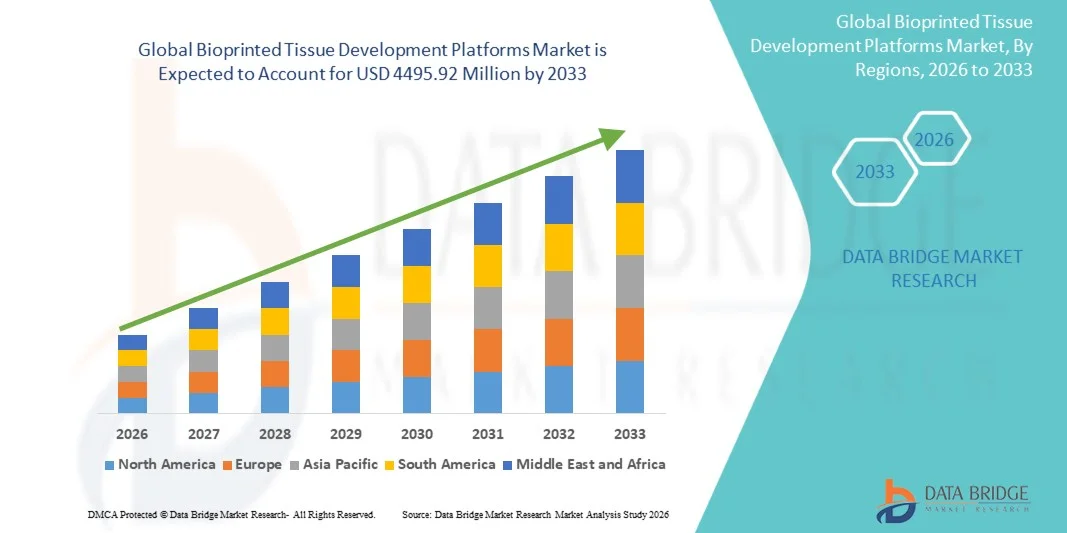
- The global bioprinted tissue development platforms market size was valued at USD 972.00 Million in 2025 and is expected to reach USD 4495.92 Million by 2033, at a CAGR of 21.10% during the forecast period
- The market growth is largely fueled by rapid advancements in 3D bioprinting technologies, increased investments in regenerative medicine, and growing adoption of bioprinted tissue platforms for drug testing, disease modeling, and organ-on-chip applications in both research and clinical settings
- Furthermore, rising demand for personalized medicine, increasing focus on reducing animal testing, and the integration of advanced biomaterials and automated printing systems are establishing bioprinted tissue development platforms as essential tools in modern biomedical research and pharmaceutical development. These converging factors are accelerating the uptake of Bioprinted Tissue Development Platforms solutions, thereby significantly boosting the industry's growth
Bioprinted Tissue Development Platforms Market Analysis
- Bioprinted tissue development platforms, offering advanced 3D bioprinting of functional tissues and organoids, are increasingly vital components in modern biomedical research, pharmaceutical development, and regenerative medicine due to their precision, reproducibility, and ability to model human physiology in vitro
- The escalating demand for bioprinted tissue platforms is primarily fueled by the rising adoption of personalized medicine, increasing research in drug discovery, and the need to reduce animal testing, along with technological advancements in bioinks, automated printing systems, and tissue maturation processes
- North America dominated the bioprinted tissue development platforms market with the largest revenue share of 41.8% in 2025, characterized by advanced biomedical research infrastructure, strong regulatory support, and the presence of key industry players driving adoption across pharmaceutical, academic, and clinical research laboratories
- Asia-Pacific is expected to be the fastest growing region in the bioprinted tissue development platforms market during the forecast period due to increasing investments in life sciences, growing biotechnology research, and rising adoption of bioprinting technologies in countries such as China, India, and Japan
- The 3D bioprinting systems segment dominated the largest market revenue share of 48.3% in 2025, driven by rapid adoption of advanced printing technologies in tissue engineering and regenerative research
Report Scope and Bioprinted Tissue Development Platforms Market Segmentation
|
Attributes |
Bioprinted Tissue Development Platforms Key Market Insights |
|
Segments Covered |
|
|
Countries Covered |
North America
Europe
Asia-Pacific
Middle East and Africa
South America
|
|
Key Market Players |
• Organovo Holdings, Inc. (U.S.) |
|
Market Opportunities |
|
|
Value Added Data Infosets |
In addition to the insights on market scenarios such as market value, growth rate, segmentation, geographical coverage, and major players, the market reports curated by the Data Bridge Market Research also include in-depth expert analysis, patient epidemiology, pipeline analysis, pricing analysis, and regulatory framework. |
Bioprinted Tissue Development Platforms Market Trends
“Accelerated Innovation in Tissue Engineering”
- A significant and accelerating trend in the global Bioprinted Tissue Development Platforms market is the increased adoption of multi-material and high-precision bioprinting systems
- For instance, CELLINK’s Bio X6 platform enables researchers to print complex tissue structures with multiple cell types, allowing for more physiologically relevant models
- Integration of bioinks with enhanced mechanical and biochemical properties is improving the fidelity of bioprinted tissues, enabling applications such as organ-on-chip models and preclinical drug testing. Companies like Organovo are pioneering liver and kidney tissue constructs for pharmacological studies
- The rising trend of hybrid bioprinting, combining extrusion-based, inkjet, and laser-assisted technologies, is fostering platform versatility. This allows laboratories to replicate intricate tissue architectures, enhancing research efficiency and accelerating innovation
- Growing collaborations between academic institutions, pharmaceutical companies, and biotechnology startups are pushing the development of patient-specific tissue models, which are increasingly used in personalized medicine and regenerative therapies
- The market is witnessing enhanced investment in high-throughput bioprinting technologies for large-scale tissue production, addressing the rising demand for functional tissue models in drug discovery, disease modeling, and toxicity testing
Bioprinted Tissue Development Platforms Market Dynamics
Driver
“Expanding Demand for Advanced Preclinical and Regenerative Research”
- The increasing prevalence of chronic diseases and the need for rapid, effective drug development are driving the adoption of bioprinted tissue platforms
- For instance, pharmaceutical companies are employing bioprinted cardiac and liver tissues to improve preclinical screening outcomes
- Government and private funding initiatives in North America and Europe are supporting tissue engineering research, such as the National Institutes of Health (NIH) grants for regenerative medicine studies
- Bioprinted tissue platforms enable precise modeling of human-specific pathophysiology, reducing reliance on animal models and improving translation of research findings to clinical applications. For instance, a recent study used bioprinted human kidney tissues to test nephrotoxicity of new drugs, enhancing safety assessments
- The integration of imaging and monitoring systems with bioprinted platforms allows real-time observation of tissue maturation and functionality, enhancing experimental reproducibility and reliability
- Rising awareness of personalized medicine and patient-specific therapies is increasing demand for patient-derived tissue models for disease modeling, transplantation research, and organ-on-chip application
Restraint/Challenge
“High Costs and Technical Complexity Limiting Widespread Adoption”
- The high initial cost of bioprinted tissue development platforms, including printers, bioinks, and consumables, is a major barrier, particularly for small laboratories and academic institutions
- For instance, multi-material printers like the Bio X6 can cost several hundred thousand dollars
- Technical expertise is required for successful operation, as researchers must manage cell culture conditions, bioink formulation, and post-printing maturation, limiting adoption to trained personnel
- Standardization and reproducibility challenges remain, as variations in bioink properties, printer calibration, and cell behavior can impact experimental outcomes. For instance, a laboratory reported inconsistent tissue stiffness due to variability in bioink viscosity
- Regulatory uncertainty surrounding clinical use of bioprinted tissues and scaffolds slows commercialization and investment in large-scale production
- Maintenance and operational costs, including sterile environments, temperature control, and continuous monitoring, add to the financial burden, slowing adoption in emerging markets
Bioprinted Tissue Development Platforms Market Scope
The Bioprinted Tissue Development Platforms market is segmented on the basis of type, application, and end user.
• By Type
On the basis of type, the market is segmented into 3D bioprinting systems, bioinks, and tissue maturation platforms. The 3D bioprinting systems segment dominated the largest market revenue share of 48.3% in 2025, driven by rapid adoption of advanced printing technologies in tissue engineering and regenerative research. 3D bioprinting systems enable precise layer‑by‑layer fabrication of complex tissue constructs using multiple cell types, biomaterials, and growth factors. Increasing funding for research in organ‑on‑a‑chip and personalized medicine applications is boosting investment in these systems. Hospitals, research institutes, and pharmaceutical firms deploy 3D bioprinters to model tissues for disease studies and drug testing, replacing or supplementing animal models. Technological advancements, including multi‑material and high‑resolution printing capabilities, further strengthen segment dominance. Regulatory support for innovative tissue engineering research in key markets such as the U.S., EU, and Asia‑Pacific reinforces growth. Integration with AI and imaging technologies improves print precision and reproducibility. High initial equipment cost is offset by long‑term research benefits. Collaborative research efforts between academia and industry also expand system utilization. Overall, 3D bioprinting systems remain the backbone of the market due to their foundational role in enabling complex tissue fabrication.
The bioinks segment is expected to witness the fastest CAGR of 20.4% from 2026 to 2033, fueled by rising demand for advanced biomaterials capable of mimicking native extracellular matrices. Bioinks — comprising natural polymers (like collagen, gelatin) and synthetic polymers — are critical for supporting cell viability, proliferation, and differentiation in printed tissues. Innovations in nanocomposite bioinks and growth factor‑infused formulations are driving research interest. Pharmaceutical and biotech companies invest heavily in tailored bioinks to improve disease modeling and regenerative applications. Regulatory progress in biomaterial approval pathways supports commercialization. Additionally, increased adoption of bioinks in organ‑on‑chip platforms and personalized medicine drives faster growth. Researchers are seeking bioinks with enhanced biocompatibility, mechanical integrity, and print fidelity. Academic collaborations with bioprinting hardware developers expand product portfolios. Overall, bioinks are positioned for rapid expansion as they are essential for diverse tissue engineering use cases.
• By Application
On the basis of application, the market is segmented into drug discovery, disease modeling, and regenerative medicine. The drug discovery segment held the largest market revenue share of 38.7% in 2025, driven by widespread adoption of bioprinted tissue models to simulate human physiology more accurately than traditional 2D cell cultures. Pharmaceutical companies increasingly rely on bioprinted tissues for high‑throughput screening, toxicity testing, and efficacy assessments, lowering drug development costs and timelines. Bioprinted liver, cardiac, and tumor models are gaining traction for predicting human responses, improving candidate selection quality. Contract research organizations (CROs) also adopt these platforms to meet client demand for predictive preclinical models. Technological advancements, including co‑culture and vascularized models, enhance biological relevance. Regulatory agencies encouraging human‑relevant models further accelerate adoption. Collaborative consortia between industry and research institutes support standardization and validation of bioprinted models. The integration of bioprinted model data into AI‑driven analytics strengthens predictive power. Overall, drug discovery remains dominant due to its broad commercial applicability and cost benefits.
The regenerative medicine segment is expected to witness the fastest CAGR of 22.1% from 2026 to 2033, fueled by the growing demand for patient‑specific tissue implants and advancements in stem cell bioprinting. Regenerative applications involve printing functional tissues — such as cartilage, bone, and skin — for therapeutic use and reconstructive surgeries. Rising prevalence of chronic injuries, trauma, and degenerative diseases drives demand. Moreover, advancements in immune‑compatible scaffolds and vascularization techniques enhance clinical prospects. Healthcare providers and tissue banks increasingly adopt bioprinted tissues for grafting and reconstructive procedures. Government funding and incentives for regenerative research further support market expansion. Clinical trials using bioprinted tissues for therapeutic applications are progressing globally. Increased collaboration between medical device makers and bioprinting companies accelerates product introductions. Enhanced regulatory clarity on regenerative therapies also fosters adoption. Overall, regenerative medicine is rapidly growing due to its high clinical impact and therapeutic potential.
• By End User
On the basis of end user, the market is segmented into pharmaceutical & biotechnology companies, academic & research institutes, and hospitals & clinics. The pharmaceutical & biotechnology companies segment dominated the largest market revenue share of 46.9% in 2025, driven by extensive use of bioprinted tissues for drug development, toxicity screening, and personalized medicine applications. Large pharma and biotech firms allocate significant budgets for advanced tissue platforms to improve drug success rates and reduce R&D attrition. Collaborations with bioprinting technology providers enable tailored tissue models that mimic human pathophysiology. Contract research organizations (CROs) also bolster segment growth by offering bioprinting‑based testing services. Integration of bioprinted tissues into pharma pipelines supports regulatory submissions and data reproducibility. Academic & industry partnerships further enhance platform adoption. Enhanced capabilities of bioprinting hardware and software improve throughput and reliability. Overall, this segment remains dominant due to high commercial utility in the pharmaceutical value chain.
The academic & research institutes segment is expected to witness the fastest CAGR of 21.5% from 2026 to 2033, driven by increasing research initiatives in tissue engineering, regenerative medicine, and disease modeling. Universities and public research labs are adopting bioprinted tissue development platforms to investigate disease mechanisms, stem cell behavior, and organ development processes. Government grants and funding programs supporting biotech research fuel growth. Cross‑disciplinary research between engineering, cell biology, and translational medicine drives innovation. Academic adoption also fosters workforce training and long‑term ecosystem growth. Partnerships with industry accelerate commercialization pathways. Increased publication output and conference activity raise awareness and drive demand for advanced tools. Emerging markets with expanding research infrastructure further contribute to segment growth.
Bioprinted Tissue Development Platforms Market Regional Analysis
- North America dominated the bioprinted tissue development platforms market with the largest revenue share of 41.8% in 2025, characterized by advanced biomedical research infrastructure, strong regulatory support, and the presence of key industry players driving adoption across pharmaceutical, academic, and clinical research laboratories. The region’s leadership is further reinforced by robust funding for tissue engineering research and widespread implementation of cutting-edge bioprinting platforms for drug development and regenerative medicine studies
- Consumers and research institutions in the region highly value the precision, scalability, and reliability of North American bioprinted tissue systems. For instance, platforms such as CELLINK Bio X6 and Organovo’s exVive3D liver tissues are being extensively adopted by academic and pharmaceutical labs for organ-on-chip applications, preclinical testing, and disease modeling, highlighting the strong practical utility of these technologies
- The market expansion is additionally supported by a technologically skilled workforce, advanced laboratory facilities, and the integration of bioprinting with imaging, AI-based analytics, and automation. These capabilities facilitate the production of complex, multi-cellular tissue constructs, enhancing research efficiency and accuracy in regenerative medicine
U.S. Bioprinted Tissue Development Platforms Market Insight
The U.S. bioprinted tissue development platforms market captured the largest revenue share of 83% in North America in 2025, fueled by strong investments in life sciences research and growing adoption of high-precision bioprinting technologies. Leading academic and pharmaceutical institutions are increasingly leveraging bioprinted tissues for drug testing, disease modeling, and organ regeneration studies. For example, researchers at Harvard’s Wyss Institute have utilized bioprinted cardiac tissues to study heart disease mechanisms and drug responses, underlining the country’s position as a hub for innovation.
Europe Bioprinted Tissue Development Platforms Market Insight
The Europe bioprinted tissue development platforms market is projected to expand at a substantial CAGR during the forecast period, driven by increasing government and EU-backed funding for biotechnology, stringent quality regulations, and growing awareness of personalized medicine. The adoption of multi-material and hybrid bioprinting platforms is rising across research centers in Germany, France, and the Netherlands, enabling advanced tissue engineering projects for pharmaceutical and regenerative applications.
U.K. Bioprinted Tissue Development Platforms Market Insight
The U.K. bioprinted tissue development platforms market is anticipated to grow at a noteworthy CAGR during the forecast period, fueled by strong academic research infrastructure, government-backed life science initiatives, and increasing collaborations between universities and biotech startups. For instance, University College London has implemented bioprinted skin tissue models for dermatological research and toxicology testing, showcasing practical applications in both healthcare and pharma sectors.
Germany Bioprinted Tissue Development Platforms Market Insight
The Germany bioprinted tissue development platforms market is expected to expand at a considerable CAGR during the forecast period, supported by robust biotechnology investment, state-of-the-art laboratory infrastructure, and increasing demand for organ-on-chip and regenerative medicine studies. German research institutions are pioneering bioprinted vascular and liver tissues for drug screening, demonstrating the country’s leadership in high-precision tissue engineering applications.
Asia-Pacific Bioprinted Tissue Development Platforms Market Insight
The Asia-Pacific bioprinted tissue development platforms market is poised to grow at the fastest CAGR during the forecast period due to increasing investments in life sciences, expansion of biotechnology research facilities, and rising adoption of bioprinting technologies in China, India, and Japan. Government-backed initiatives, such as China’s National Key R&D Program in regenerative medicine, are accelerating technology deployment in research laboratories and pharmaceutical companies across the region.
Japan Bioprinted Tissue Development Platforms Market Insight
The Japan bioprinted tissue development platforms market is gaining momentum due to the country’s advanced research culture, high adoption of automation technologies, and strong focus on regenerative medicine and organ transplantation studies. Academic institutions, such as Kyoto University, are increasingly using bioprinted tissue constructs for preclinical drug testing and regenerative therapies, highlighting Japan’s strategic adoption of these platforms in life sciences research.
China Bioprinted Tissue Development Platforms Market Insight
The China bioprinted tissue development platforms market accounted for the largest market revenue share in Asia-Pacific in 2025, attributed to the country’s significant investments in biotechnology, rapid expansion of research laboratories, and growing pharmaceutical and regenerative medicine sectors. Companies such as Revotek and 3D Bioprinting Solutions are driving adoption by offering scalable, affordable bioprinting solutions for both academic and industrial applications, strengthening China’s position as a key regional hub.
Bioprinted Tissue Development Platforms Market Share
The Bioprinted Tissue Development Platforms industry is primarily led by well-established companies, including:
• Organovo Holdings, Inc. (U.S.)
• CELLINK AB (Sweden)
• Aspect Biosystems (Canada)
• Allevi, Inc. (U.S.)
• Inventia Life Science (Australia)
• Poietis SAS (France)
• Cellink Life Science AB (Sweden)
• EnvisionTEC GmbH (Germany)
• 3D Bioprinting Solutions (Russia)
• BICO Group AB (Sweden)
• Advanced Solutions Life Sciences (U.S.)
• RegenHu SA (Switzerland)
• Cyfuse Biomedical K.K. (Japan)
• TeVido BioDevices, Inc. (U.S.)
• Advanced BioMatrix, Inc. (U.S.)
Latest Developments in Global Bioprinted Tissue Development Platforms Market
- In April 2025, FluidForm Bio announced the publication of a groundbreaking study on its CHIPS (Collagen‑based High‑resolution Internally Perfusable Scaffolds) 3D‑bioprinted tissue platform in Science Advances, demonstrating the ability to fabricate vascularized, functional tissue constructs that support insulin secretion, marking a significant advancement toward clinically relevant bioprinted organs. This development bridges foundational bioprinting methods with therapeutic tissue platforms aimed at regenerative medicine and disease treatment
- In April 2025, FluidForm Bio revealed a major advancement in vascularized tissue engineering using its FRESH™ 3D bioprinting technology, where enhanced nutrient diffusion and scalable perfusion strategies significantly improved cell viability in thick tissue constructs, addressing a critical limitation in engineered tissue fabrication. This breakthrough supports the development of complex, functional tissues with applications in regenerative therapies and chronic disease treatment
- In April 2025, FluidForm Bio strengthened its intellectual property position with the issuance of a U.S. patent covering key aspects of its proprietary FRESH 3D bioprinting technology, reinforcing its leadership in next‑generation tissue development platforms and expanding its ability to commercialize clinically relevant bioprinted tissues
- In February 2026, CollPlant Biotechnologies Ltd. launched BioFlex, a ready‑to‑print rhCollagen‑based bioink kit designed for Digital Light Processing (DLP) 3D bioprinting applications. The BioFlex system enables rapid formulation of tunable, high‑resolution bioinks for biofabrication of advanced tissue models, drug discovery research, and engineered tissues or organ scaffolds. This product aims to streamline tissue engineering workflows, accelerate R&D timelines, and improve reproducibility in bioprinted tissue constructs

- Interactive Data Analysis Dashboard
- Company Analysis Dashboard for high growth potential opportunities
- Research Analyst Access for customization & queries
- Competitor Analysis with Interactive dashboard
- Latest News, Updates & Trend analysis
- Harness the Power of Benchmark Analysis for Comprehensive Competitor Tracking
Data collection and base year analysis are done using data collection modules with large sample sizes. The stage includes obtaining market information or related data through various sources and strategies. It includes examining and planning all the data acquired from the past in advance. It likewise envelops the examination of information inconsistencies seen across different information sources. The market data is analysed and estimated using market statistical and coherent models. Also, market share analysis and key trend analysis are the major success factors in the market report. To know more, please request an analyst call or drop down your inquiry.
The key research methodology used by DBMR research team is data triangulation which involves data mining, analysis of the impact of data variables on the market and primary (industry expert) validation. Data models include Vendor Positioning Grid, Market Time Line Analysis, Market Overview and Guide, Company Positioning Grid, Patent Analysis, Pricing Analysis, Company Market Share Analysis, Standards of Measurement, Global versus Regional and Vendor Share Analysis. To know more about the research methodology, drop in an inquiry to speak to our industry experts.
Data Bridge Market Research is a leader in advanced formative research. We take pride in servicing our existing and new customers with data and analysis that match and suits their goal. The report can be customized to include price trend analysis of target brands understanding the market for additional countries (ask for the list of countries), clinical trial results data, literature review, refurbished market and product base analysis. Market analysis of target competitors can be analyzed from technology-based analysis to market portfolio strategies. We can add as many competitors that you require data about in the format and data style you are looking for. Our team of analysts can also provide you data in crude raw excel files pivot tables (Fact book) or can assist you in creating presentations from the data sets available in the report.













