


What is the Bioprocess Technology Market Size and Overview?
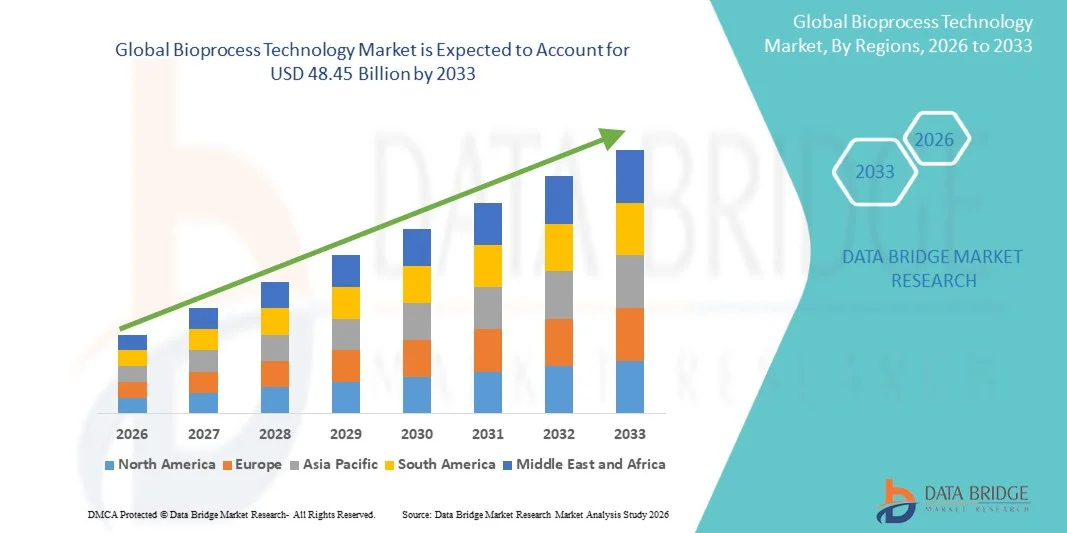
As per Data Bridge Market Research analysis The bioprocess technology market was valued at USD 24.68 billion in 2025 and is projected to reach USD 48.45 billion by 2033, growing at a CAGR of 8.80% from 2026 to 2033. The market is experiencing robust growth driven by increasing biopharmaceutical , rising adoption of single-use technologies, and growing investments in biologics, vaccines, and cell and gene therapy development.
The expanding demand for biologics and biosimilars worldwide, coupled with continuous advancements in upstream and downstream processing technologies, is encouraging biopharmaceutical manufacturers and contract development and manufacturing organizations (CDMOs) to modernize their production capabilities. Automated bioprocessing systems, advanced bioreactors, and real-time process monitoring solutions are increasingly replacing conventional manufacturing approaches, enabling higher productivity, improved scalability, and enhanced process efficiency across research, clinical, and commercial-scale bioproduction.
Market Size & Forecast
- Global Market Value (2025): USD 24.68 Billion
- Expected Market Value (2033): USD 48.45 Billion
- Forecast CAGR (2026–2033): 8.80%
- Leading Region in 2025: North America
- Fastest Growing Region: Asia Pacific
What are the Major Takeaways of Bioprocess Technology Market?
- North America dominated the bioprocess technology market with the largest revenue share of 38.42% in 2025, supported by a strong biopharmaceutical manufacturing base, significant R&D investments, and widespread adoption of advanced bioprocessing solutions.
- The Upstream Processing segment led the market with a 38.64% share in 2025, driven by its critical role in cell culture development, fermentation, media preparation, and biologics production.
- Asia-Pacific is expected to be the fastest-growing region at a CAGR of 9.1% from 2026 to 2033, fueled by expanding biomanufacturing capacity, increasing healthcare investments, and growing biologics production in China, India, and South Korea.
- Process Monitoring & Automation are the fastest-growing technology type, projected to register a CAGR of 10.4%, reflecting the surge in demand for real-time process control and manufacturing optimization.
- The Fed-Batch Processing segment dominated the mode of operation category with a 47.21% revenue share in 2025, led by its widespread use in commercial biopharmaceutical manufacturing.
- Monoclonal Antibodies accounted for 32.58% of the market, preferred by the increasing use of biologics for the treatment of cancer, autoimmune diseases, and chronic disorders.
- The Cell & Gene Therapy segment is the fastest-growing application category, with a CAGR of 12.6%, driven by the rapid advancements in regenerative medicine and personalized healthcare
Report Scope and Bioprocess Technology Market Segmentation
Attributes |
Bioprocess Technology Key Market Insights |
|
Segments Covered |
|
|
Countries Covered |
North America · U.S. · Canada · Mexico Europe · Germany · France · U.K. · Netherlands · Switzerland · Belgium · Russia · Italy · Spain · Turkey · Rest of Europe Asia-Pacific · China · Japan · India · South Korea · Singapore · Malaysia · Australia · Thailand · Indonesia · Philippines · Rest of Asia-Pacific Middle East and Africa · Saudi Arabia · U.A.E. · South Africa · Egypt · Israel · Rest of Middle East and Africa South America · Brazil · Argentina · Rest of South America |
|
Key Market Players |
· Thermo Fisher Scientific Inc. (U.S.) · Sartorius AG (Germany) · Danaher Corporation (U.S.) · Merck KGaA (Germany) · Eppendorf SE (Germany) · Repligen Corporation (U.S.) · Bio-Rad Laboratories, Inc. (U.S.) · Agilent Technologies, Inc. (U.S.) · Corning Incorporated (U.S.) · Lonza Group AG (Switzerland) · Getinge AB (Sweden) · FUJIFILM Corporation (Japan) · 3M (U.S.) · Avantor, Inc. (U.S.) · Waters Corporation (U.S.) · Solaris Biotechnology Srl (Italy) · INFORS HT (Switzerland) · PBS Biotech, Inc. (U.S.) · ABEC, Inc. (U.S.) · Esco Micro Pte. Ltd. (Singapore) |
|
Market Opportunities |
· Expansion of cell and gene therapy commercialization · Increasing adoption of single-use bioprocessing systems · Growth of biopharmaceutical manufacturing capacity in emerging markets |
|
Value Added Data Infosets |
In addition to the insights on market scenarios such as market value, growth rate, segmentation, geographical coverage, and major players, the market reports curated by the Data Bridge Market Research also include in-depth expert analysis, patient epidemiology, pipeline analysis, pricing analysis, and regulatory framework. |
What is the Key Trend in the Bioprocess Technology Market?
Trend: Growing Adoption of Single-Use Bioprocessing Technologies
Biopharmaceutical manufacturers are increasingly adopting single-use bioprocessing systems to improve operational flexibility, reduce contamination risks, and lower capital expenditure associated with traditional stainless-steel infrastructure. The integration of disposable bioreactors, filtration assemblies, and fluid management systems enables faster changeovers and streamlined production processes. Contract development and manufacturing organizations are similarly leveraging single-use platforms to support multi-product manufacturing through standardized, scalable workflows, while advancements in automation and process monitoring technologies create highly efficient environments that closely support modern biologics production requirements.
For instance, in February 2025, Sartorius AG expanded its single-use bioprocessing portfolio with advanced automation capabilities designed to improve manufacturing flexibility and process efficiency for biologics producers.
Bioprocess Technology Market Dynamics
Key Market Driver: Rising Demand for Biologics and Advanced Therapeutic Manufacturing
The rapid expansion of biologics, biosimilars, and cell and gene therapies has created substantial demand for advanced bioprocess technologies that can support complex production requirements, process scalability, and regulatory compliance. Biopharmaceutical companies, CDMOs, and research organizations are deploying integrated bioprocessing platforms as a core component of their manufacturing strategy, improving productivity, accelerating development timelines, and enhancing product quality. The growing emphasis on precision medicine and targeted therapies continues to increase the need for sophisticated upstream and downstream processing solutions across commercial manufacturing facilities worldwide.
For instance, in June 2024, Thermo Fisher Scientific expanded bioprocessing capabilities through investments in biologics manufacturing infrastructure to support increasing global demand for advanced therapies.
Key Restraint/Challenge: High Capital Requirements for Advanced Bioprocess Infrastructure
A significant restraint in the global bioprocess technology market is the high upfront investment required for advanced manufacturing systems. Modern facilities integrate sophisticated bioreactors, purification equipment, automation platforms, and process analytical technologies, demanding substantial expenditure in procurement, validation, and ongoing maintenance. The total cost of ownership extends to regulatory compliance, workforce training, and periodic technology upgrades, making adoption difficult for smaller biotechnology companies, academic institutions, and organizations operating in resource-constrained markets. The complexity of implementing large-scale bioprocessing facilities further increases financial and operational barriers across the industry.
For instance, in 2024, several large-scale biologics manufacturing expansion projects undertaken by Fujifilm Diosynth Biotechnologies highlighted the significant capital commitments required to establish advanced bioprocess production capacity.
Key Market Opportunity: Expansion of Cell and Gene Therapy Manufacturing Platforms
The expansion of cell and gene therapy manufacturing presents a significant market opportunity. Advanced bioprocess platforms can enable scalable production, improve process consistency, and support commercialization of highly specialized therapeutic products. The development of automated manufacturing systems and closed processing technologies is further enhancing operational efficiency while reducing contamination risks. Growing investments in regenerative medicine, personalized therapies, and next-generation biologics are opening growth opportunities across established and emerging healthcare markets throughout North America, Europe, and Asia-Pacific.
For instance, in March 2025, Lonza Group AG announced continued expansion of advanced therapy manufacturing capabilities to address rising global demand for cell and gene therapy production services.
How is the Bioprocess Technology Market Segmented?
The bioprocess technology market is segmented on the basis of technology, mode of operation, application, and end user.
- By Technology
On the basis of technology, the global bioprocess technology market is segmented into upstream processing, downstream processing, process analytical technology, and process monitoring & automation. The Upstream Processing segment dominated the market with a 38.64% share in 2025, driven by its critical role in cell culture development, fermentation, media preparation, and biologics production. Biopharmaceutical manufacturers increasingly invest in upstream technologies to improve cell productivity, optimize yields, and enhance manufacturing efficiency. The growing production of monoclonal antibodies, vaccines, and recombinant proteins continues to support demand for advanced upstream solutions. Innovations in bioreactors, cell culture media, and automation platforms are further strengthening segment growth. The increasing adoption of single-use technologies has also improved flexibility and reduced contamination risks. As biologics manufacturing expands globally, upstream processing remains the foundation of commercial bioproduction activities.
The Process Monitoring & Automation segment is projected to register the fastest growth at a CAGR of 10.4% from 2026 to 2033, driven by rising demand for real-time process control and manufacturing optimization. Automated systems help improve product consistency, reduce operational errors, and ensure regulatory compliance. The integration of artificial intelligence, machine learning, and advanced analytics is significantly enhancing process visibility and decision-making. Manufacturers are increasingly adopting digital bioprocessing platforms to improve efficiency and reduce production costs. Growing emphasis on continuous manufacturing is further accelerating investment in automation technologies. The shift toward smart biomanufacturing facilities is expected to create substantial growth opportunities for this segment over the forecast period.
- By Mode of Operation
On the basis of mode of operation, the global bioprocess technology market is segmented into batch processing, fed-batch processing, and continuous processing. The Fed-Batch Processing segment dominated the market with a 47.21% share in 2025 due to its widespread use in commercial biopharmaceutical manufacturing. This approach provides greater control over nutrient supply, resulting in improved cell growth and higher product yields. It is extensively utilized in the production of monoclonal antibodies, vaccines, and recombinant proteins. Manufacturers prefer fed-batch systems because they offer a balance between operational flexibility and process efficiency. The technology also supports large-scale production while maintaining product quality and consistency. Continuous advancements in bioreactor design and process optimization continue to strengthen its market position.
The Continuous Processing segment is expected to witness the fastest growth at a CAGR of 11.2% from 2026 to 2033, driven by increasing demand for cost-effective and highly efficient manufacturing processes. Continuous systems enable uninterrupted production, reducing downtime and improving facility utilization. These platforms support greater scalability while lowering operating expenses and resource consumption. Regulatory agencies are increasingly encouraging the adoption of advanced manufacturing approaches that enhance product quality and consistency. The growing focus on process intensification and operational excellence is accelerating implementation across biopharmaceutical facilities. As manufacturers seek to improve productivity and shorten production timelines, continuous processing is gaining significant traction worldwide.
- By Application
On the basis of application, the global bioprocess technology market is segmented into monoclonal antibodies, vaccines, recombinant proteins, cell & gene therapy, biosimilars, stem cell research, tissue engineering, industrial biotechnology, food & beverage biotechnology, environmental biotechnology, and other biopharmaceutical applications. The Monoclonal Antibodies segment led the market with a 32.58% share in 2025, driven by the increasing use of biologics for the treatment of cancer, autoimmune diseases, and chronic disorders. Monoclonal antibodies represent one of the largest categories of biopharmaceutical products globally. Growing regulatory approvals and expanding therapeutic indications continue to increase production requirements. Biopharmaceutical companies are investing heavily in advanced bioprocess technologies to improve manufacturing efficiency and scalability. Rising healthcare expenditure and growing patient demand for targeted therapies further support market growth. The segment continues to benefit from strong research and commercial activity across major pharmaceutical markets.
The Cell & Gene Therapy segment is expected to register the fastest growth at a CAGR of 12.6% from 2026 to 2033, fueled by rapid advancements in regenerative medicine and personalized healthcare. Increasing clinical trial activity and product commercialization are creating strong demand for specialized bioprocess technologies. These therapies require highly controlled manufacturing environments and advanced processing platforms. Investments from biotechnology companies, pharmaceutical manufacturers, and research institutions are accelerating technology adoption. The emergence of automated and closed-system manufacturing solutions is improving scalability and operational efficiency. Growing success in treating previously untreatable diseases is expected to further drive segment expansion during the forecast period.
- By End User
On the basis of end user, the global bioprocess technology market is segmented into biopharmaceutical companies, biotechnology companies, CDMOs, CROs, academic & research institutes, hospitals & clinical laboratories, food & beverage manufacturers, and industrial biotechnology companies. The Biopharmaceutical Companies segment dominated the market with a 43.67% share in 2025, supported by extensive investments in biologics development and commercial manufacturing. These organizations represent the largest users of bioprocess technologies for producing monoclonal antibodies, vaccines, biosimilars, and advanced therapeutics. Growing demand for innovative biologic medicines is driving continuous expansion of manufacturing capabilities. Companies are increasingly adopting automation, single-use systems, and advanced analytical technologies to improve productivity. Regulatory requirements for product quality and consistency further support investments in modern bioprocess infrastructure. The strong pipeline of biologics under development continues to reinforce segment leadership.
The CDMOs segment is projected to witness the fastest growth at a CAGR of 11.8% from 2026 to 2033, driven by increasing outsourcing of biopharmaceutical development and manufacturing activities. Pharmaceutical and biotechnology companies are relying on CDMOs to reduce capital expenditures and accelerate time-to-market. These organizations provide specialized expertise, flexible production capacity, and access to advanced manufacturing technologies. Rising complexity of biologics and cell-based therapies is further increasing demand for outsourced services. Continuous investments in facility expansion and technology upgrades are strengthening CDMO capabilities worldwide. The growing preference for strategic outsourcing partnerships is expected to significantly support segment growth over the forecast period.
Bioprocess Technology Market Regional Analysis
North America dominated the global bioprocess technology market with the largest revenue share of 38.42% in 2025, supported by a strong biopharmaceutical manufacturing base, significant R&D investments, and widespread adoption of advanced bioprocessing solutions. The region also benefits from advanced healthcare infrastructure, high adoption of single-use bioprocessing systems, and growing demand for biologics, biosimilars, and cell and gene therapies across commercial and research applications. Increasing focus on process automation, continuous manufacturing, and next-generation therapeutic development continues to strengthen North America’s leadership position in the global market.
U.S. Bioprocess Technology Market Insight
The U.S. bioprocess technology market is witnessing strong growth due to rising investments in biologics manufacturing, biotechnology research, and advanced therapeutic development technologies. The country’s mature biopharmaceutical ecosystem, along with increasing adoption of single-use systems, automation platforms, and continuous bioprocessing solutions, is driving demand across commercial, research, and contract manufacturing applications. In addition, growing emphasis on biologics production efficiency and expanding cell and gene therapy pipelines is accelerating bioprocess technology adoption across biopharmaceutical companies and research institutions.
Europe Bioprocess Technology Market Insight
The Europe bioprocess technology market remains a major contributor to global revenue, driven by strong government support, technological innovation, and high demand for advanced biomanufacturing solutions. The widespread use of modern bioprocess technologies in biologics production, vaccine manufacturing, and biotechnology research programs is supporting market expansion across the region. Increasing investments in single-use technologies, coupled with strict regulatory standards and a highly skilled workforce, continue to enhance the adoption of bioprocess technology throughout Europe.
U.K. Bioprocess Technology Market Insight
The U.K. bioprocess technology market is experiencing steady growth, supported by rising adoption of advanced manufacturing technologies in biopharmaceutical production, research, and development applications. Increasing investments in modern bioprocess infrastructure and growing demand for efficient, scalable production solutions are contributing to market growth. Furthermore, integration of automation, process analytics, and digital biomanufacturing technologies is improving operational performance and production efficiency, positioning the U.K. as a key innovation hub in the bioprocess technology industry.
Germany Bioprocess Technology Market Insight
The Germany bioprocess technology market is expanding steadily due to the country’s strong biotechnology sector, advanced research capabilities, and increasing adoption of next-generation manufacturing technologies. Biopharmaceutical companies, research organizations, and contract manufacturers are increasingly utilizing bioprocess technologies for biologics production, process optimization, and R&D activities. Continuous advancements in automation, process monitoring, and single-use technologies, along with strong government focus on innovation and life sciences development, are further driving market growth in Germany.
Asia-Pacific Bioprocess Technology Market Insight
The Asia-Pacific bioprocess technology market is expected to witness rapid growth, driven by increasing healthcare investments, expanding biopharmaceutical production, and rising investments in biotechnology infrastructure across countries such as China, India, and Japan. Growing demand for biologics, increasing adoption of advanced manufacturing technologies, and rising need for scalable and cost-effective production solutions are supporting regional market expansion. In addition, the growing presence of biopharmaceutical manufacturing facilities and research centers is accelerating bioprocess technology adoption across commercial and academic sectors.
Japan Bioprocess Technology Market Insight
The Japan bioprocess technology market is witnessing consistent growth due to rising investments in biologics manufacturing, biotechnology innovation, and advanced healthcare initiatives. Biopharmaceutical manufacturers, research institutes, and biotechnology companies are increasingly adopting advanced bioprocess technologies for therapeutic production, process optimization, and R&D purposes. Moreover, increasing integration of automation and digital manufacturing technologies and the country’s focus on high-quality healthcare solutions are further contributing to market growth.
China Bioprocess Technology Market Insight
The China bioprocess technology market is growing rapidly, driven by increasing biotechnology investments, expanding biopharmaceutical manufacturing infrastructure, and rising government focus on healthcare innovation and biologics production. Growing adoption of automated and single-use bioprocessing platforms across commercial, research, and contract manufacturing sectors is significantly boosting market demand. In addition, rising investments in biopharmaceutical R&D, increasing demand for advanced therapies, and rapid technological advancements are positioning China as one of the fastest-growing markets for bioprocess technology globally.
Bioprocess Technology Market Share
The bioprocess technology industry is primarily led by well-established companies, including:
- Thermo Fisher Scientific Inc. (U.S.)
- Sartorius AG (Germany)
- Danaher Corporation (U.S.)
- Merck KGaA (Germany)
- Eppendorf SE (Germany)
- Repligen Corporation (U.S.)
- Bio-Rad Laboratories, Inc. (U.S.)
- Agilent Technologies, Inc. (U.S.)
- Corning Incorporated (U.S.)
- Lonza Group AG (Switzerland)
- Getinge AB (Sweden)
- FUJIFILM Corporation (Japan)
- 3M (U.S.)
- Avantor, Inc. (U.S.)
- Waters Corporation (U.S.)
- Solaris Biotechnology Srl (Italy)
- INFORS HT (Switzerland)
- PBS Biotech, Inc. (U.S.)
- ABEC, Inc. (U.S.)
- Esco Micro Pte. Ltd. (Singapore)
Latest Developments in Bioprocess Technology Market
- In June 2025, Sartorius Stedim Biotech announced the completion of a major expansion of its manufacturing and R&D facilities in Aubagne, France. The project nearly doubled cleanroom capacity, introduced automated production lines for single-use bioprocessing bags, and expanded laboratories for product development and customer training, strengthening the company's ability to support global biopharmaceutical manufacturing demand
- In April 2025, Sartorius Stedim Biotech entered a strategic partnership with Tulip Interfaces to develop Biobrain® Operate powered by Tulip, a digital manufacturing platform designed to improve end-to-end visibility, reduce process variability, and optimize single-use bioprocessing operations through advanced digital applications
- In February 2025, Thermo Fisher Scientific announced the acquisition of Solventum's Purification & Filtration business for approximately USD 4.1 billion, expanding its capabilities in bioprocess filtration technologies used for biologics manufacturing and strengthening its position in the global bioprocessing market
- In December 2022, Merck KGaA announced the acquisition of Erbi Biosystems, adding the Breez™ micro-bioreactor platform to its upstream bioprocess portfolio. The acquisition enhances rapid process development, continuous perfusion cell culture, and scalable manufacturing capabilities for monoclonal antibodies and cell therapies
- In April 2022, Merck announced the acquisition of Lonza's MAST® (Modular Automated Sampling Technology) platform, an automated bioreactor sampling system that enables real-time process monitoring and supports digitally integrated bioprocess manufacturing, improving efficiency and accelerating biologics production

- Interactive Data Analysis Dashboard
- Company Analysis Dashboard for high growth potential opportunities
- Research Analyst Access for customization & queries
- Competitor Analysis with Interactive dashboard
- Latest News, Updates & Trend analysis
- Harness the Power of Benchmark Analysis for Comprehensive Competitor Tracking
Data collection and base year analysis are done using data collection modules with large sample sizes. The stage includes obtaining market information or related data through various sources and strategies. It includes examining and planning all the data acquired from the past in advance. It likewise envelops the examination of information inconsistencies seen across different information sources. The market data is analysed and estimated using market statistical and coherent models. Also, market share analysis and key trend analysis are the major success factors in the market report. To know more, please request an analyst call or drop down your inquiry.
The key research methodology used by DBMR research team is data triangulation which involves data mining, analysis of the impact of data variables on the market and primary (industry expert) validation. Data models include Vendor Positioning Grid, Market Time Line Analysis, Market Overview and Guide, Company Positioning Grid, Patent Analysis, Pricing Analysis, Company Market Share Analysis, Standards of Measurement, Global versus Regional and Vendor Share Analysis. To know more about the research methodology, drop in an inquiry to speak to our industry experts.
Data Bridge Market Research is a leader in advanced formative research. We take pride in servicing our existing and new customers with data and analysis that match and suits their goal. The report can be customized to include price trend analysis of target brands understanding the market for additional countries (ask for the list of countries), clinical trial results data, literature review, refurbished market and product base analysis. Market analysis of target competitors can be analyzed from technology-based analysis to market portfolio strategies. We can add as many competitors that you require data about in the format and data style you are looking for. Our team of analysts can also provide you data in crude raw excel files pivot tables (Fact book) or can assist you in creating presentations from the data sets available in the report.













