


What is the Biorepositories Market Size and Overview?
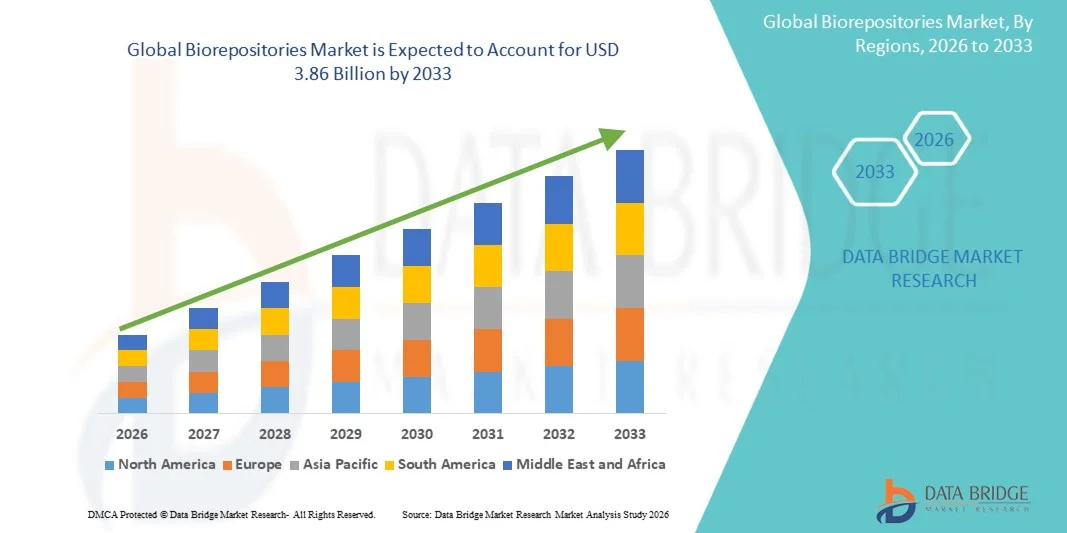
- As per Data Bridge Market Research Analysis The biorepositories market was valued at USD 1.96 billion in 2025 and is projected to reach USD 3.86 billion by 2033, registering a CAGR of 8.80% during the forecast period.
- Rising investments in genomics, increasing adoption of companion diagnostics, and the expansion of oncology and rare disease research are significantly increasing demand for high-quality biospecimen storage. Pharmaceutical companies and contract research organizations are increasingly outsourcing biospecimen management to specialized biorepositories to improve regulatory compliance, sample traceability, and operational efficiency. According to the National Institutes of Health (NIH), biorepositories play a vital role in preserving the integrity and reproducibility of research by securely storing biological samples for future use. The World Health Organization's International Agency for Research on Cancer (IARC) manages a biobank with over 6 million samples to study gene–environment interactions, underscoring the scale and importance of these facilities in global health research.
Market Size & Forecast
- Global Market Value (2025): USD 1.96 Billion
- Expected Market Value (2033): USD 3.86 Billion
- Forecast CAGR (2026–2033): 8.80%
- Leading Region in 2025: North America
- Fastest Growing Region: Asia-Pacific
Key Market Trends & Insights
- North America dominated the biorepositories market with the largest revenue share of 47.2% in 2025, valued at USD 2.0 billion. The region's dominance is supported by robust clinical research infrastructure, strong pharmaceutical and biotechnology sectors, significant investments in precision medicine, and the presence of leading market players. The U.S. is the largest market for biobanking, with a share of over 40%.
- Asia-Pacific is expected to witness the fastest growth, with a projected CAGR of 11.2% from 2026 to 2033. The region generated revenue of USD 0.89 billion in 2025 and is projected to reach USD 2.07 billion by 2033, accounting for 19.1% of the global market. Growth is fueled by increasing biopharmaceutical R&D activities, expanding clinical trial volumes, and growing demand in countries such as China and India. Primary factors driving clinical research in the region include low cost per patient and the presence of diverse patient populations that are easy to recruit.
- Biorepository services was the largest service segment in 2025, generating USD 3.45 billion and accounting for a major share of the market, expected to grow at a CAGR of 8.9% to reach USD 6.29 billion by 2033.
- Clinical products dominated the product segment in 2024 with a 73.7% market share, driven by regulatory drug development requirements for validated human biospecimens in biomarker discovery, companion diagnostics, and therapeutic response assessment.
- Phase iii held a prominent position in 2024, as these trials involve large patient populations requiring significant biological sample volumes, generating nearly 3.6 million data points that underscore the need for streamlined storage and retrieval systems.
- Oncology, immunology, and rare diseases represent the largest application segments, driven by increasing clinical trial complexity requiring collection of a wider range of biospecimens per participant, increasing storage capacity requirements.
- Technological advancements are transforming biorepository operations through ai-driven process automation, data analytics, and robotics, enabling workflow automation, inventory optimization, and predictive analytics.
- Sustainability trends are influencing biorepository operations, with laboratories adopting energy-efficient storage systems and eco-friendly cryopreservation technologies.
Report Scope and Biorepositories Market Segmentation
|
Attributes |
Biorepositories Key Market Insights |
|
Segments Covered |
|
|
Countries Covered |
North America
Europe
Asia-Pacific
Middle East and Africa
South America
|
|
Key Market Players |
|
|
Market Opportunities |
|
|
Value Added Data Infosets |
In addition to the insights on market scenarios such as market value, growth rate, segmentation, geographical coverage, and major players, the market reports curated by the Data Bridge Market Research also include in-depth expert analysis, patient epidemiology, pipeline analysis, pricing analysis, and regulatory framework. |
What is the Key Trend in the Biorepositories Market?
Trend: AI and Automation Revolutionizing Biorepository Operations
Artificial intelligence is transforming biobank operations through workflow automation, inventory optimization, and predictive analytics. AI-driven process automation, data analytics, and robotics are driving the evolution of biobanks from conventional sample storage to large-scale, data-rich, multi-omics and AI-enabled research infrastructure. AI-based laboratory information management systems (LIMS) reduce manual errors during sample accessioning while improving chain-of-custody documentation required under FDA and EMA guidelines.
For instance, in April 2025, Sapio Sciences introduced Sapio Biorepository Management solution, providing centralized, flexible management of biospecimens across multiple sites with barcode-based tracking, electronic signature support, automated discrepancy resolution, and complete audit trails for regulatory-grade compliance.
Biorepositories Market Dynamics
Key Market Driver: Rising Clinical Trial Volumes and Complexity
The rapid expansion of pharmaceutical and biotechnology research activities is generating increasing volumes of biological samples and associated clinical data. According to ClinicalTrials.gov, more than 540,000 clinical studies have been registered worldwide, with oncology representing the largest therapeutic area. Phase III studies generate millions of biological data points and require long-term preservation of thousands of biospecimens, driving increasing investments in automated biorepository facilities.
For instance, the NIH All of Us Research Program, as of July 2025, has enrolled more than 865,000 participants and holds biospecimens from over 600,000 participants. Additionally, as of 2020, China accounted for 34.83% of global clinical trials conducted.
Key Restraint/Challenge: Regulatory Complexities and Data Privacy Concerns
The biorepositories market must navigate regulatory complexities and address logistical challenges of sample transportation and storage. Ethical considerations and data privacy regulations, such as GDPR and HIPAA, shape the governance of biospecimen storage, emphasizing the need for secure and compliant biorepository infrastructure. Stringent regulatory requirements from ICH-GCP, FDA, and EMA mandate long-term storage of clinical data and biospecimens. Challenges such as ethical concerns, data privacy, informed consent, and lack of standardization persist, especially across international collaborations.
For instance, NABL in India issued updated accreditation criteria for biobanks aligned with ISO 20387:2018, reflecting the growing global emphasis on quality, consistency, and ethical practices. The Sri Sathya Sai Biobank & Research Hub, inaugurated in November 2025, was established as an ISO 20387-compliant facility.
Key Market Opportunity: Expansion in Emerging Markets
Emerging markets, particularly in Asia-Pacific, offer significant growth opportunities for biorepository providers. The increasing number of biopharmaceutical companies and the need for specialized biorepository and archiving solutions in countries such as China and India are driving market expansion. Primary factors driving clinical research in the region include low cost per patient and the presence of diverse patient populations that are easy to recruit.
For instance, China's clinical trial biorepository market generated revenue of USD 244.3 million in 2025 and is expected to reach USD 708.4 million by 2033, at a CAGR of 14.6%. India's market generated USD 118.1 million in 2025 and is expected to reach USD 309.6 million by 2033, at a CAGR of 13.1%.
Biorepositories Market Scope
The biorepositories market is segmented on the basis of service, product, phase, application, and region.
- By Service
On the basis of service, the biorepositories market is segmented into biorepository services and archiving solution services. Biorepository services was the largest service segment in 2025, generating revenue of USD 3.45 billion and accounting for a major share of the market. In the Asia-Pacific region, biorepository services accounted for a revenue share of 74.95% in 2025. The biorepository services segment is expected to grow at a CAGR of 8.9% from 2026 to 2033, reaching USD 6.29 billion. Archiving solution services are also expected to grow notably in the upcoming years, driven by increasing regulatory requirements for long-term storage of clinical trial data. The rising complexity of clinical trials and the need for secure, compliant sample storage are further supporting the growth of both service segments.
- By Product
On the basis of product, the biorepositories market is segmented into clinical products and preclinical products. Clinical products dominated the market in 2024, with a market share of 73.7%. Clinical products dominate the market because regulatory drug development requires validated human biospecimens for biomarker discovery, companion diagnostics, and therapeutic response assessment. The clinical products segment encompasses human tissues, organs, stem cells, and other biological materials essential for testing the efficacy and safety of new drugs. The increasing number of oncology clinical trials further strengthens demand for clinical biospecimen storage compared with preclinical research. The preclinical products segment also plays a critical role in early-stage research and is expected to gain significant market share during the forecast period from 2025 to 2034.
- By Phase
On the basis of phase, the biorepositories market is segmented into preclinical, Phase I, Phase II, Phase III, and Phase IV. In 2024, the Phase III segment held a prominent position in the clinical trial biorepository and archiving solutions market. Phase III clinical trials typically involve large patient populations, requiring the collection, processing, and long-term storage of significant volumes of biological samples, driving the highest demand for biorepository services. Phase III trials can generate nearly 3.6 million data points, underscoring the need for streamlined data storage and retrieval systems. The Phase II segment is expected to grow at a rapid CAGR during 2025-2034, driven by an increase in the number of mid-sized clinical trials. The growing pipeline of cell and gene therapies and the expansion of rare disease research are further supporting demand across all clinical phases.
- By Application
On the basis of application, the biorepositories market is segmented into oncology, immunology, rare diseases, and others. The increasing complexity of clinical trials, particularly in oncology, immunology, and rare diseases, is significantly driving demand for advanced biobanking solutions. Precision oncology and rare disease programs now collect more biospecimen types per participant, effectively doubling the capacity requirements for sample repositories. The expansion of oncology research, rare disease programs, immunology, regenerative medicine, and public health surveillance is shaping market demand. According to ClinicalTrials.gov, more than 540,000 clinical studies have been registered worldwide, with oncology representing the largest therapeutic area. The growing focus on biomarker discovery and companion diagnostics further supports the need for high-quality, well-annotated biospecimens across these application segments.
Biorepositories Market Regional Analysis
North America Biorepositories Market Insight
North America held a dominant market position, capturing 47.2% share in 2025, valued at USD 2.0 billion. The region's dominance is supported by robust clinical research infrastructure, strong pharmaceutical and biotechnology sectors, significant investments in precision medicine, and the presence of leading market players. The U.S. is the largest market for biobanking, with a share of over 40%. The U.S. Centers for Disease Control and Prevention (CDC) exemplifies this approach through the National ALS Biorepository, linking biological specimens with epidemiological data to improve research on neurodegenerative diseases such as Amyotrophic Lateral Sclerosis (ALS). The NIH All of Us Research Program, which as of July 2025 has enrolled more than 865,000 participants and holds biospecimens from over 600,000 participants, further underscores the scale of biobanking infrastructure in the region.
Europe Biorepositories Market Insight
Europe represents a significant market for biorepositories, supported by strong regulatory frameworks, advanced healthcare infrastructure, and growing demand from the pharmaceutical and biotechnology sectors. The region benefits from stringent data privacy regulations such as GDPR, which shape the governance of biospecimen storage and emphasize the need for secure and compliant biorepository infrastructure. Countries such as Germany, the United Kingdom, and France are leading biorepository adoption in Europe, driven by their strong research institutions and pharmaceutical industries. UK Biobank is a prominent player in the European market, hosting a cloud-based health Research Analysis Platform that makes research projects and data accessible to researchers, with AWS supporting data management through cloud computing credits.
Asia-Pacific Biorepositories Market Insight
Asia-Pacific is expected to witness the fastest growth, with a projected CAGR of 11.2% from 2026 to 2033. The region generated revenue of USD 0.89 billion in 2025 and is projected to reach USD 2.07 billion by 2033, accounting for 19.1% of the global market. Growth is fueled by increasing biopharmaceutical R&D activities, expanding clinical trial volumes, and growing demand in countries such as China and India. Primary factors driving clinical research in the region include low cost per patient and the presence of diverse patient populations that are easy to recruit. China is projected to register the highest CAGR from 2026 to 2033. India's clinical trial biorepository and archiving solutions market generated USD 0.12 billion in 2025 and is expected to reach USD 0.31 billion by 2033.
Middle East & Africa Biorepositories Market Insight
The Middle East and Africa region represents an emerging market, with demand primarily concentrated in the Gulf Cooperation Council (GCC) countries and South Africa. The MEA clinical trial biorepository market generated revenue of USD 0.30 billion in 2025 and is expected to grow at a CAGR of 8.8% from 2026 to 2033, reaching USD 0.58 billion by 2033. The region accounted for 6.4% of the global clinical trial biorepository and archiving solutions market in 2025. The UAE is expected to register the highest CAGR from 2026 to 2033. Middle East & Africa is one of the emerging markets for conducting clinical trials owing to increase in the demand for quality care, presence of a diverse population, and ease in patient recruitment. Governments across the region are increasing investments in healthcare infrastructure and research capabilities to diversify their economies.
South America Biorepositories Market Insight
South America represents an emerging market, with growing demand influenced by increasing clinical trial activity, rising healthcare investments, and expanding pharmaceutical research capabilities. Brazil dominates the South American market, driven by the country's large economy, growing healthcare sector, and increasing government focus on research and development. However, market growth is currently constrained by limited infrastructure, budget constraints, and economic volatility compared to more developed regions.
Biorepositories Market Share
The biorepositories industry is primarily led by well-established companies, including:
- Thermo Fisher Scientific Inc. (U.S.)
- Becton, Dickinson and Company (U.S.)
- Merck KGaA (Germany)
- Qiagen N.V. (Netherlands)
- Tecan Group Ltd. (Switzerland)
- Hamilton Company (U.S.)
- Avantor, Inc. (U.S.)
- Azenta, Inc. (U.S.)
- Cryoport, Inc. (U.S.)
- Labcorp (U.S.)
- PHC Holdings Corporation (Japan)
- Brooks Automation, Inc. (U.S.)
- Precision for Medicine (U.S.)
- LabConnect (U.S.)
- ATCC (U.S.)
- UK Biobank Limited (U.K.)
- Promega Corporation (U.S.)
- VWR International, LLC (U.S.)
- Eurofins Scientific (Luxembourg)
- Medpace Holdings Inc. (U.S.)
- Q2 Solutions (U.S.)
- Charles River Laboratories International Inc. (U.S.)
- Beckman Coulter (U.S.)
- Panasonic Corporation (Japan)
- BioLife Solutions (U.S.)
- ASKION GmbH (Germany)
Latest Developments in Biorepositories Market
- In March 2026, Azenta, Inc. completed the acquisition of UK Biocentre Limited for GBP 20.5 million. The acquisition strengthens Azenta's end-to-end biorepository and sample lifecycle management capabilities in the U.K. while expanding its European footprint by establishing UK Biocentre as a regional operational hub. UK Biocentre generated approximately GBP 15.3 million in revenue during the twelve months ended September 2025, and the acquisition is expected to support long-term organic revenue growth across Europe.
- In January 2026, ABS Bio, Inc. acquired Cureline, Inc. The acquisition expanded ABS Bio's global biospecimen sourcing and biorepository capabilities by integrating nearly 300 clinical collection sites worldwide. The combined organization enhances specimen procurement, histology services, and biopharma research support for drug discovery and diagnostic development.
- In November 2025, Continental Hospitals launched an AI-enabled biobank in Hyderabad, India. Developed in collaboration with Chronicle Bio, the next-generation biobank combines advanced biospecimen storage infrastructure with AI-driven data systems to support biomedical research, precision medicine, and therapeutic development. The facility stores diverse biological samples linked with clinical and genomic data to accelerate global research initiatives.
- In November 2025, the Sri Sathya Sai Biobank & Research Hub was inaugurated in India. The ISO 20387-compliant facility is India's first integrated precision medicine biobank and is scalable to five million biospecimens. The initiative aims to strengthen genomic research, improve India's representation in global genomic datasets, and support the country's BioE3 Policy and Viksit Bharat 2047 vision.
- In November 2025, the PRECEDE Foundation partnered with Azenta, Inc. The collaboration enables Azenta to provide secure biorepository storage and logistics services for pancreatic cancer research samples collected from more than 60 academic medical centers worldwide. The partnership supports large-scale biospecimen management for cancer research and early disease detection initiatives.
- In July 2025, India's Union Minister Dr. Jitendra Singh inaugurated the National Biobank at CSIR-IGIB. Established under the Phenome India Project, the facility supports the development of India's longitudinal health database by collecting high-quality biospecimens and health data for precision medicine, population health research, and personalized treatment development.

- Interactive Data Analysis Dashboard
- Company Analysis Dashboard for high growth potential opportunities
- Research Analyst Access for customization & queries
- Competitor Analysis with Interactive dashboard
- Latest News, Updates & Trend analysis
- Harness the Power of Benchmark Analysis for Comprehensive Competitor Tracking
Data collection and base year analysis are done using data collection modules with large sample sizes. The stage includes obtaining market information or related data through various sources and strategies. It includes examining and planning all the data acquired from the past in advance. It likewise envelops the examination of information inconsistencies seen across different information sources. The market data is analysed and estimated using market statistical and coherent models. Also, market share analysis and key trend analysis are the major success factors in the market report. To know more, please request an analyst call or drop down your inquiry.
The key research methodology used by DBMR research team is data triangulation which involves data mining, analysis of the impact of data variables on the market and primary (industry expert) validation. Data models include Vendor Positioning Grid, Market Time Line Analysis, Market Overview and Guide, Company Positioning Grid, Patent Analysis, Pricing Analysis, Company Market Share Analysis, Standards of Measurement, Global versus Regional and Vendor Share Analysis. To know more about the research methodology, drop in an inquiry to speak to our industry experts.
Data Bridge Market Research is a leader in advanced formative research. We take pride in servicing our existing and new customers with data and analysis that match and suits their goal. The report can be customized to include price trend analysis of target brands understanding the market for additional countries (ask for the list of countries), clinical trial results data, literature review, refurbished market and product base analysis. Market analysis of target competitors can be analyzed from technology-based analysis to market portfolio strategies. We can add as many competitors that you require data about in the format and data style you are looking for. Our team of analysts can also provide you data in crude raw excel files pivot tables (Fact book) or can assist you in creating presentations from the data sets available in the report.













