What is the Biostimulant Seed Coatings Market Size and Growth Rate?
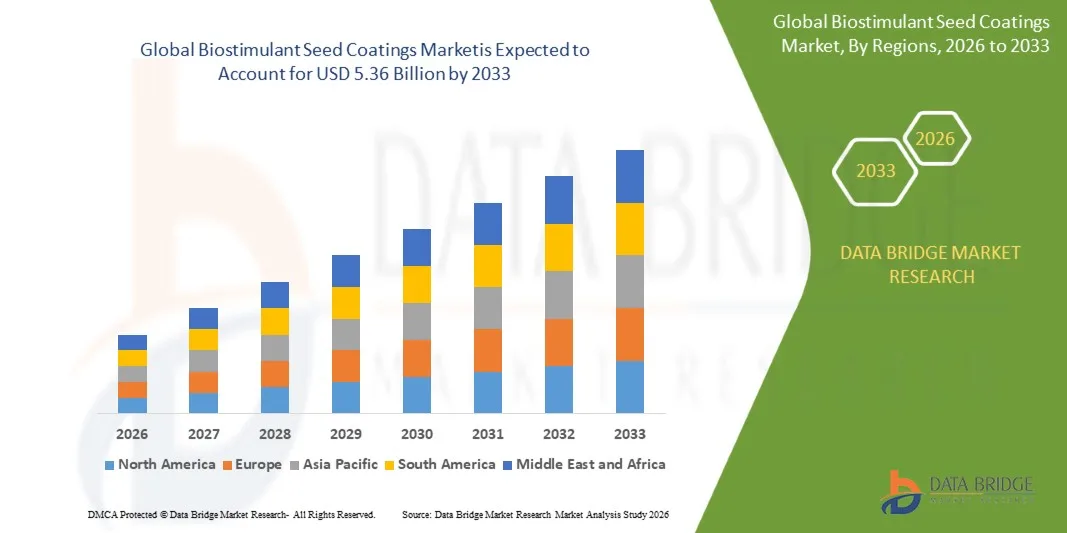
- As per Data Bridge Market Research analysis, the biostimulant seed coatings market was valued at USD 2.15 billion in 2025 and is projected to reach USD 5.36 billion by 2033, growing at a CAGR of 12.10% from 2026 to 2033.
- The market is experiencing consistent growth driven by rising demand for sustainable crop inputs, increasing adoption of seed-applied biologicals, and expanding applications across cereals, oilseeds, fruits, vegetables, and specialty crops.
- The increasing shift toward sustainable agriculture, improved crop establishment, and reduced dependence on chemical inputs, combined with growing integration of microbial and plant-derived actives into seed treatment programs, is supporting market adoption. Biostimulant seed coatings are being applied across cereals, oilseeds, vegetables, and row crops, delivering microbial and biochemical biostimulants directly at the seed interface to support germination, root growth, and stress tolerance within seed treatment programs.
Market Size & Forecast
- Global Market Value (2025): USD 2.15 Billion
- Expected Market Value (2033): USD 5.36 Billion
- Forecast CAGR (2026–2033): 12.10%
- Leading Region in 2025: North America
- Fastest Growing Region: Asia-Pacific
What are the Major Takeaways of the Biostimulant Seed Coatings Market?
- North America dominated the biostimulant seed coatings market with the largest revenue share of 34.20% in 2025, supported by strong adoption of seed treatments, established seed companies, and high investment in biological crop inputs across the region.
- Asia-Pacific is expected to be the fastest-growing region at a CAGR of 14.60% from 2026 to 2033, fueled by expanding commercial seed production, rising biologicals adoption, and growing focus on sustainable farming.
- The microbial segment led the market with a 38.6% share in 2025, driven by rising use of beneficial bacteria and fungi to improve early crop performance.
- Amino acids are the fastest-growing product type, projected to register a CAGR of 13.2%, reflecting the surge in demand for plant-derived actives that support stress tolerance.
- The film coating segment dominated the technique category with a 49.3% revenue share in 2025, led by extensive use in cereals, oilseeds, and row crop seed.
- Cereals and grains accounted for 43.7% of the market share in 2025, preferred by increasing treatment of wheat, corn, rice, and barley seed.
- The fruits and vegetables segment is the fastest-growing application category, with a CAGR of 14.1%, driven by increasing high-value crop production.
Report Scope and Biostimulant Seed Coatings Market Segmentation
|
Attributes |
Biostimulant Seed Coatings Key Market Insights |
|
Segments Covered |
|
|
Countries Covered |
North America
Europe
Asia-Pacific
Middle East and Africa
South America
|
|
Key Market Players |
|
|
Market Opportunities |
|
|
Value Added Data Infosets |
In addition to the insights on market scenarios such as market value, growth rate, segmentation, geographical coverage, and major players, the market reports curated by the Data Bridge Market Research also include import export analysis, production capacity overview, production consumption analysis, price trend analysis, climate change scenario, supply chain analysis, value chain analysis, raw material/consumables overview, vendor selection criteria, PESTLE Analysis, Porter Analysis, and regulatory framework. |
What is the Key Trend in the Biostimulant Seed Coatings Market?
- Seed companies and agricultural input suppliers are increasingly shifting toward integrated seed treatment programs that combine biostimulants with protection and coating technologies, using microbial, nutrient, and plant-derived actives to improve establishment and reduce chemical dependence across major crops.
- For instance, in July 2026, Syngenta and Groundwork BioAg formed a partnership for mycorrhizal technology, expanding the biologicals platform into crop-performance and soil-health solutions that can complement seed-applied programs for growers, while major suppliers including Bayer, Syngenta, Corteva, and BASF continue to place biological functions inside integrated seed treatment platforms.
- Biostimulant seed treatments are moving from demonstration programs into repeat commercial use, with seed companies and treaters adopting standardized formulations for large-scale application across regions and crop types.
- Regulatory and sustainability pressure is also shaping coatings, as suppliers develop compliant film coats and biodegradable materials that reduce reliance on restricted microplastic chemistry while maintaining adhesion and flowability.
- For instance, in July 2025, Bayer launched Yoalo, a biostimulant seed treatment for corn based on Bacillus velezensis, designed to enhance early crop performance while reducing dependence on agrochemicals in commercial production, while the company also documented Susteed for vegetable seed using Bacillus amyloliquefaciens QST713 in 2026.
- As sustainable agriculture, precision seed treatment, and biological innovation continue to advance, biostimulant seed coatings are expected to evolve beyond conventional seed enhancement into a core delivery platform for crop nutrition, resilience, and productivity worldwide.
What are the Key Drivers of the Biostimulant Seed Coatings Market?
- Growing demand for sustainable agriculture and reduced chemical use is increasing adoption of biostimulants applied directly on seed to improve germination, early vigor, and nutrient uptake.
- For instance, in July 2024, Syngenta Crop Protection entered a strategic collaboration with Ginkgo Bioworks through its Ag Biologicals platform, supporting development of biological solutions that can strengthen seed-applied and crop performance programs for growers worldwide, as leading suppliers increase investment in biologicals, microbial technologies, and combination products.
- Seed companies and treaters are expanding biological portfolios and manufacturing capacity, increasing availability of microbial and nutrient-based actives for commercial coating programs across major crops and regions.
- For instance, in May 2026, BASF commissioned its Ludwigshafen BioHub to manufacture biological products, including biological seed treatment, reflecting investment in fermentation capacity to support growing demand from seed treatment customers as suppliers prepare for larger commercial volumes of microbial products.
- With growers seeking higher yields from limited inputs, seed-applied biostimulants offer targeted, resource-efficient delivery that supports crop establishment under variable field conditions and limited input budgets.
What Factors Are Challenging the Growth of the Biostimulant Seed Coatings Market?
- Biostimulant seed coatings require stable formulations, viable microorganisms, and compatibility with chemical treatments, while storage conditions and shelf life can affect efficacy and commercial scalability, particularly in hot or humid storage conditions.
- Regulatory restrictions on coating polymers and microplastics require reformulation, testing, and registration, which can increase development costs and extend timelines for suppliers and seed treaters, particularly when new polymers must match established adhesion and flowability performance.
- In April 2026, Incotec launched Disco Red L-1140, a microplastic-free film coating for cereal seeds. The company noted that the European restriction on intentionally added microplastics will affect seed coatings from 2028. Developing alternatives that maintain adhesion, low dust-off, seed safety, and compatibility with plant-protection products creates additional testing and reformulation requirements for coating suppliers.
- The combination of formulation complexity, registration requirements, variable field performance, and cost sensitivity can limit expansion among smaller seed companies, particularly where conventional treatments already satisfy basic protection requirements or where field trials are costly.
How is the Biostimulant Seed Coatings Market Segmented?
The biostimulant seed coatings market is segmented on the basis of product, technique, application, and end user.
- By Product
On the basis of product, the biostimulant seed coatings market is segmented into microbial, seaweed extracts, humic substances, amino acids, and others. The microbial segment dominated the market with 38.6% share in 2025, supported by increasing use of beneficial bacteria and fungi to improve early crop performance. Microbial actives can improve nutrient availability, root development, and plant resilience when applied at the seed interface. They are increasingly used across corn, soybean, cereals, and vegetable seed. Improvements in strain selection, fermentation, and formulation stability are further strengthening demand. Integration with film coatings and polymers also enables better adhesion and survival on the seed surface, which supports consistent field performance across diverse climates.
The amino acids segment is projected to register the fastest growth at a CAGR of 13.2% from 2026 to 2033, driven by increasing demand for plant-derived actives that support stress tolerance. Amino acids and protein hydrolysates can support germination, nutrient uptake, and recovery under cold or dry conditions. Their applications include cereals, oilseeds, vegetables, and specialty crops. Increasing use of non-microbial actives with simple storage and compatibility is creating additional demand across seed companies, treaters, and growers. Improvements in extraction and formulation are enhancing consistency. Combination products with micronutrients are also expanding commercial use. Growth is also supported by growers seeking renewable, naturally derived alternatives that improve abiotic stress tolerance and soil health.
- By Technique
On the basis of technique, the biostimulant seed coatings market is segmented into film coating, pelleting, and encrusting. The film coating segment dominated the market with 49.3% share in 2025, supported by extensive use in cereals, oilseeds, and row crop seed. Film coats offer a balanced combination of adhesion, dust reduction, and compatibility with biological actives for high-volume treatment. Their availability across multiple polymers and suppliers expands the potential customer base. Seed companies use film coating to deliver uniform active loading across large seed lots. The technique also supports colorants, markers, and flowability improvements for planting equipment.
The pelleting segment is projected to register the fastest growth at a CAGR of 13.0% from 2026 to 2033, supported by increasing adoption in small-seeded vegetable and specialty crops. Pelleting improves seed size and uniformity, enabling precision planting and simultaneous delivery of nutrients or biostimulants. Producers are increasingly specifying coatings that combine singulation benefits with biological functions. Seed companies and equipment suppliers are developing materials that fit automated planters and high-density plantings. Improved binders and filler materials further strengthen the segment’s attractiveness. Seed quality and compatibility requirements remain important considerations for expansion, particularly for fragile or high-value seed lots.
- By Application
On the basis of application, the biostimulant seed coatings market is segmented into cereals & grains, oilseeds & pulses, fruits & vegetables, and others. The cereals and grains segment dominated the application category with 43.7% share in 2025, supported by increasing treatment of wheat, corn, rice, and barley seed. Seed-applied biostimulants help improve early vigor, stand establishment, and stress tolerance. Sustainability goals are increasing the use of biological actives in large-acreage crops. Growth in precision planting and integrated seed treatment further strengthens demand. Growers are also seeking products that combine consistent performance, compatibility, and ease of application across different coating lines. Corn and wheat programs remain central to commercial adoption.
The fruits and vegetables segment is projected to register the fastest growth at a CAGR of 14.1% from 2026 to 2033, driven by increasing high-value crop production, demand for uniform stands, and focus on residue reduction. Small seeds benefit from pelleting and coating systems that support precise planting and consistent emergence. Producers in Europe, Asia-Pacific, and North America are investing in improved seed quality and sustainable inputs. Retail and export demand for fresh produce is creating additional opportunities. Strict residue expectations make biological seed treatments particularly attractive. Supportive policies for sustainable production can further improve adoption across regions and crop segments.
- By End User
On the basis of end user, the biostimulant seed coatings market is segmented into seed companies, seed treatment service providers, farmers & growers, research institutions, and others. The seed companies segment dominated the end-user category with 52.4% share in 2025, supported by increasing requirements for factory-applied, consistent, and compliant seed treatment. Seed companies rely on coating and biological technologies to differentiate products and improve crop establishment. The segment uses automated coating lines for cereals, oilseeds, and vegetables. Increasing investment in biological portfolios and coating capacity is creating further opportunities. Large seed lots also make reliable formulation performance an important consideration in procurement decisions for seed companies and distributors.
The seed treatment service providers segment is projected to register the fastest growth at CAGR of 13.6% from 2026 to 2033, driven by increasing demand for custom treatment, regional seed processing, and access to biological technologies. Commercial treaters offer flexible application of biostimulants, protectants, and colorants for retailers, cooperatives, and growers. Providers are expanding equipment, storage, and technical support to handle new formulations. Closer collaboration with suppliers is accelerating development of tailored coating programs. Stricter handling and stewardship requirements are further supporting professional treatment. Cost competitiveness, product compatibility, and technical support remain important considerations for deployment across regions and customer segments.
Which Region Holds the Largest Share of the Biostimulant Seed Coatings Market?
- North America dominated the biostimulant seed coatings market with the largest revenue share of 34.20% in 2025, supported by strong adoption of seed treatments, established seed companies, and high investment in biological crop inputs across the region.
- The region also benefits from large-scale row crop production, advanced seed treatment infrastructure, and the presence of established agricultural input companies, along with strong demand for biological seed treatments. Increasing investment in sustainable inputs, precision planting, and coating technologies continues to strengthen North America’s position in the global market, supported by strong grower education programs.
U.S. Biostimulant Seed Coatings Market Insight
The U.S. biostimulant seed coatings market is witnessing consistent growth due to rising investments in biological seed treatment, precision planting, and sustainable production practices. Seed companies, treaters, and growers are increasingly focusing on early vigor and nutrient efficiency. Moreover, large corn, soybean, and wheat acreage and continued launches of biological seed treatments, supported by strong research and distribution networks, are further contributing to market growth in the U.S.
Canada Biostimulant Seed Coatings Market Insight
Canada’s biostimulant seed coatings market is gaining momentum as farmers increasingly adopt sustainable seed treatment technologies to improve germination, nutrient uptake, root development, and crop resilience. Demand is supported by extensive cereal, canola, soybean, and pulse cultivation, alongside the need to manage cold soils and variable growing conditions. Microbial inoculants, seaweed extracts, humic substances, and amino-acid-based formulations are emerging as important product categories. Innovation from agricultural biotechnology companies, growing interest in biological inputs, and precision seed-treatment technologies are expected to support market expansion.
Asia-Pacific Biostimulant Seed Coatings Market Insight
The Asia-Pacific biostimulant seed coatings market is expected to witness rapid growth, driven by expanding commercial seed production, rising adoption of biologicals, and increasing government support for sustainable agriculture across countries such as China, India, Japan, and Australia. Growing demand for higher yields, food security, and reduced chemical use is supporting regional market expansion. In addition, the region’s large smallholder base and increasing adoption of treated seed are accelerating demand for coating solutions across diverse crops and farming systems.
China Biostimulant Seed Coatings Market Insight
China’s biostimulant seed coatings market is gaining momentum as agricultural modernization, food security priorities, and sustainable farming practices drive demand for biological seed enhancement technologies. Microbial inoculants, seaweed extracts, humic substances, and amino acids are gaining attention for improving germination, root development, nutrient uptake, and stress tolerance. Corn, wheat, rice, soybean, and vegetable crops offer important application opportunities.
India Biostimulant Seed Coatings Market Insight
The India biostimulant seed coatings market is experiencing steady growth, supported by expanding seed production, government focus on sustainable farming, and rising awareness of biologicals. Seed companies, input suppliers, and farmer organizations are increasingly seeking affordable, effective seed-applied solutions. Furthermore, growing demand for higher yields, improved stand establishment, and reduced chemical inputs, along with expanding domestic biological manufacturing, is supporting wider adoption of biostimulant seed coatings in India, supported by rising adoption of treated seed among commercial growers.
Which are the Top Companies in Biostimulant Seed Coatings Market?
The biostimulant seed coatings industry is primarily led by well-established companies, including:
- Bayer AG (Germany)
- Syngenta Group (Switzerland)
- BASF SE (Germany)
- Corteva, Inc. (U.S.)
- UPL Limited (India)
- Novonesis (Denmark)
- Koppert Biological Systems (Netherlands)
- Valent BioSciences LLC (U.S.)
- Verdesian Life Sciences LLC (U.S.)
- Rizobacter Argentina S.A. (Argentina)
- Croda International plc (U.K.)
- Bioceres Crop Solutions (Argentina)
- Pivot Bio (U.S.)
- Sumitomo Chemical Co., Ltd. (Japan)
- FMC Corporation (U.S.)
- Nufarm Limited (Australia)
- Lallemand Inc. (Canada)
- Italpollina S.p.A. (Italy)
- Germains Seed Technology (U.K.)
- Gowan Company, LLC (U.S.)
What are Latest Developments in Biostimulant Seed Coatings Market?
- In July 2026, Syngenta and Groundwork BioAg formed a partnership for mycorrhizal technology, expanding Syngenta’s biologicals platform into mycorrhizal crop-performance and soil-health solutions, as seed companies and growers look for biological options that complement seed-applied programs and improve nutrient uptake in sustainable crop production systems worldwide, while Corteva Agriscience Japan also launched MycoUp, a microbial biostimulant containing an arbuscular mycorrhizal fungus, in May 2026.
- In July 2026, Corteva Agriscience offered LumiGEN Premium seed-treatment options with the Lumidapt Optima nutrient growth promoter in its 2026 winter oilseed rape range, reflecting growing use of nutrient and biostimulant functions within commercial seed treatment packages as European growers seek integrated protection and nutrition options for sowing in key production regions.
- In May 2026, BASF commissioned its Ludwigshafen BioHub to manufacture biological products, including biological seed treatment, strengthening fermentation capacity and supporting its integrated portfolio, following the November 2025 French registration of its Integral Pro sunflower seed treatment ahead of the 2026 sowing season and highlighting the shift of biologicals toward commercial seed use.
- In April 2026, Incotec launched a microplastic-free film coat for cereal seed, responding to treaters’ need for coating performance without restricted microplastic chemistry, and widening the range of compliant coating materials, as emerging biodegradable seed coating technologies create additional opportunities for suppliers and seed companies, with seed coating accounting for 53.52% of the global seed treatment market in 2026, according to Fortune Business Insights.
- In July 2025, Bayer launched Yoalo, a biostimulant seed treatment for corn based on Bacillus velezensis, aimed at enhancing early crop performance while reducing dependence on agrochemicals, alongside Ibisio and Susteed, new biological seed-treatment solutions targeting bird protection, nutrient availability, crop stimulation, and fungal disease management, while Syngenta collaborated with Ginkgo Bioworks on its Ag Biologicals platform in July 2024.

- Interactive Data Analysis Dashboard
- Company Analysis Dashboard for high growth potential opportunities
- Research Analyst Access for customization & queries
- Competitor Analysis with Interactive dashboard
- Latest News, Updates & Trend analysis
- Harness the Power of Benchmark Analysis for Comprehensive Competitor Tracking
Data collection and base year analysis are done using data collection modules with large sample sizes. The stage includes obtaining market information or related data through various sources and strategies. It includes examining and planning all the data acquired from the past in advance. It likewise envelops the examination of information inconsistencies seen across different information sources. The market data is analysed and estimated using market statistical and coherent models. Also, market share analysis and key trend analysis are the major success factors in the market report. To know more, please request an analyst call or drop down your inquiry.
The key research methodology used by DBMR research team is data triangulation which involves data mining, analysis of the impact of data variables on the market and primary (industry expert) validation. Data models include Vendor Positioning Grid, Market Time Line Analysis, Market Overview and Guide, Company Positioning Grid, Patent Analysis, Pricing Analysis, Company Market Share Analysis, Standards of Measurement, Global versus Regional and Vendor Share Analysis. To know more about the research methodology, drop in an inquiry to speak to our industry experts.
Data Bridge Market Research is a leader in advanced formative research. We take pride in servicing our existing and new customers with data and analysis that match and suits their goal. The report can be customized to include price trend analysis of target brands understanding the market for additional countries (ask for the list of countries), clinical trial results data, literature review, refurbished market and product base analysis. Market analysis of target competitors can be analyzed from technology-based analysis to market portfolio strategies. We can add as many competitors that you require data about in the format and data style you are looking for. Our team of analysts can also provide you data in crude raw excel files pivot tables (Fact book) or can assist you in creating presentations from the data sets available in the report.