What is the Global Biotechnological Plant Breeding and CRISPR Plants Market Size and Growth Rate?
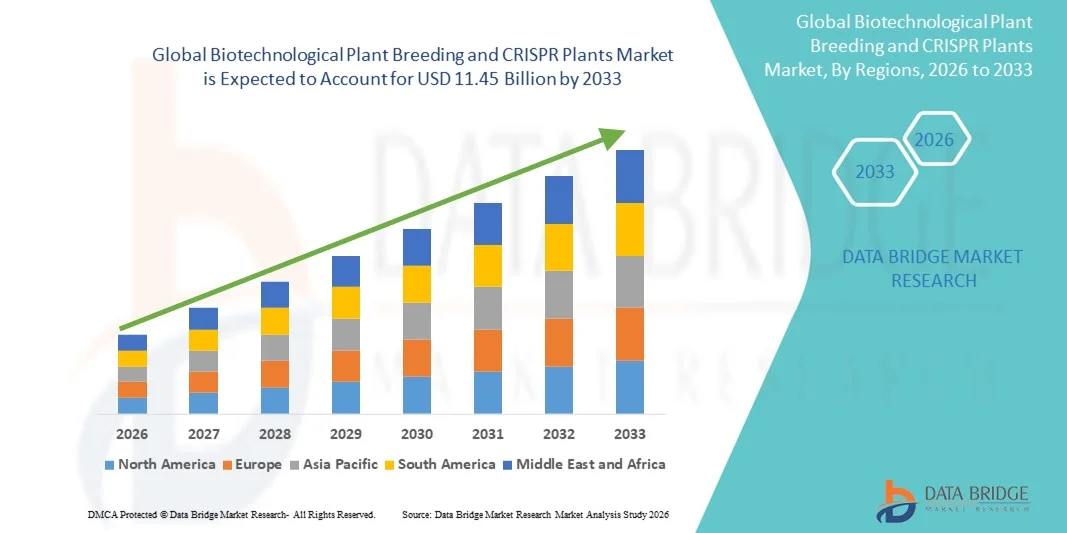
- The global biotechnological plant breeding and CRISPR plants market size was valued at USD 6.21 billion in 2025 and is expected to reach USD 16.18 billion by 2033, at a CAGR of12.70% during the forecast period
- Major factors that are expected to boost the growth of the biotechnological plant breeding and CRISPR plants market in the forecast period are the increase in the demand enhanced crop varieties utilizing the modern breeding techniques and the growing essence of the improved crop varieties for sustainable crop production
- Furthermore, the exponential fall in the cost for genomic solutions and the technological developments safeguard strong market growth are few of the factors anticipated to further propel the growth of the biotechnological plant breeding and CRISPR plants market.
What are the Major Takeaways of Biotechnological Plant Breeding and CRISPR Plants Market?
- The increase in the price of the modern breeding methods in comparison to the conventional breeding, infrastructural limits and the absence of laboratory infrastructure are few of the other factors projected to further impede the growth of the biotechnological plant breeding and CRISPR plants market in the timeline period
- In addition, the growing investments from seed companies and the private sector investments in the research and development further provide the opportunities for the growth of the biotechnological plant breeding and CRISPR plants market in the coming years
- However, the absence of technical awareness which can affect the adoption of modern plant breeding methods in the advancing countries might further challenge the growth of the biotechnological plant breeding and CRISPR plants market in the near future
- Asia-Pacific dominated the biotechnological plant breeding and CRISPR plants market with a 41.69% revenue share in 2025, driven by rapid expansion of biotechnology research, plant genomics initiatives, and increasing adoption of CRISPR-based breeding technologies across China, Japan, India, South Korea, and Southeast Asia
- North America is projected to register the fastest CAGR of 11.98% from 2026 to 2033, driven by growing agricultural biotech startups, strong private R&D investment, and adoption of CRISPR tools for precision crop improvement
- The Hybridization segment dominated the market with a 41.2% share in 2025, driven by its proven ability to generate high-yielding, uniform, and resilient plant varieties
Report Scope and Biotechnological Plant Breeding and CRISPR Plants Market Segmentation
|
Attributes |
Biotechnological Plant Breeding and CRISPR Plants Key Market Insights |
|
Segments Covered |
|
|
Countries Covered |
North America
Europe
Asia-Pacific
Middle East and Africa
South America
|
|
Key Market Players |
|
|
Market Opportunities |
|
|
Value Added Data Infosets |
In addition to the insights on market scenarios such as market value, growth rate, segmentation, geographical coverage, and major players, the market reports curated by the Data Bridge Market Research also include in-depth expert analysis, pricing analysis, brand share analysis, consumer survey, demography analysis, supply chain analysis, value chain analysis, raw material/consumables overview, vendor selection criteria, PESTLE Analysis, Porter Analysis, and regulatory framework. |
What is the Key Trend in the Biotechnological Plant Breeding and CRISPR Plants Market?
Rising Adoption of Advanced Genetic Editing, High-Throughput Breeding, and Precision Plant Development
- The biotechnological plant breeding and CRISPR plants market is witnessing strong adoption of high-throughput genome editing tools, automated phenotyping platforms, and precision breeding technologies designed to accelerate crop improvement, yield enhancement, and disease resistance development
- Companies are integrating AI-driven analytics, robotics-assisted breeding, and CRISPR-Cas systems to optimize gene editing efficiency, reduce development timelines, and achieve targeted plant traits with higher precision
- Growing demand for sustainable agriculture, improved food security, and climate-resilient crop varieties is driving adoption of advanced breeding platforms across research institutions, commercial seed producers, and biotechnology firms
- For instance, companies such as Bayer AG, KWS, DuPont, Syngenta, and Benson Hill have implemented CRISPR-based tools and automation platforms for enhanced plant trait development and accelerated R&D cycles
- Increasing focus on disease-resistant, drought-tolerant, and nutrient-enriched crop varieties is pushing adoption of integrated breeding solutions combining molecular markers, genome editing, and data-driven selection
- As global agriculture faces pressure from climate change, Biotechnological Plant Breeding and CRISPR Plants remain crucial for rapid, scalable, and precise crop improvement
What are the Key Drivers of Biotechnological Plant Breeding and CRISPR Plants Market?
- Rising need for high-yield, climate-resilient, and pest-resistant crop varieties is driving demand for genome-editing tools, marker-assisted breeding, and CRISPR technologies
- For instance, in 2025, leading players such as Bayer AG, KWS, DuPont, Syngenta, and Benson Hill expanded their CRISPR and high-throughput breeding platforms to enhance crop trait development and accelerate commercialization
- Growing adoption of digital agriculture, precision farming, and data-driven crop selection is boosting demand for molecular breeding solutions across North America, Europe, and Asia-Pacific
- Advances in genomics, automation, and phenotyping platforms have increased efficiency, accuracy, and speed of crop development processes
- Rising investments in agricultural biotechnology, sustainable seed production, and research collaborations support long-term growth in CRISPR-based breeding
- Increasing government initiatives promoting biotech crops, coupled with global food security concerns, further propel market expansion
Which Factor is Challenging the Growth of the Biotechnological Plant Breeding and CRISPR Plants Market?
- High costs associated with genome-editing technologies, specialized laboratory setups, and skilled personnel limit adoption among smaller seed producers and research labs
- For instance, during 2024–2025, fluctuations in regulatory approvals, licensing fees, and laboratory equipment costs increased operational expenses for several global biotech firms
- Complex regulatory frameworks for genetically edited crops, ethical concerns, and public perception slow adoption in some regions
- Limited awareness of advanced breeding technologies in emerging markets reduces deployment in smallholder and regional farming systems
- Competition from traditional breeding methods and hybrid seed development creates market pressure and adoption barriers
- Companies are addressing these challenges by investing in cost-efficient gene-editing platforms, training programs, automation tools, and strategic collaborations to expand global adoption of Biotechnological Plant Breeding and CRISPR Plants
How is the Biotechnological Plant Breeding and CRISPR Plants Market Segmented?
The market is segmented on the basis of process, type, trait, and application.
- By Process
On the basis of process, the biotechnological plant breeding and CRISPR plants market is segmented into Mass Selection, Pure Line Selection, Hybridization, and Mutation Breeding. The Hybridization segment dominated the market with a 41.2% share in 2025, driven by its proven ability to generate high-yielding, uniform, and resilient plant varieties. Hybridization remains widely adopted due to its efficiency in combining desirable traits, improving disease resistance, and accelerating crop improvement cycles across cereals, oilseeds, and vegetables. Increasing integration with CRISPR and molecular marker-assisted techniques further enhances its precision, efficiency, and trait predictability.
The Mutation Breeding segment is projected to grow at the fastest CAGR from 2026 to 2033, as emerging technologies enable targeted genetic modifications, rapid generation of novel traits, and the development of climate-resilient crops. Research institutions and biotech firms increasingly deploy mutation-based approaches to accelerate innovation and meet global food security and sustainability goals.
- By Type
On the basis of type, the market is segmented into Conventional Breeding and Biotechnological Methods. The Biotechnological Methods segment dominated the market with a 44.7% share in 2025, due to the rising adoption of CRISPR, gene-editing, and molecular breeding tools that allow precise, rapid, and efficient development of crop varieties. These methods are widely utilized for developing disease-resistant, herbicide-tolerant, and nutrient-enriched crops, reducing development time compared to conventional breeding.
The Conventional Breeding segment is expected to grow at the fastest CAGR from 2026 to 2033, as hybrid approaches that combine traditional techniques with modern genomics and phenotyping tools gain traction. Farmers and breeders in emerging markets continue to rely on conventional practices, complemented by biotechnological tools, to enhance productivity and sustainability.
- By Trait
On the basis of trait, the market is segmented into Herbicide Tolerance, Disease Resistance, Yield Improvement, and Other Traits. The Yield Improvement segment dominated the market with a 38.9% share in 2025, driven by the growing demand for high-output crops to meet global food security and increasing population needs. Biotechnological breeding and CRISPR enable precise enhancement of yield-related genes while ensuring adaptability to stress conditions, nutrient efficiency, and market-preferred qualities.
The Disease Resistance segment is projected to grow at the fastest CAGR from 2026 to 2033, supported by rising prevalence of plant pathogens, climate change-induced disease risks, and demand for reduced pesticide usage. Integration of genome-editing techniques, marker-assisted selection, and high-throughput screening is fueling rapid adoption across commercial seed producers and research institutes.
- By Application
On the basis of application, the market is segmented into Cereals and Grains, Oilseeds and Pulses, Fruits and Vegetables, and Other Crop Types. The Cereals and Grains segment dominated the market with a 42.5% share in 2025, as these crops form the backbone of global food supply, driving investment in advanced breeding, CRISPR-based trait enhancement, and stress tolerance improvement.
The Fruits and Vegetables segment is expected to grow at the fastest CAGR from 2026 to 2033, propelled by increasing consumer demand for quality, nutrition, shelf-life, and disease-resistant horticultural produce. Rapid adoption of precision breeding, genome editing, and molecular-assisted selection ensures faster product development and enhanced productivity, supporting sustainable agricultural practices across commercial and emerging markets.
Which Region Holds the Largest Share of the Biotechnological Plant Breeding and CRISPR Plants Market?
- Asia-Pacific dominated the biotechnological plant breeding and CRISPR plants market with a 41.69% revenue share in 2025, driven by rapid expansion of biotechnology research, plant genomics initiatives, and increasing adoption of CRISPR-based breeding technologies across China, Japan, India, South Korea, and Southeast Asia. Strong government support for agricultural innovation, high investment in R&D, and advanced genomics facilities are further driving market leadership
- Leading companies in Asia-Pacific are introducing advanced CRISPR tools, high-throughput genotyping systems, and precision breeding platforms, strengthening the region’s technological advantage. Continuous development in genetically improved crops and climate-resilient plant varieties fuels long-term growth
- Extensive research ecosystems, high talent concentration, and strong public-private collaboration reinforce regional dominance
China Biotechnological Plant Breeding and CRISPR Plants Market Insight
China is the largest contributor to Asia-Pacific, supported by massive biotechnology R&D investments, government-backed genomic programs, and world-leading plant breeding facilities. Rising demand for high-yield, disease-resistant, and climate-resilient crops drives adoption of CRISPR technologies for plant editing. Local innovation, regulatory support, and integration of AI in breeding pipelines further accelerate domestic and export adoption.
Japan Biotechnological Plant Breeding and CRISPR Plants Market Insight
Japan shows steady growth driven by advanced genomics infrastructure, precision agriculture initiatives, and strong collaboration between research institutes and biotech companies. High focus on sustainable agriculture, high-value crop improvement, and regulatory support encourages CRISPR-based breeding adoption for long-term impact.
India Biotechnological Plant Breeding and CRISPR Plants Market Insight
India is emerging as a significant growth hub due to expanding agricultural biotechnology centers, increasing startup activity, and government-supported initiatives in crop genomics. Rising demand for high-yield crops, pest-resistant varieties, and improved food security is driving CRISPR adoption in plant breeding programs across universities, research labs, and industrial agriculture.
South Korea Biotechnological Plant Breeding and CRISPR Plants Market Insight
South Korea contributes significantly due to strong focus on biotech innovation, high-performance genomic research infrastructure, and rising demand for climate-resilient crops. Development of AI-driven breeding pipelines, high-throughput genotyping, and integration of CRISPR technologies accelerates adoption across industrial agriculture and research applications.
North America Biotechnological Plant Breeding and CRISPR Plants Market
North America is projected to register the fastest CAGR of 11.98% from 2026 to 2033, driven by growing agricultural biotech startups, strong private R&D investment, and adoption of CRISPR tools for precision crop improvement. Expansion of smart farming, genomics-driven crop breeding, and regulatory frameworks supporting gene-edited crops fuel the high growth trajectory.
U.S. Biotechnological Plant Breeding and CRISPR Plants Market Insight
The U.S. is the largest contributor in North America, supported by extensive R&D centers, well-funded agricultural biotech startups, and widespread adoption of CRISPR-based plant breeding platforms. Increasing development of climate-resilient and high-yield crops drives demand for advanced genomic tools.
Canada Biotechnological Plant Breeding and CRISPR Plants Market Insight
Canada contributes significantly due to strong genomics research infrastructure, rising investment in agricultural biotech, and focus on sustainable crop improvement. Universities, research institutes, and private sector collaborations boost adoption of CRISPR technologies for enhanced crop performance.
Which are the Top Companies in Biotechnological Plant Breeding and CRISPR Plants Market?
The biotechnological plant breeding and CRISPR plants industry is primarily led by well-established companies, including:
- Bayer AG (Germany)
- KWS SAAT SE & Co. KGaA (Germany)
- DuPont (U.S.)
- SGS SA (Switzerland)
- DLF Seeds Ltd. (Denmark)
- BioConsortia Inc. (U.S.)
- Hudson River Biotechnology (U.S.)
- Pacific Biosciences of California, Inc. (U.S.)
- Eurofins Scientific (Luxembourg)
- Syngenta AG (Switzerland)
- Land O'Lakes, Inc. (U.S.)
- Advanta Limited (India)
- J.R. Simplot Company (U.S.)
- Benson Hill Inc. (U.S.)
- Evogene (Israel)
- Limagrain (France)
- Equinom (Israel)
What are the Recent Developments in Global Biotechnological Plant Breeding and CRISPR Plants Market?
- In February 2025, KWS SAAT SE & Co. KGaA (Germany) introduced new combination sugar beet seed varieties integrating the CONVISO SMART system with enhanced Cercospora protection (CR+), strengthening its market position across several European regions, with plans for further expansion, highlighting the company’s commitment to advanced crop protection and yield improvement
- In January 2025, Syngenta Vegetable Seeds, part of Syngenta Group (Switzerland), signed a global licensing agreement with Apricus Seeds (US), granting Syngenta exclusive access to Apricus' melon, squash, and watermelon germplasm, thereby enhancing its cucurbit portfolio and reinforcing its competitive edge in the vegetable seed market
- In November 2024, Hazera, a Limagrain (France) brand, inaugurated a state-of-the-art R&D tomato greenhouse in Made, the Netherlands, spanning nearly 5 hectares, repurposed from a commercial operation to focus on disease-resistant, high-yield tomato varieties using innovative breeding techniques, demonstrating the company’s commitment to sustainability and global tomato market innovation
- In October 2023, SAKATA SEED CORPORATION (Japan) acquired Brazilian seed company Isla Sementes LTDA and its holding firm, Spalding, for USD 12.7 million, aiming to expand its market share among smallholder farmers and home gardeners, leveraging Isla's distribution network to boost projected sales by USD 3 million over five years, strengthening its footprint in Latin America
- In August 2023, Pairwise (US) and Bayer AG (Germany) signed a five-year, multi-million-dollar agreement to advance gene-edited short-stature corn for Bayer’s Preceon Smart Corn System, improving resistance to extreme weather and enhancing input efficiency through Pairwise’s Fulcrum platform, reflecting continued innovation in climate-resilient crop development

- Interactive Data Analysis Dashboard
- Company Analysis Dashboard for high growth potential opportunities
- Research Analyst Access for customization & queries
- Competitor Analysis with Interactive dashboard
- Latest News, Updates & Trend analysis
- Harness the Power of Benchmark Analysis for Comprehensive Competitor Tracking
Data collection and base year analysis are done using data collection modules with large sample sizes. The stage includes obtaining market information or related data through various sources and strategies. It includes examining and planning all the data acquired from the past in advance. It likewise envelops the examination of information inconsistencies seen across different information sources. The market data is analysed and estimated using market statistical and coherent models. Also, market share analysis and key trend analysis are the major success factors in the market report. To know more, please request an analyst call or drop down your inquiry.
The key research methodology used by DBMR research team is data triangulation which involves data mining, analysis of the impact of data variables on the market and primary (industry expert) validation. Data models include Vendor Positioning Grid, Market Time Line Analysis, Market Overview and Guide, Company Positioning Grid, Patent Analysis, Pricing Analysis, Company Market Share Analysis, Standards of Measurement, Global versus Regional and Vendor Share Analysis. To know more about the research methodology, drop in an inquiry to speak to our industry experts.
Data Bridge Market Research is a leader in advanced formative research. We take pride in servicing our existing and new customers with data and analysis that match and suits their goal. The report can be customized to include price trend analysis of target brands understanding the market for additional countries (ask for the list of countries), clinical trial results data, literature review, refurbished market and product base analysis. Market analysis of target competitors can be analyzed from technology-based analysis to market portfolio strategies. We can add as many competitors that you require data about in the format and data style you are looking for. Our team of analysts can also provide you data in crude raw excel files pivot tables (Fact book) or can assist you in creating presentations from the data sets available in the report.