


Bipolar Transistor Market Size
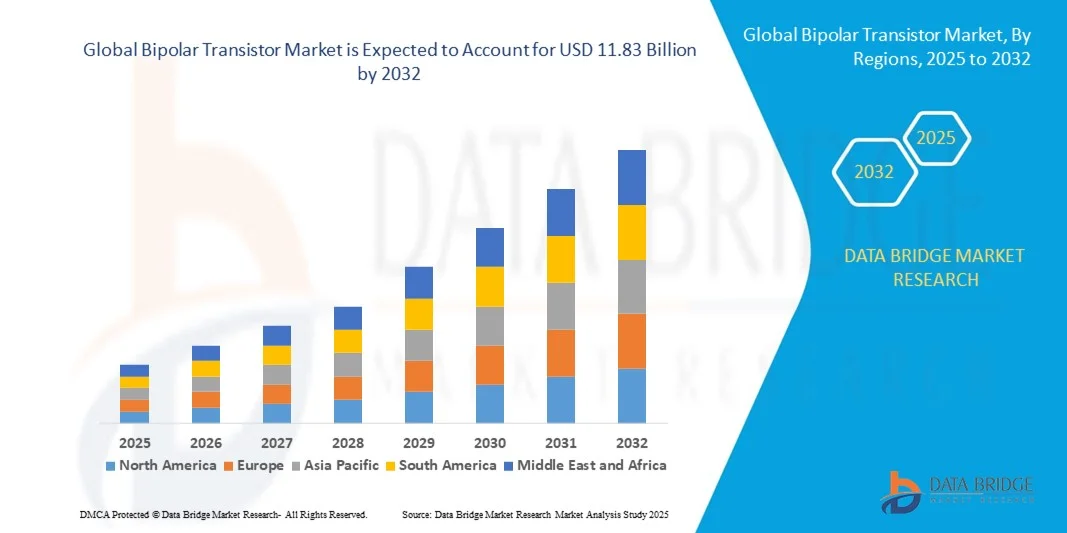
- The global bipolar transistor market size was valued at USD 7.95 billion in 2024 and is expected to reach USD 11.83 billion by 2032, at a CAGR of 5.1% during the forecast period
- The market growth is largely fuelled by rising demand for high-performance analog and switching devices across automotive, industrial, and consumer electronics applications
- Increasing adoption of electric vehicles (EVs) and power electronics systems, which rely on bipolar transistors for efficient current amplification and switching, is driving market expansion
Bipolar Transistor Market Analysis
- Technological advancements in transistor design, including high-frequency and high-power bipolar transistors, are enabling improved performance, durability, and energy efficiency in applications such as EV inverters, industrial machinery, and renewable energy systems
- Market players are focusing on miniaturization, thermal management, and material innovations to meet evolving demands in automotive electronics, communication systems, and consumer devices
- North America dominated the bipolar transistor market with the largest revenue share in 2024, driven by the increasing adoption of high-power electronics, industrial automation, and electric vehicle technologies
- Asia-Pacific region is expected to witness the highest growth rate in the global bipolar transistor market, driven by technological advancements, expanding electronics manufacturing base, and growing demand from industrial, automotive, and telecommunication sectors
- The NPN transistor segment held the largest market revenue share in 2024, driven by its high switching speed, robustness, and widespread use in analog and digital circuits. NPN transistors are highly preferred in industrial and consumer electronics applications for amplification, signal processing, and high-current switching tasks
Report Scope and Bipolar Transistor Market Segmentation
|
Attributes |
Bipolar Transistor Key Market Insights |
|
Segments Covered |
|
|
Countries Covered |
North America
Europe
Asia-Pacific
Middle East and Africa
South America
|
|
Key Market Players |
|
|
Market Opportunities |
|
|
Value Added Data Infosets |
In addition to the insights on market scenarios such as market value, growth rate, segmentation, geographical coverage, and major players, the market reports curated by the Data Bridge Market Research also include in-depth expert analysis, geographically represented company-wise production and capacity, network layouts of distributors and partners, detailed and updated price trend analysis and deficit analysis of supply chain and demand. |
Bipolar Transistor Market Trends
Increasing Adoption of Bipolar Transistors in High-Power and Analog Applications
- The growing use of bipolar transistors in high-power analog circuits and switching applications is transforming the semiconductor landscape. Their ability to handle large currents and operate efficiently in high-frequency conditions drives adoption across automotive, industrial, and consumer electronics sectors. In addition, the reliability and thermal stability of these transistors make them essential for critical power management systems and mission-critical industrial equipment
- Rising demand for electric vehicles (EVs) and renewable energy systems is accelerating the deployment of bipolar transistors in inverters, motor controllers, and power management modules. These components enhance system efficiency and reliability, directly impacting operational performance. The trend is further amplified by government incentives and policies promoting clean energy adoption, which is creating long-term market growth opportunities
- Technological advancements in transistor design, packaging, and thermal management are further fueling market growth. Improvements in silicon, SiC, and GaN bipolar transistors allow higher voltage tolerance and lower energy losses, attracting industrial and automotive applications. This also enables smaller form factors and integration into compact devices, reducing overall system costs while increasing operational efficiency
- For instance, in 2023, a leading European EV manufacturer integrated advanced SiC bipolar transistors into its inverter systems, boosting energy efficiency and enabling faster motor response. This integration also reduced heat generation and improved system reliability, reinforcing the importance of bipolar transistors in high-performance EVs
- While high-power electronics and automotive growth drive demand, continuous R&D and process innovation are critical to maintain adoption and support next-generation applications. In addition, collaborations between semiconductor manufacturers and automotive OEMs are facilitating faster deployment of cutting-edge bipolar transistor solutions globally
Bipolar Transistor Market Dynamics
Driver
Increasing Demand for High-Power Switching and Analog Applications
- The rising need for high-power switching in industrial and consumer electronics is pushing manufacturers to prioritize bipolar transistors as essential components. Their robustness, high current handling, and reliability make them ideal for automotive, telecom, and industrial applications. Moreover, emerging trends such as industrial automation and smart factories are boosting demand for high-performance switching solutions
- Electric vehicles, renewable energy, and industrial automation adoption have increased demand for bipolar transistors in inverters, motor drives, and power regulation modules. These devices improve overall system efficiency and reduce energy losses. The increasing deployment of energy storage solutions and hybrid industrial systems further amplifies the requirement for durable and efficient bipolar transistors
- Ongoing innovations in semiconductor materials, thermal performance, and packaging are enhancing transistor capabilities, attracting broader adoption across multiple sectors. Advanced packaging solutions also enable higher power density and reduced parasitic losses, which improves device efficiency and operational reliability across diverse applications
- For instance, in 2022, a major North American industrial equipment manufacturer upgraded to advanced SiC bipolar transistors in its high-frequency switching systems, improving efficiency and lowering operational costs. The transition also enhanced long-term system durability, reduced maintenance costs, and supported higher throughput in manufacturing processes
- While demand is driven by high-power applications and industrial automation, sustained growth depends on continuous material and design innovation to meet evolving electronic system requirements. In addition, rising consumer expectations for faster, more efficient electronics are fueling further adoption in automotive, aerospace, and communication sectors
Restraint/Challenge
High Cost of Advanced Bipolar Transistors and Supply Chain Limitations
- Advanced bipolar transistors, particularly those using SiC and GaN technologies, are expensive, limiting adoption to high-end industrial, automotive, and consumer electronics applications. Smaller manufacturers often face cost barriers for large-scale implementation. The high investment requirement slows market penetration in developing regions despite growing demand for energy-efficient solutions
- Complex manufacturing processes, material scarcity, and global supply chain disruptions contribute to delays in production and distribution. These challenges affect timely availability, especially in emerging markets where demand is rapidly growing. Furthermore, reliance on specialized raw materials and advanced fabrication facilities adds to lead times and increases production costs
- Limited technical expertise for integrating high-performance bipolar transistors in specialized applications can reduce adoption rates. End-users require additional training and support to fully leverage these components. Companies are investing in technical partnerships, workforce training, and localized support to address integration challenges and ensure smooth deployment
- For instance, in 2023, electronics manufacturers in South America reported delays in deploying high-frequency transistor modules due to component shortages and production bottlenecks, impacting project timelines. This highlighted the vulnerability of global supply chains and emphasized the need for local manufacturing and inventory strategies
- While bipolar transistor technology continues to advance, addressing cost, supply chain reliability, and technical skill gaps is critical. Stakeholders are focusing on scalable production, localized manufacturing, and workforce training to enable broader adoption and long-term market growth. Increased collaboration between suppliers and end-users is expected to mitigate supply chain risks over time
Bipolar Transistor Market Scope
The market is segmented on the basis of product type, application, and end-user industry.
- By Product Type
On the basis of product type, the bipolar transistor market is segmented into NPN Transistors, PNP Transistors, and Heterojunction Bipolar Transistors (HBTs). The NPN transistor segment held the largest market revenue share in 2024, driven by its high switching speed, robustness, and widespread use in analog and digital circuits. NPN transistors are highly preferred in industrial and consumer electronics applications for amplification, signal processing, and high-current switching tasks.
The PNP transistor segment is expected to witness the fastest growth rate from 2025 to 2032, fueled by its complementary use with NPN transistors in push-pull amplifier circuits, power regulation systems, and automotive electronics. PNP transistors offer improved thermal stability and efficient current handling, making them ideal for high-power and high-frequency applications across multiple sectors.
- By Application
On the basis of application, the bipolar transistor market is segmented into Temperature Sensors, Electronics, Digital Logic, Amplifiers, Logarithmic Converters, and Others. The Amplifiers segment held the largest market revenue share in 2024, driven by the growing demand for audio, signal, and industrial amplification systems. Bipolar transistors in amplifiers offer high linearity, low distortion, and superior power efficiency, making them indispensable in consumer and industrial electronics.
The Digital Logic segment is expected to witness the fastest growth rate from 2025 to 2032, fueled by the increasing adoption of bipolar transistors in high-speed logic circuits, microcontrollers, and computing devices. Bipolar transistors in digital logic applications provide fast switching, reliability, and compatibility with legacy systems, supporting the demand for high-performance electronics in both industrial and consumer sectors.
- By End-User Industry
On the basis of end-user industry, the bipolar transistor market is segmented into Televisions, Computers, Audio Amplifiers, Mobile Phones, Radio Transmitters, and Industrial Control. The Audio Amplifiers segment held the largest market revenue share in 2024, attributed to the widespread use of high-fidelity audio systems, home entertainment, and professional sound equipment. Bipolar transistors ensure efficient amplification and low signal distortion, contributing to superior audio performance.
The Industrial Control segment is expected to witness the fastest growth rate from 2025 to 2032, driven by the increasing use of bipolar transistors in motor drives, power management modules, and automation systems. These transistors enable precise control, high reliability, and efficient energy use, supporting the adoption of smart factories and industrial automation globally.
Bipolar Transistor Market Regional Analysis
- North America dominated the bipolar transistor market with the largest revenue share in 2024, driven by the increasing adoption of high-power electronics, industrial automation, and electric vehicle technologies
- Consumers and industries in the region highly value the reliability, high current handling, and efficiency of bipolar transistors for automotive, consumer electronics, and industrial applications
- This widespread adoption is further supported by advanced semiconductor manufacturing infrastructure, high R&D investments, and the growing preference for energy-efficient and high-performance electronic systems, establishing bipolar transistors as essential components across multiple sectors
U.S. Bipolar Transistor Market Insight
The U.S. bipolar transistor market captured the largest revenue share in 2024 within North America, fueled by strong demand from electric vehicles, renewable energy systems, and industrial automation. Manufacturers are increasingly prioritizing high-performance bipolar transistors for inverters, motor drives, and power management modules. The growing adoption of advanced semiconductor technologies, such as SiC and GaN-based transistors, combined with government initiatives promoting energy efficiency, is significantly contributing to market growth.
Europe Bipolar Transistor Market Insight
The Europe bipolar transistor market is expected to witness the fastest growth rate from 2025 to 2032, primarily driven by rising demand for energy-efficient electronics and industrial automation. Increasing urbanization, the adoption of electric vehicles, and stringent energy regulations are fostering the use of bipolar transistors across multiple applications. European industries are also integrating these components into power management and high-frequency switching systems, supporting market expansion across industrial, automotive, and consumer electronics segments.
U.K. Bipolar Transistor Market Insight
The U.K. bipolar transistor market is expected to witness significant growth from 2025 to 2032, driven by rising demand for high-power switching devices and analog circuits. The increasing adoption of renewable energy technologies and industrial automation is encouraging manufacturers to integrate advanced bipolar transistors in inverters, amplifiers, and motor controllers. Strong research and development capabilities, coupled with government incentives for energy-efficient systems, are expected to further stimulate market growth in both industrial and consumer applications.
Germany Bipolar Transistor Market Insight
The Germany bipolar transistor market is projected to witness robust growth from 2025 to 2032, fueled by a strong industrial base, technological advancements, and increasing focus on energy efficiency. Germany’s emphasis on sustainable electronics and high-performance industrial systems is driving the adoption of bipolar transistors in automotive, energy, and consumer electronics applications. The integration of advanced semiconductor materials and high-reliability designs is further boosting market penetration, especially in high-power and high-frequency applications.
Asia-Pacific Bipolar Transistor Market Insight
The Asia-Pacific bipolar transistor market is expected to witness the fastest growth rate from 2025 to 2032, driven by rapid industrialization, technological advancements, and rising adoption of electric vehicles and renewable energy systems. Countries such as China, Japan, and India are experiencing increasing demand for high-performance transistors in automotive, consumer electronics, and industrial applications. In addition, the region is emerging as a manufacturing hub for semiconductor components, enhancing affordability and accessibility of bipolar transistors across a wide range of end users.
Japan Bipolar Transistor Market Insight
The Japan bipolar transistor market is expected to witness strong growth from 2025 to 2032 due to the country’s high-tech culture, focus on energy efficiency, and advanced electronics industry. The increasing adoption of smart electronics, renewable energy systems, and electric vehicles is boosting demand for high-performance bipolar transistors. Integration with IoT-enabled industrial and consumer devices, along with Japan’s emphasis on precision engineering, is further driving market expansion in both industrial and consumer electronics segments.
China Bipolar Transistor Market Insight
The China bipolar transistor market accounted for the largest market revenue share in Asia-Pacific in 2024, attributed to the country’s rapid industrialization, expanding consumer electronics sector, and high adoption of electric vehicles. China is a key hub for semiconductor manufacturing, and bipolar transistors are increasingly used in automotive, industrial, and consumer electronics applications. Government initiatives supporting energy efficiency, smart manufacturing, and renewable energy integration are further accelerating market growth in the region.
Bipolar Transistor Market Share
The Bipolar Transistor industry is primarily led by well-established companies, including:
- Diodes Incorporated (U.S.)
- Semiconductor Components Industries, LLC (U.S.)
- Mouser Electronics, Inc. (U.S.)
- Vishay Intertechnology, Inc. (U.S.)
- Cree, Inc. (U.S.)
- Infineon Technologies AG (Germany)
- Alpha and Omega Semiconductor (U.S.)
- ROHM CO., LTD (Japan)
- STMicroelectronics (Switzerland)
- Renesas Electronics Corporation (Japan)
- Texas Instruments Incorporated (U.S.)
- PANJIT (Taiwan)
- Broadcom (U.S.)
- Toshiba India Pvt. Ltd. (India)
- Fuji Electric Co. Ltd. (Japan)
- Maxim Integrated (U.S.)
- ABB (Switzerland)
- Hitachi, Ltd. (Japan)
- SEMIKRON International GmbH (Germany)
- WeEn Semiconductors (Taiwan)

- Interactive Data Analysis Dashboard
- Company Analysis Dashboard for high growth potential opportunities
- Research Analyst Access for customization & queries
- Competitor Analysis with Interactive dashboard
- Latest News, Updates & Trend analysis
- Harness the Power of Benchmark Analysis for Comprehensive Competitor Tracking
Global Bipolar Transistor Market, Supply Chain Analysis and Ecosystem Framework
To support market growth and help clients navigate the impact of geopolitical shifts, DBMR has integrated in-depth supply chain analysis into its Global Bipolar Transistor Market research reports. This addition empowers clients to respond effectively to global changes affecting their industries. The supply chain analysis section includes detailed insights such as Global Bipolar Transistor Market consumption and production by country, price trend analysis, the impact of tariffs and geopolitical developments, and import and export trends by country and HSN code. It also highlights major suppliers with data on production capacity and company profiles, as well as key importers and exporters. In addition to research, DBMR offers specialized supply chain consulting services backed by over a decade of experience, providing solutions like supplier discovery, supplier risk assessment, price trend analysis, impact evaluation of inflation and trade route changes, and comprehensive market trend analysis.
Data collection and base year analysis are done using data collection modules with large sample sizes. The stage includes obtaining market information or related data through various sources and strategies. It includes examining and planning all the data acquired from the past in advance. It likewise envelops the examination of information inconsistencies seen across different information sources. The market data is analysed and estimated using market statistical and coherent models. Also, market share analysis and key trend analysis are the major success factors in the market report. To know more, please request an analyst call or drop down your inquiry.
The key research methodology used by DBMR research team is data triangulation which involves data mining, analysis of the impact of data variables on the market and primary (industry expert) validation. Data models include Vendor Positioning Grid, Market Time Line Analysis, Market Overview and Guide, Company Positioning Grid, Patent Analysis, Pricing Analysis, Company Market Share Analysis, Standards of Measurement, Global versus Regional and Vendor Share Analysis. To know more about the research methodology, drop in an inquiry to speak to our industry experts.
Data Bridge Market Research is a leader in advanced formative research. We take pride in servicing our existing and new customers with data and analysis that match and suits their goal. The report can be customized to include price trend analysis of target brands understanding the market for additional countries (ask for the list of countries), clinical trial results data, literature review, refurbished market and product base analysis. Market analysis of target competitors can be analyzed from technology-based analysis to market portfolio strategies. We can add as many competitors that you require data about in the format and data style you are looking for. Our team of analysts can also provide you data in crude raw excel files pivot tables (Fact book) or can assist you in creating presentations from the data sets available in the report.













