


What is the Birth Defects Market Size and Overview?
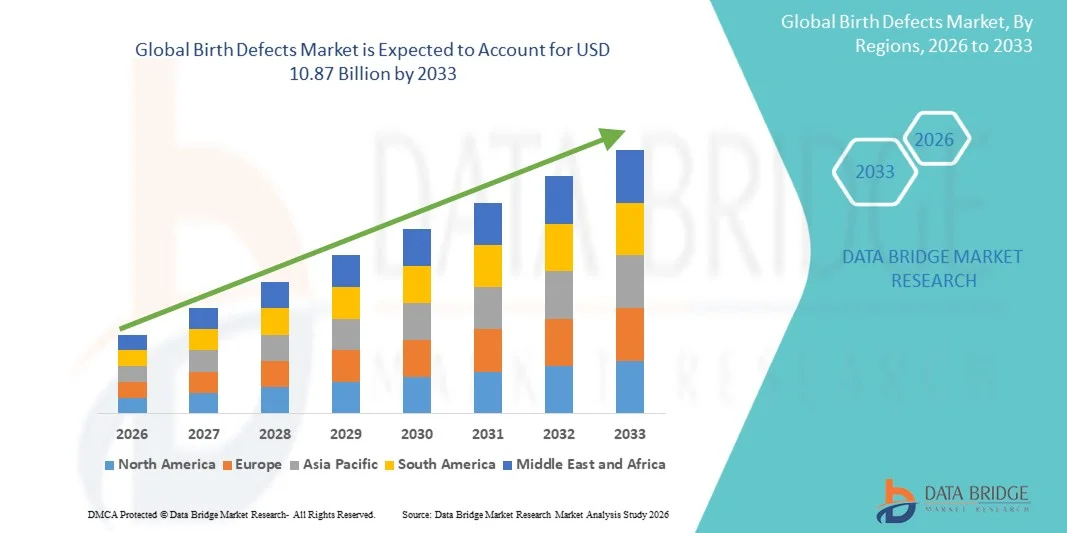
As per Data Bridge Market Research analysis, the Birth Defects Market was valued at USD 7.53 billion in 2025 and is projected to reach USD 10.87 billion by 2033, growing at a CAGR of 4.70% from 2026 to 2033. The market is experiencing consistent growth driven by increasing prevalence of congenital disorders, rising adoption of prenatal and newborn screening programs, and growing advancements in genetic diagnostic technologies. Expanding healthcare infrastructure, increasing awareness regarding early detection of congenital abnormalities, and continuous improvements in neonatal and pediatric care services are further supporting market expansion across developed and emerging healthcare economies.
The increasing global focus on maternal and child healthcare, combined with advancements in prenatal imaging and molecular diagnostics, is encouraging healthcare providers to strengthen early detection and intervention capabilities for congenital disorders. Hospitals and specialty care centers are increasingly utilizing advanced fetal monitoring systems, chromosomal testing, and neonatal intensive care technologies to improve treatment outcomes and reduce infant mortality associated with birth defects. Rising investments in pediatric surgical procedures, rehabilitation services, and precision medicine approaches are further contributing to long term market development.
Market Size & Forecast
- Global Market Value (2025): USD 7.53 Billion
- Expected Market Value (2033): USD 10.87 Billion
- Forecast CAGR (2026–2033): 4.70%
- Leading Region in 2025: North America
- Fastest Growing Region: Asia-Pacific
Key Market Trends & Insights
- North America dominated the Birth Defects Market with the largest revenue share of 39.6% in 2025, supported by advanced prenatal screening infrastructure, high healthcare expenditure, and strong adoption of genetic diagnostic technologies across maternal and pediatric healthcare systems
- The lower extremities segment led the market with a 57% share in 2025, driven by the higher incidence of congenital deformities such as clubfoot, limb length discrepancies, hip dysplasia, and lower limb skeletal abnormalities
- Asia-Pacific is expected to be the fastest-growing region at a CAGR of 8.51% from 2026 to 2033, fueled by improving healthcare infrastructure, rising birth rates, and increasing awareness regarding prenatal and neonatal screening programs
- Surgical are the fastest-growing treatment type, projected to register a CAGR of 12.4% from 2026 to 2033, supported by increasing demand for corrective procedures for congenital heart defects, craniofacial abnormalities, spinal deformities, and limb malformations
- The structural segment dominated the type category with a 48% revenue share in 2025, led by high prevalence of congenital heart defects, cleft lip and palate, neural tube defects, and musculoskeletal abnormalities requiring early medical intervention
- Diagnosis accounted for 46% of the market in 2025, preferred by increasing adoption of prenatal screening, genetic testing, fetal imaging, and newborn screening technologies for early detection of congenital abnormalities
- The functional/developmental segment is the fastest-growing type category, with a CAGR of 11.8% from 2026 to 2033, driven by increasing diagnosis of neurological, metabolic, genetic, and developmental disorders in newborns and children
Report Scope and Birth Defects Market Segmentation
|
Attributes |
Birth Defects Key Market Insights |
|
Segments Covered |
|
|
Countries Covered |
North America
Europe
Asia-Pacific
Middle East and Africa
South America
|
|
Key Market Players |
|
|
Market Opportunities |
|
|
Value Added Data Infosets |
In addition to the insights on market scenarios such as market value, growth rate, segmentation, geographical coverage, and major players, the market reports curated by the Data Bridge Market Research also include depth expert analysis, patient epidemiology, pipeline analysis, pricing analysis, and regulatory framework. |
What is the Key Trend in the Birth Defects Market?
Trend: Growing Prenatal Genetic Screening Adoption
Healthcare providers are increasingly adopting advanced prenatal genetic screening and fetal diagnostic technologies to improve early detection of congenital abnormalities and reduce neonatal complications. Non-invasive prenatal testing, chromosomal analysis, and fetal imaging systems are witnessing strong demand across maternal healthcare centers due to rising awareness regarding early intervention and preventive care. Advancements in genomic sequencing and AI-assisted prenatal diagnostics are further improving screening accuracy and clinical outcomes across high-risk pregnancies.
Companies such as Illumina and Natera are actively expanding non-invasive prenatal testing solutions, while the Centers for Disease Control and Prevention (CDC) estimates that birth defects affect approximately 1 in every 33 babies born annually in the U.S., highlighting the growing need for advanced prenatal screening technologies.
Birth Defects Market Dynamics
Key Market Driver: Rising Congenital Disorder Prevalence
The increasing prevalence of congenital abnormalities and genetic disorders globally is significantly driving demand for advanced diagnostic, treatment, and neonatal care solutions within the Birth Defects market. Rising maternal age, genetic mutations, nutritional deficiencies, environmental exposure risks, and chronic health conditions are contributing to increasing incidence of congenital heart defects, neural tube defects, and developmental disorders. Healthcare systems are increasingly investing in prenatal screening programs, neonatal intensive care infrastructure, and pediatric specialty services to improve survival and long-term health outcomes among affected infants.
Organizations such as the World Health Organization (WHO) estimate that approximately 240,000 newborns die globally within 28 days of birth every year due to congenital disorders, while companies such as Medtronic and Abbott continue expanding pediatric cardiac and neonatal care technologies for congenital defect management.
Key Restraint/Challenge: Limited Access to Specialized Healthcare
A major challenge in the Birth Defects market is the limited availability of specialized prenatal diagnostics, pediatric surgeons, and neonatal intensive care services across low-income and rural healthcare regions. Many developing countries continue to face shortages of trained genetic counselors, fetal medicine specialists, and advanced screening infrastructure, resulting in delayed diagnosis and limited treatment accessibility for congenital disorders. High costs associated with genetic testing, corrective surgeries, and long-term rehabilitation services further restrict access to comprehensive care for affected families.
According to the March of Dimes global report on birth defects, disparities in maternal healthcare access and prenatal screening availability remain significant across emerging economies, particularly in parts of Africa and South Asia where neonatal healthcare infrastructure remains underdeveloped.
Key Market Opportunity: Growth in Neonatal Genetic Testing
The rapid expansion of neonatal genetic testing and precision medicine technologies is creating significant growth opportunities for the Birth Defects market. Advanced genomic diagnostics and newborn screening programs are enabling earlier identification of inherited metabolic disorders, chromosomal abnormalities, and developmental conditions, supporting timely clinical intervention and improved treatment outcomes. Increasing integration of AI-driven genomic interpretation and molecular diagnostics is further enhancing testing efficiency and scalability across hospitals and diagnostic laboratories.
Companies such as Thermo Fisher Scientific and PerkinElmer are actively expanding newborn screening and genetic testing solutions, while the National Institutes of Health (NIH) continues supporting genomic research initiatives aimed at improving early diagnosis and personalized treatment approaches for congenital disorders.
How is the Birth Defects Market Segmented?
The birth defects market is segmented on the basis of type, extremities, and treatment.
• By Type
On the basis of type, the Birth Defects Market is segmented into structural, functional/developmental, and others. The Structural segment dominated the market with the largest share of 48% in 2025, driven by the high prevalence of congenital heart defects, cleft lip and palate, neural tube defects, and musculoskeletal abnormalities requiring early medical intervention. Increasing availability of advanced prenatal imaging technologies and neonatal diagnostic systems is improving early identification of structural abnormalities, which supports higher treatment demand. Growing awareness regarding congenital anomaly screening during pregnancy is further contributing to segment growth. The segment also benefits from rising surgical correction procedures and long-term rehabilitation requirements among affected infants and children. Expanding healthcare infrastructure and improved access to pediatric specialty care continue to strengthen the dominance of the structural defects segment.
The Functional/Developmental segment is projected to register the fastest growth at a CAGR of 11.8% from 2026 to 2033, driven by increasing diagnosis of neurological, metabolic, genetic, and developmental disorders in newborns and children. Rising adoption of genomic testing, newborn screening programs, and precision medicine approaches is significantly improving detection rates for developmental abnormalities. Growing awareness regarding autism spectrum disorders, cognitive impairments, and inherited metabolic diseases is further accelerating demand for specialized treatment and monitoring services. Advancements in molecular diagnostics and pediatric genetic counseling are enhancing clinical management outcomes. Increasing government support for early childhood developmental screening and long-term disease management programs is expected to accelerate segment expansion across developed and emerging healthcare markets.
• By Extremities
On the basis of extremities, the Birth Defects Market is segmented into lower extremities and upper extremities. The Lower Extremities segment dominated the market with a share of 57% in 2025, supported by the higher incidence of congenital deformities such as clubfoot, limb length discrepancies, hip dysplasia, and lower limb skeletal abnormalities. Rising demand for orthopedic corrective surgeries, prosthetics, and physiotherapy services is contributing significantly to segment growth. Early intervention programs and advancements in pediatric orthopedic treatment techniques are improving functional recovery outcomes among affected children. Increasing healthcare spending on congenital mobility disorders and rehabilitation services further strengthens market demand. The growing availability of minimally invasive correction procedures and customized orthopedic support devices continues to reinforce segment dominance.
The Upper Extremities segment is projected to register the fastest growth at a CAGR of 10.6% from 2026 to 2033, driven by increasing diagnosis of congenital hand deformities, upper limb reduction defects, and musculoskeletal abnormalities affecting arm movement and coordination. Advancements in reconstructive surgery, 3D-printed prosthetics, and pediatric rehabilitation therapies are improving treatment accessibility and recovery outcomes. Rising awareness regarding early surgical correction and occupational therapy for upper limb defects is further supporting market expansion. Increasing investments in pediatric assistive technologies and advanced orthopedic implants are accelerating innovation within the segment. Growing adoption of personalized rehabilitation programs and functional mobility enhancement therapies is expected to contribute significantly to future growth.
• By Treatment
On the basis of treatment, the Birth Defects Market is segmented into diagnosis, surgical, and medication. The Diagnosis segment dominated the market with the largest share of 46% in 2025, driven by increasing adoption of prenatal screening, genetic testing, fetal imaging, and newborn screening technologies for early detection of congenital abnormalities. Rising awareness among healthcare providers and parents regarding the importance of early diagnosis is significantly supporting market growth. Advancements in molecular diagnostics, chromosomal analysis, and non-invasive prenatal testing are improving accuracy and reducing diagnostic delays. Government initiatives promoting maternal healthcare screening programs and newborn health monitoring are further accelerating segment adoption. Expanding access to advanced diagnostic laboratories and pediatric specialty centers continues to strengthen the leadership position of the diagnosis segment.
The Surgical segment is projected to register the fastest growth at a CAGR of 12.4% from 2026 to 2033, driven by increasing demand for corrective procedures for congenital heart defects, craniofacial abnormalities, spinal deformities, and limb malformations. Continuous advancements in minimally invasive pediatric surgery, robotic-assisted procedures, and neonatal intensive care support are improving surgical success rates and recovery outcomes. Growing availability of specialized pediatric surgeons and multidisciplinary treatment centers is further enhancing treatment accessibility. Rising healthcare investments in congenital disorder management and post-surgical rehabilitation services are contributing significantly to segment expansion. Increasing focus on improving quality of life and long-term functional outcomes among affected children is expected to accelerate surgical treatment adoption globally.
Which Region Holds the Largest Share of the Birth Defects Market?
North America dominated the birth defects market and accounted for the largest revenue share of 39.6% in 2025, driven by advanced prenatal screening infrastructure, high healthcare expenditure, and strong adoption of genetic diagnostic technologies across maternal and pediatric healthcare systems. The region benefits from widespread awareness regarding congenital disorder prevention and early diagnosis, supported by extensive newborn screening programs and specialized pediatric treatment centers. Increasing prevalence of congenital heart defects and genetic abnormalities is further contributing to demand for advanced treatment and long term care services. In addition, strong government healthcare support and the presence of leading biotechnology and medical device companies continue to reinforce North America’s leadership position in the global market.
U.S. Birth Defects Market Insight
The U.S. Birth Defects market is experiencing strong growth driven by increasing adoption of prenatal genetic testing, rising prevalence of congenital disorders, and strong investments in pediatric healthcare innovation. Hospitals and specialty clinics are increasingly utilizing advanced fetal imaging, chromosomal screening, and molecular diagnostic technologies for early detection and intervention. The country’s highly developed healthcare infrastructure and strong presence of leading pharmaceutical and biotechnology companies are supporting continuous advancements in treatment and rehabilitation services. In addition, growing awareness regarding maternal health management and early childhood care programs is further accelerating market expansion across the U.S.
Canada Birth Defects Market Insight
The Canada Birth Defects market is witnessing steady growth supported by increasing awareness regarding prenatal healthcare and rising government initiatives promoting newborn screening programs. Healthcare providers are increasingly focusing on early diagnosis and multidisciplinary treatment approaches to improve long term health outcomes among affected children. The country’s expanding access to genetic counseling and pediatric specialty care services is contributing significantly to market development. In addition, advancements in neonatal intensive care infrastructure and growing investments in maternal healthcare programs are further supporting market growth in Canada.
Europe Birth Defects Market Insight
The Europe Birth Defects market is expanding steadily due to rising adoption of advanced prenatal diagnostics, strong healthcare reimbursement systems, and increasing focus on congenital disorder prevention strategies. The region benefits from highly developed healthcare infrastructure and strong regulatory support for maternal and neonatal health screening programs. Healthcare institutions across the region are increasingly utilizing genomic testing, fetal monitoring, and minimally invasive surgical procedures for effective management of congenital abnormalities. Rising investments in pediatric research and rehabilitation services continue to support regional market growth.
U.K. Birth Defects Market Insight
The U.K. Birth Defects market is growing steadily, driven by increasing awareness regarding prenatal screening and strong adoption of advanced fetal diagnostic technologies. Healthcare providers are increasingly emphasizing early intervention and multidisciplinary treatment strategies to improve neonatal health outcomes. The presence of a well established public healthcare system and growing investments in pediatric genetic research are further supporting market development. In addition, rising focus on maternal nutrition, preventive healthcare, and newborn monitoring programs is strengthening market expansion in the U.K.
Germany Birth Defects Market Insight
The Germany Birth Defects market is expanding due to strong healthcare infrastructure, increasing adoption of precision diagnostics, and growing investments in pediatric specialty care services. Hospitals and research institutions are increasingly utilizing genomic analysis and advanced imaging technologies to improve early detection and management of congenital abnormalities. The country’s strong emphasis on medical innovation and healthcare quality standards is supporting demand for advanced treatment solutions. In addition, rising awareness regarding genetic counseling and rehabilitation therapies is further accelerating market development in Germany.
Asia-Pacific Birth Defects Market Insight
The Asia-Pacific Birth Defects market is expected to register the fastest growth with a CAGR of 8.51% from 2026 to 2033, driven by improving healthcare infrastructure, rising birth rates, and increasing awareness regarding prenatal and neonatal screening programs. Rapid expansion of healthcare access across emerging economies is significantly improving diagnosis and treatment availability for congenital disorders. Countries such as China, India, Japan, and South Korea are witnessing increasing investments in maternal healthcare, pediatric diagnostics, and genetic testing technologies. In addition, growing government initiatives aimed at reducing infant mortality and improving maternal health outcomes are further accelerating regional market expansion.
Japan Birth Defects Market Insight
The Japan Birth Defects market is witnessing steady growth supported by advanced healthcare technologies, strong neonatal care infrastructure, and increasing adoption of genetic diagnostic solutions. Healthcare providers are increasingly focusing on early prenatal detection and personalized treatment strategies to improve pediatric health outcomes. The country’s strong emphasis on medical innovation and precision healthcare is supporting the integration of advanced fetal imaging and molecular testing technologies. In addition, growing awareness regarding congenital disease prevention and rehabilitation services is strengthening demand in Japan.
China Birth Defects Market Insight
The China Birth Defects market is growing rapidly due to rising healthcare investments, increasing awareness regarding maternal and infant health, and expanding access to prenatal screening programs. Hospitals and diagnostic centers are increasingly adopting advanced fetal imaging, chromosomal testing, and newborn screening technologies to improve early diagnosis rates. The country’s large birth population and improving healthcare infrastructure are supporting significant demand for congenital disorder treatment and management services. In addition, strong government initiatives promoting maternal healthcare modernization and pediatric disease prevention are further driving market growth in China.
Which are the Top Companies in Birth Defects Market?
The birth defects industry is primarily led by well-established companies, including:
- Altogen Biosystems (U.S.)
- American Gene Technologies Inc. (U.S.)
- Applied Tissue Technologies LLC (U.S.)
- Asklepios BioPharmaceutical, Inc. (U.S.)
- Medtronic (Ireland)
- Abbott (U.S.)
- Boston Scientific Corporation (U.S.)
- Edwards Lifesciences Corporation (U.S.)
- Johnson & Johnson Services, Inc. (U.S.)
- Getinge AB (Sweden)
- Terumo Cardiovascular Systems Corporation (Japan)
- W. L. Gore & Associates, Inc. (U.S.)
- Lepu Medical Technology (Beijing)Co.,Ltd. (China)
- Allscripts Healthcare, LLC (U.S.)
- Carestream Health (U.S.)
- Agfa-Gevaert Group (Belgium)
- BD (U.S.)

- Interactive Data Analysis Dashboard
- Company Analysis Dashboard for high growth potential opportunities
- Research Analyst Access for customization & queries
- Competitor Analysis with Interactive dashboard
- Latest News, Updates & Trend analysis
- Harness the Power of Benchmark Analysis for Comprehensive Competitor Tracking
Data collection and base year analysis are done using data collection modules with large sample sizes. The stage includes obtaining market information or related data through various sources and strategies. It includes examining and planning all the data acquired from the past in advance. It likewise envelops the examination of information inconsistencies seen across different information sources. The market data is analysed and estimated using market statistical and coherent models. Also, market share analysis and key trend analysis are the major success factors in the market report. To know more, please request an analyst call or drop down your inquiry.
The key research methodology used by DBMR research team is data triangulation which involves data mining, analysis of the impact of data variables on the market and primary (industry expert) validation. Data models include Vendor Positioning Grid, Market Time Line Analysis, Market Overview and Guide, Company Positioning Grid, Patent Analysis, Pricing Analysis, Company Market Share Analysis, Standards of Measurement, Global versus Regional and Vendor Share Analysis. To know more about the research methodology, drop in an inquiry to speak to our industry experts.
Data Bridge Market Research is a leader in advanced formative research. We take pride in servicing our existing and new customers with data and analysis that match and suits their goal. The report can be customized to include price trend analysis of target brands understanding the market for additional countries (ask for the list of countries), clinical trial results data, literature review, refurbished market and product base analysis. Market analysis of target competitors can be analyzed from technology-based analysis to market portfolio strategies. We can add as many competitors that you require data about in the format and data style you are looking for. Our team of analysts can also provide you data in crude raw excel files pivot tables (Fact book) or can assist you in creating presentations from the data sets available in the report.













