


Global Bladder Prolapse (Cystocele) Market Overview
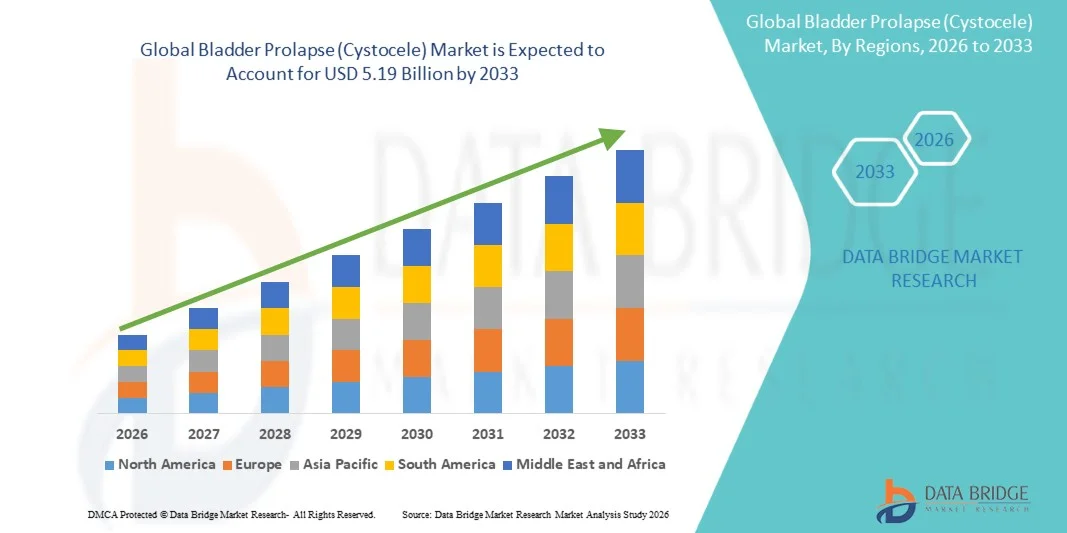
The global Bladder Prolapse (Cystocele) market was valued at USD 3.46 billion in 2025 and is projected to reach USD 5.19 billion by 2033, growing at a CAGR of 5.20% from 2026 to 2033. The market is experiencing consistent growth driven by the rising prevalence of pelvic floor disorders, increasing awareness regarding women’s health conditions, and growing advancements in minimally invasive treatment procedures and diagnostic technologies. Expanding healthcare infrastructure and increasing adoption of pelvic reconstructive therapies are further supporting market expansion across developed and emerging economies.
The increasing incidence of bladder prolapse (cystocele) among aging women, combined with growing risk factors such as obesity, childbirth complications, menopause, and chronic pelvic muscle weakness, is encouraging healthcare providers and gynecological centers to adopt advanced diagnostic and treatment approaches. Minimally invasive surgical procedures, pelvic floor repair therapies, and non-surgical management solutions such as pessary devices and pelvic floor rehabilitation are increasingly replacing conventional treatment methods in many healthcare settings, offering improved patient outcomes, reduced recovery time, and enhanced quality of life.
Key Market Trends & Insights
- North America dominated the global Bladder Prolapse (Cystocele) market with the largest revenue share of 38.25% in 2025, supported by advanced healthcare infrastructure, rising awareness regarding pelvic floor disorders, and increasing adoption of minimally invasive treatment procedures.
- The Surgical Treatment segment led the market with a 43.65% share in 2025, driven by increasing preference for pelvic reconstructive surgeries, growing availability of advanced surgical devices, and rising prevalence of severe cystocele cases.
- Asia-Pacific is expected to be the fastest-growing region at a CAGR of 7.8% from 2026 to 2033, fueled by improving women’s healthcare infrastructure, rising awareness regarding pelvic health conditions, and increasing healthcare expenditure across China, India, and Japan.
- The Hospitals segment dominates the end-user category with a 42.35% revenue share in 2025, driven by higher patient admissions for pelvic floor disorder management and the availability of advanced gynecological surgical infrastructure and specialized care units.
- Hospital Pharmacy accounts for 57.80% of the distribution channel segment, supported by strong in-hospital dispensing of prescribed therapies, immediate post-operative medication needs, and integrated hospital procurement systems.
- The Surgery segment dominated the global Bladder Prolapse (Cystocele) market with a 43.65% share in 2025, driven by the increasing prevalence of severe pelvic organ prolapse cases requiring surgical intervention for long-term symptom relief and structural correction.
Market Size & Forecast
- Global Market Value (2025): USD 3.46 Billion
- Expected Market Value (2033): USD 5.19 Billion
- Forecast CAGR (2026–2033): 5.20%
- Leading Region in 2025: North America
- Fastest Growing Region: Asia-Pacific
Report Scope and Global Bladder Prolapse (Cystocele) Market Segmentation
|
Attributes |
Bladder Prolapse (Cystocele) Key Market Insights |
|
Segments Covered |
|
|
Countries Covered |
North America · U.S. · Canada · Mexico Europe · Germany · France · U.K. · Netherlands · Switzerland · Belgium · Russia · Italy · Spain · Turkey · Rest of Europe Asia-Pacific · China · Japan · India · South Korea · Singapore · Malaysia · Australia · Thailand · Indonesia · Philippines · Rest of Asia-Pacific Middle East and Africa · Saudi Arabia · U.A.E. · South Africa · Egypt · Israel · Rest of Middle East and Africa South America · Brazil · Argentina · Rest of South America |
|
Key Market Players |
· Pfizer Inc. (U.S.) · Johnson & Johnson Services, Inc. (U.S.) · Boston Scientific Corporation (U.S.) · Medtronic plc (Ireland) · Coloplast A/S (Denmark) · CooperSurgical, Inc. (U.S.) · Becton, Dickinson and Company (U.S.) · Cook Medical (U.S.) · Laborie Medical Technologies Corp. (Canada) · MedGyn Products, Inc. (U.S.) · Integra LifeSciences Holdings Corporation (U.S.) · Stryker Corporation (U.S.) · Teleflex Incorporated (U.S.) · Olympus Corporation (Japan) · Karl Storz SE & Co. KG (Germany) · Richard Wolf GmbH (Germany) · Promedon Group (Argentina) · Caldera Medical (U.S.) · Ethicon, Inc. (U.S.) · C. R. Bard, Inc. (U.S.) · Neomedic International (Spain) · FemSelect Ltd. (Israel) · Uromed Kurt Drews KG (Germany) · Panpac Medical Corporation (Taiwan) · Verity Medical Ltd. (Ireland) |
|
Market Opportunities |
· Growing Adoption of Minimally Invasive Surgical Procedures for Pelvic Organ Prolapse Treatment · Increasing Demand for Advanced Pelvic Floor Rehabilitation and Non-Surgical Management Solutions · Rising Investments in Women’s Healthcare Infrastructure and Innovative Urogynecological Devices |
|
Value Added Data Infosets |
In addition to the insights on market scenarios such as market value, growth rate, segmentation, geographical coverage, and major players, the market reports curated by the Data Bridge Market Research also include in-depth expert analysis, geographically represented company-wise production and capacity, network layouts of distributors and partners, detailed and updated price trend analysis and deficit analysis of supply chain and demand. |
Global Bladder Prolapse (Cystocele) Market Trends
Trend: Rising Adoption of Minimally Invasive and Non-Surgical Treatment Approaches
Healthcare providers and urogynecology specialists are increasingly adopting minimally invasive procedures and non-surgical treatment solutions for bladder prolapse (cystocele) management to improve patient outcomes and reduce recovery time. Vaginal pessary devices, pelvic floor rehabilitation therapies, and laparoscopic pelvic reconstructive surgeries are gaining significant traction due to their lower complication rates and enhanced patient comfort. In addition, increasing integration of advanced imaging technologies and AI-assisted diagnostic systems is improving early detection and treatment planning for pelvic floor disorders. Hospitals and specialty clinics are also leveraging personalized treatment protocols and rehabilitation programs to support long-term pelvic health management among aging female populations. For instance, increasing adoption of robotic-assisted gynecological surgeries and minimally invasive pelvic floor repair procedures across North America and Europe is significantly enhancing treatment precision and reducing hospitalization duration. Rising awareness campaigns related to women’s pelvic health and urinary incontinence management are further strengthening demand for advanced cystocele treatment solutions globally.
Global Bladder Prolapse (Cystocele) Market Dynamics
Key Market Driver: Increasing Prevalence of Pelvic Floor Disorders Among Aging Female Population
The rising prevalence of pelvic floor disorders and urinary incontinence among aging women is creating substantial demand for advanced bladder prolapse treatment solutions globally. Factors such as childbirth trauma, obesity, menopause, chronic constipation, and weakened pelvic muscles are contributing significantly to the growing incidence of cystocele cases. Healthcare providers, hospitals, and specialty gynecology centers are increasingly adopting advanced surgical and non-surgical therapies to improve patient quality of life and reduce long-term complications. According to healthcare estimates, pelvic organ prolapse affects millions of women globally, with a significant percentage of women over the age of 50 experiencing some degree of pelvic floor dysfunction. The growing geriatric female population and increasing awareness regarding early diagnosis and treatment are further accelerating market growth. In addition, rising investments in women’s healthcare infrastructure and urogynecological research are supporting the development of innovative treatment devices and minimally invasive surgical procedures.
Key Restraint/Challenge: High Cost and Complications Associated with Surgical Treatments
A significant restraint in the global Bladder Prolapse (Cystocele) market is the high cost associated with advanced surgical procedures and post-operative care. Modern pelvic reconstructive surgeries often require specialized surgical equipment, experienced urogynecologists, and prolonged follow-up care, increasing the overall treatment expenditure for patients and healthcare systems. In addition, complications related to surgical mesh implants, recurrence of prolapse, infection risks, and post-surgical discomfort continue to create concerns among patients and healthcare professionals.For instance, regulatory scrutiny surrounding transvaginal mesh implants in several countries has increased caution regarding certain prolapse repair procedures, impacting adoption rates of specific surgical techniques. Moreover, limited awareness regarding pelvic floor disorders and inadequate access to specialized women’s healthcare services in developing regions remain significant barriers to early diagnosis and effective treatment adoption.
Key Market Opportunity: Expansion of Pelvic Floor Rehabilitation and Personalized Women’s Healthcare
The growing focus on preventive women’s healthcare and pelvic floor rehabilitation presents a significant market opportunity for bladder prolapse treatment providers. Increasing adoption of non-invasive therapies such as pelvic floor muscle training, physiotherapy, biofeedback systems, and vaginal support devices is creating strong demand for long-term cystocele management solutions. AI-enabled diagnostic platforms and digital rehabilitation programs are also supporting personalized treatment planning and remote patient monitoring. The development of advanced urogynecological devices, improved biomaterials for pelvic repair, and robotic-assisted surgical technologies is further expanding treatment accessibility and efficiency across hospitals and specialty clinics. In addition, rising healthcare investments in Asia-Pacific, Latin America, and the Middle East are creating new growth opportunities for manufacturers and service providers focused on women’s pelvic health and minimally invasive prolapse management solutions
Global Bladder Prolapse (Cystocele) Market Scope
The Bladder Prolapse (Cystocele) market is segmented on the basis of treatment, diagnosis, end-users, and distribution channel.
• By Treatment
On the basis of treatment, the global Bladder Prolapse (Cystocele) market is segmented into Kegel exercise, physical therapy, vaginal pessary, estrogen replacement therapy, surgery, and others. The surgery segment dominated the market with a share of 43.65% in 2025 due to the increasing prevalence of severe pelvic organ prolapse cases requiring surgical intervention for long-term symptom relief and structural correction. Rising adoption of minimally invasive surgical procedures, robotic-assisted pelvic floor repair, and advanced urogynecological surgical devices is significantly driving segment growth. In addition, increasing healthcare expenditure, growing awareness regarding women’s pelvic health, and expanding availability of specialized gynecological treatment centers are supporting the widespread adoption of surgical treatment options globally. Hospitals and specialty clinics are increasingly performing laparoscopic and vaginal reconstructive procedures to improve patient outcomes and reduce recovery time. Moreover, the growing geriatric female population and rising incidence of obesity, childbirth-related complications, and menopause-associated pelvic muscle weakness are further accelerating demand for surgical treatment solutions in the global market.
The vaginal pessary segment is expected to witness the fastest CAGR of 6.8% from 2026 to 2033, driven by increasing preference for non-surgical and minimally invasive management approaches for bladder prolapse treatment. Vaginal pessaries provide cost-effective and convenient symptom management for elderly patients and women unsuitable for surgery. Rising awareness regarding conservative treatment approaches, growing adoption of personalized women’s healthcare, and increasing availability of technologically advanced pessary devices are supporting segment expansion. In addition, healthcare providers are increasingly recommending pessary therapy for early-stage cystocele management due to lower complication risks and improved patient comfort. Expanding homecare services, increasing focus on pelvic floor rehabilitation, and growing demand for outpatient treatment solutions are further accelerating the adoption of vaginal pessaries globally.
• By Diagnosis
On the basis of diagnosis, the global Bladder Prolapse (Cystocele) market is segmented into cystourethrogram, MRI, urodynamics, cystoscopy, and others. The MRI segment dominated the market with a share of 35.42% in 2025 due to its high diagnostic accuracy, superior soft tissue visualization capabilities, and growing use in evaluating pelvic floor disorders and associated complications. MRI technology enables healthcare professionals to assess bladder positioning, pelvic muscle integrity, and prolapse severity with improved precision, supporting effective treatment planning and surgical decision-making. Increasing investments in advanced diagnostic imaging infrastructure, growing adoption of minimally invasive diagnostic procedures, and rising awareness regarding early detection of pelvic organ prolapse are further strengthening segment growth. In addition, hospitals and specialty gynecology centers are increasingly integrating MRI-based diagnostic workflows for comprehensive pelvic health evaluation and improved patient outcomes.
The urodynamics segment is projected to register the fastest CAGR of 6.5% from 2026 to 2033, driven by increasing demand for functional bladder assessment and urinary incontinence evaluation among cystocele patients. Urodynamic testing helps healthcare providers analyze bladder pressure, urine flow, and pelvic floor functionality, supporting accurate diagnosis and personalized treatment strategies. Rising prevalence of urinary dysfunction disorders, increasing geriatric female population, and growing focus on preventive women’s healthcare are accelerating adoption of urodynamic diagnostic procedures globally. In addition, technological advancements in digital urodynamic systems and increasing availability of outpatient diagnostic facilities are further supporting segment expansion across hospitals and specialty clinics.
• By End-Users
On the basis of end-users, the global Bladder Prolapse (Cystocele) market is segmented into hospitals, homecare, specialty clinics, and others. The hospitals segment dominated the market with a share of 42.18% in 2025 due to the high volume of pelvic reconstructive surgeries, advanced diagnostic procedures, and availability of specialized urogynecology departments within hospital settings. Hospitals are increasingly adopting advanced surgical technologies, robotic-assisted treatment systems, and minimally invasive pelvic repair procedures to improve treatment efficiency and patient safety. In addition, growing patient preference for comprehensive healthcare facilities, increasing healthcare expenditure, and rising availability of reimbursement support for gynecological procedures are contributing to segment dominance. Expanding hospital infrastructure across developed and emerging economies and increasing collaborations between healthcare providers and medical device manufacturers are further strengthening the leading position of this segment in the market.
The homecare segment is expected to witness the fastest CAGR of 6.7% from 2026 to 2033, driven by increasing demand for non-invasive treatment management and rehabilitation-based care solutions among elderly female patients. Growing adoption of pelvic floor exercise programs, vaginal pessary management, and remote patient monitoring technologies is supporting the expansion of homecare services globally. In addition, rising awareness regarding preventive pelvic healthcare, increasing preference for cost-effective treatment solutions, and expanding access to digital healthcare platforms are contributing significantly to market growth. Healthcare providers are also increasingly promoting home-based rehabilitation programs and telehealth consultations to improve long-term patient outcomes and reduce hospitalization rates.
• By Distribution Channel
On the basis of distribution channel, the global Bladder Prolapse (Cystocele) market is segmented into hospital pharmacy, online pharmacy, and retail pharmacy. The hospital pharmacy segment dominated the market with a share of 47.36% in 2025 due to increasing patient admissions for pelvic floor disorder treatment and rising prescription rates for surgical support products, hormonal therapies, and post-operative medications within hospital settings. Hospital pharmacies play a critical role in ensuring immediate access to prescribed medications, pessary devices, and specialized urogynecological treatment products for inpatient and outpatient care. In addition, strong coordination between hospitals, healthcare professionals, and pharmaceutical suppliers is improving product accessibility and treatment continuity. Rising number of gynecological surgeries, increasing investments in hospital infrastructure, and expanding specialty healthcare services are further reinforcing the dominance of the hospital pharmacy segment globally.
The online pharmacy segment is projected to witness the fastest CAGR of 6.9% from 2026 to 2033, driven by increasing digitalization of healthcare services and growing consumer preference for convenient medicine purchasing platforms. Online pharmacies provide improved accessibility to pelvic healthcare products, hormonal therapies, pessary devices, and rehabilitation support products, particularly for elderly patients and individuals in remote regions. Increasing internet penetration, growing adoption of telemedicine services, and rising demand for home delivery healthcare solutions are supporting rapid segment expansion. In addition, competitive pricing, subscription-based medicine delivery services, and growing awareness regarding women’s pelvic health management are further accelerating adoption of online pharmacy platforms globally.
Global Bladder Prolapse (Cystocele) Market Regional Analysis
North America dominated the Bladder Prolapse (Cystocele) market and accounted for the largest revenue share of 38.25% in 2025, supported by advanced healthcare infrastructure, rising awareness regarding pelvic floor disorders, and increasing adoption of minimally invasive treatment procedures. The region also benefits from strong availability of specialized urogynecology centers, favorable reimbursement policies, and growing investments in women’s healthcare technologies. Increasing prevalence of pelvic organ prolapse among the aging female population, along with rising adoption of robotic-assisted surgeries, pelvic floor rehabilitation therapies, and advanced diagnostic systems, continues to strengthen North America’s leadership position in the global market.
U.S. Bladder Prolapse (Cystocele) Market Insight
The U.S. Bladder Prolapse (Cystocele) market is witnessing strong growth due to rising prevalence of pelvic floor disorders, increasing healthcare expenditure, and growing adoption of minimally invasive treatment procedures. The country’s advanced healthcare ecosystem, along with increasing availability of robotic-assisted surgical systems, AI-enabled diagnostic technologies, and pelvic floor rehabilitation programs, is driving demand across hospitals, specialty clinics, and ambulatory care centers. In addition, growing awareness regarding women’s pelvic health and increasing focus on early diagnosis and treatment are accelerating adoption of advanced cystocele management solutions across the U.S. healthcare sector.
North America Bladder Prolapse (Cystocele) Market Insight
The North America Bladder Prolapse (Cystocele) market remains a major contributor to global revenue, driven by strong healthcare infrastructure, technological innovation, and rising demand for advanced pelvic floor disorder treatment solutions. The widespread adoption of minimally invasive surgeries, vaginal pessary devices, pelvic floor rehabilitation therapies, and advanced imaging technologies is supporting market expansion across the region. Increasing investments in women’s healthcare services, coupled with rising awareness regarding pelvic organ prolapse and strong presence of leading medical device manufacturers, continue to enhance the adoption of bladder prolapse treatment solutions throughout North America.
U.K. Bladder Prolapse (Cystocele) Market Insight
The U.K. Bladder Prolapse (Cystocele) market is experiencing steady growth, supported by rising awareness regarding women’s pelvic health, increasing adoption of minimally invasive gynecological procedures, and growing healthcare investments. Increasing availability of advanced urogynecology services and pelvic floor rehabilitation programs is contributing significantly to market growth. Furthermore, integration of advanced imaging systems, robotic-assisted surgeries, and personalized treatment approaches is improving treatment efficiency and patient outcomes, positioning the U.K. as a key market for bladder prolapse treatment innovation in Europe.
Germany Bladder Prolapse (Cystocele) Market Insight
The Germany Bladder Prolapse (Cystocele) market is expanding steadily due to the country’s advanced healthcare infrastructure, strong medical technology industry, and increasing adoption of next-generation diagnostic and treatment technologies. Hospitals, specialty clinics, and research institutions are increasingly utilizing minimally invasive surgical systems, pelvic floor rehabilitation therapies, and AI-assisted diagnostic platforms for effective cystocele management. Continuous advancements in robotic surgery, urogynecological devices, and women’s healthcare research, along with strong government focus on healthcare innovation and patient safety, are further driving market growth in Germany.
Asia-Pacific Bladder Prolapse (Cystocele) Market Insight
The Asia-Pacific Bladder Prolapse (Cystocele) market is expected to witness rapid growth, driven by improving women’s healthcare infrastructure, rising awareness regarding pelvic health conditions, and increasing healthcare expenditure across countries such as China, India, and Japan. Growing prevalence of pelvic floor disorders, increasing adoption of minimally invasive treatment procedures, and expanding access to advanced gynecological healthcare services are supporting regional market expansion. In addition, rising investments in healthcare modernization, increasing availability of specialized women’s healthcare centers, and growing focus on early diagnosis and preventive care are accelerating adoption of bladder prolapse treatment solutions across the region. Asia-Pacific is expected to be the fastest-growing region at a CAGR of 7.8% from 2026 to 2033.
Japan Bladder Prolapse (Cystocele) Market Insight
The Japan Bladder Prolapse (Cystocele) market is witnessing consistent growth due to rising geriatric female population, increasing investments in advanced healthcare technologies, and growing awareness regarding pelvic floor disorders. Hospitals and specialty clinics are increasingly adopting minimally invasive surgical procedures, robotic-assisted gynecological systems, and pelvic floor rehabilitation therapies for improved patient outcomes. Moreover, increasing integration of AI-assisted diagnostics and the country’s focus on high-quality and efficient healthcare delivery are further contributing to market growth.
China Bladder Prolapse (Cystocele) Market Insight
The China Bladder Prolapse (Cystocele) market is growing rapidly, driven by increasing healthcare expenditure, expanding hospital infrastructure, and rising government focus on women’s healthcare services. Growing adoption of minimally invasive surgical procedures, pelvic floor rehabilitation therapies, and advanced diagnostic technologies across hospitals and specialty clinics is significantly boosting market demand. In addition, rising awareness regarding pelvic health conditions, increasing investments in medical technology innovation, and expanding access to gynecological healthcare services are positioning China as one of the fastest-growing markets for Bladder Prolapse (Cystocele) globally.
Global Bladder Prolapse (Cystocele) Market Share
The Bladder Prolapse (Cystocele) industry is primarily led by well-established companies, including:
- Pfizer Inc. (U.S.)
- Johnson & Johnson Services, Inc. (U.S.)
- Boston Scientific Corporation (U.S.)
- Medtronic plc (Ireland)
- Coloplast A/S (Denmark)
- CooperSurgical, Inc. (U.S.)
- Becton, Dickinson and Company (U.S.)
- Cook Medical (U.S.)
- Laborie Medical Technologies Corp. (Canada)
- MedGyn Products, Inc. (U.S.)
- Integra LifeSciences Holdings Corporation (U.S.)
- Stryker Corporation (U.S.)
- Teleflex Incorporated (U.S.)
- Olympus Corporation (Japan)
- Karl Storz SE & Co. KG (Germany)
- Richard Wolf GmbH (Germany)
- Promedon Group (Argentina)
- Caldera Medical (U.S.)
- Ethicon, Inc. (U.S.)
- C. R. Bard, Inc. (U.S.)
- Neomedic International (Spain)
- FemSelect Ltd. (Israel)
- Uromed Kurt Drews KG (Germany)
- Panpac Medical Corporation (Taiwan)
- Verity Medical Ltd. (Ireland)
Latest Developments in Global Bladder Prolapse (Cystocele) Market
- In March 2022, Valencia Technologies Corporation received U.S. FDA approval for its eCoin Peripheral Neurostimulator System for urgency urinary incontinence treatment. The implantable tibial nerve stimulation device was designed to improve bladder control and support patients suffering from pelvic floor and urinary dysfunction disorders commonly associated with bladder prolapse (cystocele)
- In August 2021, the U.S. Food and Drug Administration (FDA) reaffirmed safety concerns regarding transvaginal surgical mesh products used for pelvic organ prolapse repair after reviewing post-market surveillance data. The agency highlighted increased risks of mesh exposure and tissue erosion compared with native tissue repair procedures, significantly influencing treatment approaches and accelerating demand for safer minimally invasive prolapse management solutions
- In February 2023, Boston Scientific Corporation expanded its women’s health and pelvic floor disorder treatment portfolio through continued investments in minimally invasive urogynecological technologies and pelvic organ prolapse management solutions. The company focused on enhancing physician training programs and improving patient outcomes through advanced pelvic reconstructive technologies
- In October 2023, Medtronic plc strengthened its minimally invasive surgery portfolio with continued advancements in robotic-assisted surgical technologies widely utilized in gynecological and pelvic floor reconstructive procedures. The development supported increasing adoption of precision-based surgical interventions for bladder prolapse and related pelvic disorders globally
- In May 2024, Coloplast A/S announced expanded investments in women’s pelvic healthcare solutions, focusing on continence care, pelvic floor disorder management, and advanced urogynecological treatment technologies. The initiative aimed to improve accessibility to non-surgical and rehabilitation-based prolapse management solutions across healthcare facilities globally
- In January 2025, Johnson & Johnson MedTech highlighted ongoing advancements in robotic-assisted gynecological surgery platforms and minimally invasive pelvic repair technologies to improve surgical precision, reduce recovery time, and support better long-term outcomes for women undergoing pelvic organ prolapse treatment procedures

- Interactive Data Analysis Dashboard
- Company Analysis Dashboard for high growth potential opportunities
- Research Analyst Access for customization & queries
- Competitor Analysis with Interactive dashboard
- Latest News, Updates & Trend analysis
- Harness the Power of Benchmark Analysis for Comprehensive Competitor Tracking
Data collection and base year analysis are done using data collection modules with large sample sizes. The stage includes obtaining market information or related data through various sources and strategies. It includes examining and planning all the data acquired from the past in advance. It likewise envelops the examination of information inconsistencies seen across different information sources. The market data is analysed and estimated using market statistical and coherent models. Also, market share analysis and key trend analysis are the major success factors in the market report. To know more, please request an analyst call or drop down your inquiry.
The key research methodology used by DBMR research team is data triangulation which involves data mining, analysis of the impact of data variables on the market and primary (industry expert) validation. Data models include Vendor Positioning Grid, Market Time Line Analysis, Market Overview and Guide, Company Positioning Grid, Patent Analysis, Pricing Analysis, Company Market Share Analysis, Standards of Measurement, Global versus Regional and Vendor Share Analysis. To know more about the research methodology, drop in an inquiry to speak to our industry experts.
Data Bridge Market Research is a leader in advanced formative research. We take pride in servicing our existing and new customers with data and analysis that match and suits their goal. The report can be customized to include price trend analysis of target brands understanding the market for additional countries (ask for the list of countries), clinical trial results data, literature review, refurbished market and product base analysis. Market analysis of target competitors can be analyzed from technology-based analysis to market portfolio strategies. We can add as many competitors that you require data about in the format and data style you are looking for. Our team of analysts can also provide you data in crude raw excel files pivot tables (Fact book) or can assist you in creating presentations from the data sets available in the report.












