


What is the Blast Chiller Size and Overview?
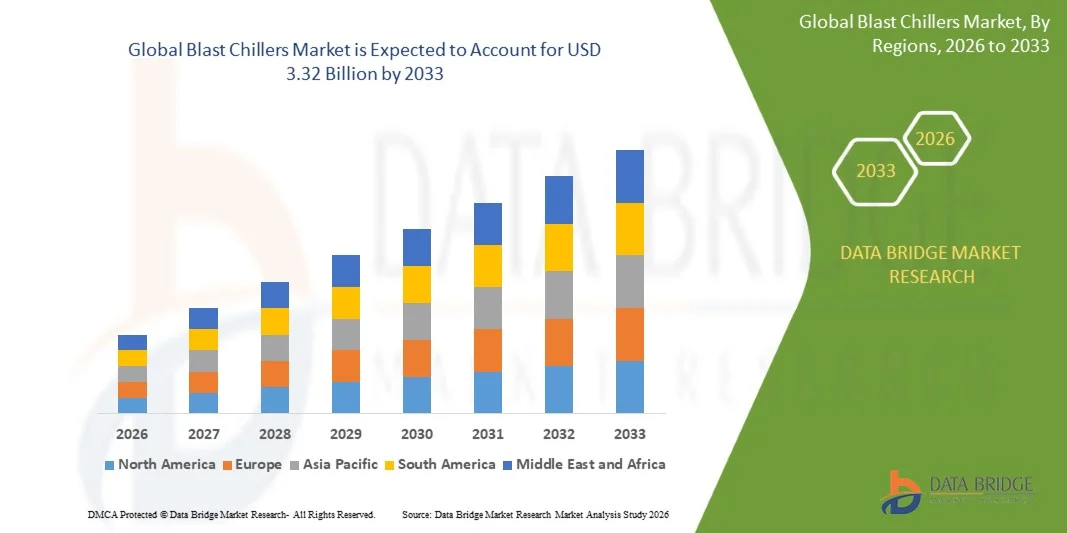
As per Data Bridge Market Research Analysis the blast chiller market was valued at USD 2.07 billion in 2025 and is projected to reach USD 3.32 billion by 2033, growing at a CAGR of 6.10% from 2026 to 2033. Blast chillers are commercial refrigeration systems used to rapidly reduce the temperature of cooked or prepared food, helping operators improve food safety, preserve product quality, reduce wastage and support cook-chill workflows.
The market is growing due to rising adoption in hotels, restaurants, central kitchens, catering facilities, bakeries, food processing plants and institutional foodservice operations. Demand is supported by stricter food safety expectations, growth in quick-service restaurants, higher consumption of frozen and ready-to-eat meals, expansion of cold-chain infrastructure, and replacement of older systems with energy-efficient and refrigerant-compliant units.
Market Size and Forecast
- Market Value (2025): USD 2.07 Billion
- Expected Market Value (2033): USD 3.32 Billion
- Forecast CAGR (2026-2031): 6.10%
- Leading Region in 2025: Europe
- Fastest-Growing Region: Asia-Pacific
Key Market Trends and Insights
- Europe dominated the global blast chiller market with the largest revenue share of 33.8% in 2025, supported by stringent food safety regulations, widespread adoption of cook-chill food preparation methods, and strong demand from hotels, restaurants, bakeries, institutional kitchens, and food processing facilities.
- Asia-Pacific blast chiller market is expected to witness the fastest growth rate from 2026 to 2033, supported by rapid expansion of quick-service restaurants, increasing investments in cold chain infrastructure, rising consumption of frozen and ready-to-eat foods, and the growing adoption of centralized food production models.
- The roll-in blast chillers segment held the largest market revenue share of approximately 41.3% in 2025 driven by widespread use in institutional kitchens, large hotels, catering services, hospitals, and high-volume foodservice operations. Trolley-based batch handling improves workflow efficiency, reduces manual transfer, and supports standardized cook-chill production.
- The roll-through blast chillers segment is projected to register the fastest growth at a CAGR of 8.47% from 2026 to 2033, driven by increasing demand from food processing and manufacturing facilities. Straight-line loading and unloading supports continuous production layouts, faster turnaround, and efficient movement between cooking, chilling, packaging, and storage.
- The 50-100 kg segment held the largest market revenue share of approximately 34.6% in 2025 driven by strong adoption across hotels, contract catering services, bakeries, restaurants, and mid-sized commercial kitchens. The capacity range provides a practical balance between batch output, floor space, energy use, and equipment cost.
- The above 200 kg segment is projected to register the fastest growth at a CAGR of 8.66% from 2026 to 2033, driven by expansion of central kitchens, commissaries, institutional catering, frozen meal manufacturing, and food processing plants. These users require high-throughput systems for bulk production and documented food safety performance.
Scope and Blast Chiller Market Segmentation
|
Attributes |
Blast Chiller Key Market Insights |
|
Segments Covered |
|
|
Countries Covered |
North America
Europe
Asia-Pacific
Middle East and Africa
South America
|
|
Key Market Players |
|
|
Market Opportunities |
|
|
Value Added Data Infosets |
|
What is the Key Trend in the Blast Chiller?
Trend: Rising Adoption Of Energy-Efficient And Refrigerant-Compliant Blast Chilling Systems
Growing emphasis on energy efficiency, refrigerant compliance, food safety documentation, and lifecycle cost optimization is accelerating the adoption of advanced blast chilling systems across commercial kitchens and food processing facilities. Foodservice operators are increasingly replacing aging refrigeration equipment with blast chillers that utilize low-global-warming-potential (GWP) refrigerants such as R290 and CO2, while incorporating advanced insulation, variable-speed airflow technologies, and connected monitoring capabilities to improve operational efficiency and regulatory compliance.
The increasing implementation of environmental regulations across North America and Europe is further supporting market growth. Regulatory frameworks including EPA technology-transition requirements in the U.S. and strengthened fluorinated-gas regulations in the European Union are encouraging the transition toward sustainable refrigeration technologies. Manufacturers are responding through the development of next-generation blast chillers featuring intelligent controls, HACCP documentation functions, remote monitoring, and integrated kitchen workflow management systems.
For instance, Electrolux Professional's SkyLine ChillS blast chiller range incorporates OptiFlow air distribution technology, HACCP data management, remote connectivity, SkyDuo workflow integration, and models utilizing R290 and CO2 refrigerants to improve energy performance and food safety compliance across professional kitchens.
The continued shift toward sustainable refrigeration systems, combined with growing demand for connected kitchen equipment and compliance-focused foodservice operations, is expected to strengthen long-term demand for energy-efficient blast chillers across commercial foodservice and food processing applications.
Blast Chiller Market Dynamics
Key Market Driver: Rising Adoption Of Cook-Chill And Centralized Food Production Workflows
Foodservice operators, institutional kitchens, catering providers, bakeries, healthcare facilities, and food manufacturers are increasingly adopting cook-chill and cook-freeze production methods to improve food safety, operational efficiency, and production flexibility. Blast chillers play a critical role in rapidly reducing food temperatures, minimizing bacterial growth risks, extending shelf life, preserving product quality, and enabling large-scale batch preparation.
The growing demand for integrated food production systems is further supporting market expansion. Commercial kitchens are increasingly seeking solutions that connect cooking, chilling, storage, and HACCP documentation into a unified workflow. For example, Electrolux Professional's SkyDuo platform enables communication between combi ovens and blast chillers while supporting automated HACCP monitoring and production planning, improving kitchen productivity and food safety management.
As restaurant chains, commissary kitchens, institutional catering facilities, and ready-meal manufacturers continue expanding centralized production operations, demand for blast chillers is expected to increase steadily due to their ability to deliver consistent, documented, and labor-efficient cooling processes.
Key Restraint/Challenge: High Initial Investment And Limited Availability Of Specialized Service Support
Blast chillers require significantly higher capital investment than conventional refrigeration equipment, creating a barrier for small restaurants, independent bakeries, and catering businesses. Total ownership costs often include equipment acquisition, installation, electrical infrastructure upgrades, commissioning, maintenance contracts, temperature probes, and digital monitoring systems, increasing financial pressure on cost-sensitive operators.
The industry's transition toward low-GWP refrigerants such as R290 and CO2 is also creating service and maintenance challenges. These refrigerants require specialized handling procedures, technician training, safety protocols, and certified service capabilities. In several emerging markets, the availability of qualified refrigeration technicians remains limited, making maintenance and after-sales support more complex and costly for end users.
Despite the long-term benefits of energy savings, food waste reduction, and improved compliance, high upfront investment requirements and uneven service infrastructure are expected to remain significant challenges for broader blast chiller adoption throughout the forecast period.
Key Market Opportunity: Expansion Of Central Kitchens, Ready-Meal Manufacturing And Food Delivery Networks
The rapid growth of central kitchens, cloud kitchens, quick-service restaurant commissaries, frozen ready-meal production facilities, supermarket food preparation centers, bakery chains, and e-grocery operations is creating substantial growth opportunities for blast chiller manufacturers. These facilities require rapid, repeatable, and food-safe cooling processes for prepared meals, bakery products, sauces, fresh-cut foods, and frozen products prior to packaging and distribution.
Manufacturers are also expanding regional production capabilities to support growing demand from foodservice and food processing customers. For instance, in March 2026, Hoshizaki Corporation announced an increase in its ownership stake in ARICO Vietnam from 51% to 99.616%, supporting the establishment of its first Hoshizaki-brand manufacturing base in Southeast Asia and strengthening commercial refrigeration supply capabilities across the region.
As food delivery services, centralized food production facilities, and ready-to-eat meal markets continue expanding across Asia-Pacific and other high-growth regions, demand for scalable, connected, and environmentally compliant blast chilling solutions is expected to create significant long-term growth opportunities for the global blast chiller market.
How is the Blast Chiller Segmented?
The market is segmented on the basis of product type, capacity, end user, distribution channel, type, application, and chilling.
- By Product Type
On the basis of product type, the blast chiller market is divided into roll-in blast chillers, roll-through blast chillers, reach-in blast chillers, and undercounter/countertop blast chillers. The roll-in blast chillers segment held the largest market revenue share of approximately 41.3% in 2025 driven by widespread use in institutional kitchens, large hotels, catering services, hospitals, and high-volume foodservice operations. Trolley-based batch handling improves workflow efficiency, reduces manual transfer, and supports standardized cook-chill production.
The roll-through blast chillers segment is projected to register the fastest growth at a CAGR of 8.47% from 2026 to 2033, driven by increasing demand from food processing and manufacturing facilities. Straight-line loading and unloading supports continuous production layouts, faster turnaround, and efficient movement between cooking, chilling, packaging, and storage.
- By Capacity
On the basis of capacity, the blast chiller market is divided into below 50 kg, 50-100 kg, 100-200 kg, and above 200 kg. The 50-100 kg segment held the largest market revenue share of approximately 34.6% in 2025 driven by strong adoption across hotels, contract catering services, bakeries, restaurants, and mid-sized commercial kitchens. The capacity range provides a practical balance between batch output, floor space, energy use, and equipment cost.
The above 200 kg segment is projected to register the fastest growth at a CAGR of 8.66% from 2026 to 2033, driven by expansion of central kitchens, commissaries, institutional catering, frozen meal manufacturing, and food processing plants. These users require high-throughput systems for bulk production and documented food safety performance.
- By End User
On the basis of end user, the blast chiller market is divided into hotels and restaurants, catering services, bakeries and confectionery, food processing and manufacturing plants, healthcare and institutional kitchens, and retail and supermarkets. The hotels and restaurants segment held the largest market revenue share of approximately 36.4% in 2025 driven by routine batch preparation, rapid service requirements, food safety compliance, replacement of installed equipment, and the need to preserve product quality in high-turnover commercial kitchens.
The food processing and manufacturing plants segment is projected to register the fastest growth at a CAGR of 8.93% from 2026 to 2033, driven by rising production of frozen foods, ready meals, chilled convenience products, bakery items, sauces, and standardized prepared foods for retail and e-grocery distribution.
- By Distribution Channel
On the basis of distribution channel, the blast chiller market is divided into distributors and dealers, direct sales, and online/specialty retail. The distributors and dealers segment held the largest market revenue share of approximately 54.3% in 2025 driven by buyer dependence on local product selection, installation coordination, commissioning, spare parts, preventive maintenance, and after-sales service. Dealer coverage remains particularly important for independent operators and buyers outside major cities.
The direct sales segment is projected to register the fastest growth at a CAGR of 8.76% from 2026 to 2033, driven by procurement from hotel groups, QSR chains, central kitchens, institutions, and food manufacturers seeking standardized equipment platforms, customized specifications, multi-site contracts, and long-term service agreements.Top of Form
- By Type
On the basis of type, the blast chiller market is divided into energy-efficient type and standard type. The standard type segment held the largest market revenue position in 2025 driven by its large installed base, lower initial purchase cost, broad availability, and continued use among independent restaurants, bakeries, catering units, and cost-sensitive commercial kitchens.
The energy-efficient type segment is projected to register the fastest growth from 2026 to 2033, driven by low-GWP refrigerant rules, rising electricity costs, replacement of legacy equipment, digital energy monitoring, improved insulation, variable-speed components, and buyer focus on lifecycle operating cost.
- By Application
On the basis of application, the blast chiller market is divided into catering units, restaurants, bakeries, and others. The restaurants segment held the largest market revenue share of approximately 43.2% in 2025 driven by high daily food throughput, advance preparation, menu consistency, food safety requirements, and the need to separate production from peak service periods. Blast chillers help restaurants preserve texture and reduce waste while improving kitchen planning.
The catering units segment is projected to register the fastest growth at a CAGR of approximately 7.00% from 2026 to 2033, driven by event catering, contract foodservice, institutional meal production, and demand for large-batch preparation with reliable cooling and transport-ready food safety controls.
- By Chilling
On the basis of chilling, the blast chiller market is divided into soft chilling, hard chilling, and shock freeze. The soft chilling segment held the largest market revenue position in 2025 driven by its broad use for delicate foods, smaller portions, bakery products, seafood, vegetables, and prepared dishes where controlled surface temperature helps prevent freezing damage while the core temperature is reduced safely.
The shock freeze segment is projected to register the fastest growth from 2026 to 2033, driven by expansion of frozen ready meals, bakery and confectionery production, food processing, longer-distance distribution, and demand for rapid freezing that limits large ice-crystal formation and supports product quality.
Which Region Holds the Largest Share of the Blast Chiller?
Europe Blast Chiller Market Insight
Europe dominated the global blast chiller market with the largest revenue share of 33.8% in 2025, supported by stringent food safety regulations, widespread adoption of cook-chill food preparation methods, and strong demand from hotels, restaurants, bakeries, institutional kitchens, and food processing facilities. The region benefits from a mature commercial foodservice sector, high compliance requirements, and increasing adoption of energy-efficient refrigeration technologies. Growing emphasis on low-GWP refrigerants, HACCP compliance, and sustainable kitchen operations continues to strengthen demand for advanced blast chilling equipment across both replacement and new installation projects.
U.K. Blast Chiller Market Insight
The U.K. blast chiller market is expected to witness significant growth from 2026 to 2033, driven by increasing adoption of cook-chill food preparation methods, stringent food safety regulations, and growing demand from restaurants, hotels, healthcare facilities, educational institutions, and catering operators. Foodservice businesses are increasingly investing in blast chilling systems to improve operational efficiency, reduce food waste, extend product shelf life, and support HACCP compliance. The expansion of cloud kitchens, ready-meal production, and centralized food preparation facilities is further contributing to market growth across the country.
Germany Blast Chiller Market Insight
The Germany dominated the global blast chiller market with the largest revenue share in 2025, fueled by strong demand for energy-efficient refrigeration technologies, increasing automation across commercial kitchens, and stringent food safety and environmental regulations. German foodservice operators and food manufacturers are increasingly adopting advanced blast chilling systems equipped with low-GWP refrigerants, digital monitoring capabilities, and automated temperature control features. The country's well-established food processing industry, combined with growing investments in sustainable refrigeration solutions and smart kitchen infrastructure, is expected to support continued market expansion during the forecast period.
North America Blast Chiller Market Insight
The North America blast chiller market is expected to witness substantial growth from 2026 to 2033, primarily driven by stringent refrigerant regulations, increasing adoption of cook-chill workflows, and rising demand for food safety compliance across restaurants, healthcare facilities, educational institutions, and food processing plants. The region is witnessing accelerated replacement of conventional refrigeration systems with energy-efficient and refrigerant-compliant blast chillers. Growing investments in kitchen automation, connected refrigeration systems, and cold chain infrastructure are further supporting market growth.
U.S. Blast Chiller Market Insight
The U.S. blast chiller market accounted for the largest revenue share in North America in 2025, driven by rapid adoption of commercial kitchen automation, strong foodservice infrastructure, and regulatory requirements promoting low-GWP refrigeration technologies. Foodservice operators increasingly prioritize blast chilling solutions to improve food safety, reduce waste, enhance operational efficiency, and support HACCP compliance. The expansion of restaurant chains, commissary kitchens, healthcare foodservice operations, and ready-meal production facilities continues to create strong demand for advanced blast chilling systems across the country.
Asia-Pacific Blast Chiller Market Insight
The Asia-Pacific blast chiller market is expected to witness the fastest growth rate from 2026 to 2033, supported by rapid expansion of quick-service restaurants, increasing investments in cold chain infrastructure, rising consumption of frozen and ready-to-eat foods, and the growing adoption of centralized food production models. Urbanization, changing consumer lifestyles, and expansion of food delivery services are driving demand for blast chillers across commercial kitchens and food processing facilities. The region is also emerging as a major manufacturing and distribution hub for refrigeration equipment, further supporting market growth.
China Blast Chiller Market Insight
The China blast chiller market accounted for the largest market revenue share in Asia-Pacific in 2025, attributed to the country's rapidly expanding food processing industry, growing quick-service restaurant sector, and increasing investment in cold chain logistics. Rising demand for frozen foods, prepared meals, and centralized food production facilities is accelerating blast chiller adoption. Government initiatives supporting food safety standards and modernization of food manufacturing operations are further strengthening market growth across both commercial and industrial applications.
Japan Blast Chiller Market Insight
The Japan blast chiller market is expected to witness significant growth from 2026 to 2033 due to the country's advanced foodservice infrastructure, strong emphasis on food quality and safety, and increasing adoption of connected kitchen technologies. Japanese foodservice operators are increasingly investing in automated and energy-efficient blast chilling solutions to improve operational efficiency and maintain stringent food safety standards. The growing demand for prepared meals, convenience foods, and institutional catering services is expected to further support market expansion throughout the forecast period. ([Mordor Intelligence][1])
Which are the Top Companies in Blast Chiller?
The blast chiller industry is primarily led by well-established companies, including:
- Ali Group (U.S.)
- Electrolux Professional (Sweden)
- Hoshizaki Corporation (Japan)
- Alto-Shaam Inc. (U.S.)
- Illinois Tool Works Inc. (U.S.)
- Irinox S.p.A. (Italy)
- Williams Refrigeration (U.K.)
- Foster Refrigerator (U.K.)
- Traulsen (U.S.)
- American Panel Corporation (U.S.)
- Master-Bilt Products (U.S.)
- Coldline (Italy)
- Sagi (Italy)
- Everlasting (Italy)
- Risco (Italy)
- Friulinox (Italy)
- Liebherr (Switzerland)
- Tecnomac (Italy)
- Precision Refrigeration (U.K.)
What are Latest Developments in Blast Chiller?
- In May 2024, Electrolux Professional updated its SkyLine ChillS blast chiller platform information, highlighting OptiFlow air circulation, remote monitoring, HACCP functions, SkyDuo oven-to-chiller communication, and R290 and CO2 options. The development reflects the market shift toward connected, workflow-integrated, and refrigerant-compliant professional chilling systems.
- In October 2025, Williams Refrigeration presented its blast chiller portfolio at HOST Milan and emphasized an efficient blast chiller design within its commercial refrigeration range. The event demonstrated continuing supplier investment in equipment efficiency, compact professional-kitchen integration, and international dealer engagement.
- In March 2026, Hoshizaki announced an agreement to increase its ownership in ARICO in Vietnam from 51% to 99.616%. The company stated that it had invested in production facilities for its first Hoshizaki-brand manufacturing base in Southeast Asia, with commercial refrigerator shipments beginning in early April 2026, strengthening regional supply and manufacturing capacity.

- Interactive Data Analysis Dashboard
- Company Analysis Dashboard for high growth potential opportunities
- Research Analyst Access for customization & queries
- Competitor Analysis with Interactive dashboard
- Latest News, Updates & Trend analysis
- Harness the Power of Benchmark Analysis for Comprehensive Competitor Tracking
Global Blast Chillers Market, Supply Chain Analysis and Ecosystem Framework
To support market growth and help clients navigate the impact of geopolitical shifts, DBMR has integrated in-depth supply chain analysis into its Global Blast Chillers Market research reports. This addition empowers clients to respond effectively to global changes affecting their industries. The supply chain analysis section includes detailed insights such as Global Blast Chillers Market consumption and production by country, price trend analysis, the impact of tariffs and geopolitical developments, and import and export trends by country and HSN code. It also highlights major suppliers with data on production capacity and company profiles, as well as key importers and exporters. In addition to research, DBMR offers specialized supply chain consulting services backed by over a decade of experience, providing solutions like supplier discovery, supplier risk assessment, price trend analysis, impact evaluation of inflation and trade route changes, and comprehensive market trend analysis.
Data collection and base year analysis are done using data collection modules with large sample sizes. The stage includes obtaining market information or related data through various sources and strategies. It includes examining and planning all the data acquired from the past in advance. It likewise envelops the examination of information inconsistencies seen across different information sources. The market data is analysed and estimated using market statistical and coherent models. Also, market share analysis and key trend analysis are the major success factors in the market report. To know more, please request an analyst call or drop down your inquiry.
The key research methodology used by DBMR research team is data triangulation which involves data mining, analysis of the impact of data variables on the market and primary (industry expert) validation. Data models include Vendor Positioning Grid, Market Time Line Analysis, Market Overview and Guide, Company Positioning Grid, Patent Analysis, Pricing Analysis, Company Market Share Analysis, Standards of Measurement, Global versus Regional and Vendor Share Analysis. To know more about the research methodology, drop in an inquiry to speak to our industry experts.
Data Bridge Market Research is a leader in advanced formative research. We take pride in servicing our existing and new customers with data and analysis that match and suits their goal. The report can be customized to include price trend analysis of target brands understanding the market for additional countries (ask for the list of countries), clinical trial results data, literature review, refurbished market and product base analysis. Market analysis of target competitors can be analyzed from technology-based analysis to market portfolio strategies. We can add as many competitors that you require data about in the format and data style you are looking for. Our team of analysts can also provide you data in crude raw excel files pivot tables (Fact book) or can assist you in creating presentations from the data sets available in the report.













