


Bleaching Agents Market Size
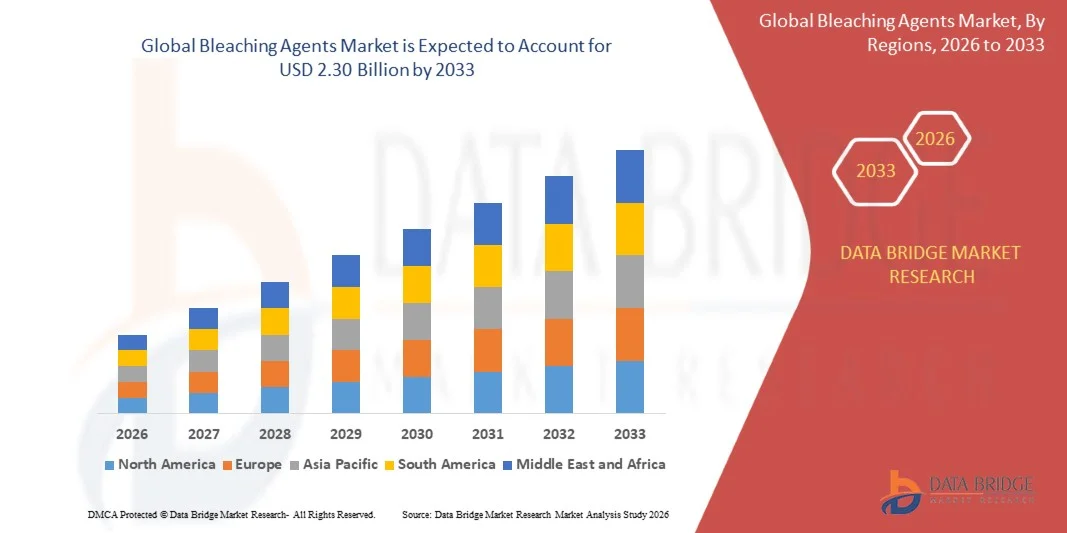
- The global bleaching agents market size was valued at USD 1.11 billion in 2025 and is expected to reach USD 2.30 billion by 2033, at a CAGR of 9.50% during the forecast period
- The market growth is largely fueled by the expanding demand for high-quality processed food products, increasing utilization of bleaching agents in flour, bakery, and dairy applications, and rising industrial usage across textile and paper manufacturing sectors, which is driving consistent consumption across multiple end-use industries
- Furthermore, growing emphasis on product quality, appearance, and safety standards in food and industrial processing, along with increasing adoption of efficient and environmentally compliant chemical solutions, is accelerating the demand for advanced bleaching agents, thereby significantly boosting the market growth
Bleaching Agents Market Analysis
- Bleaching agents are chemical substances used to remove color, whiten, or disinfect materials in industries such as food processing, textiles, paper, and water treatment. These agents improve product quality, enhance visual appeal, and ensure hygiene standards across various applications
- The escalating demand for bleaching agents is primarily driven by the rapid growth of processed food consumption, increasing industrialization, and rising need for effective disinfection and water treatment solutions, supported by advancements in chemical processing technologies and regulatory focus on product safety
- Asia-Pacific dominated the bleaching agents market with a share of 39.5% in 2025, due to expanding food processing industries, rising demand for high-quality flour and bakery products, and strong growth in textile and paper manufacturing sectors
- North America is expected to be the fastest growing region in the bleaching agents market during the forecast period due to rising demand for processed and convenience foods, advancements in food processing technologies, and strong presence of large-scale industrial operations
- Powder segment dominated the market with a market share of 60.5% in 2025, due to its longer shelf life, ease of storage and transportation, and widespread usage across small and medium-scale food processing units where handling convenience and cost efficiency are critical factors. Powdered bleaching agents are less prone to spillage and degradation, making them suitable for regions with limited storage infrastructure and fluctuating environmental conditions
Report Scope and Bleaching Agents Market Segmentation
|
Attributes |
Bleaching Agents Key Market Insights |
|
Segments Covered |
|
|
Countries Covered |
North America
Europe
Asia-Pacific
Middle East and Africa
South America
|
|
Key Market Players |
|
|
Market Opportunities |
|
|
Value Added Data Infosets |
In addition to the insights on market scenarios such as market value, growth rate, segmentation, geographical coverage, and major players, the market reports curated by the Data Bridge Market Research also include import export analysis, production capacity overview, production consumption analysis, price trend analysis, climate change scenario, supply chain analysis, value chain analysis, raw material/consumables overview, vendor selection criteria, PESTLE Analysis, Porter Analysis, and regulatory framework. |
Bleaching Agents Market Trends
“Rising Demand for Eco-Friendly and Sustainable Bleaching Agents”
- A significant trend in the bleaching agents market is the increasing demand for environmentally friendly and sustainable bleaching solutions, driven by stringent environmental regulations and rising consumer awareness regarding the impact of chemical usage across food, textile, and paper industries. This shift is encouraging manufacturers to develop low-residue and biodegradable bleaching agents that align with evolving sustainability standards
- For instance, Evonik offers hydrogen peroxide-based bleaching solutions that decompose into water and oxygen, supporting environmentally compliant processing in pulp, textile, and food applications. Such developments enhance sustainability while maintaining high bleaching efficiency across industrial operations
- The adoption of green chemistry practices is gaining momentum as industries seek to reduce harmful emissions and minimize environmental impact associated with conventional chlorine-based bleaching agents. This is encouraging the transition toward oxygen-based and enzyme-assisted bleaching processes
- The food processing industry is increasingly adopting natural and food-grade bleaching agents to meet clean-label requirements and regulatory approvals. This trend is driving innovation in safer alternatives that improve product quality without compromising health standards
- Industries are investing in advanced processing technologies that enable efficient utilization of eco-friendly bleaching agents while reducing waste generation and energy consumption. This is strengthening operational efficiency and sustainability performance across manufacturing processes
- The market is witnessing a gradual transition toward sustainable product portfolios where companies focus on regulatory compliance, reduced environmental footprint, and enhanced product safety. This trend is reinforcing long-term market growth while aligning with global sustainability objectives
Bleaching Agents Market Dynamics
Driver
“Increasing Consumption of Processed and Packaged Food Products”
- The growing consumption of processed and packaged food products is a major driver for the bleaching agents market, as these agents are widely used to improve color, texture, and overall quality of food items such as flour, bakery products, and dairy ingredients. The rising demand for visually appealing and standardized food products is significantly boosting the use of bleaching agents in food processing industries
- For instance, Archer Daniels Midland Company utilizes flour treatment solutions that include bleaching agents to ensure consistency and quality in large-scale food production. Such applications highlight the importance of bleaching agents in maintaining product uniformity and meeting consumer expectations
- The expansion of the global food processing industry is increasing the need for efficient chemical solutions that enhance shelf appeal and product performance. This is driving consistent demand for bleaching agents across both developed and emerging markets
- Urbanization and changing dietary patterns are accelerating the consumption of ready-to-eat and convenience foods, which rely on standardized raw materials treated with bleaching agents. This is further strengthening the growth trajectory of the market
- The continuous rise in global food demand and the need for consistent quality standards are sustaining this driver. The reliance on bleaching agents to enhance product appearance and processing efficiency is positioning them as critical components in the modern food industry
Restraint/Challenge
“Stringent Environmental and Regulatory Compliance on Chemical Usage”
- The bleaching agents market faces significant challenges due to stringent environmental regulations and safety standards governing the use of chemical substances, particularly chlorine-based agents that may pose risks to health and the environment. These regulations are increasing compliance requirements and limiting the use of certain conventional bleaching chemicals
- For instance, European Chemicals Agency enforces strict guidelines under REACH regulations that restrict the use of hazardous chemicals in industrial applications. Such regulatory frameworks compel manufacturers to reformulate products and invest in safer alternatives, increasing operational costs
- Compliance with environmental standards requires continuous monitoring, testing, and certification processes, which add to production complexity and cost burdens for manufacturers. This creates challenges in maintaining profitability while adhering to regulatory norms
- The shift away from traditional bleaching agents toward environmentally safe alternatives often involves higher production costs and technological investments. This impacts pricing strategies and market competitiveness, particularly for small and medium-scale manufacturers
- The increasing regulatory pressure and environmental scrutiny continue to act as a restraint on market expansion. Manufacturers must balance compliance, cost efficiency, and product performance to sustain growth in a highly regulated environment
Bleaching Agents Market Scope
The market is segmented on the basis of type, form, and application.
• By Type
On the basis of type, the bleaching agents market is segmented into azodicarbonamide, hydrogen peroxide, ascorbic acid, acetone peroxide, chlorine dioxide, and others. The hydrogen peroxide segment dominated the largest market revenue share in 2025, driven by its wide applicability across food processing, pulp and paper, and textile industries due to its strong oxidizing and bleaching properties. Its environmentally favorable decomposition into water and oxygen enhances its preference amid tightening regulatory standards on chemical usage. Industries favor hydrogen peroxide for its effectiveness in improving product appearance while maintaining safety standards. The growing emphasis on sustainable and residue-free bleaching processes further strengthens its demand across multiple industrial applications. Continuous technological advancements in production and stabilization also support its large-scale adoption.
The ascorbic acid segment is anticipated to witness the fastest growth rate from 2026 to 2033, fueled by increasing demand for clean-label and food-grade bleaching agents in the bakery and flour industry. Ascorbic acid is widely used as a dough conditioner and flour improver, enhancing texture and volume without posing health concerns. Rising consumer awareness regarding food safety and natural additives is accelerating its adoption among food manufacturers. Regulatory approvals supporting the use of ascorbic acid in food processing further contribute to its rapid growth. Its compatibility with organic and health-focused product formulations positions it as a preferred choice in evolving food processing standards.
• By Form
On the basis of form, the bleaching agents market is segmented into powder and liquid. The powder segment held the largest market revenue share of 60.5% in 2025 driven by its longer shelf life, ease of storage and transportation, and widespread usage across small and medium-scale food processing units where handling convenience and cost efficiency are critical factors. Powdered bleaching agents are less prone to spillage and degradation, making them suitable for regions with limited storage infrastructure and fluctuating environmental conditions. Their compact packaging and lower logistics costs further enhance their preference among distributors and manufacturers. In addition, powders allow precise dosage control in batch processing, which is critical in maintaining consistent product quality.
The liquid segment is expected to witness the fastest CAGR from 2026 to 2033, driven by its superior solubility, uniform mixing capabilities, and increasing adoption in large-scale industrial applications such as textiles, pulp and paper, and food processing requiring continuous and automated operations. Liquid bleaching agents enable faster processing times and improved operational efficiency due to their ease of integration into automated systems. Their ability to deliver consistent concentration levels ensures better product quality and reduced processing variability.
• By Application
On the basis of application, the bleaching agents market is segmented into bakery products, flour, cheese, and other. The flour segment dominated the largest market revenue share in 2025, driven by the extensive use of bleaching agents to improve flour color, texture, and baking performance. Bleaching agents help achieve consistent product quality, which is essential for large-scale commercial baking operations. The demand for refined and visually appealing flour products significantly contributes to segment growth. Increasing consumption of processed and packaged foods further drives the need for standardized flour treatment solutions. Regulatory allowances for specific bleaching agents in flour processing also support sustained demand.
The bakery products segment is anticipated to witness the fastest growth rate from 2026 to 2033, fueled by the rising demand for processed baked goods and premium-quality products. Bleaching agents play a crucial role in enhancing dough strength, texture, and final product appearance in bakery applications. Growing urbanization and changing dietary patterns are increasing the consumption of bakery items globally. Manufacturers are focusing on improving product consistency and shelf appeal, which drives the use of advanced bleaching solutions. The expansion of commercial bakeries and quick-service restaurants further accelerates the growth of this segment.
Bleaching Agents Market Regional Analysis
- Asia-Pacific dominated the bleaching agents market with the largest revenue share of 39.5% in 2025, driven by expanding food processing industries, rising demand for high-quality flour and bakery products, and strong growth in textile and paper manufacturing sectors
- The region’s cost-effective production environment, increasing investments in food processing infrastructure, and growing demand for packaged and processed foods are accelerating market expansion
- Rapid industrialization, favorable government initiatives supporting manufacturing, and the presence of large-scale chemical production facilities are contributing to increased consumption of bleaching agents across multiple industries
China Bleaching Agents Market Insight
China held the largest share in the Asia-Pacific bleaching agents market in 2025, owing to its dominant position in chemical manufacturing and large-scale food and textile processing industries. The country’s strong industrial base, extensive production capacity, and government support for industrial expansion are key growth drivers. Demand is further supported by increasing exports of processed food products and textiles, along with rising domestic consumption. Continuous investments in chemical processing technologies are enhancing production efficiency and product quality.
India Bleaching Agents Market Insight
India is witnessing the fastest growth in the Asia-Pacific region, fueled by rapid expansion of the food processing sector, increasing consumption of bakery and packaged food products, and rising investments in chemical manufacturing. Government initiatives such as “Make in India” and growing focus on improving food quality standards are boosting demand for bleaching agents. In addition, the growth of textile and paper industries is contributing to increased usage. Expanding domestic production capabilities and rising exports further support market growth.
Europe Bleaching Agents Market Insight
The Europe bleaching agents market is expanding steadily, supported by stringent regulatory standards, strong demand for high-quality and food-grade bleaching agents, and increasing focus on sustainable chemical processing. The region emphasizes product safety, environmental compliance, and innovation in chemical formulations. Growth is further driven by the demand from bakery, dairy, and paper industries requiring consistent product quality. Technological advancements in eco-friendly bleaching solutions are enhancing market development.
Germany Bleaching Agents Market Insight
Germany’s bleaching agents market is driven by its advanced food processing industry, strong chemical manufacturing base, and focus on high-quality production standards. The country benefits from well-established industrial infrastructure and continuous investment in research and development. Demand is particularly high in bakery, dairy, and paper sectors requiring efficient and reliable bleaching solutions. Strong export capabilities and emphasis on sustainable practices further support market growth.
U.K. Bleaching Agents Market Insight
The U.K. market is supported by a mature food and beverage industry, increasing demand for premium-quality processed foods, and growing focus on regulatory compliance and safety standards. Rising investments in food processing technologies and innovation in chemical formulations are driving demand. The presence of established manufacturers and strong distribution networks contributes to steady market growth. Increasing emphasis on clean-label ingredients is also influencing product adoption.
North America Bleaching Agents Market Insight
North America is projected to grow at the fastest CAGR from 2026 to 2033, driven by rising demand for processed and convenience foods, advancements in food processing technologies, and strong presence of large-scale industrial operations. Increasing focus on product quality, safety, and consistency is boosting the adoption of bleaching agents. Growth in the paper and textile industries further contributes to demand. In addition, ongoing investments in sustainable and efficient chemical solutions are supporting market expansion.
U.S. Bleaching Agents Market Insight
The U.S. accounted for the largest share in the North America market in 2025, underpinned by its well-established food processing industry, strong chemical manufacturing capabilities, and advanced technological infrastructure. The country’s emphasis on quality standards and regulatory compliance drives the use of efficient bleaching agents. High consumption of bakery and packaged food products further supports demand. Presence of key market players and continuous innovation in processing techniques strengthen the U.S. market position.
Bleaching Agents Market Share
The bleaching agents industry is primarily led by well-established companies, including:
- Hawkins, Inc. (U.S.)
- Siemer Milling Company (U.S.)
- Supraveni Chemicals (India)
- Spectrum Chemicals (India)
- Gujarat Alkalies and Chemical Limited (India)
- Ashland (U.S.)
- Arkema (France)
- Christeyns (Belgium)
- Aditya Birla Chemicals (India)
- Unilever (U.K.)
- Procter & Gamble (U.S.)
- The Clorox Company (U.S.)
- Spartan Chemical Company (U.S.)
- Shandong Huatai Interox Chemical (China)
- S.C. Johnson & Son (U.S.)
- Merck (Germany)
- Evonik (Germany)
- DuPont (U.S.)
- Dow Chemicals (U.S.)
- Colgate-Palmolive Company (U.S.)
Latest Developments in Global Bleaching Agents Market
- In April 2025, Aditya Birla Chemicals launched its “Vikram” brand Stable Bleaching Powder at Chem Expo India 2025, introducing a specialized 5 kg packaging format tailored for water treatment and sanitation applications, which significantly strengthens its product portfolio and enhances brand visibility in both domestic and international markets. This development supports the company’s strategic focus on expanding its chlorine derivatives segment while addressing increasing demand for reliable and high-performance disinfectants. The improved stability and effectiveness of the product enable better storage and longer usability, making it suitable for residential, municipal, and industrial applications. This launch also reinforces the company’s leadership position and intensifies competition among key players focusing on product innovation and differentiated offerings
- In December 2024, Chlorum Solutions announced an investment of over USD 70 million to establish a facility in Arizona for converting salt into sodium hypochlorite and related chemicals, which is expected to transform supply chain dynamics by enabling localized production and reducing dependency on hazardous chlorine transportation. This initiative enhances safety standards and minimizes logistical complexities associated with chemical handling and distribution. The facility is likely to support consistent supply for municipal water treatment systems while improving cost efficiency over the long term. Such investments indicate a growing industry trend toward decentralized production and safer chemical processing technologies, thereby strengthening overall market resilience
- In November 2024, ANSA McAL completed its USD 327 million acquisition of BLEACHTECH, a Cleveland-based chlor-alkali producer, which significantly enhances its manufacturing capacity and expands its footprint in the bleaching agents and related chemicals market. This acquisition enables access to advanced production technologies and high-purity product lines, improving the company’s ability to cater to municipal and industrial water treatment sectors. It also strengthens its distribution network and market reach, particularly in regions with rising demand for sanitation and water purification solutions. The move reflects increasing consolidation in the market, allowing companies to achieve economies of scale and strengthen competitive positioning
- In August 2024, Olin Corporation lifted its force majeure on chlor-alkali products and resumed production of calcium hypochlorite at its Freeport, Texas facility, which played a crucial role in restoring supply stability following disruptions caused by Hurricane Beryl. The resumption ensured timely fulfillment of pending orders and reduced supply shortages in key markets dependent on consistent availability of bleaching agents. This development highlights the importance of operational resilience and disaster recovery strategies in maintaining market balance. It also reinforces customer confidence and supports the stabilization of pricing trends across the bleaching agents market
- In July 2024, Hangzhou ASIA Chemical Engineering Co., Ltd. launched a new high-efficiency bleaching powder production line capable of producing calcium hypochlorite with over 70% chlorine content, which enhances production efficiency and supports compliance with international quality standards. This expansion enables the company to meet growing global demand for high-performance disinfectants used in water treatment and sanitation applications. The improved production capabilities reduce operational costs and increase output capacity, strengthening its competitive advantage. This development reflects the broader industry focus on technological advancement and capacity expansion to cater to rising demand across industrial and municipal sectors

- Interactive Data Analysis Dashboard
- Company Analysis Dashboard for high growth potential opportunities
- Research Analyst Access for customization & queries
- Competitor Analysis with Interactive dashboard
- Latest News, Updates & Trend analysis
- Harness the Power of Benchmark Analysis for Comprehensive Competitor Tracking
Global Bleaching Agents Market, Supply Chain Analysis and Ecosystem Framework
To support market growth and help clients navigate the impact of geopolitical shifts, DBMR has integrated in-depth supply chain analysis into its Global Bleaching Agents Market research reports. This addition empowers clients to respond effectively to global changes affecting their industries. The supply chain analysis section includes detailed insights such as Global Bleaching Agents Market consumption and production by country, price trend analysis, the impact of tariffs and geopolitical developments, and import and export trends by country and HSN code. It also highlights major suppliers with data on production capacity and company profiles, as well as key importers and exporters. In addition to research, DBMR offers specialized supply chain consulting services backed by over a decade of experience, providing solutions like supplier discovery, supplier risk assessment, price trend analysis, impact evaluation of inflation and trade route changes, and comprehensive market trend analysis.
Data collection and base year analysis are done using data collection modules with large sample sizes. The stage includes obtaining market information or related data through various sources and strategies. It includes examining and planning all the data acquired from the past in advance. It likewise envelops the examination of information inconsistencies seen across different information sources. The market data is analysed and estimated using market statistical and coherent models. Also, market share analysis and key trend analysis are the major success factors in the market report. To know more, please request an analyst call or drop down your inquiry.
The key research methodology used by DBMR research team is data triangulation which involves data mining, analysis of the impact of data variables on the market and primary (industry expert) validation. Data models include Vendor Positioning Grid, Market Time Line Analysis, Market Overview and Guide, Company Positioning Grid, Patent Analysis, Pricing Analysis, Company Market Share Analysis, Standards of Measurement, Global versus Regional and Vendor Share Analysis. To know more about the research methodology, drop in an inquiry to speak to our industry experts.
Data Bridge Market Research is a leader in advanced formative research. We take pride in servicing our existing and new customers with data and analysis that match and suits their goal. The report can be customized to include price trend analysis of target brands understanding the market for additional countries (ask for the list of countries), clinical trial results data, literature review, refurbished market and product base analysis. Market analysis of target competitors can be analyzed from technology-based analysis to market portfolio strategies. We can add as many competitors that you require data about in the format and data style you are looking for. Our team of analysts can also provide you data in crude raw excel files pivot tables (Fact book) or can assist you in creating presentations from the data sets available in the report.













