


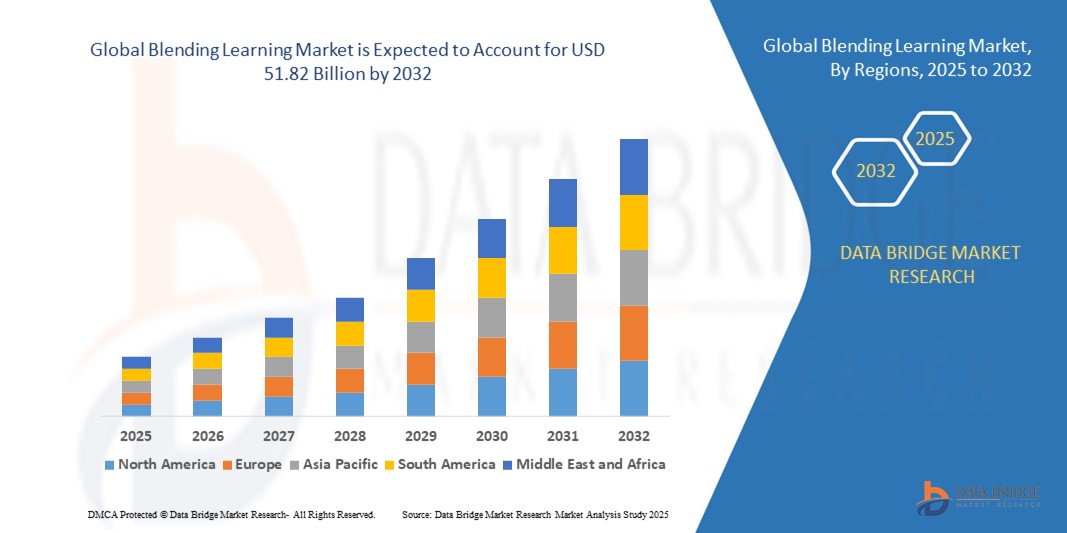
Blending Learning Market Size
- The global blending learning market size was valued at USD 23.14 billion in 2024 and is expected to reach USD 51.82 billion by 2032, at a CAGR of 10.6% during the forecast period
- The market growth is largely fueled by the rising adoption of digital education platforms, government-led initiatives to modernize learning, and the increasing integration of advanced technologies such as AI, cloud, and mobile applications into education systems. These developments are driving significant digitalization across schools, universities, and corporate training programs
- Furthermore, the growing demand for flexible, cost-effective, and personalized education solutions is establishing blending learning as a preferred model among institutions, educators, and learners. These converging factors are accelerating the uptake of blending learning solutions, thereby significantly boosting the industry's growth
Blending Learning Market Analysis
- Blending learning combines traditional classroom instruction with digital tools, online platforms, and interactive content, creating a hybrid model that enhances accessibility, engagement, and learning outcomes. This approach is increasingly adopted across academic institutions, corporate training, and professional development programs due to its adaptability and scalability
- The escalating demand for blending learning is primarily fueled by rising digital penetration, increasing need for skill-based training, and the growing preference for self-paced yet structured education. The ability to integrate face-to-face learning with digital resources is positioning blending learning as a transformative solution in the evolving global education landscape
- North America dominated the blending learning market with a share of 35.5% in 2024, due to the rapid digitalization of the education sector, strong adoption of e-learning platforms, and significant investments in EdTech by both institutions and governments
- Asia-Pacific is expected to be the fastest growing region in the blending learning market during the forecast period due to increasing urbanization, rapid digital adoption, and strong government-led initiatives to digitize education in countries such as China, India, and Japan
- Solutions segment dominated the market with a market share of 46.1% in 2024, due to the growing demand for integrated digital content platforms, learning management systems (LMS), and adaptive learning software. Educational institutions are increasingly adopting blended learning solutions to provide personalized and flexible learning experiences that cater to different student needs. The scalability of solutions across diverse institutions and their ability to integrate multimedia resources make them the cornerstone of digital education strategies. Furthermore, rising partnerships between edtech companies and schools are strengthening the adoption of advanced blended learning solutions
Report Scope and Blending Learning Market Segmentation
|
Attributes |
Blending Learning Key Market Insights |
|
Segments Covered |
|
|
Countries Covered |
North America
Europe
Asia-Pacific
Middle East and Africa
South America
|
|
Key Market Players |
|
|
Market Opportunities |
|
|
Value Added Data Infosets |
In addition to the market insights such as market value, growth rate, market segments, geographical coverage, market players, and market scenario, the market report curated by the Data Bridge Market Research team includes in-depth expert analysis, import/export analysis, pricing analysis, production consumption analysis, and pestle analysis. |
Blending Learning Market Trends
Rise of AI-driven Personalized Learning
- The increasing integration of artificial intelligence and machine learning in blended learning programs is revolutionizing educational experiences by offering adaptive, personalized content, real-time assessment, and predictive analytics to individual learners, enhancing academic engagement and outcomes
- For instance, education platforms such as Coursera, edX, and Khan Academy are embedding AI-powered recommendation engines, chatbots, and intelligent tutoring systems into their blended learning ecosystems to help teachers deliver customized learning paths, monitor progress, and address achievement gaps more effectively
- AI-based technologies support automated grading, feedback, and content curation, empowering educators to focus on higher-value teaching activities and enabling students to benefit from instant support and tailored resources
- Expansion of virtual and augmented reality tools in blended learning improves practical training and immersive educational experiences for learners across STEM, healthcare, and vocational sectors
- Data-driven decision-making enabled by advanced analytics allows institutions to optimize blended learning strategies and intervene early with targeted support for struggling students
- Rise in demand for multilingual and accessible content via natural language processing helps bridge equity gaps, supporting inclusion in diverse classroom environments
Blending Learning Market Dynamics
Driver
Rising Technological Advancements
- Accelerating advancements in digital technology—including cloud computing, learning management systems, and mobile applications—are enabling more flexible, scalable, and interactive blended learning environments adaptable to the needs of diverse student populations
- For instance, platforms such as Google Classroom, Moodle, and Microsoft Teams are providing robust infrastructures for content delivery, collaboration, and assessment, making blended models practical and scalable across K-12, higher education, and corporate training markets
- Integration of collaborative tools, gamification, and peer-to-peer learning enhances student engagement, retention, and motivation, supporting improved educational outcomes. Ubiquity of smartphones and portable devices allows anytime, anywhere access to digital content, fostering self-paced learning and lifelong skills development
- Technological innovation supports continuous improvement and expansion of blended learning models, enabling agile responses to changing curricular needs and workforce demands
- In addition, widespread cloud adoption ensures secure data storage, scalability, and rapid system deployment for institutions seeking rapid transition to blended frameworks
Restraint/Challenge
Infrastructure and Connectivity Challenges
- Infrastructure gaps—including lack of reliable internet, insufficient device accessibility, and limited digital literacy—pose significant barriers to widespread adoption and effectiveness of blended learning, particularly in rural and underserved regions
- For instance, schools and institutions in low-resource settings may struggle to offer seamless blended learning experiences due to unreliable connectivity, outdated hardware, and inadequate technical support, despite strong interest and policy mandates
- Variability in broadband speed and network stability can result in inconsistent learning experiences, undermining student engagement and equal opportunity
- Ongoing costs for hardware upgrades, network expansion, and device maintenance create financial pressures for institutions, government agencies, and families, slowing implementation of blended models
- Regulatory and privacy concerns surrounding data protection and secure online learning environments further complicate deployment, especially across international or cross-regional education markets
Blending Learning Market Scope
The market is segmented on the basis of type and application.
- By Type
On the basis of type, the blended learning market is segmented into hardware, system, and solutions. The solutions segment dominated the largest market revenue share of 46.1% in 2024, supported by the growing demand for integrated digital content platforms, learning management systems (LMS), and adaptive learning software. Educational institutions are increasingly adopting blended learning solutions to provide personalized and flexible learning experiences that cater to different student needs. The scalability of solutions across diverse institutions and their ability to integrate multimedia resources make them the cornerstone of digital education strategies. Furthermore, rising partnerships between edtech companies and schools are strengthening the adoption of advanced blended learning solutions.
The hardware segment is anticipated to witness the fastest growth rate from 2025 to 2032, driven by the rapid expansion of digital classrooms and the widespread distribution of devices such as tablets, laptops, and interactive whiteboards. Schools and educational institutions are investing in infrastructure upgrades to enable seamless digital learning experiences. The increasing affordability of smart devices and supportive government initiatives for digital literacy are further boosting hardware adoption. In addition, the integration of hardware with cloud-based tools and learning platforms enhances accessibility, making hardware investments critical for advancing blended learning in both developed and emerging regions.
- By Application
On the basis of application, the blended learning market is segmented into pre-primary school, primary school, middle school, and high school. The high school segment held the largest market revenue share in 2024, primarily due to the greater need for advanced learning tools, exam preparation resources, and subject-specific digital modules. High schools are increasingly adopting blended learning methods to improve academic performance, enable flexible scheduling, and provide access to supplementary content for competitive exams and higher education readiness. Furthermore, the rising emphasis on skill-based learning and career-oriented programs makes high schools a prime adopter of blended learning strategies.
The primary school segment is expected to witness the fastest CAGR from 2025 to 2032, fueled by the rising integration of interactive digital tools to enhance foundational learning in subjects such as math, science, and language. Early adoption of technology is being encouraged by governments and school boards to improve engagement and ensure better learning outcomes at the foundational stage. Parents are also increasingly supportive of blended learning in primary education as it enables personalized pace-based learning and fosters creativity through gamified applications. The combination of traditional classroom instruction with engaging digital content is proving highly effective in strengthening basic skills among young learners.
Blending Learning Market Regional Analysis
- North America dominated the blending learning market with the largest revenue share of 35.5% in 2024, driven by the rapid digitalization of the education sector, strong adoption of e-learning platforms, and significant investments in EdTech by both institutions and governments
- Schools and universities in the region are actively integrating blended models to improve engagement and academic outcomes. This widespread adoption is further supported by advanced internet infrastructure, high device penetration, and the growing preference for flexible learning formats
- The region’s strong presence of leading EdTech providers and increasing focus on personalized learning experiences continue to strengthen market growth
U.S. Blending Learning Market Insight
The U.S. blending learning market captured the largest revenue share in 2024 within North America, fueled by the rapid uptake of digital classrooms and strong demand for hybrid education models in K–12 and higher education. The presence of top EdTech companies and increased government funding for digital literacy programs are accelerating adoption. Growing interest in personalized, self-paced learning, along with widespread integration of AI-powered platforms and gamified applications, is further supporting expansion. In addition, the rising use of blending learning in professional training and skill development is broadening the U.S. market landscape.
Europe Blending Learning Market Insight
The Europe blending learning market is projected to expand at a substantial CAGR throughout the forecast period, primarily driven by government initiatives to modernize education systems and the rising emphasis on digital skills. Increasing adoption of e-learning platforms in both academic and corporate training settings is fueling market growth. European schools and universities are integrating blending models to support student-centric learning and improve accessibility across diverse populations. The region’s push toward digital transformation in education and the adoption of cost-effective cloud-based learning solutions are further strengthening blending learning adoption.
U.K. Blending Learning Market Insight
The U.K. blending learning market is anticipated to grow at a noteworthy CAGR during the forecast period, driven by strong adoption of digital platforms in schools, higher education, and professional training institutes. The country’s focus on building a digitally skilled workforce and government-backed funding programs for EdTech implementation are accelerating growth. Increasing use of blending learning to complement traditional classroom methods, along with a growing culture of lifelong learning, continues to boost market expansion in the U.K.
Germany Blending Learning Market Insight
The Germany blending learning market is expected to expand at a considerable CAGR during the forecast period, supported by the country’s emphasis on digital education strategies and advanced infrastructure. German schools and universities are actively shifting toward hybrid learning to enhance flexibility, accessibility, and student engagement. With strong government support for digital transformation in education and the integration of immersive technologies such as AR/VR into blending platforms, Germany is emerging as one of the leading European markets for blending learning adoption.
Asia-Pacific Blending Learning Market Insight
The Asia-Pacific blending learning market is poised to grow at the fastest CAGR during 2025 to 2032, driven by increasing urbanization, rapid digital adoption, and strong government-led initiatives to digitize education in countries such as China, India, and Japan. The region is witnessing significant demand for low-cost digital learning solutions, supported by the growing affordability of smart devices and internet access. Rising investments in EdTech startups and the widespread use of blending models in both public and private educational institutions are further boosting growth.
Japan Blending Learning Market Insight
The Japan blending learning market is gaining momentum due to its highly developed digital ecosystem, emphasis on innovative education methods, and increasing demand for flexible learning models. Blending learning is widely adopted across schools and universities, supported by government-backed digital education programs. The integration of AI, gamification, and mobile platforms is fueling adoption, while the country’s aging population and emphasis on reskilling initiatives are creating new opportunities in lifelong learning and corporate training.
China Blending Learning Market Insight
The China blending learning market accounted for the largest market revenue share in Asia-Pacific in 2024, supported by rapid digitalization of education, strong government policies, and the expansion of smart classrooms. The country’s massive student population and growing EdTech ecosystem are driving adoption across K–12, higher education, and professional training. Affordable digital platforms, local innovations, and rising investments in AI-powered learning solutions are further strengthening China’s position as a leading blending learning market.
Blending Learning Market Share
The blending learning industry is primarily led by well-established companies, including:
- McGraw-Hill (U.S.)
- Pearson(U.K.)
- Skillsoft Corporation (U.S.)
- D2L Corporation (Canada)
- Cornerstone OnDemand Inc. (U.S.)
- NIIT Limited (India)
- Blackboard Inc. (U.S.)
- City & Guilds Group (U.K.)
- Saba Software Inc. (U.S.)
- GP Strategies Corporation (U.S.)
- Aptara Inc. (U.S.)
Latest Developments in Global Blending Learning Market
- In 2022, Google added a new feature to its Google Classroom platform that enables tutors to input grading data before exporting documents to the classroom. This enhancement streamlined the grading process, saving educators time and improving workflow efficiency. By simplifying administrative tasks, the update further strengthened Google Classroom’s value proposition in the blending learning market, making it a more attractive platform for schools and institutions looking to optimize digital learning operations
- In 2022, D2L introduced its Brightspace Creator Package, designed to allow users to create and engage with digital course content through integrated workflows within the Brightspace platform. This innovation reduced the cost, time, and effort required for course development, empowering educators to deliver content more effectively. The launch positioned D2L as a stronger competitor in the blending learning market by offering practical tools that enhance flexibility and efficiency for both educators and institutions
- In April 2021, D2L announced a partnership with Zoom Video Communications, Inc., integrating Zoom’s video-first unified communications platform with the Brightspace learning platform. This collaboration enabled seamless online and blending learning experiences by combining live, face-to-face video with digital course delivery. The move significantly enhanced the comprehensiveness of D2L’s offerings in North America, reinforcing its market presence and driving adoption among institutions seeking robust hybrid learning solutions
- In January 2021, Skillsoft expanded the capabilities of its Percipio learning platform by adding new options for blending learning, covering the full breadth of learning programs. This development broadened Skillsoft’s solution portfolio, allowing it to meet diverse organizational training needs more effectively. By strengthening its platform’s adaptability and reach, Skillsoft positioned itself as a key player in driving digital transformation in corporate learning environments

- Interactive Data Analysis Dashboard
- Company Analysis Dashboard for high growth potential opportunities
- Research Analyst Access for customization & queries
- Competitor Analysis with Interactive dashboard
- Latest News, Updates & Trend analysis
- Harness the Power of Benchmark Analysis for Comprehensive Competitor Tracking
Data collection and base year analysis are done using data collection modules with large sample sizes. The stage includes obtaining market information or related data through various sources and strategies. It includes examining and planning all the data acquired from the past in advance. It likewise envelops the examination of information inconsistencies seen across different information sources. The market data is analysed and estimated using market statistical and coherent models. Also, market share analysis and key trend analysis are the major success factors in the market report. To know more, please request an analyst call or drop down your inquiry.
The key research methodology used by DBMR research team is data triangulation which involves data mining, analysis of the impact of data variables on the market and primary (industry expert) validation. Data models include Vendor Positioning Grid, Market Time Line Analysis, Market Overview and Guide, Company Positioning Grid, Patent Analysis, Pricing Analysis, Company Market Share Analysis, Standards of Measurement, Global versus Regional and Vendor Share Analysis. To know more about the research methodology, drop in an inquiry to speak to our industry experts.
Data Bridge Market Research is a leader in advanced formative research. We take pride in servicing our existing and new customers with data and analysis that match and suits their goal. The report can be customized to include price trend analysis of target brands understanding the market for additional countries (ask for the list of countries), clinical trial results data, literature review, refurbished market and product base analysis. Market analysis of target competitors can be analyzed from technology-based analysis to market portfolio strategies. We can add as many competitors that you require data about in the format and data style you are looking for. Our team of analysts can also provide you data in crude raw excel files pivot tables (Fact book) or can assist you in creating presentations from the data sets available in the report.













