


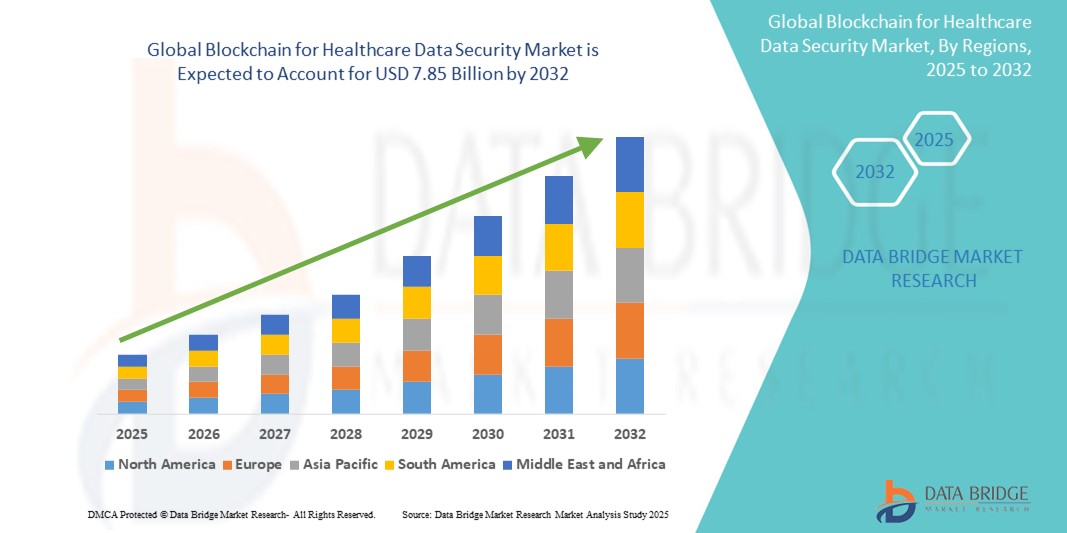
Blockchain for Healthcare Data Security Market Size
- The global blockchain for healthcare data security market size was valued at USD 1.47 billion in 2024 and is expected to reach USD 7.85 billion by 2032, at a CAGR of 23.30% during the forecast period
- The market growth is largely fueled by the growing adoption of digital health technologies and the increasing need for secure, tamper-proof healthcare data exchange across stakeholders such as hospitals, payers, pharmaceutical firms, and research organizations. Blockchain enables decentralized storage, immutable audit trails, and real-time verification, which address critical concerns related to data breaches, compliance, and patient privacy
- Furthermore, rising demand for interoperable health systems, increasing incidences of healthcare cyberattacks, and the need for improved traceability in pharmaceutical supply chains are establishing blockchain as a vital technology for healthcare data security. These converging factors are accelerating the uptake of Blockchain for Healthcare Data Security solutions, thereby significantly boosting the industry's growth
Blockchain for Healthcare Data Security Market Analysis
- Blockchain for healthcare data security solutions are increasingly vital to the modern digital health ecosystem due to their enhanced data integrity, real-time verification capabilities, and ability to provide decentralized control across healthcare stakeholders including hospitals, payers, and research organizations. These attributes make blockchain technology crucial in managing sensitive patient data and preventing cyber threats
- The escalating demand for blockchain in healthcare is primarily fueled by the rising adoption of electronic health records (EHRs), increasing data breaches, growing regulatory pressure for secure data exchange, and the need for interoperability across healthcare systems
- North America dominated the blockchain for healthcare data security market with the largest revenue share of 41.3% in 2024, characterized by robust investments in health IT infrastructure, early adoption of blockchain platforms, and a strong presence of major technology vendors. The U.S. leads the region, driven by favorable regulations, increasing incidences of cyberattacks, and growing pilot projects by healthcare providers and insurers
- Asia-Pacific is expected to be the fastest-growing region in the blockchain for healthcare data security market during the forecast period, projected to grow at a CAGR of 23.9% from 2025 to 2032, supported by rising healthcare digitalization, government-backed blockchain initiatives, and expanding medical tourism in countries such as India, China, and Singapore
- The Private Blockchain segment dominated the blockchain for healthcare data security market with a market share of 41.6% in 2024, owing to its enhanced data privacy, restricted access capabilities, and suitability for sensitive healthcare data management. Hospitals and healthcare providers increasingly prefer private blockchain networks for better compliance with HIPAA and GDPR standards
Report Scope and Blockchain for Healthcare Data Security Market Segmentation
|
Attributes |
Blockchain for Healthcare Data Security Key Market Insights |
|
Segments Covered |
|
|
Countries Covered |
North America
Europe
Asia-Pacific
Middle East and Africa
South America
|
|
Key Market Players |
|
|
Market Opportunities |
|
|
Value Added Data Infosets |
In addition to the insights on market scenarios such as market value, growth rate, segmentation, geographical coverage, and major players, the market reports curated by the Data Bridge Market Research also include in-depth expert analysis, pricing analysis, brand share analysis, consumer survey, demography analysis, supply chain analysis, value chain analysis, raw material/consumables overview, vendor selection criteria, PESTLE Analysis, Porter Analysis, and regulatory framework. |
Blockchain for Healthcare Data Security Market Trends
“Improved Security, Transparency, and Patient Data Control”
- A significant and accelerating trend in the global blockchain for healthcare data security market is the increasing adoption of blockchain technology to enhance the transparency, traceability, and security of sensitive patient data across healthcare systems
- For instance, blockchain enables the creation of tamper-proof audit trails that ensure all patient information, consent records, and clinical transactions are immutably recorded. This helps prevent unauthorized access and data manipulation, which are critical concerns in modern healthcare data management
- Blockchains also support decentralized data storage and permissioned access, empowering patients to control who accesses their health records and under what circumstances. This fosters greater trust between healthcare providers and patients while ensuring compliance with data privacy regulations such as HIPAA and GDPR
- Moreover, blockchain-integrated solutions enable seamless interoperability across healthcare systems and providers by creating unified, verifiable records. This reduces administrative inefficiencies, improves diagnostic accuracy, and enhances care coordination among hospitals, labs, payers, and clinicians
- Companies such as Guardtime, IBM, and Change Healthcare are actively deploying blockchain-based solutions for securing electronic health records (EHR), managing drug supply chains, and processing insurance claims
- The demand for secure, decentralized healthcare data infrastructure is growing rapidly across hospitals, research institutions, and insurance providers, as cyberattacks on medical systems become more frequent and costly. As a result, the blockchain for healthcare data security market is expected to witness strong and sustained growth during the forecast period
Blockchain for Healthcare Data Security Market Dynamics
Driver
“Growing Need for Data Integrity and Secure Health Information Exchange”
- The increasing reliance on electronic health records (EHRs), combined with rising concerns about healthcare data breaches, is a major driver for the adoption of blockchain in healthcare data security. Blockchain technology ensures tamper-proof records and enhances transparency and traceability in data sharing across various healthcare entities
- For instance, in April 2024, BurstIQ announced a partnership with several hospital networks to implement blockchain-powered platforms aimed at enabling secure, patient-consented data exchange. Such initiatives by industry leaders are anticipated to accelerate Blockchain for Healthcare Data Security market growth over the forecast period
- With rising awareness among healthcare providers about cyber threats and ransomware attacks, blockchain offers a decentralized solution that minimizes single points of failure and provides encrypted, traceable access to sensitive data
- Furthermore, the increasing demand for interoperable health IT systems and the growing popularity of decentralized identity management solutions are positioning blockchain as a critical component of future healthcare infrastructure. Blockchain platforms can integrate with existing EHRs and allow secure cross-institutional data exchange without compromising patient privacy
- Benefits such as immutable audit trails, real-time updates, and permission-based access to clinical and operational data are propelling adoption across hospitals, payers, and pharmaceutical companies. As regulatory bodies such as the FDA and EMA push for greater transparency in drug traceability and data handling, blockchain is gaining traction as a compliance-ready technology
- In addition, the growing application of blockchain in clinical trials, billing fraud prevention, and supply chain verification supports its integration into diverse areas of the healthcare ecosystem
Restraint/Challenge
“Scalability Issues and Regulatory Uncertainty”
- Despite its promising features, the blockchain for healthcare data Security market faces scalability challenges. Current blockchain infrastructures often struggle with processing large volumes of healthcare transactions in real time, limiting their effectiveness in high-throughput environments such as national health systems
- Furthermore, the absence of standardized regulatory frameworks across countries complicates the widespread adoption of blockchain in healthcare. Organizations must navigate a complex landscape of data privacy laws such as HIPAA, GDPR, and regional-specific healthcare regulations, often without clear guidance on blockchain applicability
- Concerns around data ownership and control also arise in decentralized systems, as stakeholders may disagree on who has permission to write or access data across a distributed ledger
- High initial implementation costs, including investments in infrastructure, training, and compliance management, also act as a barrier—especially for small- to mid-sized healthcare providers
- Overcoming these obstacles will require industry collaboration on interoperability standards, development of energy-efficient and scalable blockchain solutions, and proactive policy-making from regulatory authorities. Addressing these gaps will be essential to realizing the full potential of blockchain in securing healthcare data and driving digital trust across the ecosystem
Blockchain for Healthcare Data Security Market Scope
The Blockchain for Healthcare Data Security market is segmented into four notable segments based on type, application, end user, and component.
• By Type
On the basis of type, the blockchain for healthcare data security market is segmented into public blockchain, private blockchain, consortium blockchain, and hybrid blockchain. The private blockchain segment dominated the largest market revenue share of 41.6% in 2024, owing to its enhanced data privacy, restricted access capabilities, and suitability for sensitive healthcare data management. Hospitals and healthcare providers increasingly prefer private blockchain networks for better compliance with HIPAA and GDPR standards.
The consortium blockchain segment is projected to witness the fastest growth rate of 23.2% from 2025 to 2032, driven by collaborative efforts among multiple healthcare stakeholders including hospitals, insurers, and pharmaceutical companies aiming to streamline secure data sharing across institutions.
• By Application
On the basis of application, the market is segmented into clinical data exchange & interoperability, claims adjudication & billing management, supply chain management, drug traceability, and others. The clinical data exchange & interoperability segment held the largest market revenue share of 34.8% in 2024, due to increasing demand for secure and transparent sharing of patient data across different healthcare entities, leading to better care coordination and treatment outcomes.
The drug traceability segment is expected to register the highest CAGR of 24.5% from 2025 to 2032, fueled by regulatory mandates and the growing need to detect counterfeit drugs and ensure authenticity within pharmaceutical supply chains.
• By End User
On the basis of end user, the market is segmented into pharmaceutical companies, healthcare providers, healthcare payers, and others. The pharmaceutical companies segment dominated the market with the highest revenue share of 38.9% in 2024, driven by increasing adoption of blockchain to enhance transparency and traceability in drug manufacturing, logistics, and regulatory compliance.
The healthcare providers segment is expected to witness the fastest growth with a CAGR of 10% over the forecast period, owing to the rising need for secure and interoperable patient record systems and increasing cyber threats targeting hospitals and clinics.
• By Component
On the basis of component, the blockchain for healthcare data security market is segmented into blockchain platforms and services. The blockchain platforms segment held the largest market share of 56.3% in 2024, attributed to rising deployment of advanced decentralized systems across hospitals and life sciences organizations.
The services segment is projected to grow at the highest CAGR of 21.9% during the forecast period, due to the increasing demand for consultation, integration, and support services among healthcare stakeholders adopting blockchain infrastructure for the first time.
Blockchain for Healthcare Data Security Market Regional Analysis
- North America dominated the blockchain for healthcare data security market with the largest revenue share of 41.3% in 2024, driven by the region’s advanced healthcare IT infrastructure
- Early adoption of emerging technologies, and stringent data protection regulations such as HIPAA
- The demand for blockchain solutions is rising to enhance data interoperability and security in healthcare systems, especially in managing electronic health records (EHRs) and claims management
U.S. Blockchain for Healthcare Data Security Market Insight
The U.S. blockchain for healthcare data security market held the largest revenue share of 82% within North America in 2024. This dominance is attributed to large-scale investments by healthcare providers and payers in digital health technologies, as well as growing cybersecurity concerns. Strategic collaborations between blockchain developers and hospitals, such as the Mayo Clinic and IBM’s partnerships, are enhancing transparency and trust in data sharing. Regulatory support and pilot blockchain programs by federal agencies further boost adoption.
Europe. Blockchain for Healthcare Data Security Market Insight
The Europe blockchain for healthcare data security market is projected to expand at a substantial CAGR during the forecast period, supported by the implementation of GDPR, which emphasizes data privacy and transparency. Blockchain's decentralized architecture is appealing for secure, patient-centric data sharing across countries in the EU. Rising investments in digital health transformation and pharma supply chain transparency are key growth contributors.
U.K. Blockchain for Healthcare Data Security Market Insight
The U.K. blockchain for healthcare data security market is forecasted to grow at a noteworthy CAGR from 2025 to 2032, driven by NHS initiatives for health data interoperability and digital patient identity verification. The government’s interest in creating a secure, interoperable system across providers using blockchain-based platforms is fueling adoption.
Germany Blockchain for Healthcare Data Security Market Insight
The Germany blockchain for healthcare data security market is expected to witness a considerable CAGR from 2025 to 2032, underpinned by its robust data protection laws, strong digital health ecosystem, and state-funded pilot programs focusing on blockchain-enabled drug traceability and health insurance billing fraud prevention.
Asia Pacific Blockchain for Healthcare Data Security Market Insight
The Asia-Pacific blockchain for healthcare data security market is expected to be the fastest-growing region, with a CAGR of 23.9% from 2025 to 2032, propelled by rapid digital transformation, government initiatives promoting electronic health records, and increasing cyberattacks targeting healthcare institutions. Blockchain solutions are gaining momentum in managing medical supply chains and patient data across India, China, and Southeast Asia.
Japan Blockchain for Healthcare Data Security Market Insight
The Japan’s blockchain for healthcare data security market is growing steadily with a CAGR of 19.8%, driven by the aging population and rising demand for secure health information exchange systems. Japan is integrating blockchain with IoT-based elder care and telemedicine platforms to enhance safety and efficiency.
China Blockchain for Healthcare Data Security Market Insight
The China blockchain for healthcare data security market held the largest revenue share in Asia-Pacific in 2024, accounting for 34.9%, due to strong support from the government for blockchain pilot zones and national strategies for digital healthcare. Local tech giants such as Alibaba Health and Tencent are investing heavily in blockchain-based drug tracking and digital medical records.
Blockchain for Healthcare Data Security Market Share
The blockchain for healthcare data security industry is primarily led by well-established companies, including:
- Pfizer Inc. (U.S.)
- Intas Pharmaceutical Ltd. (India)
- Cipla (India)
- Torrent Laboratories Ltd. (India)
- Acron Laboratories (India)
- Sun Pharmaceuticals Industries Ltd. (India)
- Taj Pharmaceuticals Limited (India)
- Lannett (U.S.)
- Viatris Inc. (U.S.)
- Hikma Pharmaceuticals PLC (U.K.)
- Teva Pharmaceutical Industries Ltd. (Israel)
- Mayne Pharma Group Limited (Australia)
- Fresenius Kabi AG (Germany)
- Baxter (U.S.)
- GSK plc (U.K.)
- Perrigo Company plc (U.S.)
- AV GROW HEALTH CARE (India)
- Lupin (India)
- Hetero (India)
- Zydus Group (India)
Latest Developments in Global Blockchain for Healthcare Data Security Market
- In April 2025, the U.S. Department of Health and Human Services (HHS) Office for Civil Rights (OCR) proposed significant updates to the HIPAA Security Rule to address increasing cybersecurity threats. The changes mandate encryption of ePHI, implementation of multifactor authentication, and enhanced network segmentation. These proposed regulations are expected to significantly accelerate the adoption of blockchain-based healthcare data security systems, due to their ability to ensure immutable, encrypted, and decentralized data storage
- In May 2025, researchers introduced hChain 4.0, a next-generation permissioned blockchain framework designed for healthcare. This system combines pseudonymization, attribute-based access control, and partial homomorphic encryption to secure Electronic Health Records (EHRs) from edge devices to blockchain networks. The pilot aims to provide scalable, HIPAA-compliant data exchange among healthcare providers while maintaining patient confidentiality
- In March 2025, Circular Protocol, in collaboration with Arculus and IT Lab, launched the “Smart Share” platform—a blockchain-based solution for secure medical data authentication. The platform allows patients and providers to digitally sign and verify sensitive records using hardware card keys, offering tamper-proof medical identity and improving interoperability across systems
- In December 2024, in response to multiple large-scale healthcare cyberattacks—including a breach of 100 million UnitedHealth records—HHS OCR emphasized the critical need for secure patient data systems. Blockchain-based solutions were highlighted as a viable method to ensure data traceability, tamper resistance, and secure access controls in real-time
- In April 2025, a joint study published in Medical Technology revealed that blockchain combined with artificial intelligence is emerging as a preferred defense mechanism against ransomware and phishing attacks in healthcare. As of 2024, over 305 million healthcare records were compromised globally, prompting nearly 20% of U.S. hospitals to adopt or pilot blockchain-integrated systems for healthcare data security
- In February 2025, a report by the U.S. Government Accountability Office (GAO) reinforced the value of decentralized technologies such as blockchain for improving resilience in healthcare data infrastructures. The report recommended federal incentives to support blockchain adoption in public and private healthcare institutions

- Interactive Data Analysis Dashboard
- Company Analysis Dashboard for high growth potential opportunities
- Research Analyst Access for customization & queries
- Competitor Analysis with Interactive dashboard
- Latest News, Updates & Trend analysis
- Harness the Power of Benchmark Analysis for Comprehensive Competitor Tracking
Data collection and base year analysis are done using data collection modules with large sample sizes. The stage includes obtaining market information or related data through various sources and strategies. It includes examining and planning all the data acquired from the past in advance. It likewise envelops the examination of information inconsistencies seen across different information sources. The market data is analysed and estimated using market statistical and coherent models. Also, market share analysis and key trend analysis are the major success factors in the market report. To know more, please request an analyst call or drop down your inquiry.
The key research methodology used by DBMR research team is data triangulation which involves data mining, analysis of the impact of data variables on the market and primary (industry expert) validation. Data models include Vendor Positioning Grid, Market Time Line Analysis, Market Overview and Guide, Company Positioning Grid, Patent Analysis, Pricing Analysis, Company Market Share Analysis, Standards of Measurement, Global versus Regional and Vendor Share Analysis. To know more about the research methodology, drop in an inquiry to speak to our industry experts.
Data Bridge Market Research is a leader in advanced formative research. We take pride in servicing our existing and new customers with data and analysis that match and suits their goal. The report can be customized to include price trend analysis of target brands understanding the market for additional countries (ask for the list of countries), clinical trial results data, literature review, refurbished market and product base analysis. Market analysis of target competitors can be analyzed from technology-based analysis to market portfolio strategies. We can add as many competitors that you require data about in the format and data style you are looking for. Our team of analysts can also provide you data in crude raw excel files pivot tables (Fact book) or can assist you in creating presentations from the data sets available in the report.













