


Blockchain Gaming Market Size
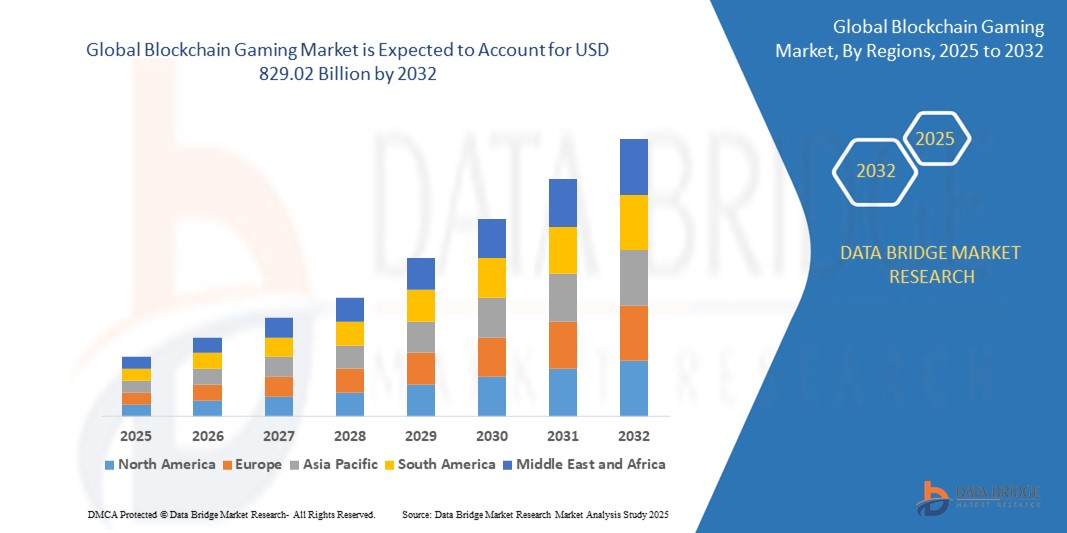
- The global blockchain gaming market size was valued at USD 14.07 billion in 2024 and is expected to reach USD 829.02 billion by 2032, at a CAGR of 66.45% during the forecast period
- The market growth is largely fuelled by the increasing adoption of play-to-earn (P2E) models, rising demand for decentralized ownership, and growing interest in in-game assets with real-world value
- Expanding integration of non-fungible tokens (NFTs) and smart contracts is enabling secure, transparent, and player-owned ecosystems, driving deeper engagement and monetization potential
Blockchain Gaming Market Analysis
- Rapid advancements in blockchain infrastructure, rising integration of non-fungible tokens (NFTs), and increased investment from venture capital firms are reshaping the gaming ecosystem
- Developers are leveraging blockchain for enhanced transparency, player-driven economies, and secure digital asset management
- Asia-Pacific dominated the blockchain gaming market with the largest revenue share of 46.32% in 2024, driven by rapid digital adoption, rising smartphone penetration, and increasing investments in decentralized gaming platforms
- North America region is expected to witness the highest growth rate in the global blockchain gaming market, driven by advanced infrastructure, favorable regulatory environment for digital assets, and a growing ecosystem of blockchain startups and investors
- The role-playing games segment dominated the market with the largest revenue share in 2024, driven by strong user engagement, immersive storytelling, and enhanced monetization opportunities through blockchain-based asset ownership. Players are increasingly attracted to role-playing formats due to the ability to earn and trade digital items, tokens, or characters that hold real-world value. The genre also allows developers to build complex decentralized economies, giving users a sense of agency and investment in gameplay progression
Report Scope and Blockchain Gaming Market Segmentation
|
Attributes |
Blockchain Gaming Key Market Insights |
|
Segments Covered |
|
|
Countries Covered |
North America
Europe
Asia-Pacific
Middle East and Africa
South America
|
|
Key Market Players |
• Animoca Brands (Hong Kong) • Wemade Co., Ltd. (South Korea) |
|
Market Opportunities |
• Expansion of Metaverse-Based Gaming Platforms • Rising Adoption of Non-Fungible Tokens (NFTs) in Gaming |
|
Value Added Data Infosets |
In addition to the market insights such as market value, growth rate, market segments, geographical coverage, market players, and market scenario, the market report curated by the Data Bridge Market Research team includes in-depth expert analysis, import/export analysis, pricing analysis, production consumption analysis, and pestle analysis. |
Blockchain Gaming Market Trends
“Rising Popularity Of Play-To-Earn (P2E) Business Models”
- Play-to-earn models are transforming the gaming landscape by enabling players to earn digital tokens or cryptocurrencies through gameplay, achievements, and in-game participation. This approach shifts the focus from pure entertainment to income generation, attracting a broader demographic of users globally
- These models foster financial inclusivity by creating alternative income sources in underserved regions where job opportunities may be limited. As players monetize their gaming time, the model turns gaming into an economic lifeline rather than a leisure-only activity
- Blockchain allows players to own in-game assets as verified digital property, which can be sold or traded on decentralized platforms for real-world currency. This enhances player autonomy, encouraging investment of time and effort into virtual worlds
- Developers and publishers use P2E mechanics to strengthen user engagement, extend average gameplay time, and build player-driven economies that ensure steady revenue streams through virtual asset transactions and token ecosystems
- For instance, Axie Infinity became a major source of income for thousands in the Philippines during the COVID-19 pandemic. Entire communities engaged in the game daily, demonstrating the power of P2E to influence livelihoods at scale
Blockchain Gaming Market Dynamics
Driver
“Integration Of NFTs And Decentralized Economies In Gaming”
- Blockchain empowers players to securely own, exchange, and monetize in-game assets through non-fungible tokens (NFTs), adding permanence, rarity, and real-world value to digital possessions. This fosters a deeper emotional and financial investment in games
- Decentralized game economies give users an active role in content creation, governance, and monetization, reducing the reliance on centralized game publishers and enhancing transparency and fairness in profit-sharing
- Token-based economies provide a variety of financial incentives—such as earning tokens through gameplay, staking for rewards, or contributing to development decisions—turning gamers into ecosystem stakeholders
- Interoperability across blockchains allows digital assets to be moved across games, platforms, and virtual environments. This strengthens users’ digital identities, asset value retention, and the long-term usability of their investments
- For instance, The Sandbox enables users to purchase virtual land NFTs, design interactive spaces, and profit through rentals or resale. This showcases how user creativity and ownership can translate directly into financial returns
Restraint/Challenge
“Regulatory Uncertainty and Security Concerns”
- Regulatory ambiguity surrounding cryptocurrencies and NFTs poses major legal challenges for blockchain games. Unclear jurisdictional rules increase compliance risks and make it difficult to scale or operate legally in multiple regions
- Blockchain games are susceptible to serious security vulnerabilities, including coding flaws in smart contracts, wallet breaches, and phishing attacks. These risks can lead to massive losses and damage player confidence in decentralized ecosystems
- Governments and regulatory bodies often scrutinize token-based games for possible violations related to gambling laws, securities regulations, or money laundering frameworks. This legal gray area stifles innovation and investor confidence
- Operating across borders becomes difficult as countries apply varying standards for digital assets, hindering global expansion and limiting participation from users and developers in certain regions
- For instance, the Ronin Network hack in March 2022 led to a loss of over USD 600 million from Axie Infinity. The breach exposed critical weaknesses in the game’s infrastructure, raising alarms about the need for stricter security protocols in blockchain gaming
Blockchain Gaming Market Scope
The market is segmented on the basis of type and platform.
- By Type
On the basis of type, the blockchain gaming market is segmented into role-playing games, open world games, and collectible games. The role-playing games segment dominated the market with the largest revenue share in 2024, driven by strong user engagement, immersive storytelling, and enhanced monetization opportunities through blockchain-based asset ownership. Players are increasingly attracted to role-playing formats due to the ability to earn and trade digital items, tokens, or characters that hold real-world value. The genre also allows developers to build complex decentralized economies, giving users a sense of agency and investment in gameplay progression.
The open world games segment is expected to witness the fastest growth rate from 2025 to 2032, fueled by increasing demand for expansive virtual environments and high interactivity. Open world blockchain games allow players to explore freely and own virtual land or resources as non-fungible tokens (NFTs), offering persistent value across sessions. The integration of decentralized governance models and user-generated content further amplifies engagement and long-term retention within open world gaming ecosystems.
- By Platform
On the basis of platform, the blockchain gaming market is segmented into ETH (Ethereum), BNB Chain, and Polygon. The Ethereum segment captured the largest market revenue share in 2024 due to its early-mover advantage, robust developer community, and established support for smart contracts and NFT standards such as ERC-721 and ERC-1155. Many of the pioneering blockchain games were built on Ethereum, which continues to serve as the backbone for high-value decentralized gaming projects.
The Polygon segment is expected to witness the fastest growth rate from 2025 to 2032, driven by its low transaction fees, high throughput, and scalable Layer 2 infrastructure. Polygon is rapidly gaining traction among developers looking to offer seamless user experiences without the congestion and high gas fees often associated with Ethereum. Its compatibility with existing Ethereum-based tools and growing ecosystem support make it a favored choice for launching next-generation blockchain games targeting mainstream adoption.
Blockchain Gaming Market Regional Analysis
- Asia-Pacific dominated the blockchain gaming market with the largest revenue share of 46.32% in 2024, driven by rapid digital adoption, rising smartphone penetration, and increasing investments in decentralized gaming platforms
- Consumers in the region are drawn to the economic incentives offered by play-to-earn models and the integration of blockchain with mobile-first games
- The expansion of blockchain infrastructure, large gaming communities, and supportive regulatory efforts in countries such as South Korea and Japan are further bolstering market growth, making Asia-Pacific a key hub for blockchain game development and consumption
China Blockchain Gaming Market Insight
The China blockchain gaming market accounted for the largest revenue share in Asia-Pacific in 2024, supported by a strong digital ecosystem, a massive gamer population, and robust interest in crypto-based technologies. Although regulatory scrutiny around cryptocurrency remains, blockchain integration in gaming is gaining traction, particularly through non-fungible tokens (NFTs) and decentralized apps. Major Chinese tech companies are exploring blockchain-based gaming frameworks, and the country’s push towards metaverse development further accelerates the market.
Japan Blockchain Gaming Market Insight
The Japan blockchain gaming market is expected to witness the fastest growth rate from 2025 to 2032, driven by the country’s strong tradition of gaming innovation and its growing blockchain startup ecosystem. Japanese developers are increasingly experimenting with NFT-based games and in-game digital ownership models. High consumer interest in game monetization, combined with Japan’s tech-savvy population and favorable legal environment for digital assets, is encouraging broader adoption of blockchain gaming across mobile and console platforms.
North America Blockchain Gaming Market Insight
The North America blockchain gaming market is expected to witness the fastest growth rate from 2025 to 2032, driven by technological maturity, high disposable incomes, and widespread interest in decentralized finance (DeFi) integration within games. The U.S. leads regional development with a surge in blockchain game studios and venture capital inflows. The market also benefits from a well-established player base that is receptive to early adoption of Web3 innovations, NFTs, and in-game token economies.
U.S. Blockchain Gaming Market Insight
The U.S. blockchain gaming market is expected to witness the fastest growth rate from 2025 to 2032, fuelled by strong venture capital backing, major developer participation, and the mainstreaming of cryptocurrency usage. A large portion of the gaming community is actively engaging with play-to-earn models, metaverse integrations, and NFT-based ecosystems. Moreover, increasing cross-platform compatibility and interoperability of digital assets are positioning the U.S. as a global leader in blockchain gaming innovation.
Europe Blockchain Gaming Market Insight
The Europe blockchain gaming market is expected to witness the fastest growth rate from 2025 to 2032, supported by a rising demand for decentralized gaming experiences and progressive regulatory frameworks regarding digital assets. Countries such as Germany and France are investing in blockchain startups and enabling game developers to integrate tokenization into their platforms. The European market is witnessing strong consumer engagement through NFT-based collectible games and community-driven development models, making it an emerging region for blockchain gaming expansion.
U.K. Blockchain Gaming Market Insight
The U.K. blockchain gaming market is expected to witness the fastest growth rate from 2025 to 2032, due to growing interest in Web3 gaming ecosystems and investor confidence in NFT-driven business models. The country’s active crypto community and well-regulated financial environment make it an attractive base for blockchain game startups. Government support for innovation and access to blockchain accelerators and incubators are expected to further stimulate market growth throughout the forecast period.
Germany Blockchain Gaming Market Insight
The Germany blockchain gaming market is expected to witness the fastest growth rate from 2025 to 2032, propelled by increasing awareness of decentralized platforms and the country’s strong digital infrastructure. Germany’s gaming audience shows a growing preference for secure, transparent, and ownership-based experiences, supporting the rise of blockchain gaming. The government’s proactive stance on blockchain use in various sectors, including entertainment, positions Germany as a key player in the European market.
Blockchain Gaming Market Share
The blockchain gaming industry is primarily led by well-established companies, including:
• Animoca Brands (Hong Kong)
• Sky Mavis (Vietnam)
• Dapper Labs (Canada)
• Mythical Games (U.S.)
• Immutable (Australia)
• Wemade Co., Ltd. (South Korea)
• Gala Games (U.S.)
• Sorare (France)
• The Sandbox (Hong Kong)
• Horizon Blockchain Games (Canada)
Latest Developments in Global Blockchain Gaming Market
- In May 2025, Pudgy Penguins announced the launch of Pengu Clash, a blockchain-based multiplayer skill game built on the TON blockchain. This fast-paced game offers a new interactive experience for fans, expanding the Pudgy Penguins intellectual property into the gaming space. By leveraging Telegram’s user base of over 1 billion, the launch significantly enhances community engagement and positions Pudgy Penguins as a key player in the growing blockchain gaming ecosystem
- In October 2022, Cool Cats Group secured a strategic investment from Animoca Brands to support its transformation into a globally recognized NFT brand. This partnership will leverage Animoca’s blockchain expertise and network to scale Cool Cats’ reach in the digital collectibles and gaming ecosystem, boosting its influence in the NFT market
- In August 2022, Splinterlands entered into a partnership with the Major League Soccer Players Association (MLSPA) to co-develop a Play-to-Earn (P2E) blockchain-based soccer game. This collaboration aims to merge sports entertainment with blockchain gaming, enhancing fan engagement while expanding Splinterlands’ presence in the sports gaming segment
- In July 2022, Dacoco’s Alien Worlds partnered with Zilliqa to integrate new features focused on competitive gaming. This integration will enable Alien Worlds to utilize Zilliqa’s eSports partnerships, bringing blockchain gaming and traditional eSports together, thereby driving innovation and attracting a broader gaming audience
- In March 2022, Wemade partnered with mobile advertising firm YouAppi to promote games on its WEMIX platform. This collaboration is designed to enhance visibility and user acquisition for Wemade’s blockchain-based games, strengthening its market position in the growing Web3 gaming sector
- In November 2021, Community Gaming partnered with Sky Mavis to host the Axie Infinity Fall Showcase tournament. This initiative aimed to expand Axie Infinity’s player base by increasing exposure through organized competitive events, helping Sky Mavis solidify its footprint in the blockchain gaming arena

- Interactive Data Analysis Dashboard
- Company Analysis Dashboard for high growth potential opportunities
- Research Analyst Access for customization & queries
- Competitor Analysis with Interactive dashboard
- Latest News, Updates & Trend analysis
- Harness the Power of Benchmark Analysis for Comprehensive Competitor Tracking
Data collection and base year analysis are done using data collection modules with large sample sizes. The stage includes obtaining market information or related data through various sources and strategies. It includes examining and planning all the data acquired from the past in advance. It likewise envelops the examination of information inconsistencies seen across different information sources. The market data is analysed and estimated using market statistical and coherent models. Also, market share analysis and key trend analysis are the major success factors in the market report. To know more, please request an analyst call or drop down your inquiry.
The key research methodology used by DBMR research team is data triangulation which involves data mining, analysis of the impact of data variables on the market and primary (industry expert) validation. Data models include Vendor Positioning Grid, Market Time Line Analysis, Market Overview and Guide, Company Positioning Grid, Patent Analysis, Pricing Analysis, Company Market Share Analysis, Standards of Measurement, Global versus Regional and Vendor Share Analysis. To know more about the research methodology, drop in an inquiry to speak to our industry experts.
Data Bridge Market Research is a leader in advanced formative research. We take pride in servicing our existing and new customers with data and analysis that match and suits their goal. The report can be customized to include price trend analysis of target brands understanding the market for additional countries (ask for the list of countries), clinical trial results data, literature review, refurbished market and product base analysis. Market analysis of target competitors can be analyzed from technology-based analysis to market portfolio strategies. We can add as many competitors that you require data about in the format and data style you are looking for. Our team of analysts can also provide you data in crude raw excel files pivot tables (Fact book) or can assist you in creating presentations from the data sets available in the report.













