


Blue Tea Market Size
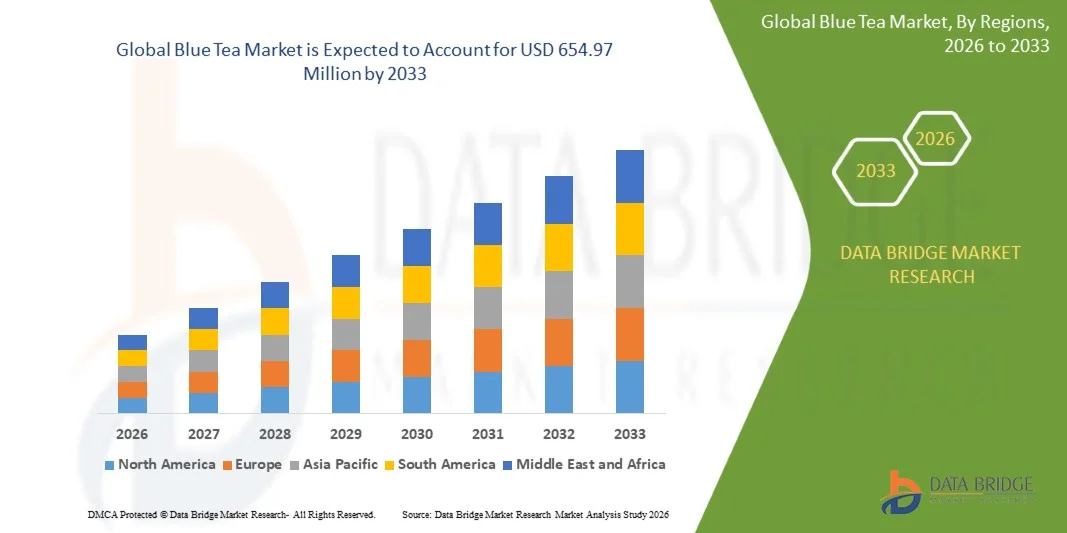
- The global blue tea market size was valued at USD 275.16 million in 2025 and is expected to reach USD 654.97 million by 2033, at a CAGR of 11.45% during the forecast period
- The market growth is largely driven by rising consumer awareness of health and wellness benefits associated with herbal and functional teas, particularly antioxidant-rich and caffeine-free beverages such as blue tea
- Furthermore, increasing preference for clean-label, natural, and visually appealing beverages, along with growing influence of social media and wellness trends, is accelerating the adoption of blue tea across retail, foodservice, and specialty beverage channels, thereby supporting overall market expansion
Blue Tea Market Analysis
- Blue tea is a herbal infusion derived primarily from butterfly pea flower, known for its natural blue color, antioxidant properties, and calming effects, and is widely consumed as a wellness beverage in both traditional and modern formulations
- The growing demand for blue tea is mainly supported by shifting consumer lifestyles toward preventive healthcare, increasing interest in functional and botanical ingredients, and expanding availability of premium herbal teas through offline and online distribution platforms
- North America dominated the blue tea market with a share of 27% in 2025, due to rising consumer awareness of functional beverages and increasing preference for natural, antioxidant-rich teas
- Asia-Pacific is expected to be the fastest growing region in the blue tea market during the forecast period due to increasing health awareness, rising disposable incomes, and a strong tradition of herbal tea consumption
- Loose leaves segment dominated the market with a market share of 58.5% in 2025, due to consumer preference for premium quality, authentic taste, and traditional brewing practices. Consumers often associate loose leaf products with superior aroma and freshness, supporting their widespread adoption across households and specialty retail channels
Report Scope and Blue Tea Market Segmentation
|
Attributes |
Blue Tea Key Market Insights |
|
Segments Covered |
|
|
Countries Covered |
North America
Europe
Asia-Pacific
Middle East and Africa
South America
|
|
Key Market Players |
|
|
Market Opportunities |
|
|
Value Added Data Infosets |
In addition to the insights on market scenarios such as market value, growth rate, segmentation, geographical coverage, and major players, the market reports curated by the Data Bridge Market Research also include in-depth expert analysis, pricing analysis, brand share analysis, consumer survey, demography analysis, supply chain analysis, value chain analysis, raw material/consumables overview, vendor selection criteria, PESTLE Analysis, Porter Analysis, and regulatory framework. |
Blue Tea Market Trends
“Rising Popularity of Functional and Color-Changing Herbal Beverages”
- A significant trend in the blue tea market is the rising popularity of functional and visually distinctive herbal beverages, driven by increasing consumer interest in natural wellness drinks with added experiential value. Blue tea, derived primarily from butterfly pea flower, is gaining attention for its antioxidant properties and its natural color-changing ability when mixed with citrus or acidic ingredients, which enhances consumer engagement and product differentiation
- For instance, Teabox and Vahdam India have introduced butterfly pea flower–based blue tea products positioned around wellness, natural ingredients, and visual appeal, targeting health-conscious and premium tea consumers. These offerings have strengthened brand positioning by combining functional health benefits with a unique sensory experience that appeals to modern beverage consumers
- The demand for caffeine-free and herbal alternatives is contributing to the adoption of blue tea among consumers seeking relaxation, stress reduction, and improved hydration without stimulants. This trend is reinforcing blue tea’s role within the broader functional herbal tea segment
- Foodservice operators and cafés are incorporating blue tea into specialty beverages, mocktails, and wellness drinks to attract consumers seeking innovative and Instagram-friendly offerings. This integration is increasing visibility and encouraging trial among younger demographics
- E-commerce and specialty wellness platforms are supporting market expansion by promoting blue tea as a premium herbal product with natural color and antioxidant attributes. This is enabling brands to reach niche consumer groups interested in clean-label and functional beverages
- The market is witnessing growing alignment between visual appeal, health positioning, and natural sourcing, which is strengthening blue tea’s acceptance across global herbal beverage categories. This convergence is supporting sustained interest and reinforcing blue tea’s position as a distinctive functional drink option
Blue Tea Market Dynamics
Driver
“Growing Consumer Focus on Health, Wellness, and Natural Ingredients”
- The increasing consumer focus on preventive health and holistic wellness is driving demand for blue tea due to its natural antioxidant content and perceived benefits for stress relief and overall well-being. Consumers are actively seeking herbal beverages made from plant-based ingredients that align with clean-label and natural consumption trends
- For instance, Organic India has expanded its herbal tea portfolio to include butterfly pea flower tea, emphasizing its natural origin and wellness benefits. This positioning resonates with consumers who prioritize organic sourcing and functional health claims in their daily beverage choices
- Rising awareness of artificial additives and synthetic colorants is encouraging consumers to prefer naturally colored beverages such as blue tea. Its plant-derived pigmentation supports its appeal among clean-label and naturally formulated drink categories
- The growing popularity of herbal teas within yoga, mindfulness, and wellness communities is further accelerating blue tea adoption. These consumer segments associate blue tea with calmness, detoxification, and lifestyle balance
- The sustained shift toward natural, functional beverages is reinforcing this driver and positioning blue tea as a preferred option for consumers seeking health-oriented and visually appealing herbal drinks
Restraint/Challenge
“Limited Awareness and Premium Pricing Constraints”
- The blue tea market faces challenges related to limited consumer awareness, particularly in mass markets where traditional teas dominate purchasing behavior. Many consumers remain unfamiliar with butterfly pea flower tea and its functional attributes, which restricts broader adoption
- For instance, brands such as Tealyra, which offer butterfly pea flower tea in international markets, often rely on educational marketing to explain product benefits and usage. This requirement increases marketing costs and slows penetration compared to more established tea varieties
- Premium pricing associated with organic sourcing, limited cultivation regions, and careful processing methods acts as a barrier for price-sensitive consumers. This pricing gap limits blue tea’s reach beyond niche and premium consumer segments
- Supply chain limitations linked to the cultivation of butterfly pea flowers can affect consistent availability and cost stability. These constraints challenge manufacturers aiming to scale production while maintaining quality standards
- The combination of low awareness and higher price positioning continues to restrain rapid market growth, creating pressure on manufacturers to balance education, accessibility, and cost efficiency to expand consumer adoption
Blue Tea Market Scope
The market is segmented on the basis of product, type, and distribution channel.
• By Product
On the basis of product, the market is segmented into loose leaves, powder, and others. The loose leaves segment accounted for the largest market revenue share of 58.5% in 2025, driven by strong consumer preference for premium quality, authentic taste, and traditional brewing practices. Consumers often associate loose leaf products with superior aroma and freshness, supporting their widespread adoption across households and specialty retail channels.
The powder segment is expected to witness faster growth over the forecast period, supported by its convenience, longer shelf life, and suitability for instant preparation. Powdered formats are increasingly preferred in urban and on-the-go consumption patterns, while the others segment maintains steady demand through niche and blended product offerings.
• By Type
On the basis of type, the market is segmented into conventional and organic. The conventional segment dominated the market revenue share, attributed to its wide availability, cost effectiveness, and established supply chains across major producing regions. Conventional products continue to see strong demand due to consistent quality and accessibility across mass-market distribution channels.
The organic segment is projected to register significant growth during the forecast period, driven by rising consumer awareness regarding health, sustainability, and chemical-free cultivation practices. Growing preference for certified organic products supports the expanding adoption of this segment across premium and health-focused consumer groups.
• By Distribution Channel
On the basis of distribution channel, the market is segmented into off-trade and on-trade. The off-trade segment held the largest revenue share, supported by strong sales through supermarkets, specialty stores, and online retail platforms. Consumers favor off-trade channels for product variety, price comparison, and ease of access, contributing to their dominant position.
The on-trade segment is anticipated to experience steady growth over the forecast period, driven by rising consumption across cafés, restaurants, and hospitality settings. Increasing focus on experiential consumption and premium offerings continues to support demand through on-trade channels.
Blue Tea Market Regional Analysis
- North America dominated the blue tea market with the largest revenue share of 27% in 2025, driven by rising consumer awareness of functional beverages and increasing preference for natural, antioxidant-rich teas
- Consumers in the region strongly value the health benefits of blue tea, including stress relief, cognitive wellness, and clean-label positioning, aligning with the broader shift toward wellness-focused dietary habits
- This demand is further supported by high disposable incomes, strong penetration of specialty tea brands, and growing availability of premium herbal teas across retail and online channels, positioning blue tea as a popular choice among health-conscious consumers
U.S. Blue Tea Market Insight
The U.S. blue tea market accounted for the largest revenue share within North America in 2025, supported by the growing popularity of herbal and botanical teas among millennials and wellness-focused consumers. Increasing interest in natural mood-enhancing and antioxidant beverages is encouraging the adoption of blue tea across households and cafés. The expansion of specialty tea brands, strong e-commerce penetration, and social media-driven awareness around color-changing beverages are further accelerating market growth in the U.S.
Europe Blue Tea Market Insight
The Europe blue tea market is projected to grow at a steady CAGR during the forecast period, driven by strong demand for organic, caffeine-free, and functional beverages. Rising health consciousness, coupled with a well-established tea-drinking culture, supports the adoption of blue tea across the region. European consumers are increasingly inclined toward premium and ethically sourced herbal teas, boosting sales through both specialty stores and online platforms.
U.K. Blue Tea Market Insight
The U.K. blue tea market is expected to witness notable growth over the forecast period, driven by the country’s deep-rooted tea culture and increasing openness to novel and functional tea variants. Consumers are showing heightened interest in wellness-oriented beverages that offer visual appeal and health benefits. The expansion of specialty tea cafés and strong retail distribution networks continues to support market growth in the U.K.
Germany Blue Tea Market Insight
The Germany blue tea market is anticipated to expand at a considerable CAGR, supported by rising demand for organic and plant-based beverages. German consumers place strong emphasis on quality, sustainability, and health benefits, making blue tea an attractive option within the herbal tea segment. Growth is further encouraged by increasing availability through health food stores and premium retail channels.
Asia-Pacific Blue Tea Market Insight
The Asia-Pacific blue tea market is expected to grow at the fastest CAGR during the forecast period, driven by increasing health awareness, rising disposable incomes, and a strong tradition of herbal tea consumption. Rapid urbanization and growing interest in functional beverages across countries such as China, Japan, and India are accelerating market adoption. The region also benefits from local availability of butterfly pea flower, supporting product accessibility and affordability.
Japan Blue Tea Market Insight
The Japan blue tea market is gaining traction due to the country’s strong preference for functional and aesthetically appealing beverages. Japanese consumers value the calming and antioxidant properties of blue tea, aligning with traditional wellness practices. The integration of blue tea into cafés, ready-to-drink formats, and premium packaging is further supporting market expansion.
China Blue Tea Market Insight
The China blue tea market held the largest revenue share in Asia Pacific in 2025, driven by rising demand for traditional herbal ingredients combined with modern wellness trends. The country’s large consumer base, increasing disposable incomes, and strong e-commerce ecosystem are facilitating widespread adoption of blue tea. Growing interest in natural health products and visually distinctive beverages continues to propel market growth across urban centers.
Blue Tea Market Share
The blue tea industry is primarily led by well-established companies, including:
- Numi Organic Tea (U.S.)
- Blue Willow Tea (U.S.)
- Sancha Tea (India)
- Asheville Tea Company (U.S.)
- Octavius Tea (India)
- Lake Missoula Tea Company (U.S.)
- Rishi Tea & Botanicals (U.S.)
- Yum Cha Tea Company (Australia)
- Bigelow Tea (U.S.)
- Noble Roots Urban Garden LLC (U.S.)
- Blue Tea (India)
- The Hale Tea Company (U.S.)
- Tucson Tea Company (U.S.)
- Revival Tea Company (U.S.)
Latest Developments in Global Blue Tea Market
- In October 2024, Bigelow Tea expanded its herbal portfolio by introducing two caffeine-free butterfly pea flower teas, Sapphire Bay and Vanilla Midnight, strengthening its presence in the functional and visually appealing tea segment. This launch supports market growth by increasing mainstream consumer exposure to color-changing herbal teas while reinforcing demand for ethically sourced ingredients through partnerships with women-owned farms in Thailand
- In October 2024, Octavius launched Butterfly Blue Pea Flower Tea, marking a strategic move to capitalize on rising consumer interest in antioxidant-rich and stress-relief beverages. This introduction enhances the blue tea market in India by aligning premium tea positioning with wellness-focused consumption trends and daily health routines
- In May 2024, Numi Organic Tea introduced its Relax and Regenerate Herbal Supplement Tea Line featuring butterfly pea flower within its Damiana Tea range, reinforcing the convergence of herbal teas and functional supplementation. This development supports market expansion by positioning blue tea as a wellness-enhancing product backed by organic and Fair Trade sourcing credentials
- In March 2023, Rishi’s Sparkling Botanicals launched Blue Tea Jasmine, a ready-to-drink sparkling beverage infused with butterfly pea flower, broadening blue tea applications beyond traditional brewing formats. The product’s vibrant color transformation and premium ingredient sourcing helped drive interest in blue tea within the functional RTD beverage segment
- In March 2023, Sparkling Botanicals by Rishi showcased Blue Tea Jasmine at Natural Products Expo West, increasing visibility of blue tea among health-focused retailers and consumers. This introduction played a role in accelerating market awareness by highlighting blue tea’s aesthetic appeal, natural sourcing, and versatility in innovative beverage formulations

- Interactive Data Analysis Dashboard
- Company Analysis Dashboard for high growth potential opportunities
- Research Analyst Access for customization & queries
- Competitor Analysis with Interactive dashboard
- Latest News, Updates & Trend analysis
- Harness the Power of Benchmark Analysis for Comprehensive Competitor Tracking
Global Blue Tea Market, Supply Chain Analysis and Ecosystem Framework
To support market growth and help clients navigate the impact of geopolitical shifts, DBMR has integrated in-depth supply chain analysis into its Global Blue Tea Market research reports. This addition empowers clients to respond effectively to global changes affecting their industries. The supply chain analysis section includes detailed insights such as Global Blue Tea Market consumption and production by country, price trend analysis, the impact of tariffs and geopolitical developments, and import and export trends by country and HSN code. It also highlights major suppliers with data on production capacity and company profiles, as well as key importers and exporters. In addition to research, DBMR offers specialized supply chain consulting services backed by over a decade of experience, providing solutions like supplier discovery, supplier risk assessment, price trend analysis, impact evaluation of inflation and trade route changes, and comprehensive market trend analysis.
Data collection and base year analysis are done using data collection modules with large sample sizes. The stage includes obtaining market information or related data through various sources and strategies. It includes examining and planning all the data acquired from the past in advance. It likewise envelops the examination of information inconsistencies seen across different information sources. The market data is analysed and estimated using market statistical and coherent models. Also, market share analysis and key trend analysis are the major success factors in the market report. To know more, please request an analyst call or drop down your inquiry.
The key research methodology used by DBMR research team is data triangulation which involves data mining, analysis of the impact of data variables on the market and primary (industry expert) validation. Data models include Vendor Positioning Grid, Market Time Line Analysis, Market Overview and Guide, Company Positioning Grid, Patent Analysis, Pricing Analysis, Company Market Share Analysis, Standards of Measurement, Global versus Regional and Vendor Share Analysis. To know more about the research methodology, drop in an inquiry to speak to our industry experts.
Data Bridge Market Research is a leader in advanced formative research. We take pride in servicing our existing and new customers with data and analysis that match and suits their goal. The report can be customized to include price trend analysis of target brands understanding the market for additional countries (ask for the list of countries), clinical trial results data, literature review, refurbished market and product base analysis. Market analysis of target competitors can be analyzed from technology-based analysis to market portfolio strategies. We can add as many competitors that you require data about in the format and data style you are looking for. Our team of analysts can also provide you data in crude raw excel files pivot tables (Fact book) or can assist you in creating presentations from the data sets available in the report.













