


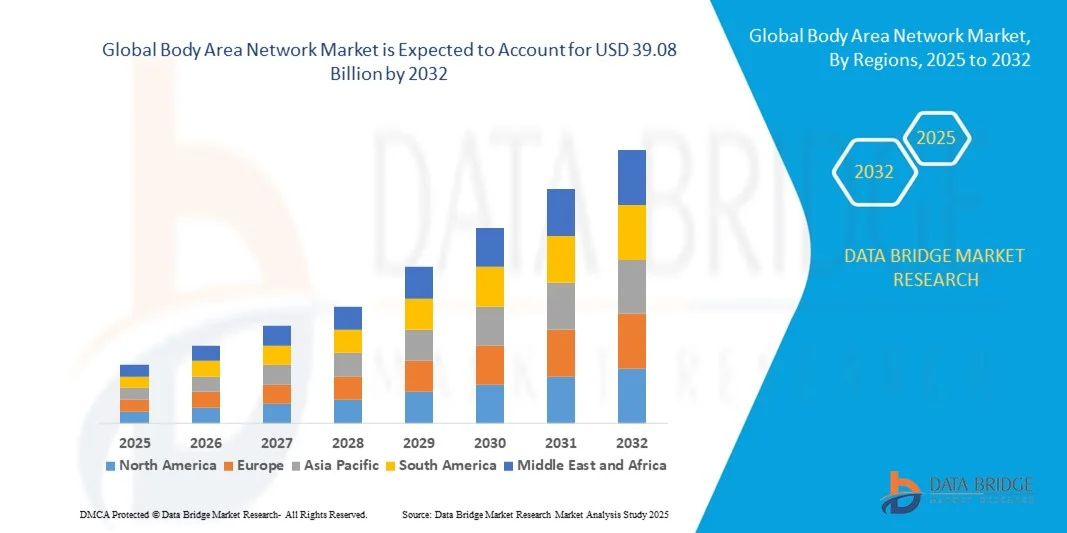
What is the Global Body Area Network Market Size and Growth Rate?
- The global body area network market size was valued at USD 15.67 billion in 2024 and is expected to reach USD 39.08 billion by 2032, at a CAGR of 20.10% during the forecast period
- Growth in the penetration of wearable devices, rise in the technological developments in the communication and medical devices technologies, and increasing application of body area network by a wide range of end user verticals such as healthcare, sports, security, military and others are the major factors attributable to the growth of body area network market
What are the Major Takeaways of Body Area Network Market?
- Rising focus on the adoption of advanced technologies in manufacturing the wearable devices will emerge as the major body area network market growth driving factor. Growing digitization of emerging economies such as India and China and rising awareness in regards to maintaining physical fitness will further aggravate the body area network market value
- Growing initiatives and policies by the government to support digital healthcare and growing availability of low cost fitness devices will further carve the way for the growth of the body area network market
- Asia-Pacific dominated the body area network market with the largest revenue share of 41.2% in 2024, driven by rising disposable incomes, urbanization, and the strong presence of leading manufacturers across China, Japan, South Korea, and India
- North America is expected to grow at the fastest CAGR of 6.4% from 2025 to 2032, propelled by advanced healthcare infrastructure, rapid adoption of wearable health monitoring devices, and rising security concerns in both residential and commercial applications
- The sensors segment dominated the market with the largest revenue share of 38.6% in 2024, owing to their critical role in collecting physiological and environmental data in BAN systems
Report Scope and Body Area Network Market Segmentation
|
Attributes |
Body Area Network Key Market Insights |
|
Segments Covered |
|
|
Countries Covered |
North America
Europe
Asia-Pacific
Middle East and Africa
South America
|
|
Key Market Players |
|
|
Market Opportunities |
|
|
Value Added Data Infosets |
In addition to the insights on market scenarios such as market value, growth rate, segmentation, geographical coverage, and major players, the market reports curated by the Data Bridge Market Research also include in-depth expert analysis, pricing analysis, brand share analysis, consumer survey, demography analysis, supply chain analysis, value chain analysis, raw material/consumables overview, vendor selection criteria, PESTLE Analysis, Porter Analysis, and regulatory framework. |
What is the Key Trend in the Body Area Network Market?
Enhanced Convenience Through AI and Voice Integration
- A growing trend in the body area network (BAN) market is the increasing integration of artificial intelligence (AI) and voice-controlled platforms such as Amazon Alexa, Google Assistant, and Apple HomeKit, which significantly improves user control and convenience
- For instance, the August Wi-Fi BAN integrates with all three major assistants, while Level Lock+ is fully compatible with Siri and Apple HomeKit, offering users seamless hands-free security management
- AI-powered BANs enhance functionality by learning user behavior, optimizing access patterns, and delivering intelligent alerts, with models such as Ultraloq improving fingerprint recognition accuracy and detecting unusual activity
- Integration with smart ecosystems enables centralized management of locks, lighting, climate, and security devices, creating a unified smart living environment
- Companies such as WELOCK are actively developing AI-enabled BANs with automatic locking/unlocking features and compatibility with Google Assistant and Alexa, further boosting adoption
- This trend is reshaping consumer expectations, with rising demand for intuitive, interconnected, and voice-enabled security systems across residential and commercial sectors
What are the Key Drivers of Body Area Network Market?
- The rising prevalence of security concerns among homeowners and businesses, alongside rapid adoption of smart home ecosystems, is driving body area network demand
- In April 2024, Onity, Inc. (Honeywell International, Inc.) advanced its IoT-based Passport security solution with integrated sensors, showcasing the industry’s move toward innovative, connected locking systems
- BANs offer superior features such as remote monitoring, activity logs, and tamper alerts, making them attractive compared to traditional locks
- Increasing consumer interest in interconnected smart homes positions body area networks as a key component within these systems, ensuring seamless integration with other devices
- Demand is fueled by benefits such as keyless entry, remote access for family or service providers, and smartphone app-based control, which provide convenience and flexibility
- The rise of DIY smart installations and the availability of user-friendly body area networks further strengthen adoption across residential and commercial segments
Which Factor is Challenging the Growth of the Body Area Network Market?
- Cybersecurity vulnerabilities in connected body area network devices remain a major concern, as reliance on network connectivity makes them susceptible to hacking and breaches
- Reports of IoT-related vulnerabilities have discouraged some consumers from adopting body area network solutions, underscoring the need for stronger security
- Companies such as August and Level Home emphasize advanced encryption and authentication protocols to build consumer trust, but skepticism still exists
- The relatively high initial cost of advanced BANs compared to traditional locks creates adoption barriers, especially in price-sensitive markets
- While affordable options from brands such as Wyze are emerging, premium BANs with features such as biometric scanning and integrated cameras remain costly
- Overcoming these issues will require robust cybersecurity, consumer awareness efforts, and more cost-effective solutions to ensure sustained body area network market growth
How is the Body Area Network Market Segmented?
The market is segmented on the basis of component, technology, device type, and end user.
- By Component
On the basis of component, the body area network market is segmented into displays, application processors and memory modules, pulse generators, electromechanicals, communication and interface components, power management units, sensors, and others. The sensors segment dominated the market with the largest revenue share of 38.6% in 2024, owing to their critical role in collecting physiological and environmental data in BAN systems. Sensors are widely used in healthcare wearables, fitness devices, and implantables, driving large-scale adoption. Their ability to track vital signs such as heart rate, glucose levels, and body temperature makes them indispensable for health monitoring.
The application processors and memory modules segment is expected to witness the fastest CAGR of 20.9% from 2025 to 2032, driven by the rising demand for real-time data processing, energy-efficient computing, and integration of AI algorithms in next-generation BAN devices.
- By Technology
On the basis of technology, the body area network market is segmented into Bluetooth, Wi-Fi, Zigbee, and others. The Bluetooth segment accounted for the largest market revenue share of 41.3% in 2024, driven by its low energy consumption, short-range reliability, and seamless integration with smartphones and wearables. Bluetooth’s widespread availability across devices enhances its role as the default connectivity option for most BAN solutions. Healthcare devices, smartwatches, and fitness trackers predominantly rely on Bluetooth for continuous monitoring and secure communication.
The Wi-Fi segment is anticipated to grow at the fastest CAGR of 19.8% from 2025 to 2032, supported by its ability to provide high-speed, long-range connectivity and cloud integration. Wi-Fi-enabled BAN devices enable real-time remote monitoring, making them particularly valuable in telehealth applications and hospital settings.
- By Device Type
On the basis of device type, the body area network market is segmented into wearable devices and implantable devices. The wearable devices segment dominated the market with the largest revenue share of 72.5% in 2024, driven by the popularity of smartwatches, fitness bands, and medical wearables for continuous monitoring of physical activity and health parameters. Growing consumer awareness about preventive healthcare and the rising demand for lifestyle-oriented wearable devices have further strengthened this segment’s leadership.
The implantable devices segment is projected to register the fastest CAGR of 21.1% from 2025 to 2032, supported by technological advancements in pacemakers, glucose monitoring implants, and neurostimulators. These devices are gaining traction due to their ability to provide long-term, continuous monitoring and therapeutic benefits in chronic disease management.
- By End Use
On the basis of end use, the body area network market is segmented into healthcare, sports, security, military, and others. The healthcare segment dominated the market with the largest revenue share of 49.7% in 2024, owing to the growing adoption of BANs for patient monitoring, disease management, and telehealth applications. The increasing prevalence of chronic diseases such as diabetes, cardiovascular disorders, and neurological conditions has fueled the demand for continuous health monitoring through BAN devices. In addition, hospitals and clinics are integrating BAN technology to improve care efficiency and reduce costs.
The sports segment is expected to grow at the fastest CAGR of 22.3% from 2025 to 2032, driven by the rising adoption of wearables for performance tracking, injury prevention, and fitness optimization among professional athletes and fitness enthusiasts.
Which Region Holds the Largest Share of the Body Area Network Market?
- Asia-Pacific dominated the body area network market with the largest revenue share of 41.2% in 2024, driven by rising disposable incomes, urbanization, and the strong presence of leading manufacturers across China, Japan, South Korea, and India
- Consumers in the region are rapidly adopting BANs for healthcare monitoring, sports performance tracking, and security applications, supported by government initiatives promoting digital health and smart city infrastructure
- This growth is further fueled by technological innovation, increasing smartphone penetration, and the affordability of wearable and implantable devices, making body area networks highly accessible to a broad consumer base
China Body Area Network Market Insight
The China body area network market captured the largest revenue share of 46% in Asia-Pacific in 2024, supported by the country’s expanding middle class, advanced manufacturing base, and rapid smart city developments. The adoption of body area network s in healthcare and fitness sectors is accelerating, driven by local tech firms and cost-effective product offerings. Growing demand for real-time health tracking and the integration of BANs with 5G and IoT platforms are expected to sustain momentum.
Japan Body Area Network Market Insight
The Japan body area network market is projected to grow steadily, fueled by its high-tech culture and focus on aging population needs. BANs are being widely adopted in healthcare monitoring, rehabilitation, and smart home integration. With Japanese consumers prioritizing convenience and security, the demand for AI-driven wearables and implantable solutions is gaining traction.
India Body Area Network Market Insight
The India body area network market is emerging as one of the fastest-growing within Asia-Pacific, driven by rising health awareness, growing fitness culture, and increasing government support for digital healthcare initiatives. Affordable wearables from domestic and global brands are expanding access, while the youth population’s preference for connected devices strengthens demand further.
Which Region is the Fastest Growing Region in the Body Area Network Market?
North America is expected to grow at the fastest CAGR of 6.4% from 2025 to 2032, propelled by advanced healthcare infrastructure, rapid adoption of wearable health monitoring devices, and rising security concerns in both residential and commercial applications. The region’s technologically inclined population, combined with the strong presence of global BAN players, is fostering faster adoption of AI- and IoT-enabled solutions. Increasing emphasis on preventive healthcare, insurance incentives for health monitoring, and widespread consumer preference for connected devices are expected to drive BAN penetration further.
U.S. Body Area Network Market Insight
The U.S. body area network market held the largest share of 82% in North America in 2024, fueled by consumer demand for wearable healthcare devices, fitness trackers, and smart security solutions. Strong integration with voice assistants such as Alexa, Google Assistant, and Apple Siri, combined with advanced mobile application ecosystems, is boosting adoption across households and enterprises.
Canada Body Area Network Market Insight
The Canada body area network market is projected to grow robustly, supported by rising healthcare investments, fitness awareness, and the expansion of telehealth services. Canadian consumers are increasingly adopting BAN wearables for health tracking and security, further encouraged by favorable government policies toward digital healthcare adoption.
Which are the Top Companies in Body Area Network Market?
The body area network industry is primarily led by well-established companies, including:
- FUJITSU (Japan)
- GENERAL ELECTRIC COMPANY (U.S.)
- IBM (U.S.)
- Intel Corporation (U.S.)
- SAMSUNG (South Korea)
- Sony Corporation (Japan)
- STMicroelectronics (Switzerland)
- Apple Inc. (U.S.)
- Fitbit, Inc. (U.S.)
- Medtronic (Ireland)
- Abbott (U.S.)
- Bluetooth SIG, Inc. (U.S.)
- Telefonaktiebolaget LM Ericsson (Sweden)
- TIME USA, LLC. (U.S.)
- Renesas Electronics Corporation (Japan)
- Garmin Ltd. (Switzerland)
- Zepp Health Corporation (China)
- ASUSTeK Computer Inc. (Taiwan)
- Withings (France)
- SUUNTO (Finland)
What are the Recent Developments in Global Body Area Network Market?
- In April 2025, Abbott initiated the ASCEND CSP pivotal trial to evaluate its conduction system pacing ICD lead after receiving FDA breakthrough designation, highlighting the company’s commitment to advancing cardiac care and innovation
- In April 2025, Medtronic submitted 510(k) applications for the interoperable MiniMed 780G pump integrated with Abbott CGM technology, reflecting ongoing efforts to enhance diabetes management solutions
- In March 2025, Abbott’s TRILUMINATE pivotal trial data demonstrated that TriClip therapy reduced heart-failure hospitalizations to 0.19 events per patient-year, emphasizing its potential to improve patient outcomes and quality of life
- In January 2025, Samsung showcased the Galaxy Ring and Galaxy Watch integrations at CES 2025, presenting end-to-end wellness services and reinforcing the brand’s focus on holistic digital health solutions

- Interactive Data Analysis Dashboard
- Company Analysis Dashboard for high growth potential opportunities
- Research Analyst Access for customization & queries
- Competitor Analysis with Interactive dashboard
- Latest News, Updates & Trend analysis
- Harness the Power of Benchmark Analysis for Comprehensive Competitor Tracking
Global Body Area Network Market, Supply Chain Analysis and Ecosystem Framework
To support market growth and help clients navigate the impact of geopolitical shifts, DBMR has integrated in-depth supply chain analysis into its Global Body Area Network Market research reports. This addition empowers clients to respond effectively to global changes affecting their industries. The supply chain analysis section includes detailed insights such as Global Body Area Network Market consumption and production by country, price trend analysis, the impact of tariffs and geopolitical developments, and import and export trends by country and HSN code. It also highlights major suppliers with data on production capacity and company profiles, as well as key importers and exporters. In addition to research, DBMR offers specialized supply chain consulting services backed by over a decade of experience, providing solutions like supplier discovery, supplier risk assessment, price trend analysis, impact evaluation of inflation and trade route changes, and comprehensive market trend analysis.
Data collection and base year analysis are done using data collection modules with large sample sizes. The stage includes obtaining market information or related data through various sources and strategies. It includes examining and planning all the data acquired from the past in advance. It likewise envelops the examination of information inconsistencies seen across different information sources. The market data is analysed and estimated using market statistical and coherent models. Also, market share analysis and key trend analysis are the major success factors in the market report. To know more, please request an analyst call or drop down your inquiry.
The key research methodology used by DBMR research team is data triangulation which involves data mining, analysis of the impact of data variables on the market and primary (industry expert) validation. Data models include Vendor Positioning Grid, Market Time Line Analysis, Market Overview and Guide, Company Positioning Grid, Patent Analysis, Pricing Analysis, Company Market Share Analysis, Standards of Measurement, Global versus Regional and Vendor Share Analysis. To know more about the research methodology, drop in an inquiry to speak to our industry experts.
Data Bridge Market Research is a leader in advanced formative research. We take pride in servicing our existing and new customers with data and analysis that match and suits their goal. The report can be customized to include price trend analysis of target brands understanding the market for additional countries (ask for the list of countries), clinical trial results data, literature review, refurbished market and product base analysis. Market analysis of target competitors can be analyzed from technology-based analysis to market portfolio strategies. We can add as many competitors that you require data about in the format and data style you are looking for. Our team of analysts can also provide you data in crude raw excel files pivot tables (Fact book) or can assist you in creating presentations from the data sets available in the report.













