


Global Body Armor Market Size
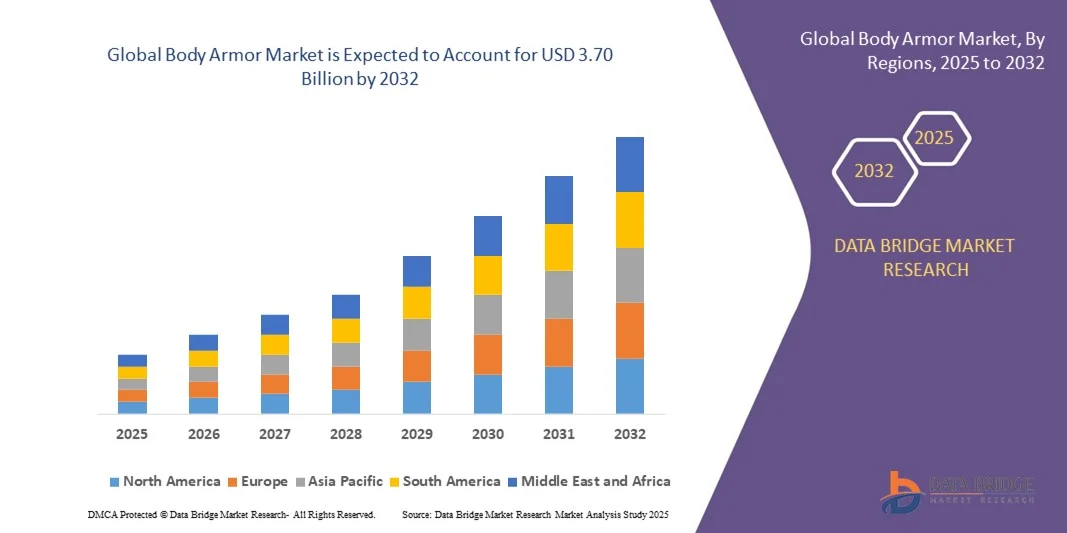
- The global Body Armor Market size was valued at USD 2.60 billion in 2024 and is expected to reach USD 3.70 billion by 2032, at a CAGR of 4.53% during the forecast period.
- The market growth is largely driven by rising security concerns across military, law enforcement, and civilian sectors, coupled with increasing investments in protective gear for defense and personal safety.
- Furthermore, advancements in lightweight materials, wearable technology, and high-performance fabrics are enhancing the effectiveness and comfort of body armor, making it more accessible and appealing to end users. These factors are collectively propelling the adoption of body armor solutions, thereby significantly contributing to the industry’s expansion.
Global Body Armor Market Analysis
- Body armor, designed to provide ballistic and stab protection for military, law enforcement, and civilian users, is increasingly essential across defense, security, and personal protection sectors due to its ability to enhance safety while maintaining mobility and comfort.
- The rising demand for body armor is primarily driven by growing security concerns, increasing defense budgets, and heightened awareness of personal safety among civilians and law enforcement personnel.
- North America dominated the Global Body Armor Market with the largest revenue share of 37.6% in 2024, supported by high defense spending, advanced manufacturing capabilities, and a strong presence of leading body armor manufacturers. The U.S. witnessed significant adoption of advanced ballistic vests and lightweight armor solutions, fueled by innovations in materials such as ultra-high-molecular-weight polyethylene (UHMWPE) and composite ceramics.
- Asia-Pacific is expected to be the fastest-growing region in the Global Body Armor Market during the forecast period, driven by rapid modernization of armed forces, increasing defense expenditure, and rising awareness of personal protection among civilians.
- The Level IIIA segment dominated the market in 2024, accounting for the largest revenue share of 38.5%, owing to its widespread use among law enforcement agencies and private security personnel.
Report Scope and Global Body Armor Market Segmentation
|
Attributes |
Body Armor Key Market Insights |
|
Segments Covered |
|
|
Countries Covered |
North America
Europe
Asia-Pacific
Middle East and Africa
South America
|
|
Key Market Players |
|
|
Market Opportunities |
|
|
Value Added Data Infosets |
In addition to the insights on market scenarios such as market value, growth rate, segmentation, geographical coverage, and major players, the market reports curated by the Data Bridge Market Research also include in-depth expert analysis, pricing analysis, brand share analysis, consumer survey, demography analysis, supply chain analysis, value chain analysis, raw material/consumables overview, vendor selection criteria, PESTLE Analysis, Porter Analysis, and regulatory framework. |
Global Body Armor Market Trends
Enhanced Protection Through Advanced Materials and Smart Features
- A significant and accelerating trend in the global Body Armor Market is the integration of advanced materials and smart technologies, such as sensors and wearable monitoring systems, into protective gear. This combination is significantly enhancing user safety, situational awareness, and operational efficiency for military, law enforcement, and civilian applications.
- For instance, some modern tactical vests incorporate sensors that can monitor the wearer’s vital signs and alert command centers in case of injury, while lightweight composite and ceramic plates provide superior ballistic protection without compromising mobility.
- Smart body armor integration enables features such as real-time threat detection, impact analysis, and adaptive protection levels. For example, certain next-generation vests can detect the force of incoming projectiles and provide data to improve future armor design or operational protocols. Furthermore, wearable monitoring systems can track fatigue, heart rate, and environmental hazards, allowing for proactive safety measures in high-risk scenarios.
- The seamless integration of body armor with digital monitoring platforms facilitates centralized management and analytics for tactical teams, allowing commanders to monitor the status of multiple personnel simultaneously and make informed operational decisions.
- This trend toward more intelligent, responsive, and data-driven protective solutions is fundamentally reshaping expectations for personal and tactical safety. Consequently, companies such as Safariland and Point Blank Enterprises are developing smart armor systems with embedded sensors, lightweight ballistic materials, and enhanced ergonomics for improved user performance and protection.
- The demand for body armor that combines advanced materials with smart, sensor-enabled features is growing rapidly across military, law enforcement, and civilian markets, as organizations increasingly prioritize both protection and situational awareness.
Global Body Armor Market Dynamics
Driver
Growing Need Due to Rising Security Concerns and Military Modernization
-
The increasing prevalence of security threats, geopolitical tensions, and the growing need for personal and personnel protection is a significant driver for the heightened demand for body armor across military, law enforcement, and civilian sectors.
- For instance, in 2024, Safariland introduced next-generation ballistic vests with improved multi-threat protection and modular add-on capabilities for tactical operations. Such advancements by key companies are expected to drive body armor market growth during the forecast period.
- As defense organizations and law enforcement agencies face evolving threats, body armor solutions offer advanced protection features such as lightweight materials, multi-threat resistance, and ergonomic designs, providing a substantial upgrade over traditional protective gear.
- Furthermore, increasing adoption of wearable technologies and sensor integration in tactical vests allows for real-time monitoring of vital signs, impact detection, and situational awareness, making modern body armor an integral component of mission readiness.
- The demand for comfortable, lightweight, and highly protective solutions, along with the focus on modular and customizable systems for diverse operational requirements, is propelling the adoption of body armor in both professional and civilian safety markets.
Restraint/Challenge
High Costs and Comfort Limitations
- The relatively high cost of advanced body armor systems, including lightweight composite plates and sensor-enabled tactical vests, poses a significant challenge to broader market adoption. Budget constraints in emerging markets and small law enforcement agencies can limit procurement of premium protective gear.
- For instance, state-of-the-art ballistic vests with multi-threat protection and integrated monitoring systems can cost significantly more than standard vests, making them less accessible to cost-sensitive organizations.
- Additionally, comfort and mobility limitations remain challenges, especially for prolonged use in field operations. Even with innovations in lightweight materials, some users experience reduced flexibility and increased fatigue when wearing heavy or fully equipped armor.
- Addressing these challenges through the development of more affordable, lightweight, and ergonomic solutions, as well as modular designs that allow users to balance protection with mobility, is crucial for expanding market penetration.
- Companies such as Point Blank Enterprises and Armor Express are focusing on improving wearer comfort, reducing weight, and offering scalable protection solutions to encourage wider adoption across diverse user segments.
Global Body Armor Market Scope
The body armor market is segmented on the basis of level, application, material, product, style and end user.
- By Level
On the basis of level, the Global Body Armor Market is segmented into Level I, Level IIA, Level II, Level IIIA, Level III, and Level IV. The Level IIIA segment dominated the market in 2024, accounting for the largest revenue share of 38.5%, owing to its widespread use among law enforcement agencies and private security personnel. It offers an optimal balance of lightweight design and protection against most handgun threats, making it suitable for daily wear and patrol operations.
Level IV, capable of stopping rifle rounds, is expected to witness the fastest CAGR of 19.8% from 2025 to 2032, driven by rising threats in defense and high-risk security operations. Increasing investment in military and tactical protective gear, along with advancements in multi-threat resistant armor, is further driving the adoption of higher-level armor for both security and defense applications.
- By Application
On the basis of application, the Global Body Armor Market is segmented into defense, law enforcement protection, and civilians. The defense segment accounted for the largest market revenue share of 42.1% in 2024, fueled by increasing military expenditure globally, modernization of armed forces, and rising regional conflicts. Defense agencies prioritize high-performance body armor that provides multi-threat protection while remaining lightweight for operational mobility.
The civilian segment is expected to witness the fastest CAGR of 18.6% from 2025 to 2032, driven by growing personal safety awareness, especially in urban areas, and demand for discreet armor solutions for personal protection. Innovations in user-friendly designs and affordable options for civilians are further accelerating the adoption of protective gear in non-military markets.
- By Material
On the basis of material, the Global Body Armor Market is segmented into steel, UHMWPE, aramid, composite ceramic, alumina, silicon carbide (SiC), ceramic-metal composite, boron carbide, and others. Aramid fiber dominated the market in 2024, with a revenue share of 34.7%, due to its high tensile strength, lightweight nature, and versatility in soft body armor applications. It is widely used in law enforcement and military vests for enhanced mobility without compromising protection.
Boron carbide is projected to witness the fastest CAGR of 20.3% from 2025 to 2032, as defense forces increasingly seek ultra-lightweight, high-strength materials for advanced hard armor plates. Continuous R&D in hybrid and multi-layered armor solutions is accelerating material innovation and adoption across various threat levels.
- By Product
On the basis of product, the Global Body Armor Market is segmented into soft, hard, and accessories. The soft body armor segment dominated the market in 2024, capturing 45.2% of revenue, due to its comfort, flexibility, and suitability for everyday use by law enforcement and security personnel. Soft armor is particularly effective against handgun and low-velocity threats, making it a preferred choice for patrol and operational wear.
The hard armor segment is expected to register the fastest CAGR of 21.0% from 2025 to 2032, driven by the growing need for high-level protection against rifles and advanced ballistic threats. The increasing adoption of modular hard armor plates in tactical vests and mission-specific applications is significantly fueling market growth.
- By Style
On the basis of style, the Global Body Armor Market is segmented into vests, plates, and accessories. Vests dominated the market in 2024, holding a revenue share of 47.5%, owing to their widespread use in both law enforcement and civilian personal protection markets. They provide full torso coverage, ergonomic design, and the ability to integrate soft or hard armor inserts, enhancing comfort and mobility.
Plate-style armor is projected to witness the fastest CAGR of 19.6% from 2025 to 2032, driven by tactical and military applications that demand high-level, mission-specific protection. Ongoing innovations in modular and lightweight plate carriers are contributing to increased adoption.
- By End User
On the basis of end user, the Global Body Armor Market is segmented into military and civilian. The military segment held the largest market revenue share of 50.3% in 2024, reflecting the consistent demand for combat-ready armor in armed forces worldwide. Rising defense budgets, modernization programs, and multi-threat operational requirements continue to support market dominance.
The civilian segment is expected to witness the fastest CAGR of 18.9% from 2025 to 2032, driven by heightened personal safety concerns, urban security challenges, and the availability of discreet protective gear for everyday use. Growth in civilian tactical and recreational applications is further boosting adoption rates.
Global Body Armor Market Regional Analysis
- North America dominated the Global Body Armor Market with the largest revenue share of 37.6% in 2024, driven by rising defense budgets, advanced military modernization programs, and heightened focus on law enforcement safety.
- The region’s armed forces and security agencies are increasingly adopting high-performance body armor solutions that provide multi-threat protection while remaining lightweight and ergonomically designed for operational mobility.
- This widespread adoption is further supported by strong government initiatives, technological advancements in materials such as aramid and UHMWPE, and rising awareness of personal safety among civilians, establishing advanced body armor as a preferred solution across military, law enforcement, and civilian applications.
U.S. Body Armor Market Insight
The U.S. body armor market captured the largest revenue share of 82% in North America in 2024, driven by high defense spending, advanced military modernization programs, and stringent law enforcement safety requirements. The growing emphasis on personal protection for law enforcement personnel and civilians has fueled the adoption of lightweight, multi-threat body armor solutions. Additionally, technological advancements in materials such as aramid, UHMWPE, and composite ceramics, combined with modular and ergonomic designs, are further propelling the market. Increasing awareness of personal safety, coupled with rising incidents of violent crimes and active shooter situations, is encouraging both government agencies and private individuals to invest in protective gear.
Europe Body Armor Market Insight
The Europe body armor market is projected to expand at a significant CAGR during the forecast period, primarily driven by increased government investments in defense modernization and stringent law enforcement regulations. Rising concerns regarding public safety, terrorism threats, and civil unrest are driving demand for advanced protective gear. European countries are adopting lightweight, multi-threat armor solutions for military, police, and private security applications. Moreover, the focus on ergonomic designs, comfort, and high-performance materials is fostering adoption in both operational and civilian use cases, across residential, commercial, and public sectors.
U.K. Body Armor Market Insight
The U.K. body armor market is anticipated to grow at a notable CAGR during the forecast period, driven by heightened security concerns and increasing demand for personal protective equipment across law enforcement and civilian sectors. Rising incidents of urban violence and terrorist threats have prompted the adoption of multi-threat armor solutions. The country’s robust defense infrastructure and focus on safety protocols in public and commercial spaces are further boosting market growth. Additionally, innovations in lightweight, modular designs and the growing trend of private security services are encouraging wider adoption among commercial establishments and individual users.
Germany Body Armor Market Insight
The Germany body armor market is expected to expand at a steady CAGR during the forecast period, fueled by rising awareness of occupational safety, government defense initiatives, and the demand for technologically advanced protective gear. German law enforcement and military agencies are increasingly deploying lightweight, high-strength armor for operational efficiency. Additionally, civilian adoption is growing for personal safety, particularly in urban and high-risk areas. The country’s emphasis on innovation and quality in defense and protective equipment is promoting the use of materials such as aramid, UHMWPE, and ceramic composites, supporting both military and commercial applications.
Asia-Pacific Body Armor Market Insight
The Asia-Pacific body armor market is poised to grow at the fastest CAGR of 23.5% during the forecast period of 2025 to 2032, driven by increasing defense budgets, rising law enforcement modernization, and heightened public safety awareness in countries such as China, India, and Japan. Rapid urbanization, technological advancements in lightweight armor materials, and increasing geopolitical tensions are accelerating adoption. Furthermore, the region’s growing manufacturing capabilities in armor components and plates are making advanced body armor more accessible and affordable. Rising civilian demand for personal protection, coupled with government initiatives for security and emergency response, is further propelling market growth.
Japan Body Armor Market Insight
The Japan body armor market is gaining traction due to the country’s focus on public safety, disaster preparedness, and modernization of law enforcement protective equipment. Increasing urbanization and demand for lightweight, ergonomically designed armor for both security personnel and civilians are driving growth. The integration of advanced materials such as UHMWPE and ceramic composites enhances multi-threat protection while maintaining mobility. Japan’s aging population is also expected to spur demand for user-friendly protective gear that is easy to wear for extended periods in both residential and commercial applications.
China Body Armor Market Insight
The China body armor market accounted for the largest revenue share in Asia-Pacific in 2024, attributed to high defense spending, rapid urbanization, and growing awareness of personal and public safety. China is a major producer and consumer of advanced body armor solutions, with strong domestic manufacturing capabilities for soft and hard armor products. Rising adoption among military, law enforcement, and civilian sectors, along with government initiatives for smart city security and high-risk area protection, is significantly propelling market growth. The availability of affordable, technologically advanced armor solutions is further encouraging widespread adoption.
Global Body Armor Market Share
The Body Armor industry is primarily led by well-established companies, including:
• DuPont (U.S.)
• 3M (U.S.)
• Safariland (U.S.)
• Point Blank Enterprises (U.S.)
• Armor Express (U.S.)
• BAE Systems (U.K.)
• Honeywell International (U.S.)
• Heckler & Koch (Germany)
• Mehler Vario System (Germany)
• Teijin Limited (Japan)
• DSM Dyneema (Netherlands)
• Avon Protection (U.K.)
• RMA Armament (U.S.)
• Centurion Body Armour (U.K.)
• Rheinmetall Defence (Germany)
• MKU Limited (India)
• IOTV Solutions (U.S.)
• Crye Precision (U.S.)
• Aramid Fiber Corp. (South Korea)
• ArmorSource (U.S.)
What are the Recent Developments in Global Body Armor Market?
- In April 2023, DuPont Protection Technologies, a global leader in advanced materials, launched a strategic initiative in South Africa aimed at supplying lightweight, high-performance body armor to local law enforcement and security agencies. This initiative underscores the company's dedication to providing innovative, reliable protective solutions tailored to regional safety needs. By leveraging its global expertise in aramid and composite materials, DuPont is reinforcing its position in the rapidly growing Global Body Armor Market.
- In March 2023, Hesco Bastion, a U.S.-based defense solutions provider, introduced its latest modular armor system designed for military and law enforcement applications. The new system offers enhanced multi-threat protection while remaining lightweight and ergonomically optimized. This advancement highlights Hesco Bastion’s commitment to developing cutting-edge protective technologies that safeguard personnel in high-risk environments.
- In March 2023, Honeywell International Inc. successfully deployed an urban protection project in Bengaluru, India, integrating advanced body armor with emergency response protocols for local law enforcement. This initiative demonstrates Honeywell’s dedication to leveraging technology and protective solutions to enhance urban safety, emphasizing the growing role of armor in public security.
- In February 2023, ArmorSource LLC, a leading provider of tactical and civilian protective equipment, announced a strategic partnership with the National Law Enforcement Officers Association (NLEOA) to supply advanced body armor solutions to first responders nationwide. This collaboration aims to improve operational safety and efficiency while reinforcing ArmorSource’s commitment to innovation in protective gear.
- In January 2023, Point Blank Enterprises, a major U.S.-based body armor manufacturer, unveiled its next-generation lightweight hard armor plates at the International Association of Chiefs of Police (IACP) 2023 conference. The new plates, designed for both military and law enforcement use, offer enhanced ballistic resistance without compromising mobility. This launch highlights Point Blank’s focus on integrating advanced materials and ergonomics into protective solutions, ensuring optimal safety and performance for end-users.

- Interactive Data Analysis Dashboard
- Company Analysis Dashboard for high growth potential opportunities
- Research Analyst Access for customization & queries
- Competitor Analysis with Interactive dashboard
- Latest News, Updates & Trend analysis
- Harness the Power of Benchmark Analysis for Comprehensive Competitor Tracking
Data collection and base year analysis are done using data collection modules with large sample sizes. The stage includes obtaining market information or related data through various sources and strategies. It includes examining and planning all the data acquired from the past in advance. It likewise envelops the examination of information inconsistencies seen across different information sources. The market data is analysed and estimated using market statistical and coherent models. Also, market share analysis and key trend analysis are the major success factors in the market report. To know more, please request an analyst call or drop down your inquiry.
The key research methodology used by DBMR research team is data triangulation which involves data mining, analysis of the impact of data variables on the market and primary (industry expert) validation. Data models include Vendor Positioning Grid, Market Time Line Analysis, Market Overview and Guide, Company Positioning Grid, Patent Analysis, Pricing Analysis, Company Market Share Analysis, Standards of Measurement, Global versus Regional and Vendor Share Analysis. To know more about the research methodology, drop in an inquiry to speak to our industry experts.
Data Bridge Market Research is a leader in advanced formative research. We take pride in servicing our existing and new customers with data and analysis that match and suits their goal. The report can be customized to include price trend analysis of target brands understanding the market for additional countries (ask for the list of countries), clinical trial results data, literature review, refurbished market and product base analysis. Market analysis of target competitors can be analyzed from technology-based analysis to market portfolio strategies. We can add as many competitors that you require data about in the format and data style you are looking for. Our team of analysts can also provide you data in crude raw excel files pivot tables (Fact book) or can assist you in creating presentations from the data sets available in the report.













