


What is the Body Temperature Monitoring Market Size and Growth Rate?
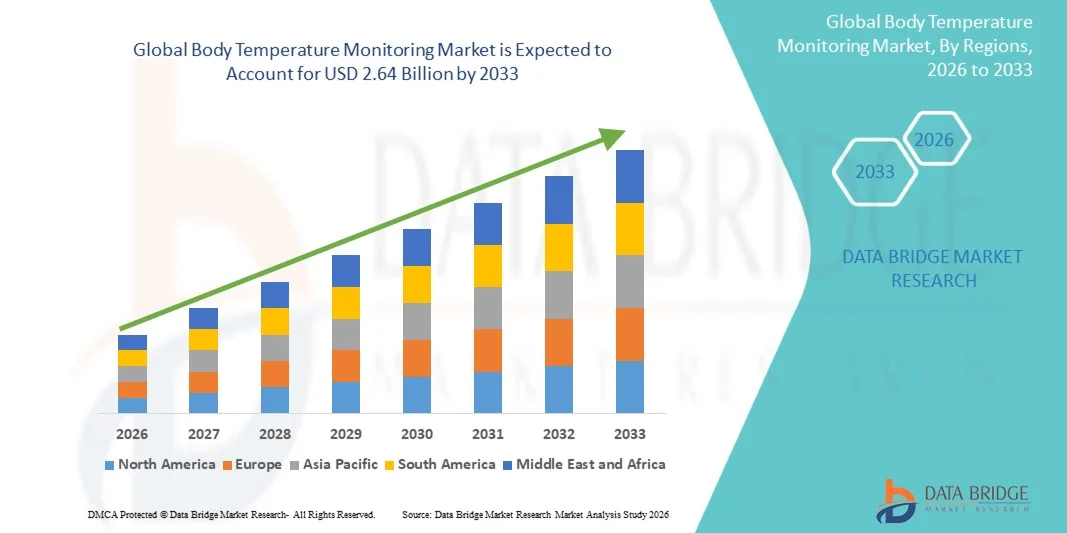
- As per Data Bridge Market Research analysis, the body temperature monitoring market was valued at USD 1.81 billion in 2025 and is projected to reach USD 2.64 billion by 2033, growing at a CAGR of 4.85% from 2026 to 2033.
- The market is experiencing consistent growth driven by the increasing prevalence of infectious diseases and fever-related conditions, growing demand for accurate and convenient temperature measurement, and the rising adoption of continuous and remote patient monitoring solutions across healthcare settings.
- The increasing focus on early disease detection and preventive healthcare, combined with the growing adoption of digital health technologies, is encouraging healthcare providers and consumers to adopt body temperature monitoring devices for timely fever detection, patient monitoring, and health assessment. Non-contact infrared thermometers, wearable temperature sensors, and connected monitoring devices are gaining traction by providing rapid, convenient, and continuous temperature measurement across hospitals, clinics, home healthcare settings, and public health screening environments.
Market Size & Forecast
- Global Market Value (2025): USD 1.81 Billion
- Expected Market Value (2033): USD 2.64 Billion
- Forecast CAGR (2026–2033): 4.85%
- Leading Region in 2025: North America
- Fastest Growing Region: Asia Pacific
What are the Major Takeaways of the Body Temperature Monitoring Market?
- North America dominated the body temperature monitoring market with the largest revenue share of 36.0% in 2025, supported by widespread adoption of digital thermometers, established healthcare infrastructure, increasing demand for remote patient monitoring, and growing utilization of advanced temperature monitoring devices across hospitals, clinics, and home-care settings.
- Asia-Pacific is expected to be the fastest-growing region at a CAGR of 5.8% from 2026 to 2033, fueled by rising healthcare expenditure, increasing prevalence of infectious diseases, expanding hospital infrastructure, growing adoption of digital healthcare technologies, and increasing demand for affordable temperature monitoring devices across emerging economies such as India and China.
- The contact devices segment led the market with a 62% share in 2025, driven by the established clinical use of digital thermometers, their measurement accuracy, ease of use, and continued demand across hospitals, clinics, and household healthcare applications.
- Non-contact infrared devices are the fastest-growing product type, projected to register a CAGR of 6.3%, reflecting increasing demand for rapid, hygienic, and touch-free temperature measurement across healthcare facilities, workplaces, public screening environments, and home-care settings.
- The offline segment dominated the distribution channel category with a 71% revenue share in 2025, supported by strong demand through hospitals, pharmacies, medical device distributors, and other established healthcare procurement channels.
- Hospitals and clinics accounted for 53% of the market share in 2025, driven by the high volume of patient temperature assessments, increasing adoption of electronic and continuous monitoring devices, and the need for reliable temperature measurement during diagnosis, treatment, and post-operative care.
- The home-care segment is the fastest-growing end-user category, with a CAGR of 6.0%, driven by the rising adoption of remote patient monitoring, increasing preference for convenient healthcare at home, growth in the elderly population, and wider availability of connected and wearable temperature monitoring devices.
Report Scope and Body Temperature Monitoring Market Segmentation
|
Attributes |
Body Temperature Monitoring Key Market Insights |
|
Segments Covered |
|
|
Countries Covered |
North America
Europe
Asia-Pacific
Middle East and Africa
South America
|
|
Key Market Players |
|
|
Market Opportunities |
|
|
Value Added Data Infosets |
In addition to the insights on market scenarios such as market value, growth rate, segmentation, geographical coverage, and major players, the market reports curated by the Data Bridge Market Research also include in-depth expert analysis, patient epidemiology, pipeline analysis, pricing analysis, and regulatory framework. |
What is the Key Trend in the Body Temperature Monitoring Market?
- Body temperature monitoring is increasingly shifting from periodic, spot-based measurements toward continuous and remote monitoring, using wearable sensors and connected devices to capture temperature data in real time and support earlier identification of changes in patient condition. Philips reported that its partnership with smartQare enables continuous monitoring of skin temperature and other vital signs across hospital and home settings.
- For instance, in June 2025, Philips announced its clinical technology partnership with smartQare to integrate the viQtor wearable biosensor, which automates monitoring of skin temperature and other vital signs and provides minute-by-minute data for hospital and home monitoring.
- Wearable and wireless temperature sensors are increasingly being integrated with remote patient monitoring platforms, allowing healthcare providers to access temperature trends without requiring patients to undergo repeated manual temperature checks.
- For instance, in May 2025, Medtronic announced a distribution agreement with Corsano Health for a multi-parameter wearable designed for continuous monitoring of vital signs, including skin temperature, with applications across hospitals and hospital-at-home settings.
- Non-contact infrared thermometers are also gaining importance because they enable rapid temperature measurement while reducing physical contact between the device and the person being assessed, supporting applications where infection-control considerations are important.
What are the Key Drivers of the Body Temperature Monitoring Market?
- The increasing adoption of remote and continuous patient monitoring is driving demand for body temperature monitoring devices that can automatically collect temperature data and provide healthcare professionals with real-time visibility into patient conditions.
- For instance, in May 2025, Medtronic expanded its Acute Care & Monitoring portfolio in Europe through a distribution agreement with Corsano Health for a medically certified wearable capable of continuously monitoring vital signs, including skin temperature, for hospital and hospital-at-home applications.
- The growing use of wearable and connected healthcare technologies is also increasing demand for temperature monitoring solutions that can integrate temperature measurements with broader patient-monitoring platforms and digital healthcare workflows.
- For instance, in June 2025, Philips reported that its smartQare partnership enables the viQtor wearable to automatically collect skin temperature, pulse rate, respiration, oxygen saturation, activity, and fall-detection data and transmit minute-by-minute information to Philips monitoring platforms for clinical monitoring.
- Regulatory attention toward the accuracy and safety of temperature-monitoring devices is also supporting demand for appropriately authorized and clinically validated solutions, particularly for infant and home-monitoring applications.
Which Factors are Challenging the Growth of the Body Temperature Monitoring Market?
- · The adoption of advanced body temperature monitoring devices can be challenging because continuous and connected systems require reliable sensors, appropriate device validation, accurate temperature measurement, data connectivity, and integration with existing healthcare workflows.
- For instance, in September 2025, the U.S. Food and Drug Administration (FDA) warned against unauthorized infant monitoring devices that measure or monitor body temperature, highlighting concerns that inaccurate measurements could delay treatment or result in unnecessary medical intervention.
- Measurement accuracy can restrict adoption because body temperature readings can be affected by the measurement method, device positioning, environmental conditions, and improper use, particularly with non-contact infrared technologies.
- For instance, in June 2025, the FDA stated that non-contact infrared thermometers can reduce cross-contamination risk but also emphasized that improper use may result in inaccurate temperature measurements, highlighting the importance of correct positioning and operating procedures.
- Continuous temperature monitoring devices can also face regulatory and compliance requirements that differ from those applicable to conventional intermittent thermometers, increasing development and commercialization complexity for manufacturers.
- For instance, in November 2025, the FDA issued a warning letter to Physitemp Instruments concerning clinical electronic thermometers and temperature-monitoring probes with continuous temperature measurement functions, noting that such devices are subject to regulatory requirements applicable to continuous measurement thermometers.
- These accuracy, regulatory, connectivity, and device-validation requirements can increase implementation complexity and may slow adoption, particularly for healthcare providers and consumers seeking low-cost temperature monitoring solutions.
How is the Body Temperature Monitoring Market Segmented?
The body temperature monitoring market is segmented on the basis of product type, measurement site, technology, application, end user, distribution channel, and geography.
- By Product Type
On the basis of product type, the body temperature monitoring market is segmented into contact thermometers, non-contact thermometers, wearable and continuous temperature monitoring devices, smart temperature monitoring patches, and other products. The contact thermometers segment dominated the market with 62.4% share in 2025, owing to their established use across hospitals, clinics, and home healthcare settings. Contact thermometers, particularly digital devices, provide reliable temperature measurements and remain widely used for routine fever detection and patient assessment. Their relatively low cost, ease of operation, and established clinical acceptance continue to support demand across healthcare settings. The continued requirement for accurate temperature measurement in routine healthcare and household applications is strengthening the position of contact thermometers.
The non-contact thermometers segment is projected to register the fastest growth at a CAGR of 6.3% from 2026 to 2033, driven by increasing demand for rapid, hygienic, and touch-free temperature measurement. Non-contact infrared thermometers enable temperature assessment without direct physical contact and are increasingly used in hospitals, clinics, households, workplaces, and screening environments. Their ability to provide rapid readings is particularly valuable where multiple individuals need to be screened within a short period.
- By Measurement Site
On the basis of measurement site, the body temperature monitoring market is segmented into oral, rectal, axillary, tympanic, temporal artery, and others. The oral segment dominated the market with 35.2% share in 2025, supported by the widespread use of oral temperature measurement for routine fever detection among adults and older children. Oral measurement provides a convenient method for obtaining body temperature in clinical and home settings. The availability of digital thermometers designed for oral measurement and their broad use in routine health assessments continue to support the segment. Increasing household healthcare awareness and the continued use of oral thermometry for fever monitoring are also contributing to demand.
The temporal artery segment is projected to register the fastest growth at a CAGR of 6.1% from 2026 to 2033, driven by increasing demand for rapid and minimally intrusive temperature measurement. Temporal artery thermometers use infrared sensing to measure temperature from the forehead or temporal region, enabling rapid assessments without the discomfort associated with some conventional measurement methods. Their suitability for children, elderly patients, and individuals requiring repeated measurements supports adoption across hospitals, clinics, and home healthcare settings. The growing preference for convenient and hygienic measurement methods is further contributing to the expansion of temporal artery temperature monitoring.
- By Application
On the basis of application, the body temperature monitoring market is segmented into fever detection and monitoring, hypothermia detection and monitoring, chronic disease management, post-operative care, infectious disease screening, and others. The fever detection and monitoring segment dominated the market with 46.2% share in 2025, driven by the widespread use of temperature measurement as an indicator of fever and infection. Body temperature monitoring is routinely used in hospitals, clinics, emergency care, pharmacies, and households to identify elevated temperatures and monitor changes during illness. The continuing need for early identification of fever and increasing awareness of temperature-based health assessment are supporting demand for monitoring devices.
The chronic disease management segment is projected to register the fastest growth at a CAGR of 6.8% from 2026 to 2033, supported by increasing adoption of remote and home-based patient monitoring. Patients requiring regular observation can benefit from connected temperature monitoring technologies that collect and transmit readings to healthcare professionals. Integration with remote patient monitoring platforms and digital health applications is expanding the role of temperature data beyond occasional fever assessment. The increasing adoption of home healthcare and connected monitoring technologies is therefore supporting the use of temperature monitoring in long-term patient management.
- By End User
On the basis of end user, the body temperature monitoring market is segmented into hospitals and clinics, home healthcare settings, ambulatory surgical centers, long-term care facilities, public health and screening centers, and others. The hospitals and clinics segment dominated the market with 53.2% share in 2025, owing to the high volume of patient assessments and the routine requirement for temperature measurement during diagnosis, treatment, admission, and post-operative monitoring. Hospitals and clinics use contact, non-contact, digital, infrared, and continuous temperature monitoring devices according to patient and clinical requirements. The increasing emphasis on patient monitoring and infection prevention is further supporting demand across healthcare facilities.
The home healthcare settings segment is projected to register the fastest growth at a CAGR of 6.0% from 2026 to 2033, driven by increasing preference for home-based care, remote patient monitoring, and convenient health assessment. Connected thermometers and wearable temperature monitoring devices allow patients and caregivers to record temperature without frequent visits to healthcare facilities. The expansion of telehealth and digital health platforms is also enabling temperature data to be incorporated into remote monitoring workflows.
- By Distribution Channel
On the basis of distribution channel, the body temperature monitoring market is segmented into offline and online. The offline segment dominated the market with 70.9% share in 2025, supported by established procurement through hospitals, clinics, pharmacies, medical distributors, retail healthcare outlets, and other physical healthcare channels. Offline channels provide consumers and healthcare organizations with direct access to medical devices and support institutional procurement through established medical-device distribution networks. The continued requirement for healthcare equipment through hospitals, clinics, pharmacies, and distributors is supporting the leading position of offline channels.
The online segment is projected to register the fastest growth at a CAGR of 7.0% from 2026 to 2033, driven by increasing consumer adoption of e-commerce, wider availability of connected health devices, and the convenience of comparing and purchasing temperature monitoring devices through digital platforms. Online channels provide access to digital thermometers, infrared devices, wearable sensors, and smart temperature monitoring products. Increasing consumer familiarity with online healthcare purchasing and the expanding availability of connected healthcare products are further supporting the growth of online distribution. Publicly available industry analysis also identifies offline channels as the established distribution route while indicating faster expansion of online sales.
Which Region Holds the Largest Share of the Body Temperature Monitoring Market?
- North America dominated the body temperature monitoring market with the largest revenue share of 36.0% in 2025, supported by advanced healthcare infrastructure, high adoption of digital medical devices, increasing demand for remote patient monitoring, and widespread use of temperature monitoring solutions across hospitals, clinics, and home healthcare settings.
- The region also benefits from increasing adoption of non-contact infrared thermometers, wearable temperature monitoring technologies, and connected healthcare devices. Growing emphasis on infection prevention, rapid fever detection, remote healthcare delivery, and continuous patient monitoring continues to strengthen North America’s position in the global market.
U.S. Body Temperature Monitoring Market Insight
The U.S. body temperature monitoring market is witnessing steady growth due to widespread healthcare infrastructure, increasing adoption of digital and non-contact thermometers, and growing demand for remote patient monitoring technologies. Hospitals, clinics, home healthcare providers, and consumers are increasingly using digital, infrared, and connected temperature monitoring devices for fever detection and routine health assessment. In addition, increasing adoption of wearable healthcare technologies, hospital-at-home models, and connected patient monitoring is supporting body temperature monitoring adoption across healthcare settings. The U.S. Food and Drug Administration also provides specific guidance for non-contact infrared thermometers, supporting awareness of appropriate use, performance, and infection-control considerations.
Asia-Pacific Body Temperature Monitoring Market Insight
The Asia-Pacific body temperature monitoring market is expected to witness rapid growth, driven by expanding healthcare infrastructure, increasing healthcare expenditure, rising awareness of digital healthcare technologies, and growing demand for affordable temperature monitoring devices across countries such as China, India, and Japan. Increasing patient populations and expanding hospital and home healthcare services are supporting the adoption of digital and infrared thermometers. In addition, growing use of remote patient monitoring, wearable healthcare devices, and connected health technologies is creating opportunities for advanced temperature monitoring solutions across the region.
Japan Body Temperature Monitoring Market Insight
The Japan body temperature monitoring market is witnessing consistent growth due to the country's advanced healthcare infrastructure, aging population, and increasing adoption of digital healthcare technologies. Hospitals, clinics, long-term care facilities, and households are increasingly using digital thermometers, infrared devices, and connected monitoring technologies for routine temperature assessment and patient monitoring. Moreover, increasing demand for home healthcare and remote monitoring, combined with Japan's strong healthcare technology ecosystem, is supporting the adoption of convenient and technologically advanced body temperature monitoring solutions.
China Body Temperature Monitoring Market Insight
The China body temperature monitoring market is growing rapidly, driven by expanding healthcare infrastructure, increasing healthcare expenditure, and rising adoption of digital medical devices. Hospitals, clinics, pharmacies, households, and public health facilities are increasingly utilizing digital and infrared thermometers for fever detection, routine health assessment, and screening applications. In addition, the expansion of connected healthcare technologies, increasing adoption of wearable devices, and growing availability of affordable temperature monitoring products are supporting market development across the country.
U.K. Body Temperature Monitoring Market Insight
The U.K. body temperature monitoring market is experiencing steady growth, supported by an established healthcare system, increasing adoption of digital medical devices, and growing demand for home-based and remote patient monitoring. Hospitals, clinics, care facilities, and households are increasingly using digital, infrared, and connected temperature monitoring devices for fever detection and routine patient assessment. Furthermore, the expansion of digital health services and increasing use of remote healthcare technologies are supporting the adoption of advanced body temperature monitoring solutions in the U.K.
Germany Body Temperature Monitoring Market Insight
The Germany body temperature monitoring market is expanding steadily due to its developed healthcare infrastructure, increasing adoption of medical technologies, and growing demand for efficient patient monitoring solutions. Hospitals, clinics, long-term care facilities, and home healthcare providers are increasingly utilizing digital thermometers, infrared devices, and connected monitoring technologies for routine temperature measurement and patient observation. Continuous developments in digital healthcare, remote patient monitoring, and wearable medical technologies, along with increasing demand for convenient and accurate temperature assessment, are further supporting market growth in Germany.
Which are the Top Companies in Body Temperature Monitoring Market?
The body temperature monitoring industry is primarily led by well-established companies, including:
- Baxter International Inc. (U.S.)
- Koninklijke Philips N.V. (Netherlands)
- Omron Healthcare, Inc. (Japan)
- Microlife Corporation (Taiwan)
- Medtronic plc (Ireland)
- Masimo Corporation (U.S.)
- Becton, Dickinson and Company (U.S.)
- Terumo Corporation (Japan)
- Drägerwerk AG & Co. KGaA (Germany)
- Helen of Troy Limited (U.S.)
- Welch Allyn, Inc. (U.S.)
- Exergen Corporation (U.S.)
- American Diagnostic Corporation (U.S.)
- A&D Company, Limited (Japan)
- Beurer GmbH (Germany)
- PAUL HARTMANN AG (Germany)
- Radiant Innovation Inc. (Taiwan)
- Rossmax International Ltd. (Taiwan)
- Easywell Biomedicals, Inc. (Taiwan)
- Guangzhou Berrcom Medical Device Co., Ltd. (China)
What are Latest Developments in Body Temperature Monitoring Market?
- In January 2024, Withings introduced BeamO, a compact four-in-one health-monitoring device combining a thermometer, electrocardiogram, oximeter, and digital stethoscope. The device uses a non-invasive temporal artery measurement to obtain core body temperature and is designed to support at-home health assessments and telehealth consultations. The launch demonstrates the integration of temperature monitoring with multiple connected health measurements in a single home-use device.
- In May 2025, Medtronic announced a distribution agreement with Corsano Health for its multi-parameter wearable, which is designed for continuous monitoring of vital signs and provides real-time patient data for hospital and hospital-at-home applications. The collaboration expands the use of wearable monitoring technologies within connected and remote-care environments.
- In June 2025, Philips announced a clinical technology partnership with smartQare to integrate the viQtor wearable biosensor into patient monitoring workflows. The wearable automatically monitors skin temperature along with pulse rate, respiration, oxygen saturation, activity, and falls, providing minute-by-minute data that can be accessed across hospital and home settings.
- In March 2025, AION Biosystems received FDA 510(k) clearance for its TempShield wearable thermometer. The single-use device is designed for continuous measurement of human body temperature through a wireless connection and is intended for use in healthcare facilities and home environments. The regulatory clearance highlights the development of wearable solutions specifically designed for continuous body temperature monitoring.
- In October 2020, Masimo launched the Radius T° continuous thermometer for consumers. The wearable wireless sensor continuously measures body temperature and transmits temperature information to a smartphone, allowing caregivers to monitor temperature trends and receive customizable notifications. The development illustrates the shift from intermittent temperature checks toward continuous, connected temperature monitoring.
- In July 2024, Exergen Corporation announced regulatory approval to launch its full line of temporal artery thermometers in Peru. The company's temporal artery thermometers are designed for non-invasive temperature measurement and are marketed for consumer and professional healthcare applications. The development reflects the continued geographic expansion of temporal artery temperature-monitoring technologies.

- Interactive Data Analysis Dashboard
- Company Analysis Dashboard for high growth potential opportunities
- Research Analyst Access for customization & queries
- Competitor Analysis with Interactive dashboard
- Latest News, Updates & Trend analysis
- Harness the Power of Benchmark Analysis for Comprehensive Competitor Tracking
Data collection and base year analysis are done using data collection modules with large sample sizes. The stage includes obtaining market information or related data through various sources and strategies. It includes examining and planning all the data acquired from the past in advance. It likewise envelops the examination of information inconsistencies seen across different information sources. The market data is analysed and estimated using market statistical and coherent models. Also, market share analysis and key trend analysis are the major success factors in the market report. To know more, please request an analyst call or drop down your inquiry.
The key research methodology used by DBMR research team is data triangulation which involves data mining, analysis of the impact of data variables on the market and primary (industry expert) validation. Data models include Vendor Positioning Grid, Market Time Line Analysis, Market Overview and Guide, Company Positioning Grid, Patent Analysis, Pricing Analysis, Company Market Share Analysis, Standards of Measurement, Global versus Regional and Vendor Share Analysis. To know more about the research methodology, drop in an inquiry to speak to our industry experts.
Data Bridge Market Research is a leader in advanced formative research. We take pride in servicing our existing and new customers with data and analysis that match and suits their goal. The report can be customized to include price trend analysis of target brands understanding the market for additional countries (ask for the list of countries), clinical trial results data, literature review, refurbished market and product base analysis. Market analysis of target competitors can be analyzed from technology-based analysis to market portfolio strategies. We can add as many competitors that you require data about in the format and data style you are looking for. Our team of analysts can also provide you data in crude raw excel files pivot tables (Fact book) or can assist you in creating presentations from the data sets available in the report.













