What is the Body Worn Insect Repellent Market Size and Growth Rate?
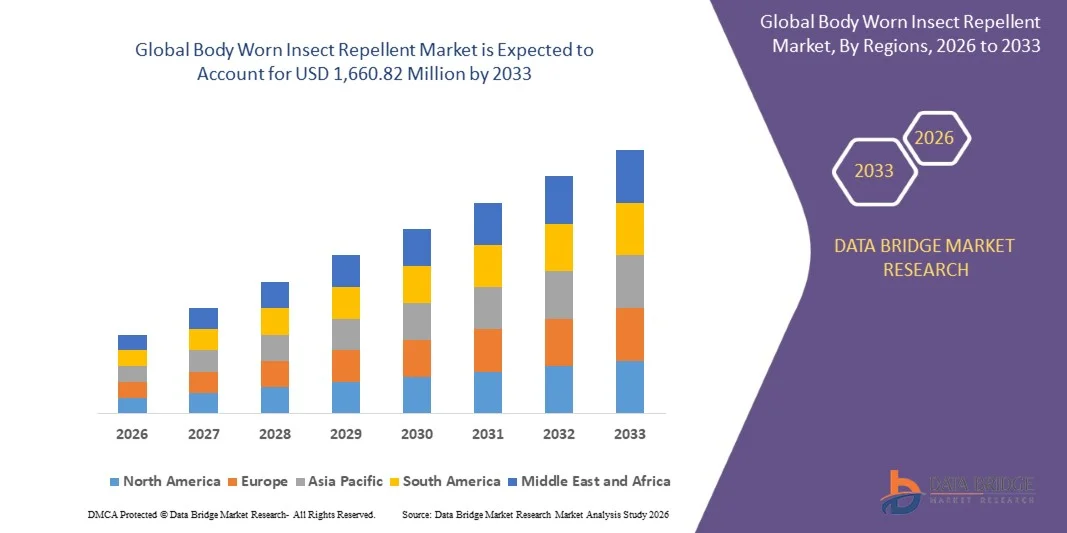
- As per Data Bridge Market Research analysis, the body worn insect repellent market was valued at USD 791.90 million in 2025 and is projected to reach USD 1,660.82 million by 2033, growing at a CAGR of 9.70% from 2026 to 2033.
- The market is experiencing consistent growth driven by rising awareness of insect-borne diseases, increasing demand for convenient personal protection solutions, and growing adoption of wearable repellent products across outdoor recreation, travel, military, and residential applications.
- The increasing prevalence of mosquito- and tick-borne diseases globally, combined with greater participation in outdoor activities and growing consumer preference for long-lasting protection, is encouraging the adoption of body worn insect repellents. Repellent bracelets, patches, clips, and other wearable formats are gaining popularity by providing convenient, portable, and hands-free protection compared with conventional topical repellents.
Market Size & Forecast
- Global Market Value (2025): USD 791.90 Million
- Expected Market Value (2033): USD 1,660.82 Million
- Forecast CAGR (2026–2033): 9.70%
- Leading Region in 2025: North America
- Fastest Growing Region: Asia Pacific
What are the Major Takeaways of the Body Worn Insect Repellent Market?
- North America dominated the body worn insect repellent market with the largest revenue share of 38.3% in 2025, supported by high consumer awareness, strong demand for personal protection, and widespread adoption of convenient wearable repellent product
- Asia-Pacific is expected to be the fastest-growing region at a CAGR of 11.1% from 2026 to 2033, fueled by the high prevalence of mosquito-borne diseases, rising consumer spending on personal care products, increasing awareness of insect-borne diseases, and growing demand for wearable protection.
- The apparel segment led the market with a 48.1% share in 2025, driven by increasing demand for insect-protective clothing among consumers participating in camping, trekking, fishing, and other outdoor activities
- Sprays are the fastest-growing product type, projected to register a CAGR of 10.7%, reflecting the surge in convenience, portability, and rapid application.
- The chemical segment dominated the ingredient type category with a 57.4% revenue share in 2025, led by the established efficacy of active ingredients such as DEET, picaridin, and IR3535.
- Mosquitoes accounted for 59.68% of the market share in 2025, preferred by consumers seeking effective protection against mosquito bites and mosquito-borne diseases, particularly during outdoor activities, travel, and in mosquito-prone regions.
- The outdoor activities segment is the fastest-growing application category, with a CAGR of 10.2%, driven by increasing participation in camping, hiking, fishing, trekking, and other recreational activities
Report Scope and Body Worn Insect Repellent Market Segmentation
|
Attributes |
Body Worn Insect Repellent Key Market Insights |
|
Segments Covered |
|
|
Countries Covered |
North America
Europe
Asia-Pacific
Middle East and Africa
South America
|
|
Key Market Players |
|
|
Market Opportunities |
|
|
Value Added Data Infosets |
In addition to the insights on market scenarios such as market value, growth rate, segmentation, geographical coverage, and major players, the market reports curated by the Data Bridge Market Research also include in-depth expert analysis, pricing analysis, brand share analysis, consumer survey, demography analysis, supply chain analysis, value chain analysis, raw material/consumables overview, vendor selection criteria, PESTLE Analysis, Porter Analysis, and regulatory framework. |
What is the Key Trend in the Body Worn Insect Repellent Market?
- Consumers are increasingly shifting toward wearable and hands-free insect protection, including repellent-treated clothing, patches, wristbands, clips, and other body-worn formats that provide convenient protection during travel and outdoor activities.
- For instance, in March 2025, Royal Robbins launched its Mosquito Protection Technology apparel collection, using tightly woven engineered fabric to create a chemical-free physical barrier against mosquitoes, demonstrating the shift toward innovative insect-protective clothing
- The trend is supported by growing demand for protection that can be incorporated into everyday clothing and accessories, reducing the need for repeated topical application while offering practical coverage during prolonged outdoor exposure.
- Repellent-treated apparel is gaining particular attention among travelers, outdoor workers, hikers, campers, and military personnel because factory-treated garments can provide longer-lasting protection against mosquitoes and ticks.
- Advances in formulation and textile treatment technologies are enabling manufacturers to develop wearable products using regulated active ingredients such as permethrin, while maintaining acceptable safety profiles when products are used according to approved directions.
- For instance, in January 2025, the U.S. EPA approved labeling for Vital Protection-treated garments and gear containing 0.52% permethrin, covering shirts, pants, shorts, hats, jackets, socks, backpacks, tents, and other wearable or outdoor products, highlighting the continued expansion of insect-repellent protection into apparel and personal gear.
- Consumers are also showing greater interest in portable protection as mosquito-borne diseases expand into new geographic areas, increasing demand for convenient personal protection products suitable for travel and outdoor lifestyles.
What are the Key Drivers of the Body Worn Insect Repellent Market?
- The increasing global burden of mosquito-borne diseases is significantly driving demand for personal insect protection products, particularly in tropical and subtropical regions where dengue, malaria, Zika, and chikungunya remain major public-health concerns.
- For instance, in April 2025, the CDC’s 2026 Yellow Book emphasized that vector-borne diseases occur at almost every travel destination and recommended travelers use insect repellents and protective measures to reduce mosquito exposure, supporting demand for convenient personal-repellent products.
- Growing travel, outdoor recreation, urbanization, and occupational exposure are encouraging consumers to adopt portable body-worn repellents that provide convenient protection without depending exclusively on sprays or lotions.
- For instance, in August 2025, the World Health Organization reported that dengue affected about half of the world’s population at risk, with an estimated 100–400 million infections annually, and recommended insect repellents containing DEET, picaridin, or IR3535 to reduce mosquito-bite exposure, reinforcing demand for personal insect-protection products.
- With mosquito-borne disease risks increasing alongside international travel and changing climatic conditions, demand for convenient wearable insect protection is expected to remain strong, supporting continued product innovation and market expansion.
Which Factors are Challenging the Growth of the Body Worn Insect Repellent Market?
The effectiveness of some wearable repellent products remains a significant challenge because protection can vary substantially according to the active ingredient, formulation, exposure conditions, product placement, and duration of use.
- For instance, in September 2024, a Journal of Medical Entomology study found that prolonged wear significantly reduced permethrin levels in military uniforms, with older garments showing lower tick irritancy and mortality, demonstrating that protection can decline over the product lifecycle.
- Regulatory requirements also restrict manufacturers from making unsupported claims, requiring evidence of safety and efficacy before insect-repellent products can be marketed with specific pest-control claims.
- The need for scientifically supported efficacy, regulatory compliance, and reliable protection performance continues to challenge the body worn insect repellent market, particularly for newer wearable formats that must demonstrate meaningful protection against mosquito bites.
- Limited protection duration and inconsistent performance across some wearable formats can restrain adoption, as effectiveness may decline with perspiration, washing, prolonged exposure, or improper placement, requiring consumers to supplement protection with conventional repellents.
- For instance, in December 2024, a research article published in the London School of Hygiene & Tropical Medicine and partner institutions found that the effectiveness of wearable repellent technologies varied across products, highlighting performance and efficacy limitations that can restrain wider adoption of body-worn repellents.
- Consumer skepticism toward certain wearable technologies can also limit market penetration, particularly when products such as ultrasonic devices, stickers, or wristbands make broad protection claims without comparable evidence to established active-ingredient repellents
How is the Body Worn Insect Repellent Market Segmented?
The body worn insect repellent market is segmented on the basis of product, ingredient, application, and distribution channel.
- By Product
On the basis of product, the body worn insect repellent market is segmented into apparel, oil and creams, stickers and patches, and sprays. The apparel segment dominated the market with an 48.1% share in 2025, driven by increasing demand for insect-protective clothing among consumers participating in camping, trekking, fishing, and other outdoor activities. These products incorporate insect-repellent treatments directly into fabrics, providing convenient protection without repeated application to the skin. Apparel is also attractive to consumers with sensitive skin who may prefer to limit direct exposure to topical repellent formulations. Advances in fabric treatment technologies are improving durability and maintaining protection through repeated washing. Growing adoption among outdoor enthusiasts, workers, and travelers is further supporting demand for treated clothing.
The sprays segment is projected to register the fastest growth at a CAGR of 10.7% during the forecast period, driven by convenience, portability, and rapid application. Sprays enable consumers to cover larger areas of exposed skin quickly, making them suitable for outdoor recreation and travel. The availability of different package sizes and formulations is expanding their appeal across consumer groups. Established active ingredients such as DEET and other synthetic and naturally derived compounds provide protection against mosquitoes and other insects. Increasing consumer awareness of insect-borne diseases is encouraging the use of portable spray products in high-exposure environments. Improvements in packaging, spray mechanisms, and low-odor formulations are further enhancing user convenience.
- By Ingredient
On the basis of ingredient, the body worn insect repellent market is segmented into natural and chemical. The chemical segment dominated the market with 57.4% share in 2025, supported by the established efficacy of active ingredients such as DEET, picaridin, and IR3535. Chemical repellents are widely preferred because they provide consistent and comparatively long-lasting protection against a broad range of insects. They are particularly important in regions where mosquito- and tick-borne diseases create significant personal-protection requirements. Health authorities commonly recommend registered chemical repellents for travelers and individuals exposed to vector-prone environments. Chemical formulations also maintain reliable performance during prolonged outdoor exposure and challenging climatic conditions.
The natural segment is projected to witness the fastest growth at a CAGR of 9.8% during forecast period, driven by increasing consumer preference for plant-derived, skin-friendly, and environmentally conscious insect protection. Natural repellents commonly incorporate botanical ingredients such as citronella, eucalyptus, lemongrass, and neem. Growing concerns regarding harsh chemicals and synthetic formulations are encouraging consumers to explore alternative protection products. Manufacturers are responding by expanding portfolios of natural and plant-based formulations across oils, creams, sprays, and wearable products. Increasing sustainability awareness is also encouraging the development of biodegradable and naturally derived repellent solutions. Improvements in formulation technology are helping manufacturers address concerns over the shorter protection duration of some natural ingredients.
- By Application
On the basis of application, the body worn insect repellent market is segmented into mosquitoes, ticks, fleas, outdoor activities, travel & tourism, home use, and commercial/industrial applications. The mosquitoes segment dominated the market with 40% share in 2025, as of demand based on market assessments identifying mosquitoes as the principal target insect category. This dominance reflects the widespread prevalence of mosquito-borne diseases and the large global population exposed to mosquito bites. Body worn repellents provide convenient protection during outdoor exposure where mosquito contact is more frequent. Apparel, sprays, creams, stickers, and patches can all be used to reduce mosquito-bite exposure. Demand is particularly strong in tropical and subtropical regions where mosquito populations and disease transmission remain high.
The outdoor activities segment is projected to register the fastest growth at 10.2% CAGR during forecast period, driven by increasing participation in camping, hiking, fishing, trekking, and other recreational activities. Outdoor consumers often experience prolonged exposure to mosquitoes, ticks, and other insects, increasing their reliance on convenient protective products. Wearable apparel, sprays, patches, and other portable solutions are particularly suitable for these activities. The segment accounted for approximately 44.8% of global revenues in 2025 in one recent market assessment, highlighting its importance to overall demand. Outdoor enthusiasts also frequently purchase multiple protection formats, such as treated clothing combined with sprays or patches, increasing product consumption.
- By Distribution Channel
On the basis of distribution channel, the body worn insect repellent market is segmented into retailers, supermarket, online retailers, health and beauty retailers, and others. The supermarket segment dominated the market with 30% share in 2025, benefiting from extensive consumer reach, high product visibility, and convenient availability of multiple insect-repellent formats under one roof. Supermarkets and hypermarkets offer apparel, creams, oils, sprays, and other products, allowing consumers to compare alternatives easily. Regular discounts, promotions, and bulk purchasing opportunities further encourage sales through these channels. Their expanding presence across emerging economies is increasing access to insect-repellent products among a broader consumer base. Consumers also benefit from immediate product availability, particularly during seasonal mosquito peaks and travel periods.
The online retailers segment is projected to register the fastest growth at 10.5% CAGR during forecast period, supported by rising e-commerce penetration, greater smartphone usage, and consumer preference for convenient home delivery. Online platforms provide access to a wider range of specialized products, including natural repellents, insect-repellent apparel, patches, and premium outdoor protection products. Consumers can compare product specifications, reviews, prices, and formulations before making purchasing decisions. Discounts, promotional campaigns, free delivery, and direct-to-consumer sales are further strengthening online demand. The online channel is particularly attractive for consumers in areas where specialized repellent products have limited physical-store availability. Increasing digital payment adoption and expanding e-commerce infrastructure in emerging markets are expected to support continued growth.
Which Region Holds the Largest Share of the Body Worn Insect Repellent Market?
- North America dominated the body worn insect repellent market with the largest revenue share of 38.3% in 2025, supported by high consumer awareness, strong demand for personal protection, and widespread adoption of convenient wearable repellent product
- The region also benefits from well-established retail and e-commerce infrastructure, strong adoption of insect-repellent apparel and wearable products, and high consumer spending on outdoor and personal-care products. Increasing concerns regarding mosquito- and tick-borne diseases, particularly in the U.S., together with growing preference for convenient and long-lasting protection, continue to strengthen North America's leadership position in the global market.
U.S. Body Worn Insect Repellent Market Insight
The U.S. body worn insect repellent market is witnessing strong growth due to high consumer awareness of insect-borne diseases, strong purchasing power, and widespread participation in outdoor activities such as camping, hiking, fishing, hunting, and sports. The country’s established retail and e-commerce infrastructure, along with the presence of major insect-repellent brands, is driving demand across apparel, oils and creams, sprays, stickers, and patches. Increasing concerns regarding mosquito- and tick-borne diseases are encouraging consumers to adopt convenient and portable protection products for both recreational and everyday use. In addition, growing preference for long-lasting, skin-friendly, and easy-to-apply repellents is encouraging manufacturers to develop innovative wearable and treated-fabric solutions.
Asia-Pacific Body Worn Insect Repellent Market Insight
The Asia-Pacific body worn insect repellent market is expected to witness rapid growth, driven by the high prevalence of mosquito-borne diseases, rising disposable incomes, expanding outdoor activities, and increasing awareness of personal insect protection across countries such as China, India, and Japan. Growing exposure to mosquitoes in tropical and subtropical climates is increasing demand for convenient protection products that can be used during daily activities, travel, and outdoor recreation. Adoption of wearable protection formats, including insect-repellent apparel, wristbands, patches, and portable sprays, is supporting regional market expansion. In addition, expanding retail networks, supermarkets, pharmacies, and online marketplaces are improving the availability of insect-repellent products across urban and semi-urban areas.
Japan Body Worn Insect Repellent Market Insight
The Japan body worn insect repellent market is witnessing consistent growth due to strong consumer awareness of mosquito protection, seasonal outdoor exposure, and demand for convenient personal insect-repellent products. Mosquito exposure generally increases during warmer and more humid periods, supporting seasonal demand for portable and easy-to-use protection solutions. Consumers are increasingly adopting sprays, patches, wearable products, treated clothing, and other convenient formats for outdoor activities, travel, gardening, and daily use. Moreover, Japan’s preference for compact, low-odor, practical, and aesthetically designed consumer products is encouraging manufacturers to develop innovative insect-repellent formats. Growing interest in products that combine convenience with skin-friendly and natural ingredients is further supporting product diversification.
China Body Worn Insect Repellent Market Insight
The China body worn insect repellent market is growing rapidly, driven by increasing awareness of mosquito-borne diseases, rising urban consumer spending, expanding outdoor lifestyles, and growing interest in convenient wearable protection. The country's large consumer base and varied climatic conditions create substantial demand for mosquito protection products, particularly during warmer and wetter seasons. Consumers are increasingly adopting mosquito-repellent wristbands, patches, apparel, sprays, and other portable products, particularly for children, families, travelers, and outdoor consumers. Rising demand for natural and herbal formulations is also encouraging manufacturers to introduce products based on citronella, lemongrass, tea tree oil, eucalyptus, and other botanical ingredients. The rapid expansion of e-commerce platforms is improving access to specialized and premium insect-repellent products beyond traditional retail channels.
U.K. Body Worn Insect Repellent Market Insight
The U.K. body worn insect repellent market is experiencing steady growth, supported by rising awareness of insect-borne diseases, increasing international travel, and demand for convenient insect protection during outdoor activities. Consumers are increasingly seeking portable and easy-to-use products such as sprays, patches, treated apparel, and other wearable formats for travel, camping, gardening, hiking, and recreational activities. Although mosquito exposure is generally seasonal, international travelers frequently require protection when visiting tropical and subtropical destinations where mosquito-borne diseases are more prevalent. Expanding online retail and health and beauty distribution channels are improving product accessibility and allowing consumers to compare a wider selection of conventional and natural formulations. Increasing preference for DEET alternatives, plant-based ingredients, and skin-friendly products is also encouraging manufacturers to diversify their offerings.
Germany Body Worn Insect Repellent Market Insight
The Germany body worn insect repellent market is expanding steadily due to increasing participation in outdoor recreation, growing consumer awareness of insect-borne health risks, and demand for reliable personal protection products. Consumers are adopting repellents for hiking, camping, cycling, gardening, fishing, travel, and other outdoor activities where exposure to mosquitoes and ticks can increase. Growing concerns about tick-related diseases, particularly among outdoor enthusiasts, are also strengthening demand for protective clothing and other body-worn solutions. Growing availability through pharmacies, supermarkets, specialty retailers, outdoor stores, and online platforms is supporting wider market penetration and making specialized products easier to access.
Which are the Top Companies in Body Worn Insect Repellent Market?
The body worn insect repellent industry is primarily led by well-established companies, including:
- Craghoppers (U.K.)
- Newell Brands Inc. (U.S.)
- Thermacell (U.S.)
- Sawyer (U.S.)
- Coghlan's (Canada)
- Lifemarque Limited (U.K.)
- APS BIOCONTROL (U.K.)
- L.L.Bean Inc. (U.S.)
- Duluth Trading Company (U.S.)
- The Orvis Company Inc. (U.S.)
- Columbia Sportswear Company (U.S.)
- Original Buff S.A. (Spain)
- Outdoor Research, LLC (U.S.)
- S.C. Johnson & Son, Inc. (U.S.)
- SPECTRUM BRANDS, INC. (U.S.)
- 3M (U.S.)
- Dabur India Limited (India)
- Insect Shield, LLC (U.S.)
- The Original Bug Shirt Company (Canada)
- Care Plus (Netherlands)
What are Latest Developments in Body Worn Insect Repellent Market?
- In May 2024, incognito launched its new Insect Repellent Bracelet, a reusable wearable product made with handcrafted wooden beads and a refillable capsule containing java citronella, lemon eucalyptus, and peppermint oils. The bracelet is designed to be worn on the wrist or ankle and provides protection against mosquitoes, midges, gnats, horseflies, fleas, and other biting insects, with each capsule lasting 18 days or more. This launch demonstrates growing innovation in natural and reusable wearable insect-repellent products.
- In May 2024, Emlord highlighted its CAYA insect-repellent clothing range for children, developed using a treatment process intended to provide insect protection without requiring repellent to be sprayed directly onto the skin. The clothing was designed specifically for children participating in outdoor activities and provides protection against insects such as mosquitoes and ticks. The development reflects increasing demand for DEET-free, wearable insect protection integrated directly into everyday children's clothing.
- In November 2023, Craghoppers introduced its updated NosiLife insect-repellent clothing technology, adding odor-elimination functionality to its plant-based insect-repellent apparel. The technology uses eucalyptus citriodora oil as the active repellent and sources the plant material through regenerative agriculture practices. The development demonstrates the industry's shift toward multifunctional, plant-based wearable protection combining insect repellency with odor management.
- In May 2023, MILLET launched its ANTI INSECT apparel series, its first clothing line incorporating insect-repellent functionality. The products use a skin-friendly contact-repellent material designed to discourage insects from remaining on the fabric and were positioned for consumers participating in hiking, camping, and other outdoor activities. The launch illustrates the integration of insect protection directly into technical outdoor apparel.
- In November 2021, BugShield Clothing launched mosquito-protection apparel in India using Insect Shield technology, introducing mosquito-repellent wraps for women along with T-shirts, polos, track pants, and trousers for children. The collection was designed to provide insect protection without changing the fabric's feel or fit and targeted everyday use as well as hiking, biking, trekking, and camping. The launch represented a significant expansion of treated insect-repellent apparel for the Indian consumer market.

- Interactive Data Analysis Dashboard
- Company Analysis Dashboard for high growth potential opportunities
- Research Analyst Access for customization & queries
- Competitor Analysis with Interactive dashboard
- Latest News, Updates & Trend analysis
- Harness the Power of Benchmark Analysis for Comprehensive Competitor Tracking
Data collection and base year analysis are done using data collection modules with large sample sizes. The stage includes obtaining market information or related data through various sources and strategies. It includes examining and planning all the data acquired from the past in advance. It likewise envelops the examination of information inconsistencies seen across different information sources. The market data is analysed and estimated using market statistical and coherent models. Also, market share analysis and key trend analysis are the major success factors in the market report. To know more, please request an analyst call or drop down your inquiry.
The key research methodology used by DBMR research team is data triangulation which involves data mining, analysis of the impact of data variables on the market and primary (industry expert) validation. Data models include Vendor Positioning Grid, Market Time Line Analysis, Market Overview and Guide, Company Positioning Grid, Patent Analysis, Pricing Analysis, Company Market Share Analysis, Standards of Measurement, Global versus Regional and Vendor Share Analysis. To know more about the research methodology, drop in an inquiry to speak to our industry experts.
Data Bridge Market Research is a leader in advanced formative research. We take pride in servicing our existing and new customers with data and analysis that match and suits their goal. The report can be customized to include price trend analysis of target brands understanding the market for additional countries (ask for the list of countries), clinical trial results data, literature review, refurbished market and product base analysis. Market analysis of target competitors can be analyzed from technology-based analysis to market portfolio strategies. We can add as many competitors that you require data about in the format and data style you are looking for. Our team of analysts can also provide you data in crude raw excel files pivot tables (Fact book) or can assist you in creating presentations from the data sets available in the report.