


What is the Body Worn Temperature Sensors Market Size and Growth Rate?
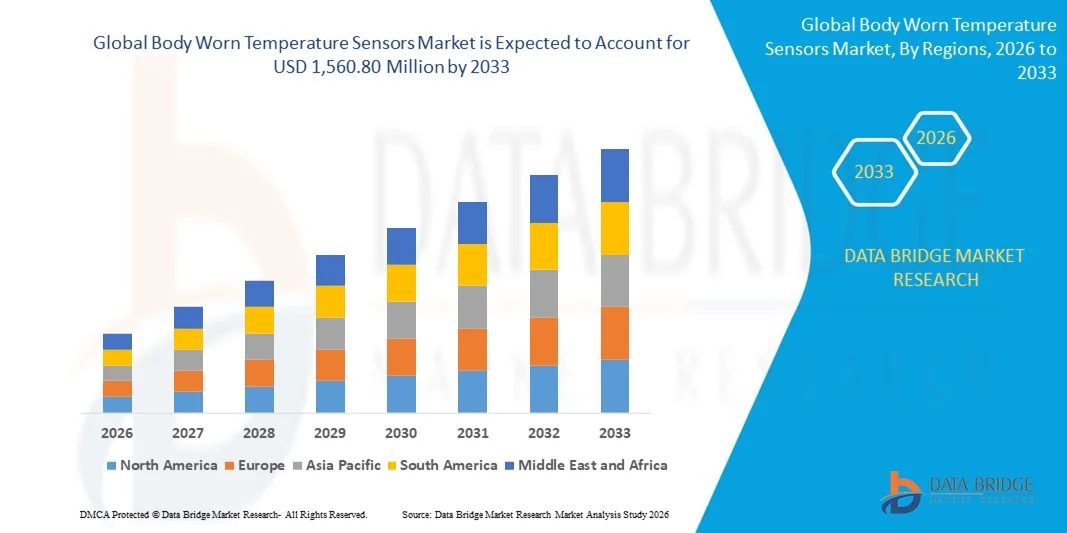
- As per Data Bridge Market Research Analysis the global body worn temperature sensors market size was valued at USD 104.26 million in 2025 and is expected to reach USD 1,560.80 million by 2033, at a CAGR of 40.25% during the forecast period
- The market growth is largely fuelled by the increasing adoption of wearable healthcare devices for continuous health monitoring, rising prevalence of chronic diseases, and growing demand for remote patient monitoring solutions
- Advances in sensor technology enabling accurate, real-time temperature measurement and integration with smartphones and healthcare apps are further supporting market expansion
Market Size & Forecast
- Global Market Value (2025): USD 104.26 million
- Expected Market Value (2033): USD 1,560.80 million
- Forecast CAGR (2026–2033): 40.25%
Body Worn Temperature Sensors Market Analysis
- The market is witnessing strong innovation driven by miniaturization, wireless connectivity, and AI-enabled data analytics, enhancing usability and accuracy
- Increasing partnerships between sensor manufacturers, wearable device companies, and healthcare institutions are driving product development and market penetration
- North America dominated the body worn temperature sensors market with the largest revenue share in 2025, driven by rising adoption of wearable health monitoring devices and increasing awareness of personal health and safety
- Asia-Pacific region is expected to witness the highest growth rate in the global body worn temperature sensors market, driven by rapid urbanization, expanding wearable device penetration, and government initiatives promoting digital health and telemedicine solutions
- The temperature sensors segment held the largest market revenue share in 2025, driven by their critical role in continuous health monitoring, infection detection, and remote patient care. These sensors are widely adopted in wearable devices, enabling accurate, real-time body temperature measurement across healthcare, fitness, and eldercare applications
Report Scope and Body Worn Temperature Sensors Market Segmentation
|
Attributes |
Body Worn Temperature Sensors Key Market Insights |
|
Segments Covered |
|
|
Countries Covered |
North America
Europe
Asia-Pacific
Middle East and Africa
South America
|
|
Key Market Players |
|
|
Market Opportunities |
|
|
Value Added Data Infosets |
In addition to the insights on market scenarios such as market value, growth rate, segmentation, geographical coverage, and major players, the market reports curated by the Data Bridge Market Research also include in-depth expert analysis, geographically represented company-wise production and capacity, network layouts of distributors and partners, detailed and updated price trend analysis and deficit analysis of supply chain and demand. |
Body Worn Temperature Sensors Market Trends
Rising Demand for Continuous Health Monitoring and Remote Patient Care
- The growing focus on wearable health technology is significantly shaping the body worn temperature sensors market, as consumers and healthcare providers increasingly prioritize real-time monitoring, early detection of anomalies, and personalized health management. Body worn temperature sensors are gaining traction due to their ability to provide continuous and accurate measurements without causing discomfort, supporting adoption across healthcare, fitness, and eldercare applications. This trend is encouraging manufacturers to innovate with smaller, more precise, and energy-efficient wearable devices
- Increasing awareness around infection control, chronic disease management, and pandemic preparedness has accelerated the demand for body worn temperature sensors in hospitals, clinics, and home healthcare. Health-conscious individuals and healthcare institutions are actively seeking wearable devices that allow remote monitoring and integration with mobile applications and telehealth platforms, prompting collaborations between device manufacturers, software developers, and healthcare providers to enhance functionality and patient outcomes
- Integration with smart devices, IoT platforms, and cloud-based analytics is influencing purchasing decisions, with manufacturers emphasizing data security, connectivity, and real-time alerts. These factors are helping providers and consumers differentiate devices in a competitive market, build trust in wearable solutions, and enable predictive healthcare management. Companies are increasingly using marketing campaigns to highlight accuracy, ease-of-use, and interoperability with healthcare systems
- For instance, in 2024, Fitbit in the U.S. and Withings in France expanded their wearable product portfolios by incorporating advanced body temperature monitoring features in smartwatches and fitness bands. These devices were introduced in response to rising demand for continuous health monitoring and remote patient care, with distribution across retail, online, and healthcare channels. The products were also marketed as essential tools for proactive health management, improving user engagement and adherence
- While demand for body worn temperature sensors is growing, sustained market expansion depends on continuous R&D, miniaturization, and cost-effective production. Manufacturers are also focusing on improving battery life, data accuracy, wireless connectivity, and integration with digital health platforms to balance device functionality, affordability, and reliability for broader adoption
Body Worn Temperature Sensors Market Dynamics
Driver
Rising Adoption of Wearable Health Monitoring Devices
- Increasing adoption of wearable devices for continuous monitoring of vital signs is a key driver for the body worn temperature sensors market. Manufacturers are developing sensors that provide accurate, real-time data for health tracking, chronic disease management, and infection control, supporting personalized healthcare solutions and improving patient outcomes
- Expanding applications in hospitals, elderly care, fitness, and workplace health monitoring are influencing market growth. Body worn temperature sensors enable remote monitoring, early warning alerts, and integration with health apps, allowing healthcare providers and users to make informed decisions. The growing trend of telehealth and digital healthcare further reinforces this adoption
- Device manufacturers are actively promoting wearable temperature sensors through product innovation, partnerships with healthcare providers, and certification initiatives. These efforts are supported by increasing consumer awareness, demand for remote patient care, and the need for proactive health monitoring, encouraging collaborations that enhance data analytics, usability, and interoperability
- For instance, in 2023, Omron Healthcare in Japan and Garmin in the U.S. reported increased incorporation of body temperature monitoring in wearable health devices. This expansion followed rising consumer preference for continuous monitoring and remote healthcare solutions, driving repeat purchases and product differentiation. Both companies also emphasized accuracy, reliability, and data security in marketing campaigns to strengthen consumer trust
- Although rising health awareness and wearable adoption support growth, wider market penetration depends on device affordability, technological innovation, and regulatory approvals. Investment in miniaturization, battery optimization, and cloud-based integration will be critical to meet global demand and maintain a competitive advantage
Restraint/Challenge
High Cost and Limited Awareness in Emerging Markets
- The relatively higher cost of advanced body worn temperature sensors compared to conventional thermometers remains a key challenge, limiting adoption among price-sensitive consumers and healthcare facilities. Higher production costs and technological complexity contribute to elevated pricing, restricting market growth in emerging regions
- Consumer and healthcare provider awareness remains uneven, particularly in developing countries where remote patient monitoring and wearable health technologies are still emerging. Limited understanding of benefits and functionality restricts adoption across certain applications, slowing market growth
- Connectivity, data privacy, and integration challenges also impact market growth, as body worn sensors require secure data transmission, adherence to regulatory standards, and compatibility with multiple platforms. Operational issues such as battery life and device maintenance further affect usability and market acceptance
- For instance, in 2024, distributors in India and Brazil supplying wearable devices for hospitals and elderly care reported slower uptake due to high prices and limited awareness of long-term benefits. Connectivity issues and compliance with healthcare standards were additional barriers, affecting adoption and market penetration
- Overcoming these challenges will require cost-effective production, improved consumer and provider education, and enhanced interoperability with healthcare systems. Collaboration with device developers, healthcare institutions, and regulatory bodies can help unlock the long-term growth potential of the global body worn temperature sensors market. Developing affordable, reliable, and user-friendly solutions will be essential for widespread adoption
Body Worn Temperature Sensors Market Scope
The body worn temperature sensors market is segmented on the basis of type and application.
- By Type
On the basis of type, the market is segmented into motion sensors, pressure sensors, temperature sensors, position sensors, inertial sensors, medical-based sensors, and image sensors. The temperature sensors segment held the largest market revenue share in 2025, driven by their critical role in continuous health monitoring, infection detection, and remote patient care. These sensors are widely adopted in wearable devices, enabling accurate, real-time body temperature measurement across healthcare, fitness, and eldercare applications.
The medical-based sensors segment is expected to witness the fastest growth rate from 2026 to 2033, driven by their precision, reliability, and integration with wearable devices for monitoring vital signs. Medical-based sensors are increasingly used in hospitals, clinics, and home healthcare, offering enhanced patient safety, proactive health management, and supporting telemedicine and digital health initiatives.
- By Application
On the basis of application, the market is segmented into fitness and wellness, infotainment, healthcare and medical, clinical settings, and industrial and military. The healthcare and medical segment held the largest market share in 2025, fueled by the growing need for continuous monitoring of patients and early detection of fever or anomalies.
The fitness and wellness segment is expected to witness the fastest growth from 2026 to 2033, driven by the increasing adoption of wearable devices among health-conscious consumers and integration with mobile applications. Devices in this segment provide users with real-time feedback, support personalized health tracking, and encourage preventive healthcare practices, boosting market expansion across consumer and professional sectors.
Body Worn Temperature Sensors Market Regional Analysis
- North America dominated the body worn temperature sensors market with the largest revenue share in 2025, driven by rising adoption of wearable health monitoring devices and increasing awareness of personal health and safety
- Consumers in the region highly value real-time monitoring capabilities, convenience, and integration with smartphones and health apps
- High disposable incomes, technologically inclined populations, and growing emphasis on preventive healthcare are supporting widespread adoption, making body worn temperature sensors a preferred solution across fitness, medical, and industrial applications
U.S. Body Worn Temperature Sensors Market Insight
The U.S. body worn temperature sensors market captured the largest revenue share in 2025 within North America, fueled by the growing demand for wearable medical devices and health-monitoring solutions. Consumers and healthcare providers are increasingly prioritizing early detection and real-time monitoring of health parameters. Integration with telehealth platforms, mobile applications, and IoT devices further boosts adoption. Rising fitness and wellness trends, along with technological innovation in sensor accuracy and miniaturization, are significantly driving market expansion.
Europe Body Worn Temperature Sensors Market Insight
The Europe body worn temperature sensors market is expected to witness the fastest growth rate from 2026 to 2033, primarily driven by the rising adoption of wearable medical devices and stringent healthcare regulations. Increasing awareness of employee and patient safety, coupled with advancements in connected health technologies, is promoting market adoption. European consumers are also attracted to the convenience, non-invasiveness, and real-time monitoring capabilities offered by these sensors. The market is expanding across clinical, industrial, and fitness applications, supported by strong healthcare infrastructure and innovation-focused initiatives.
U.K. Body Worn Temperature Sensors Market Insight
The U.K. body worn temperature sensors market is expected to witness rapid growth from 2026 to 2033, driven by rising demand for wearable healthcare solutions and industrial safety monitoring. Growing concerns regarding employee and personal health, along with government initiatives promoting digital healthcare and telemedicine, are encouraging adoption. Integration with mobile devices and IoT-enabled platforms is enhancing usability and appeal. The country’s robust e-commerce and retail ecosystem also facilitates the availability of wearable sensors for clinical, wellness, and industrial applications.
Germany Body Worn Temperature Sensors Market Insight
The Germany body worn temperature sensors market is expected to witness rapid growth from 2026 to 2033, fueled by increasing awareness of health monitoring and workplace safety. Germany’s advanced healthcare and industrial infrastructure, combined with strong technological innovation, supports adoption across hospitals, clinics, fitness centers, and manufacturing facilities. The demand for real-time data, preventive healthcare solutions, and industrial safety monitoring devices is driving market expansion. Integration with telehealth and mobile platforms further enhances the functionality and attractiveness of body worn temperature sensors.
Asia-Pacific Body Worn Temperature Sensors Market Insight
The Asia-Pacific body worn temperature sensors market is expected to witness the fastest growth rate from 2026 to 2033, driven by rapid urbanization, rising disposable incomes, and technological advancements in countries such as China, Japan, and India. Government initiatives supporting digital healthcare and workplace safety are fueling adoption. Increasing health awareness, wearable device penetration, and industrial safety requirements are driving demand across fitness, medical, and industrial applications. The region’s growing manufacturing capabilities for wearable sensors are also making devices more affordable and accessible to a broader consumer base.
Japan Body Worn Temperature Sensors Market Insight
The Japan body worn temperature sensors market is expected to witness rapid growth from 2026 to 2033, due to the country’s tech-savvy population, aging demographics, and focus on preventive healthcare. Wearable sensors are increasingly adopted in hospitals, elderly care facilities, and personal fitness applications. Integration with IoT devices, mobile health platforms, and clinical monitoring systems is driving adoption. Rising emphasis on convenience, real-time health monitoring, and safety in workplaces and public spaces further supports market expansion.
China Body Worn Temperature Sensors Market Insight
The China body worn temperature sensors market accounted for the largest revenue share in Asia-Pacific in 2025, driven by the expanding middle class, increasing awareness of personal and workplace health, and rapid adoption of wearable technology. Strong government support for healthcare digitization, combined with growing manufacturing capabilities, is boosting market availability and affordability. Adoption spans healthcare, fitness, and industrial safety applications, with real-time monitoring, mobile integration, and cost-effective solutions being key factors propelling market growth in the country.
Body Worn Temperature Sensors Market Share
The Body Worn Temperature Sensors industry is primarily led by well-established companies, including:
- Siemens (Germany)
- General Electric Company (U.S.)
- Sensirion AG (Switzerland)
- Heimann Sensor GmbH (Germany)
- Dexter Research Center (U.S.)
- MC10 (U.S.)
- Shimmer (Ireland)
- Carre Technologies Inc (Hexoskin) (Canada)
- Isansys Ltd. (U.K.)
- Maxim Integrated (U.S.)
- MBIENTLAB INC (U.S.)
- Adidas AG (Germany)
- Analog Devices, Inc. (U.S.)
- TDK Corporation (Japan)
- ZOLL Medical Corporation (U.S.)
- 4B GROUP (U.K.)
- Allegro MicroSystems, Inc. (U.S.)
- Koninklijke Philips N.V. (Netherlands)
- Amsys GmbH & Co. KG (Germany)
- Althen GmbH Mess- und Sensortechnik (Germany)
- STMicroelectronics (Switzerland)
Latest Developments in Global Body Worn Temperature Sensors Market
- In August 2024, Philips (Netherlands) announced a strategic collaboration with a leading telehealth provider to enhance its body-worn temperature sensors. The partnership aims to integrate real-time temperature monitoring with telehealth platforms, enabling remote patient monitoring and timely interventions. This initiative strengthens Philips’ digital health ecosystem and reinforces its market leadership in wearable medical devices
- In September 2024, Honeywell (U.S.) launched a new line of body-worn temperature sensors for industrial applications. The products focus on worker safety and health monitoring, addressing growing demand for occupational health solutions. By targeting industrial sectors, Honeywell expands its customer base and enhances its competitive positioning in the wearable sensor market
- In July 2024, Fitbit (U.S.) unveiled an upgraded wearable device with advanced body temperature monitoring features. The enhancement aims to provide comprehensive health tracking for consumers, supporting fitness and wellness goals. This development reinforces Fitbit’s commitment to innovation and strengthens its position in the competitive wearable technology landscape

- Interactive Data Analysis Dashboard
- Company Analysis Dashboard for high growth potential opportunities
- Research Analyst Access for customization & queries
- Competitor Analysis with Interactive dashboard
- Latest News, Updates & Trend analysis
- Harness the Power of Benchmark Analysis for Comprehensive Competitor Tracking
Global Body Worn Temperature Sensors Market, Supply Chain Analysis and Ecosystem Framework
To support market growth and help clients navigate the impact of geopolitical shifts, DBMR has integrated in-depth supply chain analysis into its Global Body Worn Temperature Sensors Market research reports. This addition empowers clients to respond effectively to global changes affecting their industries. The supply chain analysis section includes detailed insights such as Global Body Worn Temperature Sensors Market consumption and production by country, price trend analysis, the impact of tariffs and geopolitical developments, and import and export trends by country and HSN code. It also highlights major suppliers with data on production capacity and company profiles, as well as key importers and exporters. In addition to research, DBMR offers specialized supply chain consulting services backed by over a decade of experience, providing solutions like supplier discovery, supplier risk assessment, price trend analysis, impact evaluation of inflation and trade route changes, and comprehensive market trend analysis.
Data collection and base year analysis are done using data collection modules with large sample sizes. The stage includes obtaining market information or related data through various sources and strategies. It includes examining and planning all the data acquired from the past in advance. It likewise envelops the examination of information inconsistencies seen across different information sources. The market data is analysed and estimated using market statistical and coherent models. Also, market share analysis and key trend analysis are the major success factors in the market report. To know more, please request an analyst call or drop down your inquiry.
The key research methodology used by DBMR research team is data triangulation which involves data mining, analysis of the impact of data variables on the market and primary (industry expert) validation. Data models include Vendor Positioning Grid, Market Time Line Analysis, Market Overview and Guide, Company Positioning Grid, Patent Analysis, Pricing Analysis, Company Market Share Analysis, Standards of Measurement, Global versus Regional and Vendor Share Analysis. To know more about the research methodology, drop in an inquiry to speak to our industry experts.
Data Bridge Market Research is a leader in advanced formative research. We take pride in servicing our existing and new customers with data and analysis that match and suits their goal. The report can be customized to include price trend analysis of target brands understanding the market for additional countries (ask for the list of countries), clinical trial results data, literature review, refurbished market and product base analysis. Market analysis of target competitors can be analyzed from technology-based analysis to market portfolio strategies. We can add as many competitors that you require data about in the format and data style you are looking for. Our team of analysts can also provide you data in crude raw excel files pivot tables (Fact book) or can assist you in creating presentations from the data sets available in the report.













