


Bone Conduction Hearing Aids Market Size
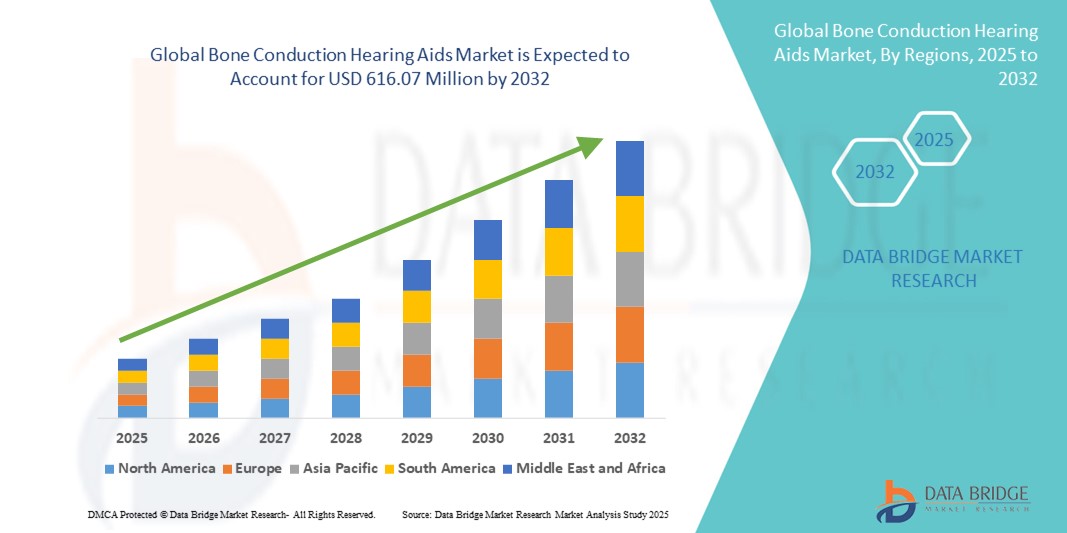
- The global bone conduction hearing aids market size was valued at USD 246.87 million in 2024 and is expected to reach USD 616.07 million by 2032, at a CAGR of 12.11% during the forecast period
- The market growth is primarily driven by the increasing prevalence of hearing loss and auditory disorders, alongside advancements in bone conduction technology that offer improved sound quality and comfort
- In addition, rising awareness about alternative hearing solutions, coupled with growing adoption in both pediatric and adult populations, is boosting demand for bone conduction hearing aids as a preferred option for patients with conductive hearing loss or single-sided deafness. These factors collectively are propelling market expansion and innovation in this sector
Bone Conduction Hearing Aids Market Analysis
- Bone conduction hearing aids, which transmit sound vibrations through the skull to the inner ear, are increasingly important devices for individuals with conductive hearing loss, single-sided deafness, or middle ear abnormalities, providing an effective alternative to conventional hearing aids
- The rising market demand is driven by technological advancements enhancing device comfort and sound quality, growing awareness of hearing health, and increasing adoption across both pediatric and adult populations
- North America dominated the bone conduction hearing aids market with the largest revenue share of 40% in 2024, supported by advanced healthcare infrastructure, higher adoption rates of hearing assistive technologies, and significant investments in R&D by leading manufacturers
- Asia-Pacific is projected to be the fastest-growing region in the bone conduction hearing aids market during the forecast period, attributed to increasing healthcare accessibility, government initiatives promoting hearing care, and rising disposable incomes in emerging economies
- The bone anchored hearing aids segment dominated the bone conduction hearing aids market with a share of 62.3% in 2024, driven by their superior effectiveness in treating various types of hearing loss through direct bone stimulation and increasing preference for implantable solutions
Report Scope and Bone Conduction Hearing Aids Market Segmentation
|
Attributes |
Bone Conduction Hearing Aids Key Market Insights |
|
Segments Covered |
|
|
Countries Covered |
North America
Europe
Asia-Pacific
Middle East and Africa
South America
|
|
Key Market Players |
|
|
Market Opportunities |
|
|
Value Added Data Infosets |
In addition to the insights on market scenarios such as market value, growth rate, segmentation, geographical coverage, and major players, the market reports curated by the Data Bridge Market Research also include in-depth expert analysis, pricing analysis, brand share analysis, consumer survey, demography analysis, supply chain analysis, value chain analysis, raw material/consumables overview, vendor selection criteria, PESTLE Analysis, Porter Analysis, and regulatory framework. |
Bone Conduction Hearing Aids Market Trends
Advancements in Implantable Technology and Wireless Connectivity
- A prominent trend shaping the global bone conduction hearing aids market is the continuous innovation in implantable devices combined with enhanced wireless connectivity features such as Bluetooth and smartphone integration, which improve user experience and device functionality
- For instance, Cochlear’s Baha 6 Max integrates advanced wireless streaming capabilities, allowing users to connect directly to smartphones, televisions, and other audio sources, significantly improving ease of use and sound quality. Similarly, MED-EL’s Bonebridge system offers implantable solutions with wireless control options through dedicated apps
- Wireless connectivity also enables seamless adjustments, remote troubleshooting, and firmware updates, reducing the need for frequent clinical visits and providing users with greater autonomy
- Furthermore, advancements in implantable device miniaturization and battery life extend comfort and usability, attracting a broader patient demographic including younger users
- This trend towards more connected, discreet, and customizable hearing solutions is raising user expectations and driving manufacturers such as Oticon Medical and Sophono to develop next-generation bone conduction devices with improved aesthetics and performance
- The increasing demand for technologically advanced and user-friendly bone conduction hearing aids is expanding across pediatric and adult patient segments, as consumers seek both functional and lifestyle-oriented hearing solutions
Bone Conduction Hearing Aids Market Dynamics
Driver
Increasing Prevalence of Hearing Loss and Rising Awareness
- The growing global incidence of hearing loss, coupled with rising public awareness about the benefits of bone conduction hearing aids, is a major driver of market growth. Early diagnosis and intervention, supported by hearing health campaigns, are increasing adoption rates
- For instance, in 2024, Cochlear Limited expanded its global outreach programs to enhance access to hearing solutions in underserved regions, contributing to broader market penetration
- Enhanced device efficacy, comfort, and availability of personalized fitting services further encourage patients and healthcare providers to opt for bone conduction devices over traditional hearing aids, especially for individuals with conductive or mixed hearing loss
- In addition, increasing healthcare expenditure and insurance coverage improvements in developed markets are supporting higher device adoption
- The integration of bone conduction hearing aids with other assistive technologies, such as cochlear implants and wireless accessories, is also fueling demand by offering comprehensive auditory rehabilitation solutions
Restraint/Challenge
High Costs and Limited Awareness in Developing Regions
- The relatively high cost of implantable bone conduction hearing aids and associated surgical procedures limits accessibility for many patients, particularly in developing countries where healthcare infrastructure and reimbursement policies are less advanced
- In addition, limited awareness about bone conduction technology and its benefits among patients and some healthcare providers restricts market growth in these regions
- For instance, the lack of specialized audiologists and implant centers in rural or low-income areas poses challenges for timely diagnosis and treatment
- Moreover, concerns about surgical risks and device maintenance requirements may discourage potential users
- Regulatory hurdles and lengthy approval processes in various countries can delay the launch of new products, limiting timely access to advanced bone conduction hearing aids in some markets
- Battery life limitations and the need for frequent recharging or replacement of external components can affect user convenience and satisfaction, potentially reducing adoption rates among certain patient groups
Bone Conduction Hearing Aids Market Scope
The market is segmented on the basis of type, product, and patient type.
- By Type
On the basis of type, the bone conduction hearing aids market is segmented into bone anchored hearing aids (baha) and traditional bone conduction hearing aids. The Bone Anchored Hearing Aids segment dominated the market with the largest revenue share of 62.3% in 2024, driven by their implantable design that offers direct bone stimulation, leading to superior sound quality and improved hearing outcomes for patients with conductive and mixed hearing loss. Their growing acceptance in clinical practice and continuous technological improvements, such as better osseointegration and wireless connectivity, further strengthen their market dominance.
Meanwhile, the Traditional Bone Conduction Hearing Aids segment is projected to register the fastest growth during the forecast period. This growth is fueled by rising demand for non-invasive, externally worn hearing aids, especially among patients hesitant to undergo surgery, as well as technological advancements improving comfort, aesthetics, and wireless features in traditional devices.
- By Product
On the basis of product, the bone conduction hearing aids market is segmented into systems, accessories, and sound processors. The Systems segment led the market with a share of 54.8% in 2024, owing to the increasing preference for comprehensive hearing aid solutions that include both sound processors and the necessary accessories, providing end-to-end hearing rehabilitation. This segment benefits from innovations such as miniaturization, improved sound processing algorithms, and wireless streaming capabilities that enhance user experience.
The Accessories segment is expected to witness the fastest growth rate over the forecast period, driven by rising consumer demand for device customization, replacement parts, and upgrades that improve device functionality and longevity. Accessories such as cables, batteries, and wireless transmitters are increasingly important as users seek to personalize and optimize their hearing aid performance.
- By Patient Type
On the basis of patient type, the bone conduction hearing aids market is segmented into children/pediatrics and adults. The Adults segment dominated the market with the largest revenue share of 67.1% in 2024, reflecting a higher prevalence of age-related and acquired hearing loss in the adult population, alongside greater purchasing power and higher adoption rates of hearing assistive technologies. The segment is further supported by increased awareness campaigns and insurance coverage facilitating access to advanced hearing solutions.
On the other hand, the Children/Pediatrics segment is anticipated to witness the fastest growth during the forecast period. This is attributed to increasing early diagnosis of congenital and acquired hearing impairments, growing parental awareness regarding hearing health, and expanding government and non-profit initiatives promoting pediatric hearing rehabilitation. Improved fitting techniques and child-friendly device designs are also contributing to the segment’s growth.
Bone Conduction Hearing Aids Market Regional Analysis
- North America dominated the bone conduction hearing aids market with the largest revenue share of 40% in 2024, supported by advanced healthcare infrastructure, higher adoption rates of hearing assistive technologies, and significant investments in R&D by leading manufacturers
- Consumers in the region benefit from widespread availability of specialized audiology centers and reimbursement policies, facilitating access to bone conduction hearing aids. The presence of key market players and ongoing R&D investments further bolster product innovation and adoption
- This dominance is supported by increasing prevalence of hearing loss among aging populations, growing government initiatives for hearing care, and a technologically savvy population that values advanced hearing solutions, positioning bone conduction hearing aids as a preferred option for patients with conductive and mixed hearing loss
U.S. Bone Conduction Hearing Aids Market Insight
The U.S. bone conduction hearing aids market dominated the global market with a revenue share of 39.5% in 2024, driven by advanced healthcare infrastructure, extensive audiology services, and strong insurance coverage supporting hearing aid adoption. The country benefits from a large aging population with increasing prevalence of hearing loss, alongside rising awareness about the benefits of bone conduction hearing aids among both patients and healthcare professionals. Significant investments in research and development by key market players such as Cochlear Limited and MED-EL have led to innovations including implantable devices with wireless connectivity and improved sound processors.
Europe Bone Conduction Hearing Aids Market Insight
The Europe bone conduction hearing aids market is projected to experience steady growth, driven by increased healthcare spending, an expanding geriatric population, and stringent regulations governing medical devices. Countries such as Germany, the U.K., and France are at the forefront, with strong healthcare infrastructures facilitating early diagnosis and treatment of hearing loss. Rising patient awareness and the integration of bone conduction hearing aids with wireless and smartphone-compatible technology are boosting adoption rates. Government initiatives and reimbursement schemes in many European countries lower the cost burden for patients, encouraging greater use of advanced hearing solutions. The region also sees growth in pediatric usage, supported by early intervention programs.
U.K. Bone Conduction Hearing Aids Market Insight
The U.K. bone conduction hearing aids market is poised for significant growth, driven by increasing public and professional awareness of hearing loss and advances in bone conduction hearing aid technologies. The country’s National Health Service (NHS) offers structured hearing care programs, improving accessibility for both adults and children. In addition, rising demand for discreet, user-friendly, and wireless-enabled devices supports market expansion. The U.K.’s robust healthcare infrastructure, combined with strong e-commerce penetration for hearing aids, facilitates convenient access and replacement services, further accelerating adoption.
Germany Bone Conduction Hearing Aids Market Insight
The Germany bone conduction hearing aids market represents one of the key European markets due to its emphasis on innovation, quality healthcare services, and patient education. The market is driven by technological advancements such as device miniaturization, improved battery life, and enhanced sound processing algorithms that improve user experience. Strong reimbursement policies make bone conduction hearing aids financially accessible to a larger population. German consumers also value sustainable and eco-friendly medical devices, prompting manufacturers to focus on environmentally responsible product designs. The integration of these devices into broader digital health ecosystems, including remote monitoring, is gaining traction.
Asia-Pacific Bone Conduction Hearing Aids Market Insight
The Asia-Pacific bone conduction hearing aids market is the fastest-growing region in the global market, with a CAGR significantly higher than the global average. Growth is propelled by improving healthcare infrastructure, rising disposable incomes, and expanding awareness of hearing loss and treatment options. Countries such as China, Japan, India, and South Korea are leading this expansion, supported by government health initiatives aimed at improving hearing care access and early diagnosis. The availability of affordable bone conduction hearing aids, coupled with an expanding base of audiology centers, is making these devices accessible to a wider population. Increasing urbanization and digital health adoption also contribute to the rapid uptake of technologically advanced hearing aids.
Japan Bone Conduction Hearing Aids Market Insight
The Japan bone conduction hearing aids market growth is fueled by its rapidly aging population and high penetration of advanced healthcare technologies. Consumers show strong preference for minimally invasive and highly effective bone conduction hearing aids that incorporate wireless connectivity and smartphone compatibility. The country benefits from a well-established healthcare system with comprehensive audiology services. Government-led hearing health campaigns and subsidies enhance accessibility for elderly patients, while innovations focusing on device aesthetics and comfort attract younger users with mild hearing loss.
India Bone Conduction Hearing Aids Market Insight
The India bone conduction hearing aids market accounted for the largest revenue share within the Asia-Pacific region in 2024, driven by rapid urbanization, rising middle-class income, and growing awareness about hearing health. The expansion of hearing care infrastructure, including an increasing number of audiology clinics and hearing aid distributors, supports market growth. Domestic manufacturers are contributing by offering affordable bone conduction hearing aids that cater to price-sensitive consumers. In addition, government programs targeting hearing impairment and disability rehabilitation help improve diagnosis and treatment rates in rural and urban areas. Increasing smartphone penetration and digital health awareness also support adoption, particularly among younger demographics.
Bone Conduction Hearing Aids Market Share
The bone conduction hearing aids industry is primarily led by well-established companies, including:
- Cochlear Limited (Australia)
- MED-EL GmbH (Austria)
- Oticon Medical (Denmark)
- Sophono, Inc. (U.S.)
- William Demant Holding A/S (Denmark)
- Sonova Holding AG (Switzerland)
- GN Hearing A/S (Denmark)
- Sivantos Pte. Ltd. (Singapore)
- Widex A/S (Denmark)
- Amplifon S.p.A. (Italy)
- Envoy Medical Corporation (U.S.)
- Bonebridge (Austria)
- Cochlear Limited (Australia)
- Platon Medical Inc. (U.S.)
- AudioBone (U.S.)
- HANSATON Akustik GmbH (Germany)
- InSound Medical Inc. (U.S.)
- Auditory Implant Systems, Inc. (U.S.)
- Starkey Hearing Technologies (U.S.)
- Audicus (U.S.)
What are the Recent Developments in Global Bone Conduction Hearing Aids Market?
- In June 2025, A collaboration between Starkey and Med‑El introduced DualSync, a streaming solution enabling synchronized audio streaming from Apple devices to both Starkey hearing aids and Med‑El cochlear implant processors starting July 1, 2025. The technology enhances the audio experience for users utilizing both device types
- In February 2025, MED‑El published a promising feasibility study on their Totally Implantable Cochlear Implant (TICI), showing comparable performance to conventional cochlear implants while offering enhanced user comfort by eliminating external components. The study underscores a major advancement toward fully integrated hearing solutions
- January 2025, At CES 2025, the hearing-healthcare segment showcased a spectrum of emerging technologies including advancements in hearing aids, hearing assistive devices, and bone conduction systems. The preview offered insights into innovations focused on streaming capabilities, improved device design, and health integrations signaling the growing convergence of consumer electronics and audiology technologies in the industry
- In September 2024, Innovators developed the la belle BC D50/70 universal bone-conduction hearing spectacles as a non-implantable auditory aid. These smart spectacles maintain pressure below 5.4 N, closely matching the audiological performance of established BCHDs
- In March 2021, Cochlear Limited announced the launch of its next-generation Baha 6 Max System featuring enhanced wireless connectivity and improved sound processing technology. This advancement aims to deliver superior auditory performance and greater comfort for patients with conductive and mixed hearing loss, reinforcing Cochlear’s leadership in bone conduction solutions

- Interactive Data Analysis Dashboard
- Company Analysis Dashboard for high growth potential opportunities
- Research Analyst Access for customization & queries
- Competitor Analysis with Interactive dashboard
- Latest News, Updates & Trend analysis
- Harness the Power of Benchmark Analysis for Comprehensive Competitor Tracking
Data collection and base year analysis are done using data collection modules with large sample sizes. The stage includes obtaining market information or related data through various sources and strategies. It includes examining and planning all the data acquired from the past in advance. It likewise envelops the examination of information inconsistencies seen across different information sources. The market data is analysed and estimated using market statistical and coherent models. Also, market share analysis and key trend analysis are the major success factors in the market report. To know more, please request an analyst call or drop down your inquiry.
The key research methodology used by DBMR research team is data triangulation which involves data mining, analysis of the impact of data variables on the market and primary (industry expert) validation. Data models include Vendor Positioning Grid, Market Time Line Analysis, Market Overview and Guide, Company Positioning Grid, Patent Analysis, Pricing Analysis, Company Market Share Analysis, Standards of Measurement, Global versus Regional and Vendor Share Analysis. To know more about the research methodology, drop in an inquiry to speak to our industry experts.
Data Bridge Market Research is a leader in advanced formative research. We take pride in servicing our existing and new customers with data and analysis that match and suits their goal. The report can be customized to include price trend analysis of target brands understanding the market for additional countries (ask for the list of countries), clinical trial results data, literature review, refurbished market and product base analysis. Market analysis of target competitors can be analyzed from technology-based analysis to market portfolio strategies. We can add as many competitors that you require data about in the format and data style you are looking for. Our team of analysts can also provide you data in crude raw excel files pivot tables (Fact book) or can assist you in creating presentations from the data sets available in the report.













