


What is the Boom Truck Market Size and Growth Rate?
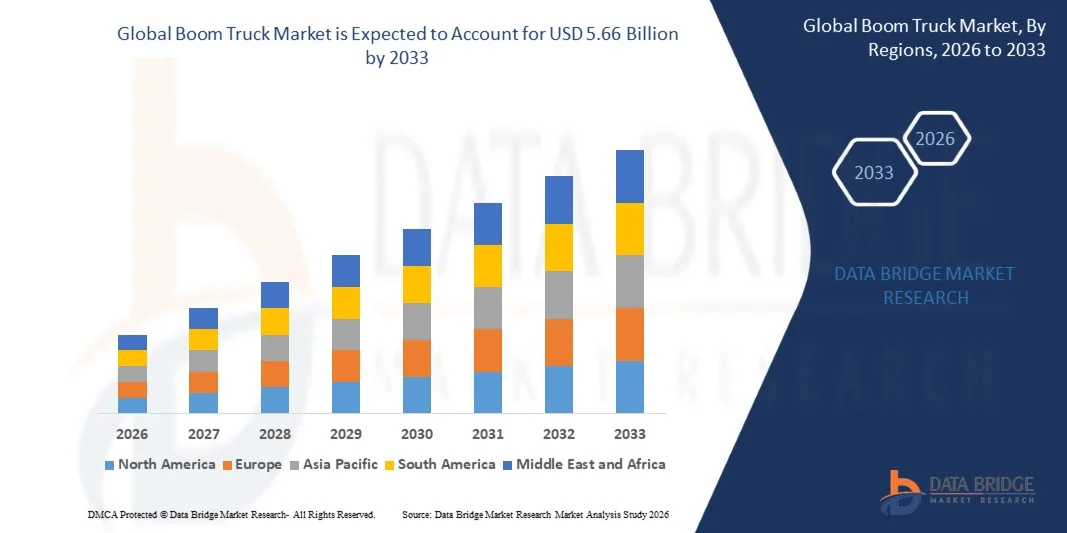
- As per Data Bridge Market Research analysis, the boom truck market was valued at USD 3.50 billion in 2025 and is projected to reach USD 5.66 billion by 2033, growing at a CAGR of 6.20% from 2026 to 2033.
- The market is experiencing consistent growth driven by rising infrastructure and construction investments, expanding utility and telecommunications networks, increasing demand for efficient material-handling equipment, and growing adoption of rental-based heavy equipment services. Boom trucks provide greater mobility and operational flexibility than conventional cranes, supporting their use across diverse worksites.
- The increasing development of roads, bridges, commercial buildings, power infrastructure, and telecommunications networks globally is compelling contractors and utility operators to adopt versatile boom trucks for lifting and positioning materials and equipment. Advancements in hydraulic systems, lifting capacity, fuel efficiency, and vehicle configurations are further improving operational productivity, while the expansion of equipment rental fleets is making boom trucks more accessible to smaller contractors.
Market Size & Forecast
- Global Market Value (2025): USD 3.50 Billion
- Expected Market Value (2033): USD 5.66 Billion
- Forecast CAGR (2026–2033): 6.20%
- Leading Region in 2025: North America
- Fastest Growing Region: Asia Pacific
What are the Major Takeaways of the Boom Truck Market?
- North America dominated the boom truck market with the largest revenue share of 35.9% in 2025, supported by strong demand from construction, utility maintenance, telecommunications, and infrastructure development.
- Asia-Pacific is expected to be the fastest-growing region at a CAGR of 13.4% from 2026 to 2033, fueled by large-scale infrastructure construction, rapid urbanization, expanding industrial activity, and increasing adoption of mobile lifting solutions across China, India, and Southeast Asia.
- The telescopic boom trucks segment led the market with a 64% share in 2025, driven by their extended reach, ease of operation, and versatility across construction and utility applications.
- Articulating boom trucks are the fastest-growing boom type, projected to register a CAGR of 7%, reflecting the surge in demand for maneuverable lifting equipment in dense urban construction and industrial material-handling environments.
- The 21–30 metric tons segment dominated the lifting capacity category with a 35.26% revenue share in 2025, led by its broad suitability for construction, utility, and telecommunications applications.
- Infrastructure accounted for 38.2% of the market share in 2025, preferred by increasing investment in roads, bridges, public infrastructure, and large-scale development projects.
- The power & utility segment is the fastest-growing application category, with a CAGR of 6%, driven by expansion of electricity transmission and distribution networks, renewable-energy infrastructure, and utility maintenance activities.
Report Scope and Boom Truck Market Segmentation
|
Attributes |
Boom Truck Key Market Insights |
|
Segments Covered |
|
|
Countries Covered |
North America
Europe
Asia-Pacific
Middle East and Africa
South America
|
|
Key Market Players |
|
|
Market Opportunities |
|
|
Value Added Data Infosets |
In addition to the market insights such as market value, growth rate, market segments, geographical coverage, market players, and market scenario, the market report curated by the Data Bridge Market Research team includes in-depth expert analysis, import/export analysis, pricing analysis, production consumption analysis, and pestle analysis. |
What is the Key Trend in the Boom Truck Market?
- Boom truck manufacturers are increasingly developing compact, maneuverable, and higher-reach configurations to serve urban construction, utility maintenance, telecommunications, and infrastructure projects where access to confined worksites is becoming increasingly important.
- For instance, in March 2026, Palfinger launched the PK 480 TEC truck-mounted articulated boom crane in India, responding to increasing demand for advanced material-handling equipment, particularly in waste treatment and other specialized applications. The crane reflects the industry's move toward more technologically advanced and versatile truck-mounted lifting solutions.
- Manufacturers are also integrating electric and low-emission power systems into truck-mounted lifting equipment to reduce fuel consumption, operating noise, and emissions, particularly for municipal, utility, and urban applications.
- Growing deployment of digital fleet-management, load-monitoring, and safety technologies is enabling operators to improve equipment utilization, monitor operating conditions, and enhance productivity while reducing equipment downtime.
- For instance, in December 2025, TIL Limited unveiled the TMS-885, an 85-tonne truck-mounted crane at EXCON 2025, featuring a five-section boom extending from 12.1 to 43.8 meters and a road speed of up to 49 km/h, highlighting the industry's move toward higher-capacity, longer-reach, and more versatile truck-mounted lifting equipment.
- As construction, utility, telecommunications, and infrastructure operators increasingly require mobile, versatile, and environmentally efficient lifting solutions, manufacturers are expected to accelerate the development of compact, electric, and technologically advanced boom trucks.
What are the Key Drivers of the Boom Truck Market?
- The rapid expansion of global infrastructure, construction, utility, and telecommunications projects is significantly increasing demand for mobile lifting equipment capable of transporting and positioning heavy materials efficiently across diverse worksites.
- For instance, in March 2026, National Crane launched the NTC80 boom truck at CONEXPO-CON/AGG 2026, offering an 80-U.S.-ton lifting capacity and 156-foot five-section telescopic boom. The model combines higher lifting capacity with road mobility and is targeted at utility, construction, and oil and gas applications, demonstrating the trend toward higher-capacity, longer-reach, and more versatile boom trucks.
- Increasing investments in power transmission, renewable energy, road construction, commercial buildings, and telecommunications networks are encouraging contractors and utility companies to deploy boom trucks because they combine truck mobility with on-site lifting capabilities.
- For instance, in March 2025, Böcker showcased its AK 48e electric truck crane at bauma 2025, with the crane available as an electric system mounted on MAN, Mercedes, Scania, or Volvo trucks. The 48-meter-class crane uses a 30-kWh battery in its hybrid configuration, highlighting the industry's shift toward electric and lower-emission truck-mounted lifting equipment.
- With infrastructure modernization and utility-network expansion continuing across developed and emerging economies, boom trucks will remain important for mobile lifting, material placement, maintenance, and installation activities, supporting sustained market expansion.
Which Factors are Challenging the Growth of the Boom Truck Market?
- Advanced boom trucks require significant capital investment because manufacturers integrate high-capacity hydraulic systems, specialized truck chassis, stabilizers, safety systems, and advanced lifting technologies.
- For instance, in April 2026, a U.S. construction-industry staffing report highlighted a critical shortage of qualified crane operators, with some high-demand states reportedly facing shortages exceeding 20% of current demand and projects experiencing delays when certified operators are unavailable. This shortage of skilled personnel can constrain boom truck utilization and increase operating costs.
- These high acquisition and maintenance costs can limit adoption among small contractors, independent operators, and businesses in price-sensitive emerging markets, particularly when equipment utilization is inconsistent.
- The combination of high equipment costs, operator-training requirements, regulatory compliance, periodic inspections, maintenance expenses, and skilled-labor shortages can increase the total cost of ownership and slow adoption among smaller end users.
- For instance, in March 2025, SafeWork NSW reported a mobile crane overturning during a lifting operation, with the boom striking a worker and causing traumatic foot injuries. The incident highlights the safety risks associated with crane stability, lifting operations, and worksite conditions, which can increase compliance, training, and operational costs for boom truck users
- These financial and operational barriers continue to restrict widespread deployment of advanced boom trucks, particularly among small and medium-sized contractors and operators with limited capital budgets, despite increasing demand for mobile lifting equipment.
How is the Boom Truck Market Segmented?
The boom truck market is segmented on the basis of boom type, lifting capacity, application, and end user.
- By Boom Type
On the basis of boom type, the boom truck market is segmented into telescopic boom trucks, articulating boom trucks, knuckle boom trucks, fixed boom trucks, stiff boom trucks, and others. The telescopic boom trucks segment dominated the market with 64% share in 2025, owing to their extended reach, ease of operation, and versatility across construction and utility applications. These trucks are widely used for utility maintenance, tree services, mid-rise construction, and signage installation projects. Their extendable straight-boom configuration enables operators to achieve substantial vertical and horizontal reach while maintaining strong lifting performance. Telescopic boom trucks are also suitable for projects requiring long and precise lifting operations across different worksites.
The articulating boom trucks segment is projected to register the fastest growth at 7% CAGR during the forecast period, driven by increasing demand for maneuverable lifting equipment in dense urban construction and industrial material-handling environments. These systems use articulated boom sections that provide greater flexibility when positioning loads around obstacles. Their ability to reach over structures and operate within confined areas makes them valuable for complex worksites. Growing urban construction is increasing demand for equipment capable of working efficiently where conventional straight-boom equipment faces accessibility limitations. Demand is also supported by expanding material-handling, infrastructure maintenance, and specialized service activities.
- By Lifting Capacity
On the basis of lifting capacity, the boom truck market is segmented into less than 10 metric tons, 10–20 metric tons, 21–30 metric tons, 31–40 metric tons, 41–50 metric tons, and more than 50 metric tons. The 21–30 metric tons segment dominated the market with 35.26% share in 2025, supported by its broad suitability for construction, utility, and telecommunications applications. Boom trucks in this capacity range provide a practical balance between lifting capability, mobility, and operating cost. They can handle medium-sized lifting requirements without requiring the larger footprint associated with heavy-duty cranes. Their versatility makes them suitable for material placement, equipment installation, infrastructure work, and utility projects.
The more than 50 metric tons segment is projected to register the fastest growth at 11% CAGR from 2026 to 2033, driven by increasing requirements for heavy-duty lifting in major infrastructure and industrial projects. High-capacity boom trucks are particularly useful where large structural components and heavy equipment must be positioned at substantial heights. Large construction developments, industrial facilities, and major infrastructure projects are expanding the addressable applications for these machines. Their truck-mounted configuration provides greater mobility compared with some conventional heavy lifting equipment. Increasing project complexity is encouraging contractors to deploy equipment with higher lifting capabilities.
- By Application
On the basis of application, the boom truck market is segmented into infrastructure, commercial construction, power & utility, industrial/petrochemical, and residential. The infrastructure segment dominated the market with 38.2% revenue share in 2025, driven by increasing investment in roads, bridges, public infrastructure, and large-scale development projects. Boom trucks provide both transportation and lifting capabilities, making them suitable for infrastructure construction and maintenance activities. They can move between dispersed worksites while performing material lifting and positioning operations. Growing infrastructure modernization across developed and emerging economies is supporting demand for versatile truck-mounted lifting equipment.
The power & utility segment is projected to register the fastest growth at 6% CAGR during the forecast period, supported by expansion of electricity transmission and distribution networks, renewable-energy infrastructure, and utility maintenance activities. Boom trucks are extensively used for powerline installation, equipment handling, maintenance, and servicing operations. Grid modernization programs are increasing demand for mobile equipment capable of reaching elevated utility infrastructure. Renewable-energy development is also creating additional requirements for equipment used during installation and maintenance activities. Utility operators benefit from boom trucks because the vehicles can travel directly to work locations while providing on-site lifting capabilities.
- By End User
On the basis of end user, the boom truck market is segmented into construction companies, utility & energy companies, municipal/public works, rental providers, and specialized service providers. The construction companies segment dominated the market with 42% share in 2025, owing to extensive boom truck utilization for lifting materials, installing structural components, and supporting construction operations. Construction companies use boom trucks across residential, commercial, and infrastructure projects because they combine road mobility with on-site lifting functionality. This configuration can reduce the need for separate transportation and lifting equipment for medium-scale activities. Contractors also benefit from the ability to move equipment between multiple project locations.
The rental providers segment is projected to register the fastest growth at 7% CAGR during the forecast period, as contractors increasingly seek flexible access to specialized lifting equipment. Rental services allow users to deploy boom trucks without bearing the full upfront cost of ownership. This model is particularly attractive to small and medium-sized contractors with variable workloads and limited capital budgets. Rental companies can also provide different lifting capacities and configurations according to individual project requirements. Increasing infrastructure and construction activity is expanding demand for short-term and project-based equipment deployment.
Which Region Holds the Largest Share of the Boom Truck Market?
- North America dominated the boom truck market with the largest revenue share of 35.9% in 2025, supported by strong demand from construction, utility maintenance, telecommunications, and infrastructure development.
- The region also benefits from substantial investments in roads, bridges, commercial buildings, telecommunications, and utility infrastructure, along with the presence of established boom truck manufacturers and advanced lifting technologies. Growing infrastructure modernization, increasing demand for high-capacity mobile lifting equipment, and continued adoption across construction and industrial applications further strengthen North America's leadership in the global boom truck market.
U.S. Boom Truck Market Insight
The U.S. boom truck market is witnessing strong growth due to rising investments in infrastructure development, construction projects, utility networks, and telecommunications infrastructure. The country’s mature construction and industrial ecosystem, along with increasing demand for efficient lifting and material-handling equipment, is driving boom truck adoption across commercial, residential, and utility applications. In addition, ongoing modernization of roads, bridges, power infrastructure, and communication networks is accelerating demand for advanced and versatile boom trucks.
Asia-Pacific Boom Truck Market Insight
The Asia-Pacific boom truck market is expected to witness rapid growth, driven by increasing urbanization, expanding construction activities, and rising investments in transportation and utility infrastructure across countries such as China, India, and Japan. Growing infrastructure development, increasing demand for efficient lifting equipment, and expanding industrial and commercial construction projects are supporting regional market expansion. In addition, rising investments in power transmission, telecommunications, renewable energy, and urban infrastructure are accelerating boom truck adoption across construction and industrial sectors.
Japan Boom Truck Market Insight
The Japan boom truck market is witnessing consistent growth due to rising investments in infrastructure modernization, construction activities, and utility maintenance. Construction companies, utility operators, and industrial organizations are increasingly adopting boom trucks for material handling, equipment installation, road maintenance, and infrastructure development. Moreover, increasing demand for compact and technologically advanced lifting equipment, along with Japan’s focus on infrastructure resilience, safety, and efficient construction operations, is further contributing to market growth.
China Boom Truck Market Insight
The China boom truck market is growing rapidly, driven by increasing urbanization, expanding infrastructure development, and rising investments in commercial and industrial construction. Growing adoption of advanced lifting equipment across construction, power, telecommunications, and logistics sectors is significantly boosting market demand. In addition, large-scale investments in transportation infrastructure, renewable energy projects, urban development, and utility networks are supporting the expansion of boom truck applications and positioning China as a major growth market globally.
U.K. Boom Truck Market Insight
The U.K. boom truck market is experiencing steady growth, supported by rising adoption of truck-mounted lifting equipment in construction, infrastructure maintenance, utilities, and telecommunications applications. Increasing investments in infrastructure modernization and growing demand for flexible, mobile, and efficient material-handling solutions are contributing to market growth. Furthermore, the adoption of advanced safety systems, improved load-management technologies, and low-emission equipment is enhancing boom truck performance and supporting market development across the U.K.
Germany Boom Truck Market Insight
The Germany boom truck market is expanding steadily due to the country’s strong construction and industrial base, advanced engineering capabilities, and increasing investments in infrastructure modernization. Construction companies, utility operators, logistics providers, and industrial organizations are increasingly utilizing boom trucks for material handling, equipment installation, and infrastructure maintenance. Continuous advancements in lifting technologies, safety systems, fuel efficiency, and low-emission solutions, along with Germany’s focus on sustainable construction and industrial innovation, are further driving market growth.
Which are the Top Companies in Boom Truck Market?
The boom truck industry is primarily led by well-established companies, including:
- Manitowoc Company, Inc. (U.S.)
- Elliott Equipment Company (U.S.)
- Altec Industries, Inc. (U.S.)
- Stellar Industries, Inc. (U.S.)
- Maintainer Corporation of Iowa (U.S.)
- Liftmoore, Inc. (U.S.)
- PALFINGER AG (Austria)
- HIAB AB (Sweden)
- Fassi Gru S.p.A. (Italy)
- Cormach S.r.l. (Italy)
- PM Oil & Steel S.p.A. (Italy)
- AMCO VEBA S.p.A. (Italy)
- HMF Group A/S (Denmark)
- COPMA Cranes S.r.l. (Italy)
- HEILA Cranes S.p.A. (Italy)
- ATLAS GmbH (Germany)
- Kanglim Co., Ltd. (South Korea)
- Soosan Industries Co., Ltd. (South Korea)
- UNIC Corporation (Japan)
- DONGYANG MECHATRONICS CORP. (South Korea)
What are Latest Developments in Boom Truck Market?
- In June 2025, Manitowoc reported that Northland Crane Service had deployed two National Crane NBT60XL boom trucks for a specialized lifting project in Minnesota. The two boom trucks were used to support the replacement of a large statue at a church temple, demonstrating the equipment’s ability to handle complex lifting operations. One crane supported crew access while the second performed the primary lifting operation. The deployment highlights the continued use of high-capacity boom trucks for specialized construction and infrastructure-related work.
- In March 2025, Manitowoc announced that it would showcase expanded crane products and technologies at bauma 2025 in Munich, Germany. The company highlighted smart technologies and expanded aftermarket support as part of its product strategy. The event provided an important platform for demonstrating new and enhanced crane solutions to construction, infrastructure, and industrial customers. This development reflects manufacturers’ continued focus on improving productivity, technology integration, and customer support in the lifting-equipment industry.
- In September 2024, Manitowoc announced plans to launch a major new crane product at bauma China 2024 in Shanghai. The company stated that the new crane would be introduced alongside its broader portfolio of Manitowoc, Potain, and Grove lifting equipment. The event was positioned as an opportunity to demonstrate new technologies and solutions for infrastructure and construction applications. The announcement reflects continued product development and portfolio expansion among global crane manufacturers to address evolving lifting requirements
- In December 2022, National Crane and LineWise announced a collaboration combining the NBT60XL boom truck with the TLL-2000 Series 3 Triple Line Lifter for high-voltage power-line work. The integrated solution was designed to allow utility contractors to perform maintenance and repairs on energized transmission lines without interrupting power service. The system expands boom truck applications in the utility sector by combining lifting capability with specialized insulated line-handling equipment.
- In August 2021, Manitowoc announced that National Crane’s NBT60XL and NBT45-2 boom trucks would be showcased at The Utility Expo. The NBT60XL was highlighted for its long boom, high load-chart capacity, transportability, and suitability for utility applications. The NBT45-2, part of the NBT40-2 Series, was presented as a compact boom truck designed for utility work and challenging jobsites. The showcase reinforced the growing role of boom trucks in utility construction and maintenance activities.

- Interactive Data Analysis Dashboard
- Company Analysis Dashboard for high growth potential opportunities
- Research Analyst Access for customization & queries
- Competitor Analysis with Interactive dashboard
- Latest News, Updates & Trend analysis
- Harness the Power of Benchmark Analysis for Comprehensive Competitor Tracking
Data collection and base year analysis are done using data collection modules with large sample sizes. The stage includes obtaining market information or related data through various sources and strategies. It includes examining and planning all the data acquired from the past in advance. It likewise envelops the examination of information inconsistencies seen across different information sources. The market data is analysed and estimated using market statistical and coherent models. Also, market share analysis and key trend analysis are the major success factors in the market report. To know more, please request an analyst call or drop down your inquiry.
The key research methodology used by DBMR research team is data triangulation which involves data mining, analysis of the impact of data variables on the market and primary (industry expert) validation. Data models include Vendor Positioning Grid, Market Time Line Analysis, Market Overview and Guide, Company Positioning Grid, Patent Analysis, Pricing Analysis, Company Market Share Analysis, Standards of Measurement, Global versus Regional and Vendor Share Analysis. To know more about the research methodology, drop in an inquiry to speak to our industry experts.
Data Bridge Market Research is a leader in advanced formative research. We take pride in servicing our existing and new customers with data and analysis that match and suits their goal. The report can be customized to include price trend analysis of target brands understanding the market for additional countries (ask for the list of countries), clinical trial results data, literature review, refurbished market and product base analysis. Market analysis of target competitors can be analyzed from technology-based analysis to market portfolio strategies. We can add as many competitors that you require data about in the format and data style you are looking for. Our team of analysts can also provide you data in crude raw excel files pivot tables (Fact book) or can assist you in creating presentations from the data sets available in the report.













