


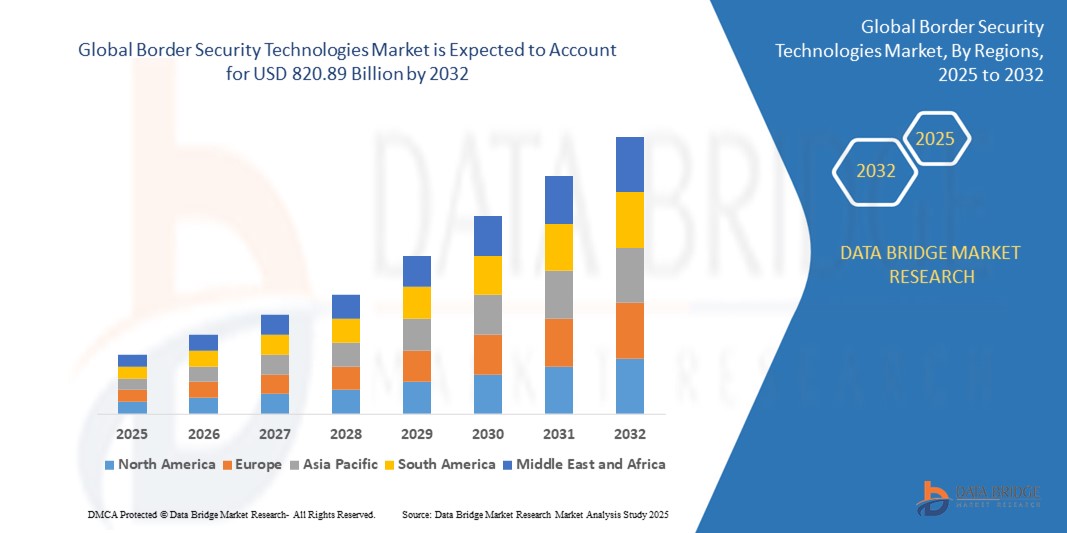
Border Security Technologies Market Size
- The global border security Technologies market size was valued at USD 87.99 billion in 2024 and is expected to reach USD 820.89 billion by 2032, at a CAGR of 32.20% during the forecast period
- The market growth is largely fuelled by the increasing geopolitical tensions, rising cross-border crimes, terrorism threats, and illegal immigration, which have prompted governments worldwide to invest heavily in advanced surveillance and defense infrastructure
Border Security Technologies Market Analysis
- The border security technologies market is witnessing robust technological advancements including the integration of artificial intelligence (AI), biometrics, and wide-band communication systems for enhanced real-time threat detection and management
- Key applications such as ground-based radar systems, aerial surveillance via drones, and naval-based optical systems are becoming crucial in safeguarding national boundaries, especially in regions with complex terrains
- North America dominated the border security technologies market with the largest revenue share in 2024, driven by rising concerns over illegal immigration, drug trafficking, and cross-border crime. Governments in the region are heavily investing in next-generation surveillance infrastructure, AI-powered detection systems, and integrated command centers to enhance security protocols across land and maritime borders
- Asia-Pacific region is expected to witness the highest growth rate in the global border security technologies market, driven by rising geopolitical tensions, territorial disputes, and increased investments in modernizing surveillance infrastructure across countries such as China, India, and South Korea
- The radar systems segment dominated the market with the largest revenue share in 2024, primarily due to their critical role in long-range surveillance, early threat detection, and real-time tracking. These systems are highly effective in monitoring vast and remote borders, including maritime and desert regions, with minimal human intervention. The integration of radar systems with AI analytics and satellite imagery further enhances situational awareness, making them indispensable for national defense operations
Report Scope and Border Security Technologies Market Segmentation
|
Attributes |
Border Security Technologies Key Market Insights |
|
Segments Covered |
|
|
Countries Covered |
North America
Europe
Asia-Pacific
Middle East and Africa
South America
|
|
Key Market Players |
|
|
Market Opportunities |
• Integration Of AI and Machine Learning in Surveillance Systems • Growing Demand for Autonomous Border Monitoring Solutions |
|
Value Added Data Infosets |
In addition to the market insights such as market value, growth rate, market segments, geographical coverage, market players, and market scenario, the market report curated by the Data Bridge Market Research team includes in-depth expert analysis, import/export analysis, pricing analysis, production consumption analysis, and pestle analysis. |
Border Security Technologies Market Trends
“Increased Deployment of AI-Powered Surveillance and Analytics”
- AI-powered surveillance systems are transforming border monitoring by enabling real-time identification of threats using machine learning algorithms and behavioral analytics. These systems reduce human dependency and enhance security efficiency
- Biometric-based AI solutions, such as facial recognition and gait analysis, are increasingly deployed at border checkpoints to authenticate travelers and detect suspicious activity
- For instance, U.S. Customs and Border Protection deployed biometric exit systems at over 30 airports, improving identity verification while speeding up clearance processes
- Countries are integrating AI with unmanned ground sensors, radar, and satellite feeds to build predictive security models and monitor remote terrains with minimal human input
- European agencies, such as Frontex, have launched AI-based towers along high-risk migration routes, enabling automated tracking of cross-border movements and minimizing false alerts
Border Security Technologies Market Dynamics
Driver
“Growing Cross-Border Threats and Rising Demand for Real-Time Surveillance”
- The rise in illegal trafficking, smuggling, and infiltration has prompted governments to adopt real-time surveillance tools across borders, replacing outdated manual systems
- Advanced technologies such as wide-band wireless systems, thermal imaging, and drones are being deployed to monitor remote and high-risk border zones
- For instance, India’s CIBMS (Comprehensive Integrated Border Management System) integrates thermal sensors, UAVs, and radar to monitor its borders with Pakistan and Bangladesh
- Demand for integrated command and control centers is surging, enabling central agencies to oversee multi-border regions and issue rapid-response directives
- These systems reduce security personnel exposure in dangerous zones while enhancing accuracy in threat identification and faster situational awareness
Restraint/Challenge
“High Cost of Deployment and Integration Across Vast Borders”
- Implementing advanced technologies such as drones, biometric towers, and radar systems over vast terrains requires significant capital, making it less feasible for low- and middle-income countries
- Operational costs rise sharply in challenging landscapes such as deserts, mountains, and forests, where infrastructure maintenance is difficult and energy access is limited
- For instance, several African nations have delayed deployment of wide-area surveillance systems due to lack of funds and high upkeep expenses
- Integrating various systems—such as UAVs, AI platforms, and wide-band communication—requires trained personnel, secure networks, and consistent software upgrades
- Long procurement cycles, customs delays, and technical compliance hurdles further hinder timely deployment and cross-border cooperation
Border Security Technologies Market Scope
The market is segmented on the basis of systems and application.
• By Systems
On the basis of systems, the border security technologies market is segmented into radar systems, laser systems, camera systems, unmanned vehicles, wide band wireless communication systems, command and control systems, biometric systems, drones, optical surveillance systems, and electric fencing systems. The radar systems segment dominated the market with the largest revenue share in 2024, primarily due to their critical role in long-range surveillance, early threat detection, and real-time tracking. These systems are highly effective in monitoring vast and remote borders, including maritime and desert regions, with minimal human intervention. The integration of radar systems with AI analytics and satellite imagery further enhances situational awareness, making them indispensable for national defense operations.
The biometric systems segment is expected to witness the fastest growth rate from 2025 to 2032, driven by rising concerns around identity verification, border control, and anti-terrorism efforts. Biometric solutions such as facial recognition, iris scanning, and fingerprint identification offer advanced capabilities for securing entry and exit points across air, land, and sea routes. Their growing adoption across European, North American, and Middle Eastern borders reflects the increasing emphasis on advanced identity management. In addition, government-led modernization programs and international travel mandates are accelerating deployment of biometric checkpoints at border crossings, airports, and seaports.
• By Application
On the basis of application, the market is segmented into ground based, aerial based, and naval based. The ground based segment held the largest market share in 2024, driven by the widespread deployment of integrated land surveillance systems across country borders. These include fence-mounted sensors, thermal imaging cameras, laser barriers, and mobile command units. Ground systems play a crucial role in preventing unauthorized crossings, smuggling, and infiltration, particularly in high-risk areas such as conflict zones and migration corridors.
The aerial based segment is expected to witness the fastest growth rate from 2025 to 2032, owing to the increasing use of drones, unmanned aerial vehicles (UAVs), and aerial surveillance radars for continuous monitoring. Aerial platforms provide real-time intelligence over difficult terrains such as forests, mountains, and coastal zones, where ground surveillance is limited. Several defense agencies are investing in high-altitude drones and tethered aerostats equipped with advanced imaging and thermal sensors to enhance aerial border surveillance and reduce response times during security breaches.
Border Security Technologies Market Regional Analysis
- North America dominated the border security technologies market with the largest revenue share in 2024, driven by rising concerns over illegal immigration, drug trafficking, and cross-border crime. Governments in the region are heavily investing in next-generation surveillance infrastructure, AI-powered detection systems, and integrated command centers to enhance security protocols across land and maritime borders
- The U.S. leads regional adoption due to its expansive borders and increasing pressure to modernize legacy systems with cutting-edge radar, biometric, and drone-based surveillance solutions. Continuous innovation and public-private collaboration further fuel this market segment
- This growth is supported by strong defense spending, the integration of AI and machine learning in border surveillance systems, and the need to manage complex migration and security threats. These dynamics are prompting federal and state agencies to deploy high-performance, scalable technologies at vulnerable entry points
U.S. Border Security Technologies Market Insight
The U.S. border security technologies market captured the largest revenue share in 2024 within North America, propelled by aggressive investments in surveillance infrastructure along the southern border and critical coastal areas. The rising use of unmanned aerial vehicles, radar networks, and biometric entry-exit systems supports both national security and immigration control. For instance, the U.S. Customs and Border Protection (CBP) has deployed integrated surveillance towers in Arizona for 24/7 threat detection and response. Ongoing policy support and technology partnerships with defense contractors are driving widespread innovation and rapid system deployment.
Europe Border Security Technologies Market Insight
The Europe border security technologies market is expected to witness the fastest growth rate from 2025 to 2032, due to increasing geopolitical tensions, refugee inflows, and terrorism threats. Border authorities in countries such as Greece, Spain, and Poland are prioritizing the adoption of biometric verification, unmanned vehicles, and wide-band communication tools for enhanced cross-border coordination. Stringent EU regulations regarding border surveillance and the European Travel Information and Authorisation System (ETIAS) are further accelerating demand for integrated, AI-based border control solutions across the region.
U.K. Border Security Technologies Market Insight
The U.K. market is expected to witness the fastest growth rate from 2025 to 2032, spurred by post-Brexit border reforms and a renewed focus on national security. The country is investing in biometric systems, camera-based surveillance, and automated entry-exit control solutions at ports and airports. For instance, the U.K. government has partnered with domestic tech firms to deploy automated gates equipped with facial recognition at Heathrow and Gatwick airports. Increased scrutiny at maritime borders and immigration points is expected to drive further adoption of sophisticated technologies.
Germany Border Security Technologies Market Insight
The Germany is expected to witness the fastest growth rate from 2025 to 2032, backed by strong federal funding for border modernization and rising concerns over illegal entries through Eastern European borders. The country is integrating drones, AI-based surveillance analytics, and electric fencing systems into its national security framework. Germany’s collaboration with EU security agencies ensures consistent upgrades in command and control infrastructure, while its focus on cybersecurity and data protection continues to influence product design and vendor selection.
Asia-Pacific Border Security Technologies Market Insight
The Asia-Pacific is expected to witness the fastest growth rate from 2025 to 2032, driven by increased border disputes, smuggling, and infiltration incidents. Countries such as India and China are rapidly upgrading their land, aerial, and coastal surveillance infrastructure with radar, laser, and command control systems. India’s deployment of smart fencing and drone surveillance along its borders with Pakistan and Bangladesh reflects the region’s strategic emphasis on technology-led border management. In addition, regional conflicts and rising military budgets in Southeast Asia are expanding market opportunities.
China Border Security Technologies Market Insight
The China commands a substantial share in the Asia-Pacific region due to its expansive borders and advanced surveillance ecosystem. The country has invested heavily in biometric verification, high-resolution camera grids, and AI-driven crowd analysis systems at international checkpoints. For instance, China's “Sharp Eyes” initiative integrates public and private surveillance feeds for real-time monitoring, enhancing national border security capabilities. The government's emphasis on internal stability and cross-border regulation continues to fuel rapid innovation and deployment of border technologies.
Japan Border Security Technologies Market Insight
The Japan is expected to witness the fastest growth rate from 2025 to 2032, driven by heightened national security measures, technological advancement, and rising geopolitical tensions in the Asia-Pacific region. The country is focusing on bolstering its maritime and aerial surveillance systems due to its extensive coastline and proximity to contested waters.
Border Security Technologies Market Share
The Border Security Technologies industry is primarily led by well-established companies, including:
- Lockheed Martin Corporation (U.S.)
- BAE Systems plc (U.K.)
- Raytheon Technologies Corporation (U.S.)
- Thales Group (France)
- Leonardo S.p.A. (Italy)
- Northrop Grumman Corporation (U.S.)
- Elbit Systems Ltd. (Israel)
- Saab AB (Sweden)
- Indra Sistemas, S.A. (Spain)
- FLIR Systems, Inc. (U.S.)

- Interactive Data Analysis Dashboard
- Company Analysis Dashboard for high growth potential opportunities
- Research Analyst Access for customization & queries
- Competitor Analysis with Interactive dashboard
- Latest News, Updates & Trend analysis
- Harness the Power of Benchmark Analysis for Comprehensive Competitor Tracking
Data collection and base year analysis are done using data collection modules with large sample sizes. The stage includes obtaining market information or related data through various sources and strategies. It includes examining and planning all the data acquired from the past in advance. It likewise envelops the examination of information inconsistencies seen across different information sources. The market data is analysed and estimated using market statistical and coherent models. Also, market share analysis and key trend analysis are the major success factors in the market report. To know more, please request an analyst call or drop down your inquiry.
The key research methodology used by DBMR research team is data triangulation which involves data mining, analysis of the impact of data variables on the market and primary (industry expert) validation. Data models include Vendor Positioning Grid, Market Time Line Analysis, Market Overview and Guide, Company Positioning Grid, Patent Analysis, Pricing Analysis, Company Market Share Analysis, Standards of Measurement, Global versus Regional and Vendor Share Analysis. To know more about the research methodology, drop in an inquiry to speak to our industry experts.
Data Bridge Market Research is a leader in advanced formative research. We take pride in servicing our existing and new customers with data and analysis that match and suits their goal. The report can be customized to include price trend analysis of target brands understanding the market for additional countries (ask for the list of countries), clinical trial results data, literature review, refurbished market and product base analysis. Market analysis of target competitors can be analyzed from technology-based analysis to market portfolio strategies. We can add as many competitors that you require data about in the format and data style you are looking for. Our team of analysts can also provide you data in crude raw excel files pivot tables (Fact book) or can assist you in creating presentations from the data sets available in the report.













