


What is the Boron Nitride Market Size and Growth Rate?
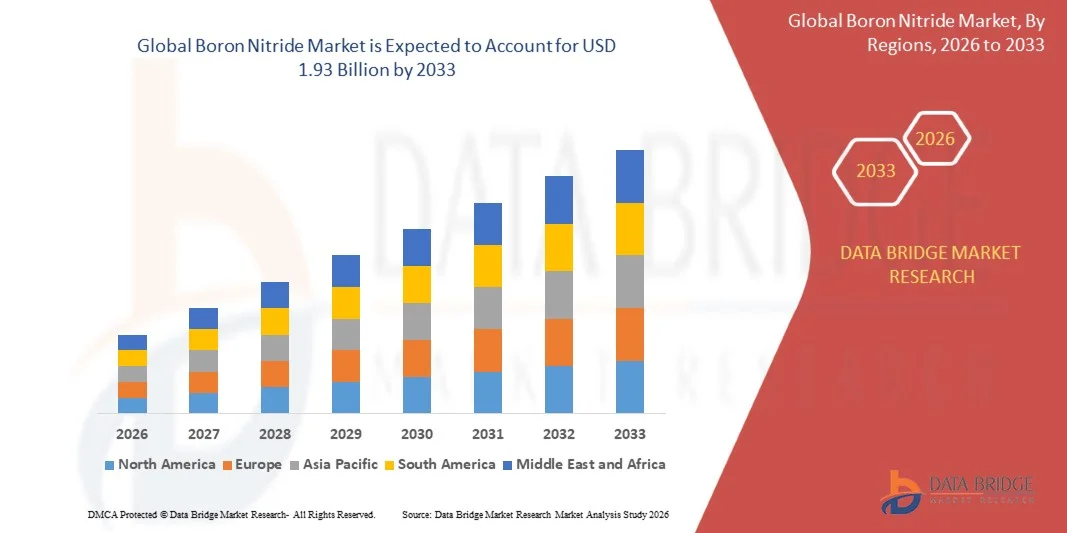
- As per Data Bridge Market Research analysis, the boron nitride market was valued at USD 1.14 billion in 2025 and is projected to reach USD 1.93 billion by 2033, growing at a CAGR of 6.84% from 2026 to 2033.
- The market is experiencing consistent growth driven by increasing demand for high-performance ceramics, rising adoption of boron nitride in electronics and semiconductor applications, and growing utilization of hexagonal boron nitride as a thermal management material due to its excellent thermal conductivity, electrical insulation properties, and chemical stability.
- The increasing demand for advanced materials in semiconductor manufacturing, thermal interface materials, aerospace components, lubricants, and high-temperature applications is driving the adoption of boron nitride products. The growing need for efficient heat dissipation solutions in electronic devices, electric vehicles, and power electronics is further supporting market expansion, with hexagonal boron nitride powders and coatings gaining significant importance across industrial applications.
Market Size & Forecast
- Global Market Value (2025): USD 1.14 Billion
- Expected Market Value (2033): USD 1.93 Billion
- Forecast CAGR (2026–2033): 6.84%
- Leading Region in 2025: North America
- Fastest Growing Region:Asia-Pacific
What are the Major Takeaways of the Boron Nitride Market?
- North America dominated the boron nitride market with the largest revenue share of 38.2% in 2025, supported by advanced electronics manufacturing, aerospace applications, strong research and development activities, and increasing demand for high-performance thermal management materials.
- Asia-Pacific is expected to be the fastest-growing region at a CAGR of 9.1% from 2026 to 2033, fueled by expanding semiconductor manufacturing, rising electronics production, increasing industrialization, and growing adoption of boron nitride materials in China, Japan, South Korea, and India.
- The hexagonal boron nitride segment led the market with a 60.65% share in 2025, driven by its excellent thermal conductivity, electrical insulation properties, chemical stability, low friction coefficient, and high-temperature resistance.
- Cubic boron nitride is the fastest-growing type, projected to register a CAGR of 8.9%, reflecting the surge in demand for superhard materials in precision machining and industrial cutting applications.
- The powder segment dominated the form category with a 50% revenue share in 2025, led by its extensive utilization across thermal management, ceramics, electronics, coatings, and composite applications.
- Boron nitride powder accounted for 45.50% of the market share in 2025, preferred by its broad application scope across electronics, metallurgy, ceramics, coatings, and thermal management industries.
- The ceramics & refractories segment is the fastest-growing application category, with a CAGR of 8.10%, driven by increasing demand for high-temperature resistant materials across industrial sectors.
Report Scope and Boron Nitride Market Segmentation
|
Attributes |
Boron Nitride Key Market Insights |
|
Segments Covered |
|
|
Countries Covered |
North America
Europe
Asia-Pacific
Middle East and Africa
South America
|
|
Key Market Players |
|
|
Market Opportunities |
|
|
Value Added Data Infosets |
|
What is the Key Trend in the Boron Nitride Market?
- Advanced thermal management applications are increasingly adopting hexagonal boron nitride (h-BN) materials to improve heat dissipation, electrical insulation, and reliability in next-generation electronic devices and semiconductor systems.
- For instance, in January 2024, Momentive Technologies highlighted its boron nitride (BN)-filled thermal management materials for electronic devices, emphasizing their ability to provide high thermal conductivity, electrical insulation, low coefficient of thermal expansion, and improved heat dissipation for applications including telecommunications, electric vehicles, and LED lighting.
- High thermal conductivity combined with excellent dielectric properties is enabling boron nitride fillers to replace conventional materials in thermal interface materials, composites, and electronic packaging applications.
- Manufacturers are increasingly developing boron nitride powders, nanosheets, and coatings for applications requiring lightweight structures, chemical stability, and high-temperature resistance across multiple industries.
- For instance, in June 2024, researchers published a study in ACS Applied Materials & Interfaces on highly thermally conductive boron nitride nanotube films for flexible electronics thermal management, demonstrating the potential of boron nitride-based materials to address heat dissipation challenges in next-generation electronic devices.
- As demand for efficient heat management solutions increases across electric vehicles, semiconductor devices, and power electronics, adoption of boron nitride-based materials is expected to accelerate, strengthening its role as a critical advanced material.
What are the Key Drivers of the Boron Nitride Market?
- The rapid expansion of semiconductor manufacturing and electronic device production has significantly increased demand for boron nitride materials used in thermal management, insulation, and high-performance component applications.
- For instance, in April 2024, Shin-Etsu Chemical announced the construction of a new semiconductor lithography materials production base in Isesaki City, Japan, with an investment of approximately USD 550 million, to expand production capacity and meet growing demand for advanced semiconductor materials.
- Electronics manufacturers, automotive suppliers, and industrial companies are integrating boron nitride-based solutions to improve thermal performance, enhance component durability, and support miniaturization of advanced devices.
- For instance, in February 2024, researchers published a study in Nature on twisted-layer boron nitride ceramics with enhanced deformability and strength, demonstrating the potential of advanced boron nitride materials for next-generation high-performance ceramic applications.
- With increasing investments in electric vehicles, power electronics, and advanced computing infrastructure, boron nitride will remain essential for improving heat management efficiency and enabling next-generation technologies.
Which Factors are Challenging the Growth of the Boron Nitride Market?
- High production costs associated with advanced boron nitride materials, including specialized manufacturing processes and purification requirements, remain a major challenge limiting widespread adoption across price-sensitive applications.
- These cost constraints restrict adoption among smaller manufacturers and industries seeking alternatives to conventional thermal management and ceramic materials with lower production expenses.
- For instance, in November 2022, researchers from Vanderbilt University and collaborators published an article in Advanced Materials highlighting that achieving scalable and cost-effective production of high-quality hexagonal boron nitride (h-BN) remains a major challenge due to synthesis complexity, layer quality control, and process scalability requirements.
- Limited availability of high-quality boron nitride grades and technical complexity in processing nanoscale forms create additional barriers for manufacturers requiring consistent material performance.
- For instance, in November 2023, Denka Company Limited filed a patent for high-purity boron nitride powder production methods, focusing on impurity reduction, particle control, and advanced heat-treatment processes, reflecting the technical complexity involved in manufacturing high-performance boron nitride materials.
- The high manufacturing complexity, raw material requirements, and pricing challenges associated with premium boron nitride products continue to slow market penetration, particularly in emerging economies and cost-sensitive industrial sectors.
How is the Boron Nitride Market Segmented?
The boron nitride market is segmented on the basis of type, form, product type, and application.
- By Type
On the basis of type, the boron nitride market is segmented into hexagonal boron nitride, cubic boron nitride, wurtzite boron nitride, amorphous boron nitride, pyrolytic boron nitride, and others. The hexagonal boron nitride (h-BN) segment dominated the market with an estimated share of 60.65% in 2025, owing to its excellent thermal conductivity, electrical insulation properties, chemical stability, low friction coefficient, and high-temperature resistance. h-BN is extensively used in thermal management applications, semiconductor manufacturing, coatings, lubricants, ceramics, and composite materials. Its graphite-like layered structure provides superior lubrication performance and makes it suitable for applications requiring low wear and high thermal stability. Increasing demand for heat dissipation materials in electronic devices and power electronics is significantly supporting segment growth.
The cubic boron nitride (c-BN) segment is projected to register the fastest growth at a CAGR of 8.9% during the forecast period, driven by increasing demand for superhard materials in precision machining and industrial cutting applications. c-BN possesses exceptional hardness, thermal stability, and chemical resistance, making it suitable for processing hardened steels and advanced alloys. Rising adoption in automotive, aerospace, and manufacturing industries is supporting segment expansion. Growing demand for high-performance abrasives and cutting tools is further accelerating its use. Increasing industrial automation and precision engineering requirements are creating new opportunities for c-BN-based products. Technological improvements in c-BN synthesis processes are also helping manufacturers improve product quality and application efficiency.
- By Form
On the basis of form, the boron nitride market is segmented into powder, pellets, coatings & solutions, lubricants, and nanotubes & nanosheets. The powder segment dominated the market with an estimated share of 50% in 2025, supported by its extensive utilization across thermal management, ceramics, electronics, coatings, and composite applications. Boron nitride powder is widely preferred due to its high thermal conductivity, electrical insulation capability, and chemical inertness. It is extensively used as a filler material in polymer composites and thermal interface materials for electronic components. Growing demand for efficient heat dissipation solutions in semiconductor devices and electric vehicle systems is increasing powder consumption. Manufacturers are focusing on developing high-purity and spherical boron nitride powders to improve processing performance. The versatility and compatibility of boron nitride powder across multiple industries continue to drive its leading market position.
The nanotubes & nanosheets segment is expected to witness the fastest growth with a CAGR of 10% during the forecast period, driven by increasing research and development activities focused on advanced nanomaterials. Boron nitride nanotubes and nanosheets offer unique properties, including high mechanical strength, thermal conductivity, electrical insulation, and chemical stability. These materials are gaining attention in flexible electronics, energy storage, aerospace composites, and advanced structural materials. Increasing investments in nanotechnology research are supporting commercialization opportunities. Growing demand for lightweight and high-performance materials is further boosting adoption. However, complex synthesis processes and high production costs remain challenges for large-scale industrial deployment.
- By Product Type
On the basis of product type, the boron nitride market is segmented into boron nitride powder, hot pressed boron nitride shapes, hexagonal boron nitride, cubic boron nitride, and spherical boron nitride powder. The boron nitride powder segment dominated the market with an estimated share of 45.50% in 2025, owing to its broad application scope across electronics, metallurgy, ceramics, coatings, and thermal management industries. Powder-based products are widely used because of their easy processing, compatibility with composite materials, and ability to enhance thermal performance. Increasing adoption in semiconductor packaging and electronic thermal management systems is driving demand. High-purity boron nitride powders are increasingly preferred for advanced industrial applications requiring superior performance. Growth in electric vehicles and power electronics is further increasing the requirement for efficient thermal materials.
The spherical boron nitride powder segment is expected to witness the fastest growth at a CAGR of 12% during the forecast period, supported by rising demand for advanced thermal interface materials and electronic packaging applications. Spherical powders provide improved flowability, packing density, and thermal conductivity compared with conventional irregular powders. These characteristics make them suitable for high-performance semiconductor and electronic device applications. Increasing miniaturization of electronic components is creating demand for efficient heat management materials. Growing adoption of electric vehicles and high-power electronic systems is further supporting market expansion. Development of customized spherical boron nitride powders for specific applications is expected to accelerate segment growth.
- By Application
On the basis of application, the boron nitride market is segmented into electronics & semiconductors, electrical insulation, lubricants, coatings, metallurgy & metal processing, ceramics & refractories, cosmetics & personal care, and others. The electronics & semiconductors segment dominated the market with an estimated share of 30.35% in 2025, driven by increasing demand for thermal management materials in electronic devices, semiconductor equipment, and power electronics. Boron nitride is widely used due to its combination of high thermal conductivity and electrical insulation properties. Rising semiconductor production and increasing complexity of electronic components are creating strong demand for advanced heat dissipation solutions. The growth of electric vehicles, 5G infrastructure, and high-performance computing is further supporting adoption.
The ceramics & refractories are expected to witness strong growth with a CAGR of 8.10% during the forecast period, supported by increasing demand for high-temperature resistant materials across industrial sectors. Boron nitride ceramics are widely used in furnace components, crucibles, semiconductor processing equipment, and advanced manufacturing systems. Rising adoption of electric vehicles, artificial intelligence hardware, data centers, and power semiconductor devices is creating significant opportunities. Boron nitride-based thermal fillers and composites are gaining importance due to their lightweight properties and excellent heat transfer capability. Increasing demand for durable materials in extreme operating environments is accelerating adoption. The shift toward advanced industrial ceramics is expected to strengthen boron nitride demand globally.
Which Region Holds the Largest Share of the Boron Nitride Market?
- North America dominated the boron nitride market with the largest revenue share of 38.2% in 2025, supported by advanced electronics manufacturing, aerospace applications, strong research and development activities, and increasing demand for high-performance thermal management materials.
- The region also benefits from significant investments in electronics, electric vehicles, high-performance computing, and advanced ceramics, along with the presence of established boron nitride manufacturers and research institutions. Increasing demand for heat dissipation materials, electrical insulation solutions, and high-temperature resistant components continues to strengthen North America’s leadership position in the global market.
U.S. Boron Nitride Market Insight
The U.S. boron nitride market is witnessing strong growth due to rising demand for advanced thermal management materials, semiconductor applications, and high-performance ceramics across electronics, aerospace, and industrial sectors. The country’s strong semiconductor manufacturing ecosystem, increasing investments in electric vehicles, and growing adoption of advanced materials for heat dissipation are driving demand for boron nitride products. In addition, the expansion of domestic semiconductor production supported by the CHIPS and Science Act, which provides approximately USD 52.7 billion in incentives for semiconductor manufacturing and research, is creating opportunities for advanced material suppliers used in electronic manufacturing processes.
Asia-Pacific Boron Nitride Market Insight
The Asia-Pacific boron nitride market is expected to witness rapid growth, driven by expanding semiconductor production, rising electronics manufacturing, and increasing demand for thermal management solutions across countries such as China, Japan, South Korea, and India. Growing investments in advanced manufacturing facilities and increasing adoption of boron nitride in electronic components, ceramics, and industrial applications are supporting regional market expansion. In addition, Asia-Pacific’s dominance in semiconductor manufacturing, with the region accounting for a significant share of global semiconductor production capacity, is accelerating demand for high-performance materials such as boron nitride.
Japan Boron Nitride Market Insight
The Japan boron nitride market is witnessing consistent growth due to rising investments in semiconductor materials, advanced ceramics, and high-performance industrial components. Japanese chemical and electronics companies are increasingly adopting boron nitride materials for thermal management, semiconductor processing equipment, and precision manufacturing applications. Moreover, Japan’s strong position in semiconductor materials manufacturing is supporting market growth, with Shin-Etsu Chemical announcing an investment of approximately around USD 550 million in 2024 for a new semiconductor lithography materials production base to expand advanced materials capacity.
China Boron Nitride Market Insight
The China boron nitride market is growing rapidly, driven by expanding semiconductor manufacturing, increasing electronics production, and rising demand for advanced thermal management materials. Growing adoption of boron nitride powders, coatings, and ceramics across electronics, metallurgy, and industrial applications is significantly boosting market demand. In addition, China’s continued investment in semiconductor self-sufficiency and advanced manufacturing capabilities, including the National Integrated Circuit Industry Investment Fund (Big Fund), which has supported billions of dollars in semiconductor development initiatives, is strengthening demand for high-performance materials used in semiconductor processes.
U.K. Boron Nitride Market Insight
The U.K. boron nitride market is experiencing steady growth, supported by increasing research activities in advanced materials, semiconductor technologies, and high-performance ceramics. Universities, research organizations, and industrial companies are increasingly exploring boron nitride nanosheets and ceramics for applications including electronics, energy storage, coatings, and thermal management. Furthermore, the U.K. government’s National Semiconductor Strategy announced in 2023 with up to 1.27 billion investment over the next decade is supporting semiconductor research, innovation, and supply chain development, creating opportunities for advanced materials such as boron nitride.
Germany Boron Nitride Market Insight
The Germany boron nitride market is expanding steadily due to the country’s strong industrial manufacturing base, advanced automotive sector, and increasing adoption of high-performance materials in electronics and engineering applications. Automotive manufacturers, semiconductor companies, and industrial suppliers are utilizing boron nitride-based solutions for thermal management, coatings, ceramics, and high-temperature applications. Continuous investments in semiconductor manufacturing and advanced materials development, including Infineon Technologies’ continued expansion of semiconductor production capacity in Germany, are supporting demand for specialized materials required in next-generation electronics.
Which are the Top Companies in Boron Nitride Market?
The boron nitride industry is primarily led by well-established companies, including:
- Momentive Technologies (U.S.)
- 3M (U.S.)
- Saint-Gobain Group. (U.S.)
- Denka Company Limited (Japan)
- Resonac Holdings Corporation. (Japan)
- Tokuyama Corporation (Japan)
- ZYP Coatings, Inc. (U.S.)
- Kennametal Inc. (U.S.)
- Element Six (U.K.)
- Sandvik AB (Sweden)
- H.C. Starck Solutions (Germany)
- Morgan Advanced Materials (U.K.)
- Carborundum Universal Limited (India)
- Precision Ceramics (U.K.)
- CeramTec GmbH (Germany)
- KYOCERA Corporation (Japan)
- CoorsTek, Inc. (U.S.)
- Ferro Corporation (U.S.)
- Haydale Graphene Industries plc (U.K.)
- Adamas Nanotechnologies, Inc. (U.S.)
What are Latest Developments in Boron Nitride Market?
- In October 2024, BeDimensional inaugurated its new production facility in Genoa, Italy, to expand manufacturing capacity for advanced two-dimensional materials, including ultra-thin boron nitride powder. The company highlighted boron nitride’s potential as an electrically insulating and anti-corrosive material for advanced applications, supporting commercialization of next-generation nanomaterials.
- In December 2023, researchers from the Korea Institute of Ceramic Engineering and Technology developed robust spherical hexagonal boron nitride particles designed for thermally conductive applications. The development focused on improving particle structure and thermal performance, supporting the use of spherical boron nitride powders in advanced thermal interface materials and electronic heat management applications.
- In August 2023, Rice University researchers developed a boron nitride-based nanocomposite combining hexagonal boron nitride and cubic boron nitride, demonstrating unique interactions with light and heat. The research highlighted potential applications in next-generation microchips, quantum devices, and advanced technology platforms.
- In July 2023, researchers demonstrated rapid growth of large-scale hexagonal boron nitride crystals, achieving a 24 mm²-scale h-BN crystal through a Ni–Cr solution growth method. The advancement supported future applications of high-quality boron nitride crystals in electronics, optoelectronics, and advanced semiconductor technologies.
- In June 2022, Haydale launched its Hi-Therm boron nitride-based thermal management product, a functionalized boron nitride dispersion technology developed to improve thermal conductivity and heat transfer performance. The product launch represented one of the first commercial applications of boron nitride “white graphene” technology, targeting energy efficiency and advanced thermal management applications.

- Interactive Data Analysis Dashboard
- Company Analysis Dashboard for high growth potential opportunities
- Research Analyst Access for customization & queries
- Competitor Analysis with Interactive dashboard
- Latest News, Updates & Trend analysis
- Harness the Power of Benchmark Analysis for Comprehensive Competitor Tracking
Global Boron Nitride Market, Supply Chain Analysis and Ecosystem Framework
To support market growth and help clients navigate the impact of geopolitical shifts, DBMR has integrated in-depth supply chain analysis into its Global Boron Nitride Market research reports. This addition empowers clients to respond effectively to global changes affecting their industries. The supply chain analysis section includes detailed insights such as Global Boron Nitride Market consumption and production by country, price trend analysis, the impact of tariffs and geopolitical developments, and import and export trends by country and HSN code. It also highlights major suppliers with data on production capacity and company profiles, as well as key importers and exporters. In addition to research, DBMR offers specialized supply chain consulting services backed by over a decade of experience, providing solutions like supplier discovery, supplier risk assessment, price trend analysis, impact evaluation of inflation and trade route changes, and comprehensive market trend analysis.
Data collection and base year analysis are done using data collection modules with large sample sizes. The stage includes obtaining market information or related data through various sources and strategies. It includes examining and planning all the data acquired from the past in advance. It likewise envelops the examination of information inconsistencies seen across different information sources. The market data is analysed and estimated using market statistical and coherent models. Also, market share analysis and key trend analysis are the major success factors in the market report. To know more, please request an analyst call or drop down your inquiry.
The key research methodology used by DBMR research team is data triangulation which involves data mining, analysis of the impact of data variables on the market and primary (industry expert) validation. Data models include Vendor Positioning Grid, Market Time Line Analysis, Market Overview and Guide, Company Positioning Grid, Patent Analysis, Pricing Analysis, Company Market Share Analysis, Standards of Measurement, Global versus Regional and Vendor Share Analysis. To know more about the research methodology, drop in an inquiry to speak to our industry experts.
Data Bridge Market Research is a leader in advanced formative research. We take pride in servicing our existing and new customers with data and analysis that match and suits their goal. The report can be customized to include price trend analysis of target brands understanding the market for additional countries (ask for the list of countries), clinical trial results data, literature review, refurbished market and product base analysis. Market analysis of target competitors can be analyzed from technology-based analysis to market portfolio strategies. We can add as many competitors that you require data about in the format and data style you are looking for. Our team of analysts can also provide you data in crude raw excel files pivot tables (Fact book) or can assist you in creating presentations from the data sets available in the report.













