


What is the Boron Nitride Nanotubes in Nanomedicine Market Size and Growth Rate?
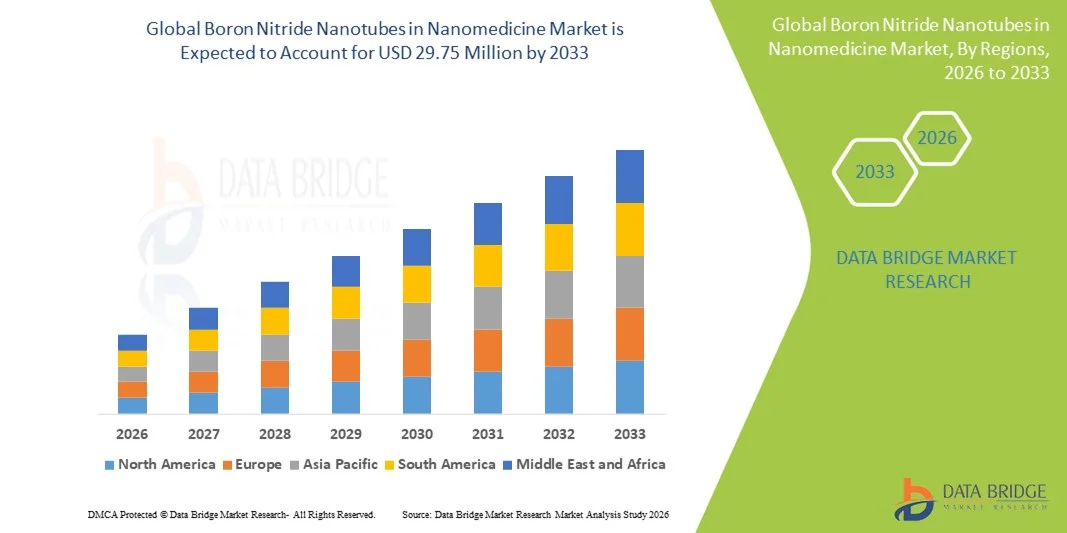
- As per Data Bridge Market Research Analysis the global Boron Nitride Nanotubes in Nanomedicine Market size was valued at USD 14.50 Million in 2025 and is expected to reach USD 29.75 Million by 2033, at a CAGR of 9.40% during the forecast period
- The market growth is largely fueled by increasing research activities in nanomedicine, rising adoption of advanced nanomaterials for drug delivery and biomedical applications, and continuous technological progress in boron nitride nanotube synthesis and functionalization. Enhanced thermal stability, biocompatibility, and mechanical strength of BNNTs are driving their growing use in both academic research and early-stage clinical development
- Furthermore, rising demand for targeted drug delivery systems, bioimaging agents, and tissue engineering solutions is establishing boron nitride nanotubes as a promising nanomaterial in next-generation medical applications. These converging factors are accelerating the uptake of boron nitride nanotubes in nanomedicine solutions, thereby significantly boosting the overall growth of the industry
Market Size & Forecast
- Global Market Value (2025): USD 14.50 Million
- Expected Market Value (2033): USD 29.75 Million
- Forecast CAGR (2026–2033): 9.40%
Boron Nitride Nanotubes in Nanomedicine Market Analysis
- Boron nitride nanotubes are emerging nanomaterials in nanomedicine due to their exceptional biocompatibility, high thermal and chemical stability, and superior mechanical properties. Their growing use in drug delivery systems, bioimaging, cancer therapy, and tissue engineering is driving adoption across research institutions, biotechnology companies, and early-stage clinical development settings
- The escalating demand for boron nitride nanotubes in nanomedicine is primarily fueled by increasing investment in nanotechnology-based therapeutics, rising prevalence of chronic diseases, and growing focus on targeted and minimally invasive treatment approaches. Continuous advancements in BNNT functionalization and surface modification techniques are further accelerating market growth
- North America dominated the boron nitride nanotubes in nanomedicine market with the largest revenue share of approximately 39.2% in 2025, supported by strong funding for nanomedicine research, advanced R&D infrastructure, early adoption of novel nanomaterials, and the presence of leading academic institutions and biotechnology firms. The U.S. accounted for the majority of regional demand due to extensive government and private-sector research initiatives
- Asia-Pacific is expected to be the fastest-growing region in the boron nitride nanotubes in nanomedicine market during the forecast period, registering a CAGR driven by increasing government support for nanotechnology research, rapid expansion of biotechnology sectors, rising healthcare expenditure, and growing academic–industry collaborations in countries such as China, Japan, South Korea, and India
- The treatments segment dominated the largest market revenue share of 57.8% in 2025, driven by the increasing application of boron nitride nanotubes (BNNTs) in advanced therapeutic solutions
Report Scope and Boron Nitride Nanotubes in Nanomedicine Market Segmentation
|
Attributes |
Boron Nitride Nanotubes in Nanomedicine Key Market Insights |
|
Segments Covered |
|
|
Countries Covered |
North America
Europe
Asia-Pacific
Middle East and Africa
South America
|
|
Key Market Players |
|
|
Market Opportunities |
|
|
Value Added Data Infosets |
|
What is the Key Trend in the Boron Nitride Nanotubes in Nanomedicine Market?
Increasing Research and Adoption of Boron Nitride Nanotubes for Biomedical Applications
- • A significant and accelerating trend in the global boron nitride nanotubes (BNNTs) in nanomedicine market is the growing focus on research-driven applications of BNNTs due to their unique physicochemical properties, including high mechanical strength, thermal stability, and biocompatibility. These characteristics make BNNTs increasingly attractive for advanced medical and therapeutic applications
- For instance, academic and research institutions have been actively investigating BNNT-based nanocarriers for targeted drug delivery, leveraging their chemical stability and low cytotoxicity to improve therapeutic efficacy while minimizing side effects. Such research efforts are contributing to the expanding interest in BNNTs within the nanomedicine field
- The increasing emphasis on targeted and precision medicine is encouraging the exploration of BNNTs for applications such as controlled drug release, gene delivery, and cellular imaging
- Furthermore, advancements in nanomaterial synthesis and surface functionalization techniques are enhancing the dispersibility and bioavailability of BNNTs, enabling more effective interaction with biological systems
- This trend toward innovative and application-specific use of BNNTs is reshaping research priorities and fostering collaboration between material scientists, biomedical researchers, and pharmaceutical developers
Boron Nitride Nanotubes in Nanomedicine Market Dynamics
Driver
Rising Demand for Advanced Nanomaterials in Drug Delivery and Regenerative Medicine
- The growing demand for advanced nanomaterials in drug delivery systems, regenerative medicine, and biomedical research is a key driver for the boron nitride nanotubes in nanomedicine market. BNNTs offer advantages such as chemical inertness and resistance to oxidation, making them suitable for use in complex biological environments
- For instance, recent preclinical studies have demonstrated the potential of BNNT-reinforced scaffolds to support cell growth and tissue regeneration, highlighting their promise in regenerative medicine applications. These findings are encouraging further investment and development in this area
- The increasing prevalence of chronic diseases and the need for more efficient and targeted therapeutic solutions are further fueling interest in BNNT-based nanomedicine platforms
- In addition, rising funding for nanotechnology research from government agencies and private organizations is accelerating the development and validation of BNNT-based biomedical applications
- The expanding pipeline of experimental nanomedicine products and the growing collaboration between research institutions and biotechnology companies are expected to support sustained market growth
Restraint/Challenge
High Production Costs and Limited Clinical Validation
- The high cost associated with the synthesis, purification, and large-scale production of boron nitride nanotubes remains a significant challenge, limiting their widespread adoption in nanomedicine applications
- For instance, many BNNT-based biomedical applications are currently confined to laboratory and preclinical research stages due to the complexity and expense of producing high-purity BNNTs at scale. This restricts commercial viability
- In addition, limited clinical data and the absence of standardized regulatory guidelines for BNNT-based medical applications create uncertainty for manufacturers and healthcare stakeholders
- Potential concerns regarding long-term biocompatibility, biodegradability, and toxicity also necessitate extensive in vivo testing, which can extend development timelines and increase costs
- Addressing these challenges through process optimization, scalable manufacturing techniques, comprehensive clinical studies, and clearer regulatory frameworks will be essential for unlocking the full potential of boron nitride nanotubes in nanomedicine
Boron Nitride Nanotubes in Nanomedicine Market Scope
The market is segmented on the basis of modality, indication, and application.
- By Modality
On the basis of modality, the Global Boron Nitride Nanotubes in Nanomedicine market is segmented into Diagnostics and Treatments. The treatments segment dominated the largest market revenue share of 57.8% in 2025, driven by the increasing application of boron nitride nanotubes (BNNTs) in advanced therapeutic solutions. BNNTs exhibit excellent biocompatibility, chemical stability, and high mechanical strength, making them suitable for targeted therapies and precision medicine. Their ability to act as carriers for drugs, genes, and therapeutic agents enhances treatment efficacy while minimizing side effects. Rising prevalence of chronic and life-threatening diseases such as cancer and cardiovascular disorders has significantly increased demand for novel treatment approaches. BNNT-based treatments are gaining traction in regenerative medicine and implantable therapies. Strong research activity and funding support therapeutic development. Increasing clinical validation further boosts adoption. Regulatory support for nanomedicine innovations strengthens market confidence. Integration with personalized medicine platforms also contributes to dominance. Pharmaceutical and biotech collaborations accelerate commercialization. Growing acceptance among clinicians supports sustained demand. These factors collectively establish treatments as the leading modality segment.
The diagnostics segment is expected to witness the fastest CAGR of 11.4% from 2026 to 2033, fueled by the rising need for early disease detection and precision diagnostics. BNNTs offer superior electrical, thermal, and optical properties that enhance biosensing and imaging performance. Their use in diagnostic imaging, biosensors, and contrast agents improves accuracy and sensitivity. Growing adoption of nanotechnology-based diagnostic tools in oncology and infectious disease testing drives growth. Increasing demand for non-invasive and rapid diagnostics further supports expansion. Technological advancements in imaging platforms strengthen BNNT integration. Expanding point-of-care testing markets contribute to higher adoption. Research institutions increasingly focus on BNNT-based diagnostic solutions. Rising healthcare investments in advanced diagnostics accelerate commercialization. Improved disease monitoring capabilities enhance clinical outcomes. Emerging economies investing in diagnostic infrastructure offer growth opportunities. These factors position diagnostics as the fastest-growing modality segment.
- By Indication
On the basis of indication, the Global Boron Nitride Nanotubes in Nanomedicine market is segmented into Oncological Diseases, Infectious Diseases, Cardiovascular Diseases, Orthopedic Disorders, Neurological Diseases, Urological Diseases, Ophthalmological Diseases, Immunological Diseases, and Others. The oncological diseases segment accounted for the largest market revenue share of 34.6% in 2025, driven by the growing global burden of cancer and the need for targeted treatment solutions. BNNTs enable precise drug delivery to tumor sites, reducing systemic toxicity and improving therapeutic outcomes. Their high surface area allows efficient loading of chemotherapeutic agents. Increasing adoption of nanocarrier-based cancer therapies supports segment dominance. Advances in imaging and diagnostics using BNNTs enhance tumor detection and monitoring. Strong research focus on nanomedicine-based oncology solutions accelerates innovation. Rising clinical trial activity in cancer nanotherapy fuels demand. Collaborations between oncology centers and nanotech firms strengthen market presence. Favorable funding for cancer research supports commercialization. Improved patient outcomes encourage clinical adoption. Regulatory approvals for nanomedicine cancer therapies boost confidence. These factors collectively drive dominance of the oncological diseases segment.
The neurological diseases segment is projected to grow at the fastest CAGR of 12.1% from 2026 to 2033, driven by increasing prevalence of neurodegenerative disorders such as Alzheimer’s and Parkinson’s disease. BNNTs show potential in crossing the blood–brain barrier, enabling effective drug delivery to the central nervous system. Growing demand for advanced neurological treatments accelerates adoption. Research advancements in nanomaterials for brain disorders support growth. Rising investments in neuroscience research strengthen the segment. BNNT-based imaging improves early diagnosis of neurological conditions. Increasing aging population globally contributes to higher disease incidence. Technological progress in targeted neurology therapies boosts demand. Collaboration between research institutes and biotech companies accelerates innovation. Growing unmet medical needs drive rapid adoption. Supportive government funding enhances development efforts. These factors collectively make neurological diseases the fastest-growing indication segment.
- By Application
On the basis of application, the Global Boron Nitride Nanotubes in Nanomedicine market is segmented into Drug Delivery, Biomaterials, Active Implants, Diagnostic Imaging, Regenerative Medicine, Vaccines, and Others. The drug delivery segment dominated the market with a revenue share of 39.2% in 2025, driven by the superior carrier properties of BNNTs. Their high loading capacity, stability, and controlled release capabilities make them ideal for targeted drug delivery systems. BNNTs enhance bioavailability and therapeutic efficiency while reducing side effects. Rising demand for personalized and precision medicine supports segment leadership. Increased prevalence of chronic diseases requiring long-term medication drives adoption. Pharmaceutical companies increasingly integrate BNNTs into advanced delivery platforms. Strong research evidence supports improved pharmacokinetics. Adoption in oncology and infectious disease treatments boosts usage. Compatibility with multiple therapeutic agents enhances versatility. Expanding clinical validation strengthens market trust. Regulatory interest in nanocarrier systems supports growth. These factors collectively reinforce dominance of the drug delivery application segment.
The regenerative medicine segment is expected to register the fastest CAGR of 13.0% from 2026 to 2033, driven by growing demand for tissue engineering and organ regeneration solutions. BNNTs offer excellent mechanical strength and biocompatibility, making them suitable for scaffolds and regenerative constructs. Rising incidence of injuries and degenerative conditions supports growth. Advances in stem cell therapy and tissue engineering fuel adoption. Increasing focus on minimally invasive regenerative treatments boosts demand. Research advancements in biomaterials accelerate BNNT integration. Expanding funding for regenerative medicine programs supports commercialization. Collaboration between academic institutions and biotech firms enhances innovation. Growing demand for advanced implants drives usage. Improved patient recovery outcomes encourage adoption. Emerging healthcare technologies accelerate market penetration. These factors collectively position regenerative medicine as the fastest-growing application segment.
Boron Nitride Nanotubes in Nanomedicine Market Regional Analysis
- North America dominated the boron nitride nanotubes in nanomedicine market, accounting for approximately 39.2% of the global revenue share in 2025
- The region’s leadership is supported by strong funding for nanomedicine research, advanced R&D infrastructure, early adoption of novel nanomaterials, and the presence of leading academic institutions and biotechnology firms
- Continuous investments in translational nanomedicine and favorable research ecosystems further contribute to market growth
U.S. Boron Nitride Nanotubes in Nanomedicine Market Insight
The U.S. boron nitride nanotubes in nanomedicine market accounted for the majority share within North America in 2025, driven by extensive government and private-sector research initiatives. High concentration of nanotechnology research programs, strong collaboration between academia and industry, and increasing focus on advanced drug delivery and therapeutic applications support sustained market demand.
Europe Boron Nitride Nanotubes in Nanomedicine Market Insight
The Europe boron nitride nanotubes in nanomedicine market is projected to expand at a substantial CAGR during the forecast period, supported by growing investments in nanotechnology research, increasing focus on advanced biomedical applications, and strong regulatory frameworks encouraging innovation. Rising collaboration between research institutions and biotechnology companies across the region is further driving market growth.
U.K. Boron Nitride Nanotubes in Nanomedicine Market Insight
The U.K. boron nitride nanotubes in nanomedicine market is anticipated to grow at a noteworthy CAGR during the forecast period, driven by increasing research activities in nanomedicine, government funding for advanced materials research, and the presence of leading academic institutions. Expanding translational research initiatives continue to support adoption.
Germany Boron Nitride Nanotubes in Nanomedicine Market Insight
The Germany boron nitride nanotubes in nanomedicine market is expected to expand at a considerable CAGR, fueled by strong emphasis on scientific research, advanced laboratory infrastructure, and increasing adoption of nanomaterials in biomedical research. Germany’s focus on innovation and precision medicine promotes steady market growth.
Asia-Pacific Boron Nitride Nanotubes in Nanomedicine Market Insight
The Asia-Pacific boron nitride nanotubes in nanomedicine market region is expected to be the fastest-growing market for boron nitride nanotubes in nanomedicine during the forecast period, registering a robust CAGR. Growth is driven by increasing government support for nanotechnology research, rapid expansion of biotechnology sectors, rising healthcare expenditure, and growing academic–industry collaborations across countries such as China, Japan, South Korea, and India.
Japan Boron Nitride Nanotubes in Nanomedicine Market Insight
The Japan boron nitride nanotubes in nanomedicine market is gaining momentum due to strong government backing for nanotechnology, advanced research capabilities, and increasing application of nanomaterials in biomedical and therapeutic research. The country’s focus on innovation and precision medicine further supports market expansion.
China Boron Nitride Nanotubes in Nanomedicine Market Insight
China accounted for the largest market revenue share in the Asia-Pacific region in 2025, driven by increasing government investment in nanotechnology research, rapid expansion of biotechnology industries, and growing academic–industry partnerships. The country’s strong focus on advanced medical research and materials science continues to propel market growth.
Which are the Top Companies in Boron Nitride Nanotubes in Nanomedicine Market?
The Boron Nitride Nanotubes in Nanomedicine industry is primarily led by well-established companies, including:
• Thomas Swan & Co. Ltd. (U.K.)
• Tekna Plasma Systems (Canada)
• NanoIntegris (Canada)
• NanoXplore Inc. (Canada)
• Saint-Gobain Advanced Materials (France)
• Hydrogen Materials Corporation (U.S.)
• Hyperion Catalysis International, Inc. (U.S.)
• Jiangsu XFNANO Materials Tech Co., Ltd. (China)
• Advanced Nano Products Co., Ltd. (South Korea)
• NanoLab, Inc. (U.S.)
• Iljin Nanotech Co., Ltd. (South Korea)
• Cnano Technology (China)
• Zyvex Labs (U.S.)
• BNNT Materials (Canada)
• American Elements (U.S.)
• Nanostructured & Amorphous Materials, Inc. (U.S.)
• Graphene Supermarket (U.S.)
• Hubei Tri-Ring Group Co., Ltd. (China)
Latest Developments in Global Boron Nitride Nanotubes in Nanomedicine Market
- In May 2021, multiple industry analyses began identifying boron nitride nanotubes as a growing component in the nanomedicine segment, with key applications anticipated in drug delivery, biomaterials, diagnostic imaging, and tissue engineering due to BNNT’s biocompatibility and physical properties
- In November 2024, a peer‑reviewed article reported on the use of BNNTs as carriers of genistein for biomedical applications, confirming that BNNTs with large surface areas can serve multiple roles from nanocarriers in targeted drug delivery to potential platforms for photothermal therapy, reflecting real progress toward clinical‑relevant nanomedicine applications
- In April 2025, an advanced computational study published in Scientific Reports demonstrated that non‑covalently functionalized BNNTs could enhance the loading and interaction profiles of chemotherapeutic drugs such as doxorubicin, indicating important strides in drug‑carrier optimization that places BNNTs closer to translational nanomedicine research pipelines
- In July 2025, a comprehensive open‑access review paper on boron nitride nanomaterials in cancer therapy underscored the strategic design principles and tailoring of BN nanostructures (including nanotubes) to maximize drug delivery capacity, stimuli‑responsive release behavior, and improved intracellular uptake, consolidating a broader scientific consensus on BNNT’s promise in nanomedicine applications

- Interactive Data Analysis Dashboard
- Company Analysis Dashboard for high growth potential opportunities
- Research Analyst Access for customization & queries
- Competitor Analysis with Interactive dashboard
- Latest News, Updates & Trend analysis
- Harness the Power of Benchmark Analysis for Comprehensive Competitor Tracking
Data collection and base year analysis are done using data collection modules with large sample sizes. The stage includes obtaining market information or related data through various sources and strategies. It includes examining and planning all the data acquired from the past in advance. It likewise envelops the examination of information inconsistencies seen across different information sources. The market data is analysed and estimated using market statistical and coherent models. Also, market share analysis and key trend analysis are the major success factors in the market report. To know more, please request an analyst call or drop down your inquiry.
The key research methodology used by DBMR research team is data triangulation which involves data mining, analysis of the impact of data variables on the market and primary (industry expert) validation. Data models include Vendor Positioning Grid, Market Time Line Analysis, Market Overview and Guide, Company Positioning Grid, Patent Analysis, Pricing Analysis, Company Market Share Analysis, Standards of Measurement, Global versus Regional and Vendor Share Analysis. To know more about the research methodology, drop in an inquiry to speak to our industry experts.
Data Bridge Market Research is a leader in advanced formative research. We take pride in servicing our existing and new customers with data and analysis that match and suits their goal. The report can be customized to include price trend analysis of target brands understanding the market for additional countries (ask for the list of countries), clinical trial results data, literature review, refurbished market and product base analysis. Market analysis of target competitors can be analyzed from technology-based analysis to market portfolio strategies. We can add as many competitors that you require data about in the format and data style you are looking for. Our team of analysts can also provide you data in crude raw excel files pivot tables (Fact book) or can assist you in creating presentations from the data sets available in the report.













