


Botanical Beverages Market Overview
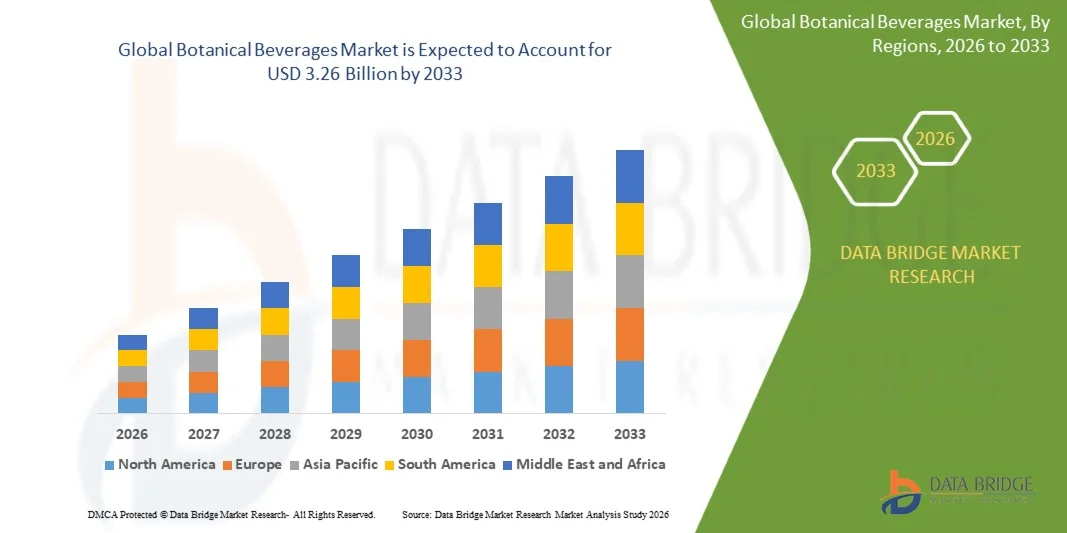
The Botanical Beverages Market was valued at USD 1.75 billion in 2025 and is projected to reach USD 3.26 billion by 2033, growing at a CAGR of 8.10% from 2026 to 2033. The market is experiencing consistent growth driven by rising consumer preference for natural, plant-based, and clean-label beverages, rapid expansion of functional drinks innovation, and increasing integration of botanicals for wellness, immunity, and hydration benefits.
Growing awareness of preventive healthcare and lifestyle-related disorders is encouraging consumers to shift away from carbonated soft drinks toward botanical beverages enriched with herbs, flowers, and plant extracts. The expansion of premium café culture, wellness tourism, and spa-based nutrition programs is further supporting demand across commercial and residential consumption channels. In addition, continuous product innovation such as adaptogen-infused drinks, sugar-free formulations, and ready-to-drink herbal blends is accelerating market adoption across both developed and emerging economies.
Market Size & Forecast
- Global Market Value (2025): USD 1.75 Billion
- Expected Market Value (2033): USD 3.26 Billion
- Forecast CAGR (2026–2033): 8.10%
- Leading Region in 2025: North America
- Fastest Growing Region: Asia-Pacific
Key Market Trends & Insights
- North America dominated the Botanical Beverages Market with the largest revenue share of 34.6% in 2025, supported by strong health-conscious consumer demand, established functional beverage brands, and high retail penetration across modern trade channels.
- The herbal teas segment dominated the market with a 37.8% share in 2025, driven by strong traditional consumption patterns, high consumer trust in natural remedies, and growing premium herbal infusion varieties such as chamomile, green tea, and rooibos across developed markets.
- Asia-Pacific is expected to be the fastest-growing region at a CAGR of 7.8% from 2026 to 2033, driven by rapid urbanization, rising disposable incomes, expanding wellness culture, and strong growth of e-commerce beverage platforms in China, India, and Japan.
- The Botanical Infused Water segment is projected to register the fastest CAGR of 8.3% from 2026 to 2033, driven by rising demand for low-calorie hydration, clean-label positioning, and increasing consumer shift toward functional everyday beverages.
Report Scope and Botanical Beverages Market Segmentation
|
Attributes |
Botanical Beverages Key Market Insights |
|
Segments Covered |
|
|
Countries Covered |
North America · U.S. · Canada · Mexico Europe · Germany · France · U.K. · Netherlands · Switzerland · Belgium · Russia · Italy · Spain · Turkey · Rest of Europe Asia-Pacific · China · Japan · India · South Korea · Singapore · Malaysia · Australia · Thailand · Indonesia · Philippines · Rest of Asia-Pacific Middle East and Africa · Saudi Arabia · U.A.E. · South Africa · Egypt · Israel · Rest of Middle East and Africa South America · Brazil · Argentina · Rest of South America |
|
Key Market Players |
• PepsiCo Inc. (U.S.) |
|
Market Opportunities |
· Expansion of functional and wellness-focused beverages · Growth of e-commerce and direct-to-consumer channels · Product innovation in low-sugar and plant-based formulations |
|
Value Added Data Infosets |
In addition to the insights on market scenarios such as market value, growth rate, segmentation, geographical coverage, and major players, the market reports curated by the Data Bridge Market Research also include in-depth expert analysis, geographically represented company-wise production and capacity, network layouts of distributors and partners, detailed and updated price trend analysis and deficit analysis of supply chain and demand. |
Botanical Beverages Market Trends
Trend: Growth in Motorsports & Professional Training
Professional sports and high-performance training environments are increasingly integrating Botanical Beverages into athlete nutrition systems to improve hydration efficiency, recovery time, and cognitive performance during endurance training. Sports academies and professional racing teams are adopting functional botanical formulations enriched with adaptogens, electrolytes, and herbal extracts to support sustained focus and stress management during simulation-based driver training. The integration of biometric tracking and telemetry-based performance monitoring enables precise assessment of hydration impact on reaction time, fatigue levels, and decision-making accuracy. VR and AR-enabled training environments in motorsports academies are also being paired with functional beverage intake studies to optimize human performance under simulated high-pressure racing conditions.
Botanical Beverages Market Dynamics
Key Market Driver: Rising Demand for Functional and Clean-Label Wellness Drinks
The rapid growth of preventive healthcare and wellness-focused consumption has significantly increased demand for Botanical Beverages enriched with functional ingredients such as green tea extract, chamomile, ginseng, turmeric, and ashwagandha. Consumers are shifting from carbonated soft drinks toward natural, plant-based hydration solutions that provide added health benefits such as immunity support, digestion improvement, stress reduction, and energy enhancement. Major beverage manufacturers and startups are investing heavily in product innovation, with more than 1,200+ new botanical beverage SKUs launched globally between 2021 and 2025, reflecting strong category expansion. The integration of AI-driven flavor development and personalized nutrition platforms is further accelerating product differentiation and market penetration across premium beverage segments.
Key Restraint/Challenge: High Production Costs and Supply Chain Volatility of Botanical Ingredients
A major restraint in the Botanical Beverages Market is the high cost and inconsistent availability of natural botanical raw materials. Ingredients such as ginseng, elderberry, lavender, and rare herbal extracts are subject to seasonal dependency, agricultural yield variations, and climate sensitivity, leading to supply chain instability. In addition, extraction, standardization, and quality control processes increase production costs significantly compared to conventional beverages. Small and mid-sized manufacturers face challenges in maintaining price competitiveness due to fluctuating raw material prices, which in some cases increased by 15–25% during 2022–2024 due to global supply chain disruptions and climate-related crop yield declines. Regulatory compliance for herbal and functional ingredients across regions such as North America and Europe further adds to operational complexity.
Key Market Opportunity: Expansion of Personalized Nutrition and AI-Driven Beverage Formulation
The integration of artificial intelligence and personalized nutrition technology presents a major growth opportunity for the Botanical Beverages market. AI-powered wellness platforms are increasingly being used to recommend customized beverage formulations based on consumer health data, lifestyle patterns, and biometric inputs. Companies are developing smart beverage ecosystems where users can receive tailored botanical drink recommendations targeting hydration, sleep improvement, energy balance, and stress management. Cloud-based wellness platforms and direct-to-consumer models are expanding rapidly, with personalized functional beverage subscriptions growing at an estimated 8–10% CAGR globally from 2026 to 2033. In addition, the use of plant-based bioactive compounds in precision nutrition is expected to create new premium product categories, particularly in North America, Europe, and urban Asia-Pacific markets.
Botanical Beverages Market Scope
The botanical beverages market is segmented on the basis of product type, distribution channel, and end use.
- By Product Type
On the basis of product type, the Botanical Beverages Market is segmented into Herbal Teas, Functional Botanical Drinks, Botanical Infused Water, and Botanical Juices. The Herbal Teas segment dominated the market with a 37.8% share in 2025, driven by strong traditional consumption patterns, high consumer trust in natural remedies, and growing premium herbal infusion varieties such as chamomile, green tea, and rooibos across developed markets. Rising demand for stress-relief, immunity-boosting, and detox-oriented beverages further strengthens segment leadership. Expansion of premium tea cafés and ready-to-drink herbal tea formats is also accelerating adoption globally. Increasing penetration in North America and Europe, along with deep-rooted cultural consumption in Asia-Pacific, supports steady dominance. Strong retail presence across supermarkets and specialty wellness stores is reinforcing volume sales. Major beverage brands are expanding organic and sugar-free herbal tea portfolios. Product innovation in cold brew herbal teas is further enhancing demand. Rising preference for caffeine-free alternatives is supporting long-term growth. Functional positioning of herbal teas in wellness routines continues to drive market share stability.
The Botanical Infused Water segment is expected to witness the fastest CAGR of 8.4% from 2026 to 2033, driven by rising demand for low-calorie hydration and clean-label functional beverages. Consumers are increasingly shifting from sugary soft drinks toward vitamin- and mineral-infused natural waters. Growing fitness culture and daily hydration tracking trends are boosting consumption. Increasing adoption in gyms, yoga studios, and wellness centers is expanding market reach. Product innovation with botanicals like mint, lemon grass, cucumber, and lavender is enhancing appeal. Rising popularity among Gen Z and millennial consumers is accelerating demand. Expansion of eco-friendly packaging formats is also supporting adoption. E-commerce platforms are enabling rapid product penetration in urban markets. Beverage startups are launching premium infused water variants targeting hydration + wellness benefits. Increasing health awareness post-pandemic continues to fuel category expansion globally.
- By Distribution Channel
On the basis of distribution channel, the Botanical Beverages Market is segmented into Supermarkets & Hypermarkets, Convenience Stores, Online Retail, and Specialty Stores. The Supermarkets & Hypermarkets segment dominated the market with a 43.2% share in 2025, driven by strong product visibility, wide SKU availability, and high consumer preference for in-store beverage selection. Large retail chains provide shelf space for both global and premium botanical brands. Bulk purchasing behavior and promotional discounts further strengthen sales through this channel. Strong penetration in urban and semi-urban regions supports dominance. Consumers prefer physical comparison of flavors and ingredients before purchase. Strategic partnerships between beverage brands and retail chains enhance availability. In-store marketing and sampling activities drive impulse purchases. Private label botanical beverages are also expanding shelf presence. High footfall in hypermarkets contributes to consistent revenue share. This channel remains the most stable distribution backbone for the market globally.
The Online Retail segment is projected to register the fastest CAGR of 9.3% from 2026 to 2033, driven by rapid growth in e-commerce grocery platforms and direct-to-consumer wellness brands. Increasing smartphone penetration and digital payment adoption are accelerating online beverage purchases. Subscription-based wellness drink models are gaining popularity among urban consumers. AI-driven personalization is helping recommend functional botanical beverages based on health preferences. D2C brands are leveraging social media marketing to drive engagement and repeat purchases. Quick commerce platforms are enabling 10–30 minute beverage delivery in metro cities. Expansion of online grocery ecosystems in India, China, and Southeast Asia is boosting growth. Cross-border availability of premium botanical brands is increasing through global e-commerce platforms. Influencer-led wellness marketing is strengthening consumer trust. Convenience and product variety remain key growth drivers in this channel.
- By End Use
On the basis of end use, the Botanical Beverages Market is segmented into Residential, Foodservice, Wellness & Fitness Centers, and Healthcare & Therapeutic Use. The Residential segment dominated the market with a 51.9% share in 2025, driven by rising at-home consumption of functional beverages and growing awareness of preventive health and immunity support. Consumers are increasingly replacing carbonated drinks with herbal and botanical alternatives in daily routines. Expansion of retail availability and online delivery channels is strengthening household penetration. Rising health consciousness post-pandemic has significantly increased repeat consumption. Families are adopting botanical beverages for digestion, hydration, and relaxation benefits. Affordable ready-to-drink formats are improving accessibility. Brand diversification across mass and premium segments supports widespread adoption. Marketing campaigns focused on natural wellness lifestyles are driving consumer engagement. Increased urban lifestyle stress is also boosting demand for calming botanical drinks. Home consumption remains the core demand driver globally.
The Wellness & Fitness Centers segment is expected to witness the fastest CAGR of 8.7% from 2026 to 2033, driven by rising integration of functional beverages into fitness and preventive healthcare ecosystems. Gyms, yoga studios, and wellness clinics are increasingly offering botanical drinks as part of recovery and hydration programs. Demand for post-workout recovery beverages enriched with adaptogens and electrolytes is growing rapidly. Fitness influencers and trainers are promoting natural hydration solutions. Corporate wellness programs are also adopting botanical beverages for employee health initiatives. Rising gym memberships in Asia-Pacific and North America is supporting growth. Sports nutrition trends are shifting toward plant-based functional hydration. Wellness cafés and juice bars are expanding globally. Healthcare practitioners are recommending botanical beverages for stress and immunity support. Increasing lifestyle disease awareness is further accelerating adoption in this segment.
Botanical Beverages Market Regional Analysis
North America dominated the Botanical Beverages Market and accounted for the largest revenue share of 34.6% in 2025, supported by strong health-conscious consumer demand, established functional beverage brands, and high retail penetration across modern trade channels. The region benefits from a mature wellness beverage ecosystem, widespread availability of herbal and plant-based drinks, and continuous product innovation by leading manufacturers targeting immunity, hydration, and digestive health benefits. Growing consumer shift toward clean-label and natural beverages further reinforces regional dominance.
U.S. Botanical Beverages Market Insight
The U.S. botanical beverages market is witnessing strong growth due to rising demand for functional drinks, increasing consumer focus on gut health and immunity, and rapid expansion of premium wellness beverage brands. The country’s well-developed retail and e-commerce ecosystem supports wide product availability, while startups and established beverage companies continue to launch innovative herbal teas, botanical waters, and functional infusions. Social media-driven wellness trends and fitness culture are further accelerating consumption.
Europe Botanical Beverages Market Insight
The Europe botanical beverages market remains a key contributor to global revenue, driven by rising preference for organic and plant-based drinks, strong herbal tea consumption culture, and supportive regulatory frameworks promoting natural ingredients. Increasing innovation in functional beverages, adaptogen-infused drinks, and sugar-free formulations is expanding product adoption across both premium and mass-market segments. Growing café culture and wellness-oriented lifestyles continue to support steady market growth across the region.
U.K. Botanical Beverages Market Insight
The U.K. botanical beverages market is witnessing steady growth driven by rising consumer shift toward wellness-oriented lifestyles and natural functional drinks. Increasing demand for herbal teas, botanical-infused waters, and plant-based beverages is supported by strong café culture and retail availability across supermarkets and specialty stores. Growing awareness of stress relief, detoxification, and immunity-boosting benefits is encouraging adoption of botanical drinks. The market is also benefiting from rapid product innovation by both established beverage companies and emerging wellness brands, alongside strong growth in online retail channels.
Germany Botanical Beverages Market Insight
The Germany botanical beverages market is expanding steadily due to strong consumer preference for natural, organic, and clean-label drinks. Increasing health awareness, coupled with demand for functional beverages offering digestive health, relaxation, and immunity benefits, is driving product adoption. Germany’s well-established retail infrastructure and growing presence of premium herbal and plant-based beverage brands are further supporting market growth. In addition, innovation in botanical formulations and sugar-free alternatives is strengthening demand across health-conscious urban consumers. The country’s strong sustainability focus is also encouraging the use of natural ingredients and eco-friendly packaging in the beverage industry.
Asia-Pacific Botanical Beverages Market Insight
The Asia-Pacific botanical beverages market is expected to witness the fastest growth with a CAGR of 7.8% from 2026 to 2033, driven by rapid urbanization, rising disposable incomes, expanding wellness culture, and strong growth of e-commerce beverage platforms in China, India, and Japan. Increasing awareness of preventive healthcare and traditional herbal consumption practices is further supporting demand. Expanding modern retail infrastructure and strong entry of global beverage brands are accelerating regional adoption.
Japan Botanical Beverages Market Insight
The Japan botanical beverages market is witnessing consistent growth due to strong cultural preference for herbal and plant-based drinks, increasing focus on health and longevity, and continuous innovation in functional tea and botanical infusion products. Manufacturers are emphasizing low-sugar, antioxidant-rich, and convenience-based beverage formats to cater to aging and health-conscious consumers. Integration of traditional ingredients with modern wellness positioning is strengthening market demand.
China Botanical Beverages Market Insight
The China botanical beverages market is growing rapidly, supported by rising health awareness, expanding middle-class population, and increasing demand for functional and herbal drinks. Strong e-commerce penetration and digital-first beverage brands are significantly boosting product accessibility. Consumers are increasingly shifting toward natural, immunity-boosting beverages, while domestic and international companies are expanding portfolios of herbal teas, botanical waters, and wellness-focused drinks.
Botanical Beverages Market Share
The botanical beverages industry is primarily led by well-established companies, including:
- PepsiCo Inc. (U.S.)
- The Coca-Cola Company (U.S.)
- Nestlé S.A. (Switzerland)
- Danone S.A. (France)
- Unilever PLC (U.K.)
- Keurig Dr Pepper Inc. (U.S.)
- Suja Life, LLC (U.S.)
- Hain Celestial Group, Inc. (U.S.)
- Arizona Beverages USA LLC (U.S.)
- Health-Ade LLC (U.S.)
- GT’s Living Foods LLC (U.S.)
- Pukka Herbs Ltd. (U.K.)
- Yogi Tea (East West Tea Company) (U.S.)
- Bigelow Tea Company (U.S.)
- Tazo Tea Company (U.S.)
- Brew Dr. Kombucha (U.S.)
- Remedy Drinks (Australia)
- Alive & Radiant Foods (U.S.)
- Rebbl Inc. (U.S.)
- Sambazon Inc. (U.S.)
- Minor Figures Ltd. (U.K.)
- Olipop Inc. (U.S.)
- Poppi (U.S.)
- RAUCH Fruchtsäfte GmbH (Austria)
- Ito En Ltd. (Japan)
Latest Developments in Botanical Beverages Market
- In March 2021, Olipop, a U.S.-based functional botanical soda brand, expanded its nationwide retail distribution across major chains including Target and Whole Foods, significantly increasing its presence in the better-for-you beverage segment. The company’s growth highlighted rising consumer demand for botanical-infused functional sodas enriched with plant fiber and prebiotics, strengthening the shift away from traditional carbonated soft drinks. This expansion marked a key milestone in the commercialization of gut-health-focused botanical beverages in mainstream retail
- In February 2022, Olipop secured major celebrity-backed investment support including funding participation from Gwyneth Paltrow and Mindy Kaling during its Series B expansion phase, accelerating innovation in botanical-based functional beverages. The brand’s strong revenue growth trajectory, surpassing $70 million annually, reinforced investor confidence in plant-based soda alternatives. This development reflects increasing financial inflows into the botanical beverages category driven by health and wellness trends
- In December 2022, Poppi, a leading prebiotic botanical soda brand, raised significant venture funding to expand production capacity and retail distribution across North America. The company reported rapid revenue growth and expansion into more than 20,000 retail locations, including major grocery chains. This funding round underscored accelerating demand for botanical beverages combining fruit-based ingredients with apple cider vinegar and gut-health positioning
- In August 2023, Olipop launched new botanical soda flavors such as Ginger Ale, expanding its nostalgic functional beverage portfolio. The product development focused on combining plant-based fiber and botanical extracts to replicate classic soda taste profiles while maintaining low sugar content. This innovation reflects the industry trend of flavor-driven expansion in botanical beverages to attract mainstream soda consumers
- In February 2025, The Coca-Cola Company entered the botanical beverages segment with the launch of “Simply Pop,” a prebiotic functional soda under its Simply brand. The product contains plant-based fiber, fruit juice, zinc, and vitamin C, targeting gut health and immunity support. This entry by a global beverage giant significantly validated the commercial potential of botanical and functional beverage categories
- In March 2025, PepsiCo announced the acquisition of Poppi for approximately USD 1.95 billion, marking one of the largest consolidations in the botanical functional beverage sector. The deal strengthened PepsiCo’s portfolio in gut-health and plant-based soda alternatives, reflecting aggressive expansion by major beverage companies into botanical wellness drinks. This acquisition highlights the strategic importance of botanical beverages in global beverage diversification

- Interactive Data Analysis Dashboard
- Company Analysis Dashboard for high growth potential opportunities
- Research Analyst Access for customization & queries
- Competitor Analysis with Interactive dashboard
- Latest News, Updates & Trend analysis
- Harness the Power of Benchmark Analysis for Comprehensive Competitor Tracking
Global Botanical Beverages Market, Supply Chain Analysis and Ecosystem Framework
To support market growth and help clients navigate the impact of geopolitical shifts, DBMR has integrated in-depth supply chain analysis into its Global Botanical Beverages Market research reports. This addition empowers clients to respond effectively to global changes affecting their industries. The supply chain analysis section includes detailed insights such as Global Botanical Beverages Market consumption and production by country, price trend analysis, the impact of tariffs and geopolitical developments, and import and export trends by country and HSN code. It also highlights major suppliers with data on production capacity and company profiles, as well as key importers and exporters. In addition to research, DBMR offers specialized supply chain consulting services backed by over a decade of experience, providing solutions like supplier discovery, supplier risk assessment, price trend analysis, impact evaluation of inflation and trade route changes, and comprehensive market trend analysis.
Data collection and base year analysis are done using data collection modules with large sample sizes. The stage includes obtaining market information or related data through various sources and strategies. It includes examining and planning all the data acquired from the past in advance. It likewise envelops the examination of information inconsistencies seen across different information sources. The market data is analysed and estimated using market statistical and coherent models. Also, market share analysis and key trend analysis are the major success factors in the market report. To know more, please request an analyst call or drop down your inquiry.
The key research methodology used by DBMR research team is data triangulation which involves data mining, analysis of the impact of data variables on the market and primary (industry expert) validation. Data models include Vendor Positioning Grid, Market Time Line Analysis, Market Overview and Guide, Company Positioning Grid, Patent Analysis, Pricing Analysis, Company Market Share Analysis, Standards of Measurement, Global versus Regional and Vendor Share Analysis. To know more about the research methodology, drop in an inquiry to speak to our industry experts.
Data Bridge Market Research is a leader in advanced formative research. We take pride in servicing our existing and new customers with data and analysis that match and suits their goal. The report can be customized to include price trend analysis of target brands understanding the market for additional countries (ask for the list of countries), clinical trial results data, literature review, refurbished market and product base analysis. Market analysis of target competitors can be analyzed from technology-based analysis to market portfolio strategies. We can add as many competitors that you require data about in the format and data style you are looking for. Our team of analysts can also provide you data in crude raw excel files pivot tables (Fact book) or can assist you in creating presentations from the data sets available in the report.













