


Bowen’s Disease Treatment Market Size
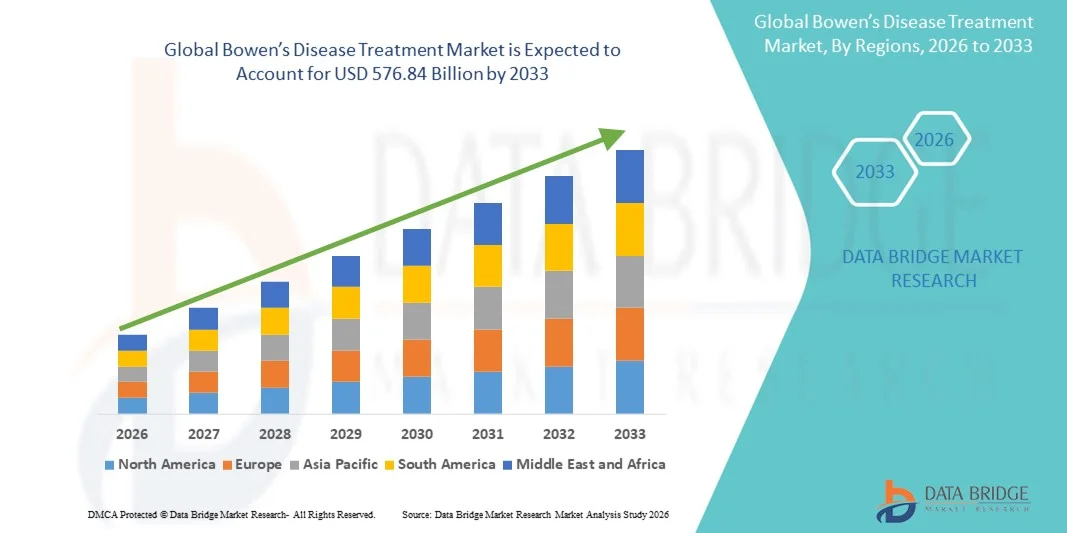
- The global Bowen’s Disease Treatment market size was valued at USD 356.50 billion in 2025 and is expected to reach USD 576.84 billion by 2033, at a CAGR of 6.20% during the forecast period
- The market growth is largely fueled by the rising prevalence of Bowen’s disease, increasing awareness regarding early diagnosis, and technological advancements in dermatology treatments. Growing use of dermoscopy, non-invasive diagnostic tools, and improved therapeutic options such as topical immunomodulators, photodynamic therapy, and targeted laser-based treatments are contributing significantly to the market expansion
- Furthermore, the increasing demand for safe, effective, and minimally invasive treatment solutions is positioning Bowen’s Disease therapies as a preferred choice across dermatology clinics and hospitals. The shift toward outpatient procedures, rising adoption of combination therapies, and greater focus on cosmetic outcomes are accelerating the uptake of Bowen’s Disease Treatment options, thereby substantially boosting the industry's growth
Bowen’s Disease Treatment Market Analysis
- Bowen’s Disease Treatment options, including topical therapies, photodynamic therapy (PDT), cryotherapy, surgery, and laser-based approaches, are becoming increasingly vital in dermatology due to rising skin cancer awareness, improved diagnostic capabilities, and a growing preference for minimally invasive procedures. The availability of multiple treatment modalities allows clinicians to tailor therapy based on lesion size, location, and cosmetic considerations
- The escalating demand for Bowen’s Disease Treatment is primarily driven by the rising global incidence of precancerous skin lesions, increasing UV exposure, expanding geriatric population, and growing emphasis on early intervention to prevent squamous cell carcinoma progression. Advancements in dermatology imaging, high-efficacy topical drugs, and innovative targeted light therapies continue to accelerate market adoption
- North America dominated the Bowen’s Disease Treatment market with the largest revenue share of 38.4% in 2025, supported by high awareness of skin cancer, strong dermatology infrastructure, early adoption of advanced treatments such as photodynamic therapy, and a high rate of dermatology consultations. The U.S. leads the region due to increased healthcare spending, widespread availability of dermatologists, and continuous research into non-invasive skin cancer management
- Asia-Pacific is expected to be the fastest-growing region in the Bowen’s Disease Treatment market with a CAGR from 2026 to 2033, driven by rising sun exposure, rapid growth in healthcare access, increasing geriatric demographics, and expanding dermatology services in countries like China, India, Japan, and South Korea. Government initiatives promoting early cancer detection also support market growth
- Skin biopsy held the largest market revenue share of 71.4% in 2025, owing to its critical role as the gold-standard diagnostic method for confirming Bowen’s disease and differentiating it from invasive squamous cell carcinoma
Report Scope and Bowen’s Disease Treatment Market Segmentation
|
Attributes |
Bowen’s Disease Treatment Key Market Insights |
|
Segments Covered |
|
|
Countries Covered |
North America
Europe
Asia-Pacific
Middle East and Africa
South America
|
|
Key Market Players |
|
|
Market Opportunities |
|
|
Value Added Data Infosets |
In addition to the insights on market scenarios such as market value, growth rate, segmentation, geographical coverage, and major players, the market reports curated by the Data Bridge Market Research also include in-depth expert analysis, patient epidemiology, pipeline analysis, pricing analysis, and regulatory framework. |
Bowen’s Disease Treatment Market Trends
Advancement of Precision Therapeutics and Diagnostic Integration
- A significant and accelerating trend in the global Bowen’s Disease Treatment market is the growing shift toward precision-based therapeutic approaches supported by improved diagnostic capabilities such as dermoscopy, confocal microscopy, and molecular pathology. This shift is enabling clinicians to personalize treatment and improve early lesion detection, reducing disease progression and recurrence
- For instance, topical immunomodulators such as imiquimod and 5-fluorouracil are increasingly being prescribed based on lesion profile and patient-specific factors, enabling more targeted management of superficial lesions. Similarly, photodynamic therapy (PDT) has gained strong clinical preference in cases requiring tissue preservation, particularly for lesions on cosmetically sensitive sites
- Advances in diagnostic technologies have significantly improved the ability to distinguish Bowen’s disease from invasive squamous cell carcinoma, reducing misdiagnosis and supporting more accurate treatment planning. Digital imaging systems and AI-assisted dermoscopy tools are helping clinicians track lesion changes over time and identify high-risk features earlier
- The integration of advanced diagnostic tools with personalized therapy selection allows physicians to recommend the most effective treatment modality—whether topical therapies, cryotherapy, PDT, or excision—based on lesion depth, location, and patient tolerance
- This increasing reliance on precision diagnostics is reshaping clinical practice guidelines and encouraging pharmaceutical and medical device companies to develop more targeted therapies and diagnostic platforms. Companies are also investing in PDT light-source innovations and improved topical formulations to enhance patient outcomes and minimize side effects
- The demand for precise, minimally invasive, and highly tolerable treatment options is rising rapidly across dermatology clinics and hospitals, as clinicians and patients increasingly prioritize accuracy, cosmetic outcomes, and long-term lesion control
Bowen’s Disease Treatment Market Dynamics
Driver
Increasing Prevalence of Precancerous Skin Lesions and Rising Focus on Early Intervention
- The rising global incidence of precancerous skin lesions, particularly among aging populations and individuals with chronic sun exposure, is a major driver accelerating the demand for Bowen’s disease treatment
- For instance, in March 2025, several dermatology research groups reported growing detection rates of in-situ squamous cell carcinoma across Europe and Asia, emphasizing the importance of early diagnosis and standardized treatment protocols. Such developments continue to drive the Bowen’s Disease Treatment market forward
- As awareness increases regarding the potential progression of Bowen’s disease into invasive squamous cell carcinoma, patients and clinicians are seeking effective early-stage interventions to prevent complications
- The growing availability of specialized dermatology services, coupled with increased patient education campaigns on skin cancer prevention, has resulted in higher screening rates and timely treatment initiation
- Furthermore, advancements in non-invasive treatment modalities such as topical therapies, cryotherapy, PDT, and targeted excision provide patients with multiple effective options, improving clinical acceptance and treatment uptake
- The trend toward regular dermatological check-ups, along with improved reimbursement for early-stage skin cancer management in many regions, contributes significantly to the rising adoption of Bowen’s Disease Treatment solutions
Restraint/Challenge
Clinical Recurrence, Treatment Limitations, and High Cost Burden
- One of the major challenges in the Bowen’s Disease Treatment market is the risk of lesion recurrence following certain treatments, such as topical therapies or cryotherapy, which may require repeated sessions or additional interventions for complete resolution
- For instance, clinical studies have reported variable recurrence rates depending on lesion location, patient immune status, and the chosen therapy, making some patients reluctant to pursue non-excisional treatment options
- Addressing these treatment limitations requires enhanced therapeutic formulations, standardized clinical guidelines, and better patient follow-up protocols to ensure durable efficacy. In addition, the lack of uniform treatment outcomes across different modalities creates uncertainty among clinicians and patients
- Moreover, the high cost associated with certain procedures, such as photodynamic therapy or advanced diagnostic imaging, can be a barrier for patients in regions with limited healthcare coverage or out-of-pocket models
- While pricing for some topical medications has become more accessible, procedures requiring specialized equipment or multiple clinical visits still contribute to a significant financial burden
- Overcoming these challenges through improved long-term efficacy data, cost-effective treatment innovations, and greater reimbursement support will be essential for sustained market expansion
Bowen’s Disease Treatment Market Scope
The market is segmented on the basis of treatment, diagnosis, end-users, and distribution channel.
- By Treatment
On the basis of treatment, the Bowen’s Disease Treatment market is segmented into topical chemotherapy, cryotherapy, curettage, photodynamic therapy, radiation therapy, and surgery. Topical chemotherapy dominated the largest market revenue share of 38.6% in 2025, driven by its strong clinical preference for non-invasive management and its effectiveness in treating early-stage carcinoma in situ. The segment benefits from high adoption due to the convenience of at-home application, fewer procedural risks, and cost-effectiveness compared to surgical options. Equally, clinicians prefer agents such as 5-fluorouracil and imiquimod because they preserve cosmetic appearance, especially for lesions on visible areas like the face and neck. Increased patient preference for painless, tissue-sparing options and rising awareness regarding early lesion management further support the dominance of topical chemotherapy. The growing emphasis on outpatient dermatology care and minimal-downtime treatment approaches also continues to reinforce its clinical and commercial strength in various regions.
Photodynamic therapy (PDT) is anticipated to witness the fastest growth rate of 21.3% CAGR from 2026 to 2033, driven by its high efficacy for superficial lesions, favorable cosmetic outcomes, and increasing availability of advanced light-based devices in dermatology clinics. PDT is gaining rapid traction in patients requiring targeted therapy with minimal scarring, especially in cosmetically sensitive or hard-to-treat locations. Its ability to minimize tissue damage and ensure controlled lesion destruction has increased its clinical acceptance. The rising number of dermatology centers equipped with PDT devices, along with technological advancements such as improved photosensitizers and shorter treatment durations, further accelerate adoption. Increasing preference for non-invasive, clinic-based treatments and expanding reimbursement in developed markets are additional contributors to its fast growth.
- By Diagnosis
On the basis of diagnosis, the Bowen’s Disease Treatment market is segmented into skin biopsy and others. Skin biopsy held the largest market revenue share of 71.4% in 2025, owing to its critical role as the gold-standard diagnostic method for confirming Bowen’s disease and differentiating it from invasive squamous cell carcinoma. The segment benefits from the irreplaceable accuracy of histopathological evaluation, enabling clinicians to determine lesion depth, cellular atypia, and treatment suitability. High demand stems from increasing screening for precancerous lesions and rising awareness of early-stage skin cancers. Growing numbers of dermatology visits and improved diagnostic infrastructure in hospitals and clinics further support the dominance of biopsy. The reliability, specificity, and widespread availability of biopsy procedures ensure continued leadership in both developed and emerging regions.
The others segment, including dermoscopy, confocal microscopy, and molecular imaging tools, is expected to witness the fastest CAGR of 18.9% from 2026 to 2033, driven by the rapid adoption of non-invasive diagnostic technologies for early detection and lesion monitoring. These tools have gained popularity due to their ability to provide real-time imaging, reduce the need for invasive procedures, and help clinicians make quicker treatment decisions. Advancements in digital dermoscopy, AI-assisted lesion analysis, and improved imaging resolution have enhanced diagnostic reliability. Increasing preference for non-biopsy monitoring in cosmetically sensitive areas and expanding availability of advanced diagnostic devices in dermatology practices further propel growth.
- By End-Users
On the basis of end-users, the Bowen’s Disease Treatment market is segmented into clinic, hospital, and others. Hospitals accounted for the largest market revenue share of 46.7% in 2025, driven by their higher patient footfall, availability of advanced diagnostic and treatment infrastructure, and ability to manage complex or large lesions. Hospitals benefit from multidisciplinary teams, enabling integrated dermatology, oncology, and surgical care for precancerous and early malignant lesions. Increased hospital-based screening programs and rising awareness of early detection further support segment dominance. The availability of photodynamic therapy units, surgical suites, and specialized pathology labs reinforces hospitals’ leadership in disease management. In additional, higher reimbursement coverage for hospital-based procedures maintains strong demand.
Clinics are expected to witness the fastest CAGR of 20.4% from 2026 to 2033, owing to the rising trend of outpatient dermatology care, increasing availability of minimally invasive treatments, and growing preference for cost-effective, quick-visit settings. Clinics are becoming primary points of diagnosis and early treatment for localized lesions due to their accessibility and shorter waiting times. The expansion of private dermatology chains, adoption of advanced diagnostic tools, and growing patient preference for non-hospital environments contribute significantly to their accelerated growth. Increasing use of topical therapies, cryotherapy, and in-office PDT makes clinics a preferred choice for many patients.
- By Distribution Channel
On the basis of distribution channel, the Bowen’s Disease Treatment market is segmented into hospital pharmacy, retail pharmacy, and online pharmacy. Hospital pharmacy dominated the largest market share of 44.8% in 2025, supported by the high volume of prescriptions originating from hospitals and the availability of specialized medications used for Bowen’s disease management. Hospitals dispense topical chemotherapeutics, post-procedure care products, and dermatology-specific medications directly to patients, ensuring better adherence and controlled treatment protocols. Strong integration between hospital dermatology departments and in-house pharmacies also contributes to segment dominance. In additional, hospital pharmacies often stock advanced and high-cost therapies that retail outlets may not carry.
Online pharmacy is anticipated to witness the fastest CAGR of 22.6% from 2026 to 2033, driven by increasing digitalization, rising patient preference for home delivery, and expanding availability of dermatology medications through e-commerce platforms. Online channels offer convenience, price transparency, and broader access to topical agents used in early disease management. Growing adoption of teledermatology further supports online medicine purchasing. The rising comfort with digital healthcare solutions and increasing penetration of online pharmacy networks in developing regions continue to accelerate segment growth.
Bowen’s Disease Treatment Market Regional Analysis
- North America dominated the Bowen’s Disease Treatment market with the largest revenue share of 38.4% in 2025
- Supported by high awareness of skin cancer, strong dermatology infrastructure, early adoption of advanced treatments such as photodynamic therapy, and a high rate of dermatology consultations
- The market leads the region due to increased healthcare spending, widespread availability of dermatologists, and continuous research into non-invasive skin cancer management
U.S. Bowen’s Disease Treatment Market Insight
The U.S. Bowen’s Disease Treatment market captured nearly 81% of North America’s revenue share in 2025, driven by high patient awareness, extensive access to dermatology clinics, and strong adoption of topical chemotherapies and photodynamic therapy. Growing demand for early diagnosis, increased use of skin biopsy procedures, and continuous advancements in outpatient dermatologic oncology are further accelerating market growth. The presence of major research institutions and rising emphasis on minimally invasive skin cancer treatments also contribute to the country’s dominance.
Europe Bowen’s Disease Treatment Market Insight
The Europe Bowen’s Disease Treatment market is projected to grow at a steady CAGR during the forecast period, driven by increasing implementation of skin cancer screening programs, strong regulatory focus on early-stage cancer detection, and high utilization of photodynamic therapy and cryotherapy. Rising prevalence of chronic sun damage and growing adoption of dermatology day-care procedures across residential and commercial healthcare settings are further supporting market expansion throughout the region.
U.K. Bowen’s Disease Treatment Market Insight
The U.K. Bowen’s Disease Treatment market is anticipated to record noteworthy growth due to rising cases of actinic keratosis and non-melanoma skin cancers, strong emphasis on early diagnosis, and increased preference for outpatient dermatologic treatment. The availability of advanced diagnostic techniques, including dermoscopy and targeted biopsies, and expanding access to topical and photodynamic therapies are encouraging both patients and healthcare providers to adopt early intervention approaches.
Germany Bowen’s Disease Treatment Market Insight
The Germany Bowen’s Disease Treatment market is expected to expand at a considerable CAGR, supported by strong healthcare infrastructure, rising adoption of digital dermatology tools, and increasing demand for eco-conscious, effective treatment options such as photodynamic therapy. Germany’s emphasis on research, technological innovation, and high awareness of skin cancer risks fosters strong uptake across both public and private healthcare facilities.
The Asia-Pacific Bowen’s Disease Treatment market is poised to grow at the fastest CAGR of 2026–2033, driven by rising sun exposure, increasing healthcare access, expanding geriatric population, and growing dermatology services in China, Japan, India, and South Korea. Government-led early cancer detection programs and improved affordability of diagnostic procedures are accelerating adoption of treatment options across the region.
Japan Bowen’s Disease Treatment Market Insight
The Japan Bowen’s Disease Treatment market is gaining traction due to a technologically advanced healthcare system, rapid aging population, and increasing awareness of early-stage skin cancers. Strong demand for minimally invasive procedures such as photodynamic therapy and cryotherapy, coupled with growing integration of digital dermatology tools, is supporting sustained market expansion.
China Bowen’s Disease Treatment Market Insight
The China Bowen’s Disease Treatment market accounted for the largest revenue share in Asia Pacific in 2025, driven by a rapidly expanding middle-class population, high levels of UV exposure, and significant increase in dermatology visits. China’s strong domestic healthcare development, improved access to biopsy diagnostics, and growing adoption of affordable topical and photodynamic therapies are key factors accelerating market growth.
.
Bowen’s Disease Treatment Market Share
The Bowen’s Disease Treatment industry is primarily led by well-established companies, including:
- Roche (Switzerland)
- Novartis (Switzerland)
- Pfizer (U.S.)
- GSK plc. (U.K.)
- Sanofi (France)
- Bristol Myers Squibb (U.S.)
- Eli Lilly (U.S.)
- Merck & Co. (U.S.)
- Bayer (Germany)
- Amgen (U.S.)
- AbbVie (U.S.)
- Regeneron (U.S.)
- Sun Pharma (India)
- Cipla (India)
- Dr. Reddy’s Laboratories (India)
- Leo Pharma (Denmark)
- Galderma (Switzerland)
Latest Developments in Global Bowen’s Disease Treatment Market
- In February 2023, the British Association of Dermatologists published updated, evidence-based guidance for the management of cutaneous squamous cell carcinoma in situ (Bowen disease), formalizing recommended options (including topical therapies, photodynamic therapy and excision) and helping standardize clinical practice across the U.K. and influencing care pathways elsewhere
- In April 2024, a comprehensive review of photodynamic therapy (PDT) for Bowen’s disease summarized accumulating clinical data showing high short-term clearance rates for ALA- and MAL-PDT, described refinements such as laser-assisted PDT to improve depth of effect, and highlighted PDT’s favorable cosmetic outcomes—reinforcing PDT’s growing role as a validated, tissue-sparing option
- In June 2024, Biofrontera commercially launched its larger-area BF-RhodoLED XL lamp (the RhodoLED XL) for use with Ameluz (BF-200 ALA) in the U.S., enabling more efficient PDT sessions and supporting broader clinic adoption of PDT platforms that are also used to treat Bowen’s and other superficial skin neoplasms
- In August 2024, peer-reviewed analyses and case reports documented expanding use of teledermatology for skin-cancer triage and two-week wait referrals, showing that teledermatology can be a safe, effective route to screen and prioritize suspected Bowen’s disease patients—accelerating remote diagnostic access and earlier treatment initiation in many centers

- Interactive Data Analysis Dashboard
- Company Analysis Dashboard for high growth potential opportunities
- Research Analyst Access for customization & queries
- Competitor Analysis with Interactive dashboard
- Latest News, Updates & Trend analysis
- Harness the Power of Benchmark Analysis for Comprehensive Competitor Tracking
Data collection and base year analysis are done using data collection modules with large sample sizes. The stage includes obtaining market information or related data through various sources and strategies. It includes examining and planning all the data acquired from the past in advance. It likewise envelops the examination of information inconsistencies seen across different information sources. The market data is analysed and estimated using market statistical and coherent models. Also, market share analysis and key trend analysis are the major success factors in the market report. To know more, please request an analyst call or drop down your inquiry.
The key research methodology used by DBMR research team is data triangulation which involves data mining, analysis of the impact of data variables on the market and primary (industry expert) validation. Data models include Vendor Positioning Grid, Market Time Line Analysis, Market Overview and Guide, Company Positioning Grid, Patent Analysis, Pricing Analysis, Company Market Share Analysis, Standards of Measurement, Global versus Regional and Vendor Share Analysis. To know more about the research methodology, drop in an inquiry to speak to our industry experts.
Data Bridge Market Research is a leader in advanced formative research. We take pride in servicing our existing and new customers with data and analysis that match and suits their goal. The report can be customized to include price trend analysis of target brands understanding the market for additional countries (ask for the list of countries), clinical trial results data, literature review, refurbished market and product base analysis. Market analysis of target competitors can be analyzed from technology-based analysis to market portfolio strategies. We can add as many competitors that you require data about in the format and data style you are looking for. Our team of analysts can also provide you data in crude raw excel files pivot tables (Fact book) or can assist you in creating presentations from the data sets available in the report.












