


Brain Tumor Diagnosis and Treatment Market Size
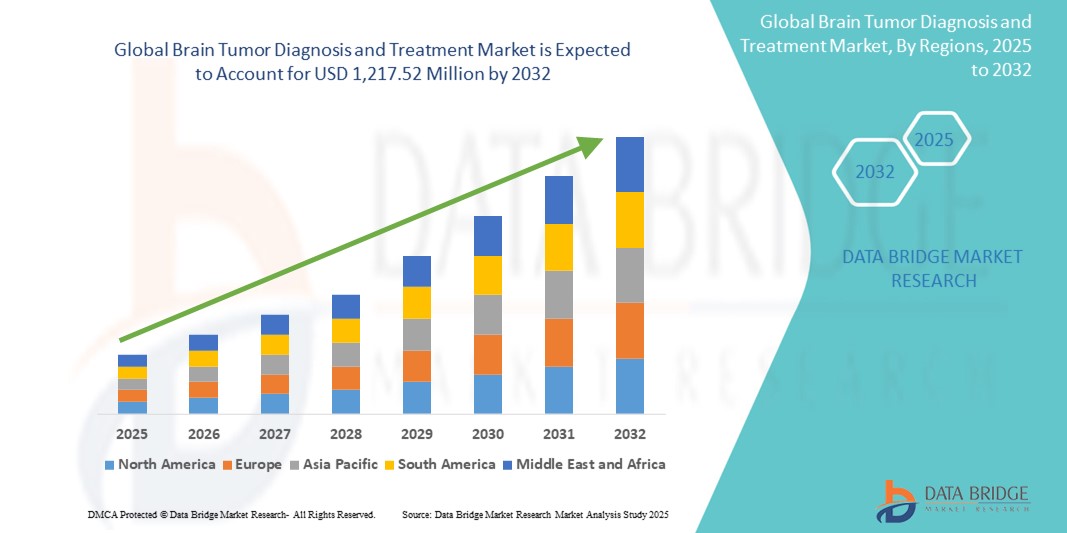
- The global brain tumor diagnosis and treatment market size was valued at USD 666.62 million in 2024 and is expected to reach USD 1,217.52 million by 2032, at a CAGR of 7.82% during the forecast period
- The market growth is largely fueled by the rising prevalence of brain tumors globally and continuous technological advancements in imaging modalities, biopsy techniques, and biomarker-based diagnostics. This has led to earlier detection and more accurate differentiation of tumor types, significantly enhancing treatment outcomes
- Furthermore, increasing consumer demand for minimally invasive, precise, and targeted treatment solutions—such as proton therapy, stereotactic radiosurgery, and targeted biologics—is establishing advanced brain tumor management as a clinical priority. These converging factors are accelerating the uptake of Brain Tumor Diagnosis and Treatment solutions, thereby significantly boosting the industry's growth
Brain Tumor Diagnosis and Treatment Market Analysis
- Brain tumor diagnosis and treatment solutions, encompassing advanced imaging technologies, surgical interventions, radiation therapy, and pharmacological treatments, are increasingly vital in modern healthcare due to their potential to significantly improve patient outcomes when detected and treated early
- The rising incidence of primary and metastatic brain tumors, coupled with increasing awareness and access to diagnostic tools, is fueling the demand for more effective and personalized treatment approaches worldwide
- North America dominated the brain tumor diagnosis and treatment market with the largest revenue share of 40.01% in 2024, driven by high healthcare expenditure, strong infrastructure for neurological care, and a high adoption rate of advanced diagnostic imaging systems such as MRI and PET-CT
- Asia-Pacific is expected to be the fastest-growing region in the brain tumor diagnosis and treatment market, projected to register a CAGR of 8.7% during the forecast period, driven by rising healthcare investments, improving diagnostic capabilities, and increasing awareness in emerging economies such as China and India
- Primary brain tumor segment dominated the brain tumor diagnosis and treatment market with a market share of 58.3% in 2024, driven by the increasing incidence of gliomas, meningiomas, and astrocytomas, as well as rising awareness and improved access to early diagnostic options
Report Scope and Brain Tumor Diagnosis and Treatment Market Segmentation
|
Attributes |
Brain Tumor Diagnosis and Treatment Key Market Insights |
|
Segments Covered |
|
|
Countries Covered |
North America
Europe
Asia-Pacific
Middle East and Africa
South America
|
|
Key Market Players |
|
|
Market Opportunities |
|
|
Value Added Data Infosets |
In addition to the insights on market scenarios such as market value, growth rate, segmentation, geographical coverage, and major players, the market reports curated by the Data Bridge Market Research also include in-depth expert analysis, pricing analysis, brand share analysis, consumer survey, demography analysis, supply chain analysis, value chain analysis, raw material/consumables overview, vendor selection criteria, PESTLE Analysis, Porter Analysis, and regulatory framework. |
Brain Tumor Diagnosis and Treatment Market Trends
“Technological Advancements Driving Precision and Accessibility in Brain Tumor Care”
- A significant and accelerating trend in the global brain tumor diagnosis and treatment market is the deepening integration of artificial intelligence (AI) with advanced diagnostic platforms such as MRI, PET-CT, and molecular imaging. These innovations are improving diagnostic precision, accelerating detection, and enabling more personalized treatment strategies
- For instance, AI-powered imaging solutions from companies such as GE HealthCare and Siemens Healthineers assist radiologists by enhancing tumor segmentation and identifying early-stage malignancies with greater accuracy. Similarly, AI-driven analytics platforms are supporting oncologists in tailoring therapy regimens based on real-time data insights and patient-specific tumor profiles
- AI integration in diagnostic and therapeutic workflows allows for continuous learning from patient data, improving accuracy and reducing false positives. Clinical decision support tools are also being adopted widely to recommend optimal treatment paths and predict outcomes based on tumor genetics, age, comorbidities, and treatment history
- The seamless convergence of digital health records with AI-based platforms is enabling centralized access to diagnostic imaging, genomic data, and treatment response metrics. This integration is proving vital in facilitating multidisciplinary collaboration among neurosurgeons, oncologists, and radiologists for effective case management
- This movement toward more intelligent, data-driven, and connected oncology ecosystems is fundamentally reshaping patient care and physician workflows. Companies are investing heavily in AI-enabled tumor classification tools, automated pathology interpretation systems, and radiogenomics to bridge the gap between diagnosis and precision treatment
- The growing demand for early and accurate diagnosis, coupled with personalized medicine approaches, is rapidly transforming the Brain Tumor Diagnosis and Treatment market. This shift is expected to continue as healthcare providers and biotech innovators leverage technology to enhance patient outcomes and streamline complex care pathways
Brain Tumor Diagnosis and Treatment Market Dynamics
Driver
“Growing Need Due to Rising Brain Tumor Incidence and Advancements in Diagnostic Technologies”
- The rising global incidence of brain tumors, both malignant and benign, has created a growing need for timely and accurate diagnostic tools and effective treatment options. This increase in disease prevalence is a key driver of market growth
- For instance, in April 2024, Siemens Healthineers introduced an advanced AI-powered MRI protocol tailored for early brain tumor detection, aimed at improving diagnostic precision and reducing scan time. Such innovations are expected to propel the brain tumor diagnosis and treatment industry forward
- As patient awareness increases and healthcare infrastructure improves globally, there is a growing demand for non-invasive diagnostic techniques, including MRI, CT scans, and liquid biopsies, which offer enhanced safety and early detection benefits
- Furthermore, the integration of genomics and biomarker-based diagnostics into oncology practices is fostering the development of personalized medicine approaches. These advancements not only aid in early diagnosis but also guide targeted therapies for improved treatment outcomes
- The demand for accessible, accurate, and rapid diagnostic solutions, along with the emergence of minimally invasive and image-guided surgical procedures, is boosting the adoption of modern brain tumor treatment options across hospitals, diagnostic centers, and specialty clinics
Restraint/Challenge
“High Treatment Costs and Limited Accessibility in Developing Regions”
- One of the major challenges in the brain tumor diagnosis and treatment market is the high cost associated with advanced diagnostic imaging (MRI, PET scans), surgical interventions, radiotherapy, and targeted drug therapies. These costs limit accessibility, especially in low- and middle-income countries
- For instance, treatments such as Gamma Knife radiosurgery or immunotherapies can cost tens of thousands of dollars, making them unaffordable for many without comprehensive insurance or government aid
- Access to specialized neurologists, oncologists, and high-end imaging equipment is often limited in rural and underserved regions, further exacerbating disparities in diagnosis and treatment timelines
- In addition, delays in diagnosis due to nonspecific symptoms and the lack of awareness among primary care providers can lead to late-stage detection, reducing the effectiveness of treatment
- Overcoming these challenges will require increased healthcare funding, public-private partnerships, expansion of telehealth neurology services, and cost-reduction strategies such as the development of low-cost diagnostic tools and generic versions of advanced drugs
Brain Tumor Diagnosis and Treatment Market Scope
The market is segmented on the basis of product type, product analysis, diagnosis type, treatment type, and end user.
• By Product Type
On the basis of product type, the brain tumor diagnosis and treatment market is segmented into primary brain tumor and secondary brain tumor. The primary brain tumor segment dominated the largest market revenue share of 58.3% in 2024, driven by increasing incidence of gliomas, meningiomas, and astrocytomas, as well as growing awareness and availability of early diagnostic options.
The secondary brain tumor segment is expected to witness the fastest CAGR of 10.2% from 2025 to 2032, primarily due to the rising prevalence of metastases from other cancers such as breast, lung, and melanoma, and increased use of imaging techniques to detect brain involvement.
• By Product Analysis
On the basis of product analysis, the brain tumor diagnosis and treatment market is segmented into stains and varnishes, shellacs, lacquers, and others. The stains and varnishes segment held the largest revenue share of 54% in 2024, attributed to their widespread use in pathology labs for histological analysis. These reagents help identify and differentiate tumor tissue types, aiding precise diagnosis.
The lacquers segment is projected to grow at the fastest CAGR 10.8% during the forecast period, as demand rises for advanced staining and coating agents used in neuro-oncology research and customized diagnostic kits.
• By Diagnosis Type
On the basis of diagnosis type, the brain tumor diagnosis and treatment market is segmented into CT scan, MRI, PET-CT scan, molecular testing, EEG, and others. The MRI segment held the highest revenue share of 34.9% in 2024, due to its high-resolution imaging, non-invasive nature, and increasing use in both diagnosis and surgical planning for brain tumors.
The molecular testing segment is anticipated to grow at the fastest CAGR of 11.4% from 2025 to 2032, driven by the rise in precision medicine and demand for biomarkers for personalized treatment plans.
• By Treatment Type
On the basis of treatment type, the brain tumor diagnosis and treatment market is segmented into surgery, radiation therapy, targeted therapy, chemotherapy, and immunotherapy. The surgery segment accounted for the largest market share in 2024 at 36.7%, as surgical removal remains the primary approach for many operable tumors, supported by advances in neurosurgical techniques and intraoperative imaging.
The immunotherapy segment is forecasted to exhibit the fastest growth, with a CAGR of 12.3% from 2025 to 2032, owing to breakthroughs in immune checkpoint inhibitors and vaccine-based treatments targeting glioblastoma and other aggressive tumors.
• By End User
On the basis of end user, the market is segmented into hospitals and ambulatory surgical centers. The hospital segment held the largest revenue share of 74.5% in 2024, driven by the availability of comprehensive diagnostic, surgical, and therapeutic services under one roof, especially in tertiary and specialty hospitals.
The ambulatory surgical centers segment is expected to register a higher CAGR 12% over the forecast period due to increasing preference for minimally invasive outpatient neurosurgical procedures and cost-efficiency benefits.
Brain Tumor Diagnosis and Treatment Market Regional Analysis
- North America dominated the global brain tumor diagnosis and treatment market with the largest revenue share of 40.01% in 2024, driven by advanced healthcare infrastructure
- High adoption of cutting-edge diagnostic technologies, and growing awareness regarding early detection
- The region benefits from strong research funding, favorable reimbursement policies, and technological integration across healthcare systems
U.S. Brain Tumor Diagnosis and Treatment Market Insight
The U.S. brain tumor diagnosis and treatment market accounted for 69.7% of the North American market. This dominance is fueled by increasing prevalence of brain tumors, high diagnostic accuracy due to widespread availability of MRI and CT imaging, and the presence of major players involved in ongoing clinical trials and drug development. The U.S. market is projected to grow at a CAGR of 8.4% from 2025 to 2032.
Europe Brain Tumor Diagnosis and Treatment Market Insight
The Europe brain tumor diagnosis and treatment market is projected to expand at a substantial CAGR throughout the forecast period, with countries across the region adopting precision diagnostics and advanced radiation therapies. The region is seeing steady growth driven by rising healthcare expenditure, improved access to specialized oncology services, and increasing clinical trial activity.
U.K. Brain Tumor Diagnosis and Treatment Market Insight
The U.K. brain tumor diagnosis and treatment market is anticipated to grow at a noteworthy CAGR during the forecast period. Growth is driven by strong NHS support for cancer initiatives, national screening programs, and investment in advanced neuroimaging equipment. Rising prevalence of glioblastoma and supportive research funding further enhance market potential.
Germany Brain Tumor Diagnosis and Treatment Market Insight
The Germany brain tumor diagnosis and treatment market is expected to expand at a considerable CAGR during the forecast period. The country’s emphasis on innovation, a robust healthcare system, and early adoption of AI in radiology and neurosurgery contribute significantly to its market position.
Asia-Pacific Brain Tumor Diagnosis and Treatment Market Insight
The Asia-Pacific brain tumor diagnosis and treatment market is expected to witness the fastest CAGR of 8.7% from 2025 to 2032. Key growth drivers include increasing healthcare expenditure, rising cancer burden, improving diagnostics infrastructure, and favorable government policies in emerging economies such as China, India, and Southeast Asia.
Japan Brain Tumor Diagnosis and Treatment Market Insight
The Japan brain tumor diagnosis and treatment market accounted for 3.7% of the Asia-Pacific market in 2024. Japan’s advanced imaging capabilities, early diagnosis culture, and a high aging population create strong demand for precision brain tumor treatments. Integration of AI and robotic surgery are also fueling innovation.
China Brain Tumor Diagnosis and Treatment Market Insight
The China brain tumor diagnosis and treatment market led the Asia-Pacific market with a 38.4% regional share. The market is projected to grow at a CAGR of 11.2% during the forecast period, supported by rapid urbanization, expansion of neuro-oncology centers, and large-scale investments in research and development by domestic biotech firms. The country is also seeing increasing public-private collaborations aimed at improving cancer care infrastructure.
Brain Tumor Diagnosis and Treatment Market Share
The brain tumor diagnosis and treatment industry is primarily led by well-established companies, including:
- Pfizer Inc. (U.S.)
- Mayo Foundation for Medical Education and Research (MFMER) (U.S.)
- GE HealthCare (U.S.)
- AstraZeneca (U.K.)
- Merck & Co., Inc. (U.S.)
- Siemens Healthineers AG (Germany)
- Carestream Health (U.S.)
- Hitachi, Ltd. (Japan)
- Koninklijke Philips N.V. (Netherlands)
- Shimadzu Corporation (Japan)
- Canon Medical Systems (Japan)
- Eisai Co., Ltd. (Japan)
- Elekta (Sweden)
- Varian Medical Systems, Inc. (U.S.)
- FUJIFILM Corporation (Japan)
- NantOmics (U.S.)
- Hologic, Inc. (U.S.)
- Thermo Fisher Scientific Inc. (U.S.)
- Genentech, Inc. (U.S.)
- Bristol-Myers Squibb Company (U.S.)
Latest Developments in Global Brain Tumor Diagnosis and Treatment Market
- In March 2024, AstraZeneca completed the acquisition of Fusion Pharmaceuticals, aiming to accelerate advancements in cancer treatment. This acquisition is focused on shifting away from conventional therapies such as chemotherapy and radiotherapy, towards more innovative and targeted approaches that enhance patient outcomes
- In January 2024, GE HealthCare acquired MIM Software, a company specializing in AI-driven imaging and workflow solutions. This acquisition enables GE HealthCare to integrate MIM’s advanced AI-enabled tools into sectors such as oncology and neurology, enhancing diagnostic accuracy and improving treatment planning across these critical healthcare domains

- Interactive Data Analysis Dashboard
- Company Analysis Dashboard for high growth potential opportunities
- Research Analyst Access for customization & queries
- Competitor Analysis with Interactive dashboard
- Latest News, Updates & Trend analysis
- Harness the Power of Benchmark Analysis for Comprehensive Competitor Tracking
Data collection and base year analysis are done using data collection modules with large sample sizes. The stage includes obtaining market information or related data through various sources and strategies. It includes examining and planning all the data acquired from the past in advance. It likewise envelops the examination of information inconsistencies seen across different information sources. The market data is analysed and estimated using market statistical and coherent models. Also, market share analysis and key trend analysis are the major success factors in the market report. To know more, please request an analyst call or drop down your inquiry.
The key research methodology used by DBMR research team is data triangulation which involves data mining, analysis of the impact of data variables on the market and primary (industry expert) validation. Data models include Vendor Positioning Grid, Market Time Line Analysis, Market Overview and Guide, Company Positioning Grid, Patent Analysis, Pricing Analysis, Company Market Share Analysis, Standards of Measurement, Global versus Regional and Vendor Share Analysis. To know more about the research methodology, drop in an inquiry to speak to our industry experts.
Data Bridge Market Research is a leader in advanced formative research. We take pride in servicing our existing and new customers with data and analysis that match and suits their goal. The report can be customized to include price trend analysis of target brands understanding the market for additional countries (ask for the list of countries), clinical trial results data, literature review, refurbished market and product base analysis. Market analysis of target competitors can be analyzed from technology-based analysis to market portfolio strategies. We can add as many competitors that you require data about in the format and data style you are looking for. Our team of analysts can also provide you data in crude raw excel files pivot tables (Fact book) or can assist you in creating presentations from the data sets available in the report.













