


What is the Global Brake Friction Market Size and Growth Rate?
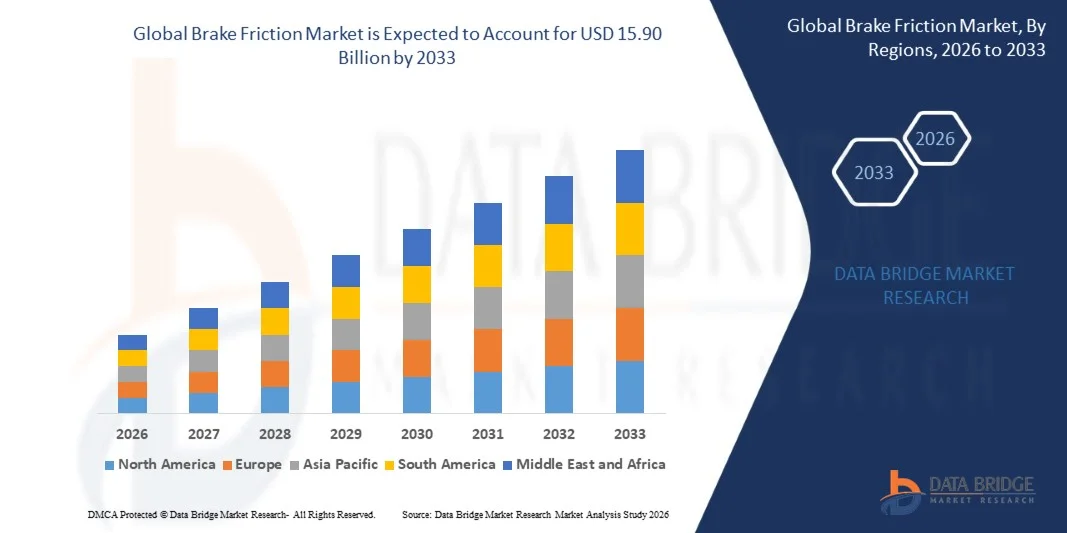
- As per Data Bridge Market Research Analysis the global brake friction market size was valued at USD 13.24 billion in 2025 and is expected to reach USD 15.90 billion by 2033, at a CAGR of 2.31% during the forecast period
- Increasing vehicle production worldwide, rising demand for advanced braking systems in passenger and commercial vehicles, growing emphasis on vehicle safety regulations, and rising adoption of high-performance friction materials such as ceramic and semi-metallic compounds are some of the major as well as vital factors which will such asly to augment the growth of the brake friction market
Market Size & Forecast
Global Market Value (2025): USD 13.24 billion
Expected Market Value (2033): USD 15.90 billion
Forecast CAGR (2026–2033): 2.31%
What are the Major Takeaways of Brake Friction Market?
- Rising demand for durable and high-performance braking components across automotive aftermarket and OEM segments along with increasing vehicle fleet size in developing economies will further contribute by generating significant opportunities that will lead to the growth of the brake friction market
- Fluctuating raw material prices, environmental regulations related to brake material composition, and the emergence of longer-lasting braking technologies which reduce replacement frequency will such asly act as market restraint factors for the growth of the Brake Friction market
- Asia-Pacific dominated the brake friction market with a 43.2% revenue share in 2025, driven by large-scale automotive production, expanding vehicle ownership, and strong growth of automotive component manufacturing across countries such as China, Japan, India, and South Korea
- North America is projected to register the fastest CAGR of 6.1% from 2026 to 2033, driven by increasing adoption of advanced braking technologies, strong growth in electric vehicle production, and expanding automotive aftermarket demand across the United States and Canada
- The Brake Pads segment dominated the market with a 52.6% share in 2025, primarily due to their widespread usage in modern passenger vehicles and light commercial vehicles equipped with disc braking systems
Report Scope and Brake Friction Market Segmentation
|
Attributes |
Brake Friction Key Market Insights |
|
Segments Covered |
|
|
Countries Covered |
North America
Europe
Asia-Pacific
Middle East and Africa
South America
|
|
Key Market Players |
|
|
Market Opportunities |
|
|
Value Added Data Infosets |
In addition to the insights on market scenarios such as market value, growth rate, segmentation, geographical coverage, and major players, the market reports curated by the Data Bridge Market Research also include in-depth expert analysis, pricing analysis, brand share analysis, consumer survey, demography analysis, supply chain analysis, value chain analysis, raw material/consumables overview, vendor selection criteria, PESTLE Analysis, Porter Analysis, and regulatory framework. |
What is the Key Trend in the Brake Friction Market?
“Increasing Shift Toward Eco-Friendly and High-Performance Friction Materials”
- The brake friction market is witnessing growing adoption of environmentally friendly and high-performance friction materials designed to improve braking efficiency, reduce emissions, and comply with strict environmental regulations
- Manufacturers are increasingly developing advanced ceramic, semi-metallic, and non-asbestos organic (NAO) brake materials that offer improved heat resistance, lower noise, reduced brake dust, and enhanced durability
- Growing demand for lightweight automotive components and high-performance braking systems in passenger and commercial vehicles is driving innovation in advanced friction material technologies
- For instance, companies such as Brembo, Continental, Akebono Brake Industry, and Robert Bosch are introducing advanced brake friction products with improved thermal stability, reduced wear, and enhanced stopping performance
- Increasing focus on vehicle safety, performance optimization, and regulatory compliance is accelerating the shift toward next-generation friction materials and advanced brake system technologies
- As vehicle performance standards and environmental regulations continue to evolve, Brake Friction solutions will remain critical for improving braking efficiency, safety, and sustainability in the automotive industry
What are the Key Drivers of Brake Friction Market?
- Rising global vehicle production and increasing demand for reliable braking systems in passenger and commercial vehicles are major factors driving the growth of the Brake Friction market
- For instance, in 2025, leading manufacturers such as Brembo, Continental AG, and Akebono expanded their brake component portfolios with advanced friction materials designed to enhance durability, heat resistance, and braking performance
- Growing adoption of electric vehicles, hybrid vehicles, and advanced driver assistance systems (ADAS) is boosting the demand for high-performance brake friction components
- Advancements in friction material technologies, including ceramic-based compounds and low-metallic brake pads, have improved braking efficiency, reduced noise levels, and extended component lifespan
- Increasing vehicle safety standards and regulatory mandates related to braking performance and environmental emissions are creating strong demand for advanced brake friction products
- Supported by rising automotive production, expanding vehicle fleets, and increasing aftermarket demand for replacement brake components, the Brake Friction market is expected to witness steady long-term growth
Which Factor is Challenging the Growth of the Brake Friction Market?
- Fluctuations in raw material prices, including steel, copper, and specialized friction compounds, can significantly impact the production costs of brake friction components
- For instance, during 2024–2025, volatility in global metal prices and supply chain disruptions increased manufacturing expenses for several brake component suppliers
- Stringent environmental regulations restricting the use of copper and other materials in brake pads require manufacturers to invest in new friction material formulations and product development
- Increasing durability of modern braking systems and longer replacement cycles can reduce the frequency of aftermarket demand for brake components
- Growing adoption of regenerative braking systems in electric vehicles is also reducing mechanical brake usage, creating long-term demand challenges for traditional brake friction products
- To address these challenges, companies are focusing on developing eco-friendly friction materials, improving manufacturing efficiency, and investing in advanced braking technologies to strengthen global market competitiveness
How is the Brake Friction Market Segmented?
The market is segmented on the basis of product type, material, vehicle type, and channel.
• By Product Type
On the basis of product type, the brake friction market is segmented into Brake Pads, Brake Linings, and Brake Shoes. The Brake Pads segment dominated the market with a 52.6% share in 2025, primarily due to their widespread usage in modern passenger vehicles and light commercial vehicles equipped with disc braking systems. Brake pads offer improved braking performance, better heat dissipation, and enhanced stopping power compared to traditional braking components. Their relatively easy replacement and frequent maintenance cycles also contribute to strong demand in both OEM and aftermarket segments. With the rising production of passenger vehicles and growing emphasis on vehicle safety, manufacturers continue to introduce advanced brake pad materials designed to reduce noise, vibration, and brake dust while improving durability and efficiency.
The Brake Linings segment is expected to grow at the fastest CAGR from 2026 to 2033, driven by increasing demand in heavy commercial vehicles, buses, and industrial transportation systems that rely heavily on drum braking systems for reliable stopping performance.
• By Material
On the basis of material, the brake friction market is segmented into Metallic, Ceramic, and Composites/Others. The Metallic segment dominated the market with a 46.8% share in 2025, supported by its superior heat resistance, durability, and strong braking performance under demanding driving conditions. Metallic brake friction materials are widely used in commercial vehicles, performance vehicles, and heavy-duty applications where high thermal stability and consistent braking power are essential. These materials provide excellent heat transfer characteristics, allowing braking systems to maintain performance even under continuous or heavy braking conditions. In addition, their long operational life and reliability make them a preferred choice for heavy transportation and industrial applications.
The Ceramic segment is expected to grow at the fastest CAGR from 2026 to 2033, driven by increasing demand for quieter braking systems, reduced brake dust, improved vehicle comfort, and the rising adoption of ceramic brake pads in premium and electric vehicles.
• By Vehicle Type
On the basis of vehicle type, the brake friction market is segmented into Passenger Vehicles and Commercial Vehicles. The Passenger Vehicles segment dominated the market with a 61.4% share in 2025, driven by the large global production and sales of passenger cars as well as the rapid growth of vehicle ownership across emerging economies. Increasing consumer demand for safe, reliable, and high-performance braking systems is encouraging automakers to integrate advanced brake friction components in passenger vehicles. In addition, growing adoption of electric vehicles, hybrid vehicles, and advanced driver assistance systems (ADAS) is increasing the demand for high-quality braking components capable of supporting enhanced safety and performance requirements.
The Commercial Vehicles segment is expected to grow at the fastest CAGR from 2026 to 2033, fueled by expanding logistics networks, increasing freight transportation, and rising demand for heavy-duty trucks and buses across global markets.
• By Channel
On the basis of channel, the brake friction market is segmented into OEM and Aftermarket. The Aftermarket segment dominated the market with a 56.2% share in 2025, primarily due to the frequent replacement cycles of brake components such as pads, shoes, and linings. Brake friction products experience significant wear during vehicle operation, making periodic replacement essential for maintaining braking efficiency and vehicle safety. The growing global vehicle fleet, increasing vehicle age, and rising maintenance requirements are significantly boosting demand in the automotive aftermarket sector. In addition, independent service centers and automotive repair facilities play a major role in driving replacement demand for brake components.
The OEM segment is expected to grow at the fastest CAGR from 2026 to 2033, supported by rising global vehicle production, increasing adoption of advanced braking technologies, and growing demand for high-performance braking components in newly manufactured vehicles.
Which Region Holds the Largest Share of the Brake Friction Market?
- Asia-Pacific dominated the brake friction market with a 43.2% revenue share in 2025, driven by large-scale automotive production, expanding vehicle ownership, and strong growth of automotive component manufacturing across countries such as China, Japan, India, and South Korea. The region hosts some of the world’s largest automobile manufacturing hubs, creating strong demand for brake pads, brake linings, and brake shoes for both OEM and aftermarket applications. Rising urbanization, growing middle-class population, and increasing vehicle sales are further strengthening market demand for advanced braking components across the region
- Leading automotive component manufacturers in Asia-Pacific are investing heavily in advanced friction material technologies, including ceramic and non-asbestos organic materials, to enhance braking efficiency and comply with tightening environmental and safety regulations. Continuous expansion of automotive production facilities and increasing adoption of electric vehicles are further supporting regional market growth
- Strong manufacturing infrastructure, cost-effective production capabilities, and increasing investments in automotive innovation further reinforce Asia-Pacific’s leadership in the global Brake Friction market
China Brake Friction Market Insight
China represents the largest contributor to the Asia-Pacific Brake Friction market due to its massive automotive manufacturing capacity and strong domestic vehicle demand. The country is home to numerous automobile and automotive component manufacturers that produce brake friction components for both domestic consumption and export markets. Rising demand for passenger vehicles, rapid expansion of electric vehicle production, and increasing focus on vehicle safety technologies are driving the adoption of advanced brake friction materials. In addition, strong government support for domestic automotive manufacturing and technological innovation continues to strengthen the growth of the brake friction market in China.
Japan Brake Friction Market Insight
Japan demonstrates steady growth in the Brake Friction market supported by its well-established automotive industry and strong technological expertise in automotive component manufacturing. Japanese manufacturers focus on producing high-quality brake friction materials that deliver superior durability, low noise, and enhanced braking efficiency. Increasing demand for hybrid vehicles, electric vehicles, and advanced driver assistance systems (ADAS) is encouraging manufacturers to develop advanced braking components that meet modern safety standards. Continuous innovation and strong export capabilities further support Japan’s position as a major contributor to the regional market.
India Brake Friction Market Insight
India is emerging as a significant growth hub in the Brake Friction market, driven by rising vehicle production, increasing vehicle ownership, and expansion of domestic automotive manufacturing. The country’s growing middle-class population and rising demand for passenger and commercial vehicles are fueling the need for reliable braking components. Government initiatives supporting automotive manufacturing and local production are encouraging brake component manufacturers to expand their production capacity. In addition, the growing automotive aftermarket sector is creating significant demand for replacement brake pads, brake shoes, and brake linings across the country.
South Korea Brake Friction Market Insight
South Korea contributes significantly to the regional Brake Friction market due to the presence of major automobile manufacturers and strong automotive component supply chains. The country’s advanced manufacturing capabilities and focus on high-performance automotive components drive the adoption of technologically advanced brake friction materials. Rapid growth in electric vehicles, hybrid vehicles, and next-generation mobility solutions is also increasing demand for efficient and durable braking systems. Continuous innovation in friction material technologies and strong export-oriented automotive manufacturing further support market growth in South Korea.
North America Brake Friction Market
North America is projected to register the fastest CAGR of 6.1% from 2026 to 2033, driven by increasing adoption of advanced braking technologies, strong growth in electric vehicle production, and expanding automotive aftermarket demand across the United States and Canada. Rising focus on vehicle safety regulations and emission control policies is encouraging the development of eco-friendly brake friction materials such as copper-free brake pads. In addition, the presence of leading automotive component manufacturers and strong investments in research and development are driving innovation in braking systems across the region.
U.S. Brake Friction Market Insight
The U.S. represents the largest market in North America due to its large automotive fleet and strong demand for replacement brake components. Increasing consumer awareness regarding vehicle maintenance and safety is driving the demand for high-quality brake friction products in the aftermarket segment. Rapid adoption of electric vehicles and advanced safety systems is also encouraging manufacturers to develop high-performance braking solutions capable of supporting modern vehicle technologies. The presence of major automotive manufacturers and component suppliers further strengthens the country’s market growth.
Canada Brake Friction Market Insight
Canada contributes significantly to the regional Brake Friction market due to steady automotive demand and strong aftermarket sales of vehicle components. The country’s harsh climatic conditions also contribute to higher wear and tear of braking components, creating consistent demand for replacement brake pads and linings. Increasing adoption of advanced safety technologies and growing vehicle ownership are further supporting market growth. In addition, strong trade relationships with the United States and integration within the North American automotive supply chain continue to drive demand for brake friction products in Canada.
Which are the Top Companies in Brake Friction Market?
The brake friction industry is primarily led by well-established companies, including:
- ABS Friction (Poland)
- Aisin Seiki Co., Ltd. (Japan)
- Akebono Brake Industry Co., Ltd. (Japan)
- Bendix Commercial Vehicle Systems LLC (U.S.)
- Brembo S.p.A. (Italy)
- Continental AG (Germany)
- Delphi Technologies (U.K.)
- Federal-Mogul LLC (U.S.)
- FTE Automotive Group (Germany)
- ITT Inc. (U.S.)
- Japan Brake Industrial Co., Ltd. (Japan)
- Macas Automotive (India)
- Masu Brakes Pvt. Ltd. (India)
- Nisshinbo Holdings Inc. (Japan)
- Robert Bosch GmbH (Germany)
What are the Recent Developments in Global Brake Friction Market?
- In February 2026, DRiV announced the expansion of its Ferodo Premier copper-free brake pad portfolio for commercial vehicles with new advanced formulations that eliminate copper while maintaining original equipment performance standards, along with a high-performance red coating that enhances initial braking friction and improves bedding-in efficiency, durability, and braking safety while reducing environmental contamination, thereby strengthening the company’s position in the eco-friendly brake friction segment
- In November 2025, Momentum USA introduced a new range of EPS Friction brake pads specifically designed for the European market and distributed exclusively by New World Friction, offering expanded coverage for passenger cars across multiple European vehicle brands and models, which significantly enhances product availability and growth opportunities in the regional automotive aftermarket
- In September 2025, Friction One established a new manufacturing facility in Juarez, Mexico, aimed at expanding the production and regional supply of friction products in North America through advanced brake pad and disc manufacturing operations, with the plant designed to operate using automation and advanced quality control systems to improve production speed, consistency, and overall manufacturing efficiency, thereby supporting the company’s regional market expansion strategy

- Interactive Data Analysis Dashboard
- Company Analysis Dashboard for high growth potential opportunities
- Research Analyst Access for customization & queries
- Competitor Analysis with Interactive dashboard
- Latest News, Updates & Trend analysis
- Harness the Power of Benchmark Analysis for Comprehensive Competitor Tracking
Data collection and base year analysis are done using data collection modules with large sample sizes. The stage includes obtaining market information or related data through various sources and strategies. It includes examining and planning all the data acquired from the past in advance. It likewise envelops the examination of information inconsistencies seen across different information sources. The market data is analysed and estimated using market statistical and coherent models. Also, market share analysis and key trend analysis are the major success factors in the market report. To know more, please request an analyst call or drop down your inquiry.
The key research methodology used by DBMR research team is data triangulation which involves data mining, analysis of the impact of data variables on the market and primary (industry expert) validation. Data models include Vendor Positioning Grid, Market Time Line Analysis, Market Overview and Guide, Company Positioning Grid, Patent Analysis, Pricing Analysis, Company Market Share Analysis, Standards of Measurement, Global versus Regional and Vendor Share Analysis. To know more about the research methodology, drop in an inquiry to speak to our industry experts.
Data Bridge Market Research is a leader in advanced formative research. We take pride in servicing our existing and new customers with data and analysis that match and suits their goal. The report can be customized to include price trend analysis of target brands understanding the market for additional countries (ask for the list of countries), clinical trial results data, literature review, refurbished market and product base analysis. Market analysis of target competitors can be analyzed from technology-based analysis to market portfolio strategies. We can add as many competitors that you require data about in the format and data style you are looking for. Our team of analysts can also provide you data in crude raw excel files pivot tables (Fact book) or can assist you in creating presentations from the data sets available in the report.













