Bread Mixes Market Overview
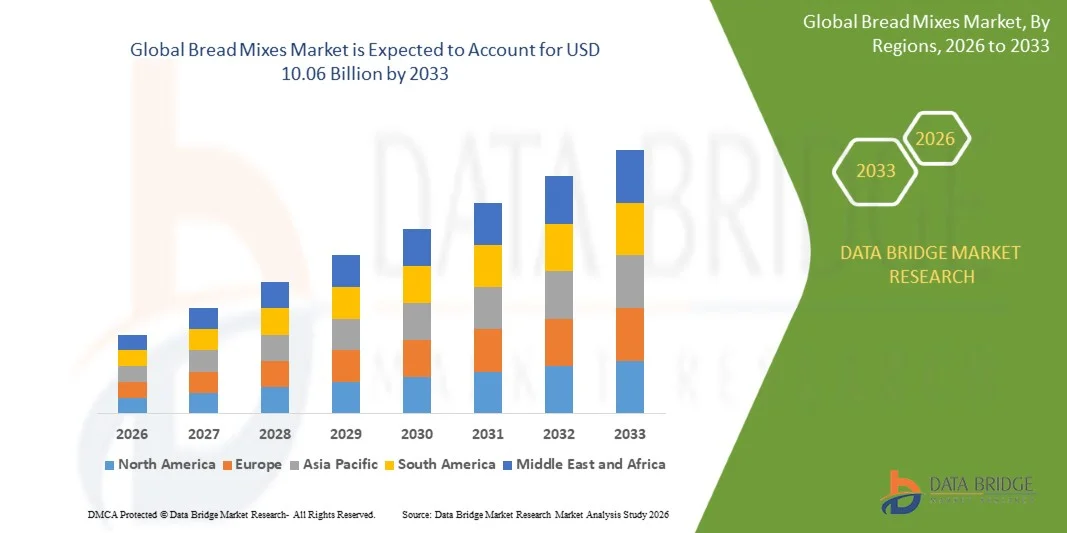
As per Data Bridge Market Research analysis, the bread mixes market was valued at USD 6.38 billion in 2025 and is projected to reach USD 10.06 billion by 2033, growing at a CAGR of 5.87% from 2026 to 2033. The market is experiencing consistent growth driven by rising consumer preference for convenient baking solutions, increasing demand for clean-label and health-oriented bakery products, and expanding adoption of specialized bread mix formulations such as gluten-free, organic, and protein-enriched variants.
The growing focus on healthier eating habits, combined with rising demand for quick meal preparation solutions and home-baking trends, is encouraging food manufacturers, bakeries, and household consumers to adopt advanced bread mix products. Conventional wheat-based mixes continue to dominate due to familiarity and cost efficiency, while gluten-free and organic alternatives are gaining traction as consumers increasingly seek functional, premium, and allergen-friendly bakery options.
Market Size & Forecast
- Global Market Value (2025): USD 6.38 Billion
- Expected Market Value (2033): USD 10.06 Billion
- Forecast CAGR (2026–2033): 5.87%
- Leading Region in 2025: Europe
- Fastest Growing Region: Asia-Pacific
Key Market Trends & Insights
- Europe dominated the bread mixes market with the largest revenue share of 31.20% in 2025, supported by strong bakery consumption patterns, established bakery infrastructure, increasing demand for convenient baking solutions, and growing adoption of specialty bread mixes across the region
- The conventional wheat-based segment led the market with a 61.85% share in 2025, driven by its affordability, widespread consumer familiarity, and extensive use across commercial bakeries and household baking applications
- Asia-Pacific is expected to be the fastest-growing region with a CAGR of 6.14% during the forecast period, fueled by rising urbanization, increasing disposable income, expanding bakery product consumption, and growing demand for convenient food products in emerging economies
- Gluten-free are the fastest-growing product type, projected to register a CAGR of 7.29%, reflecting the surge in prevalence of gluten intolerance, growing awareness of celiac disease, and rising consumer preference for healthier bakery products
- The conventional segment dominated the nature category with a 69.82% revenue share in 2025, led by its lower production cost, broad product availability, and strong acceptance among both industrial bakeries and household consumers
- Food processing industry accounted for 53.98% of the market, preferred by increasing industrial bakery production, demand for standardized formulations, and the need for consistent product quality
- The retail/household use segment is the fastest-growing application category, with a CAGR of 6.32%, driven by growing home-baking trends, increasing demand for convenient meal preparation, and expanding availability of premium baking products
Report Scope and Bread Mixes Market Segmentation
|
Attributes |
Bread Mixes Key Market Insights |
|
Segments Covered |
|
|
Countries Covered |
North America
Europe
Asia-Pacific
Middle East and Africa
South America
|
|
Key Market Players |
|
|
Market Opportunities |
|
|
Value Added Data Infosets |
In addition to the insights on market scenarios such as market value, growth rate, segmentation, geographical coverage, and major players, the market reports curated by the Data Bridge Market Research also include in-depth expert analysis, pricing analysis, brand share analysis, consumer survey, demography analysis, supply chain analysis, value chain analysis, raw material/consumables overview, vendor selection criteria, PESTLE Analysis, Porter Analysis, and regulatory framework. |
Bread Mixes Market Trends
Trend: Rising Demand for Clean-Label, Gluten-Free, and Premium Bread Mixes
Consumers are increasingly shifting toward clean-label, gluten-free, organic, and protein-enriched bread mixes that combine convenience with healthier ingredient profiles and bakery-quality results. Manufacturers are responding by developing specialty formulations, improving mixing technologies, and expanding premium product portfolios to address growing demand for ingredient transparency, nutritional value, and home-baking experiences across both retail and foodservice channels. For instance, in March 2024, King Arthur Baking Company introduced new savory bread mix kits, including focaccia, pretzel bites, flatbread, and garlic bread, targeting consumers seeking premium and convenient baking solutions.
The growing preference for premium, health-focused, and easy-to-use bakery products is accelerating innovation and product diversification in the global bread mixes market.
Bread Mixes Market Dynamics
Key Market Driver: Increasing Demand for Convenient and Health-Oriented Baking Solutions
The growing preference for convenient meal preparation, coupled with rising consumer demand for healthier bakery products, is driving adoption of bread mixes across household, retail, and commercial bakery applications. Manufacturers are investing in gluten-free, organic, clean-label, and protein-enriched formulations while adopting advanced processing technologies to improve consistency, reduce preparation time, and deliver artisanal-quality products that align with evolving consumer preferences. For instance, in May 2024, Puratos launched Sapore Lavida, a fully traceable active sourdough made with 100% whole-wheat flour sourced from regenerative agriculture, helping bakers meet growing consumer demand for healthier and sustainably produced bread.
The rising health awareness and demand for convenient bakery solutions are strengthening the long-term growth outlook for the bread mixes market.
Key Restraint/Challenge: Volatility in Raw Material Prices and Premium Ingredient Costs
A significant challenge for the bread mixes market is the fluctuating prices of wheat, specialty grains, organic ingredients, and gluten-free raw materials, which increase manufacturing costs and pressure profit margins. Premium formulations also require dedicated sourcing, certification, and specialized production facilities, making it difficult for manufacturers to maintain competitive pricing while meeting consumer expectations for quality, transparency, and nutritional value. For instance, in September 2024, the United Nations Food and Agriculture Organization (FAO) reported that international wheat prices increased amid concerns over unfavorable weather conditions in major exporting countries and continued geopolitical uncertainties affecting global grain supplies, highlighting ongoing volatility in cereal markets.
The persistent fluctuations in agricultural commodity prices remain a major challenge for manufacturers seeking stable margins and competitive pricing.
Key Market Opportunity: Expansion of Organic, Gluten-Free, and Retail Household Bread Mixes
The growing consumer preference for organic, gluten-free, and clean-label bakery products presents a significant opportunity for manufacturers to expand premium bread mix portfolios. Rising home-baking participation, increasing retail penetration, and stronger demand for ingredient transparency are encouraging investments in innovative formulations and specialty production capabilities across developed and emerging markets. For instance, in March 2024, Bob's Red Mill launched a new line of Signature Blends Baking Mixes, including brownie, cornbread, yellow cake, and chocolate cake mixes, expanding its premium baking portfolio to meet growing consumer demand for convenient, high-quality home baking solutions. This reflects the broader opportunity for manufacturers to expand value-added baking mix portfolios as demand for specialty and premium mixes continues to grow.
The rapid expansion of specialty bakery categories is creating substantial opportunities for manufacturers to develop differentiated and value-added bread mix offerings.
Bread Mixes Market Scope
The bread mixes market is segmented on the basis of product type, nature, application, and distribution channel.
- By Product Type
On the basis of product type, the global bread mixes market is segmented into conventional wheat-based, whole grain and multigrain, gluten-free, and others. The conventional wheat-based segment dominated the market with an estimated share of 61.85% in 2025, driven by its affordability, widespread consumer familiarity, and extensive use across commercial bakeries and household baking applications. These mixes provide consistent texture, reliable baking performance, and compatibility with a wide range of bread formulations. Their strong retail availability and well-established supply chains further support market leadership. Commercial food manufacturers also prefer conventional wheat-based mixes because they simplify production while ensuring product consistency at scale. High consumer acceptance across developed and emerging markets continues to reinforce the segment's dominance.
The gluten-free segment is projected to register the fastest growth at a CAGR of 7.29% from 2026 to 2033, driven by increasing prevalence of gluten intolerance, growing awareness of celiac disease, and rising consumer preference for healthier bakery products. Manufacturers are continuously introducing innovative formulations using rice flour, ancient grains, and functional ingredients to improve taste and texture. Regulatory support for gluten-free labeling is also encouraging product innovation and consumer confidence. Premium positioning and expanding retail availability are further strengthening adoption. Growing demand for clean-label and allergen-friendly bakery products is expected to accelerate segment growth during the forecast period.
- By Nature
On the basis of nature, the global bread mixes market is segmented into organic and conventional. The conventional segment led the market with an estimated share of 69.82% in 2025, owing to its lower production cost, broad product availability, and strong acceptance among both industrial bakeries and household consumers. Conventional bread mixes remain the preferred choice for large-scale commercial production because they provide consistent quality and economical manufacturing. Their extensive distribution through supermarkets and foodservice channels further strengthens demand. Manufacturers also benefit from well-established sourcing networks and production infrastructure. Continued affordability and familiarity ensure sustained leadership across global markets.
The organic segment is anticipated to witness the fastest growth at a CAGR of 6.98% from 2026 to 2033, supported by increasing consumer preference for clean-label, non-GMO, and sustainably sourced bakery ingredients. Rising awareness regarding food transparency and environmental sustainability is encouraging consumers to shift toward certified organic bakery products. Manufacturers are expanding their organic portfolios with premium formulations using natural ingredients and minimal processing. Improved retail availability and stronger organic certification standards are also driving demand. Premiumization trends across developed markets continue to create favorable growth opportunities for this segment.
- By Application
On the basis of application, the bread mixes market is segmented into food processing industry, foodservice (HoReCa), and retail/household use. The food processing industry segment dominated the market with an estimated share of 53.98% in 2025, driven by increasing industrial bakery production, demand for standardized formulations, and the need for consistent product quality. Bread mixes help manufacturers improve production efficiency while reducing preparation time and ingredient variability. Large-scale bakeries increasingly utilize premixed formulations to enhance operational productivity and reduce labor costs. Rising demand for packaged bakery products further supports segment expansion. Continuous investment in automated bakery production is strengthening long-term market leadership.
The retail/household use segment is projected to register the fastest growth at a CAGR of 6.32% from 2026 to 2033, fueled by growing home-baking trends, increasing demand for convenient meal preparation, and expanding availability of premium baking products. Social media influence and consumer interest in artisanal baking continue to encourage household adoption. Manufacturers are launching user-friendly, ready-to-bake formulations that require minimal preparation while delivering bakery-quality results. Rising e-commerce penetration and broader product accessibility further contribute to market expansion. Health-conscious consumers are also driving demand for specialty and functional bread mixes within the retail segment.
- By Distribution Channel
On the basis of distribution channel, the bread mixes market is segmented into online retailing, supermarkets, and departmental stores. The supermarkets segment dominated the market with an estimated share of 48.2% in 2025, supported by extensive product assortments, high consumer footfall, and widespread availability of conventional and specialty bread mixes. These retail outlets provide consumers with convenient access to multiple brands, promotional pricing, and immediate product availability. Strong relationships between manufacturers and organized retailers also improve product visibility and shelf penetration. Supermarkets continue to serve as the primary purchasing channel for household consumers seeking baking ingredients. Their established retail infrastructure reinforces leadership across developed and emerging markets.
The online retailing segment is expected to witness the fastest growth at an estimated CAGR of 7.8% from 2026 to 2033, driven by expanding e-commerce adoption, increasing digital grocery shopping, and growing consumer preference for doorstep delivery. Online platforms offer a broader selection of specialty, gluten-free, organic, and premium bread mixes than traditional retail outlets. Manufacturers are strengthening direct-to-consumer strategies through digital channels to improve customer engagement and product accessibility. Subscription models, personalized recommendations, and promotional campaigns are further supporting online sales growth. Increasing internet penetration and changing shopping behavior continue to accelerate expansion of this distribution channel.
Bread Mixes Market Regional Analysis
Europe dominated the bread mixes market with the largest revenue share of 31.20% in 2025, supported by strong bakery consumption patterns, established bakery infrastructure, increasing demand for convenient baking solutions, and growing adoption of specialty bread mixes across the region. The region benefits from high consumer acceptance of specialty bread products, including organic, multigrain, and gluten-free formulations. Growing preference for clean-label ingredients and artisanal-style bakery products is encouraging manufacturers to expand product innovation and premium offerings. The presence of leading bakery ingredient suppliers and advanced food processing infrastructure further supports market growth. Rising demand from both retail consumers and foodservice operators continues to strengthen Europe's leadership position in the global bread mixes market.
U.S. Bread Mixes Market Insight
The U.S. bread mixes market is witnessing strong growth due to rising demand for convenient home-baking solutions, increasing consumer preference for clean-label and specialty bakery products, and growing adoption of gluten-free and organic formulations. The country’s mature bakery industry, extensive retail distribution network, and strong culture of at-home baking continue to drive market demand across both household and commercial applications. In addition, increasing consumer focus on health, nutrition, and ingredient transparency is accelerating innovation in premium bread mix products. According to the American Bakers Association, the U.S. baking industry generates more than USD 186 billion annually and supports over 800,000 jobs, highlighting the scale of bakery consumption and production in the country.
Europe Bread Mixes Market Insight
The Europe bread mixes market remains a major contributor to global revenue, driven by strong bread consumption traditions, advanced bakery infrastructure, and increasing demand for premium and artisanal bakery products. The widespread adoption of whole-grain, organic, and specialty bread products is supporting market expansion across the region. Increasing consumer interest in clean-label ingredients and sustainable food production practices continues to enhance demand for innovative bread mix formulations. According to the International Association of Plant Bakers (AIBI), bread remains one of the most frequently consumed staple foods across Europe, with several countries reporting annual per-capita consumption exceeding 50 kg.
U.K. Bread Mixes Market Insight
The U.K. bread mixes market is experiencing steady growth, supported by increasing consumer demand for convenient baking products, growing interest in home baking, and rising adoption of healthier bakery alternatives. Demand for gluten-free, organic, and high-fiber bread mixes continues to increase as consumers seek products aligned with wellness-focused lifestyles. Furthermore, expanding supermarket offerings and online grocery penetration are improving product accessibility throughout the country. According to the Federation of Bakers, the U.K. bakery market records the equivalent of over 13 million loaves and bakery packs sold every day, demonstrating the strong and consistent demand for bakery products across the country
Germany Bread Mixes Market Insight
The Germany bread mixes market is expanding steadily due to the country’s strong baking culture, large bakery industry, and increasing demand for premium and specialty bread products. Consumers are increasingly seeking whole-grain, organic, and functional bakery products, encouraging manufacturers to diversify product portfolios. Continuous innovation in bakery ingredients and growing demand for convenience-oriented baking solutions are further supporting market growth. According to the German Bread Institute (Deutsches Brotinstitut), Germany's Bread Register contains more than 3,200 registered bread specialties, highlighting the country's deep-rooted bread culture and sustained demand for bakery products.
Asia-Pacific Bread Mixes Market Insight
The Asia-Pacific bread mixes market is expected to witness rapid growth, driven by increasing urbanization, rising disposable incomes, and expanding consumption of packaged bakery products across countries such as China, India, and Japan. Growing awareness of convenient meal preparation, increasing penetration of organized retail channels, and rising demand for premium bakery products are supporting regional market expansion. In addition, the growing popularity of Western-style baked goods and home-baking trends is accelerating adoption of bread mixes throughout the region. According to the Japan Bakery Marketing Center, Japan’s bread market exceeds 1.2 trillion yen annually, reflecting the growing consumption of bakery products and the expanding demand for baking ingredients and bread mix solutions across the Asia-Pacific region.
Japan Bread Mixes Market Insight
The Japan bread mixes market is witnessing consistent growth due to increasing demand for convenient food products, changing dietary habits, and growing interest in premium bakery offerings. Consumers are increasingly adopting home-baking products while seeking healthier formulations containing whole grains and functional ingredients. Moreover, innovation in bakery products and rising demand for convenience-oriented food solutions are further contributing to market growth. Japan’s Ministry of Agriculture, Forestry and Fisheries reports that bread has become one of the country’s most commonly consumed staple foods alongside rice, supporting continued expansion of bakery-related product categories.
China Bread Mixes Market Insight
The China bread mixes market is growing rapidly, driven by increasing urbanization, expanding middle-class population, and rising demand for convenient and Western-style bakery products. Growing consumer awareness of nutrition, increasing availability of premium bakery ingredients, and rapid development of organized retail channels are significantly boosting market demand. In addition, rising investments in food processing and bakery manufacturing are positioning China as one of the fastest-growing bakery markets globally. According to the International Trade Administration, China’s baked goods market exceeded USD 50 billion in value and continues to expand as consumers increasingly adopt packaged and premium bakery products.
Bread Mixes Market Share
The bread mixes industry is primarily led by well-established companies, including:
- General Mills, Inc. (U.S.)
- ADM (U.S.)
- Cargill, Incorporated (U.S.)
- Puratos (Belgium)
- Associated British Foods plc (U.K.)
- AB Mauri (UK) Limited (U.K.)
- Lesaffre International. (France)
- Bakels Worldwide (Switzerland)
- Corbion NV (Netherlands)
- King Arthur Baking Company, Inc. (U.S.)
- Bob's Red Mill Natural Foods (U.S.)
- The Krusteaz Company (U.S.)
- Zeelandia Group (Netherlands)
- Angel Yeast Co., Ltd. (China)
- Fazer Group (Finland)
- LAUCKE FLOUR MILLS (Australia)
- International Flavors & Fragrances Inc. (U.S.)
- Grupo Bimbo (Mexico)
- Swiss Bake Ingredients Pvt. Ltd. (India)
Latest Developments in Bread Mixes Market
- In March 2025, King Arthur Baking Company launched its new Buttermilk Biscuit Flour Blend, a specialty baking blend formulated with real buttermilk, soft wheat flour, baking powder, and salt. The launch expanded the company's premium baking portfolio alongside its Bread Mix Kits, making scratch-quality biscuits easier and more convenient for home bakers
- In May 2024, bakery ingredient manufacturers including Puratos and Dawn Foods unveiled new bakery ingredient solutions featuring aromatic sourdough starters, high-protein flour blends, and specialty inclusions designed to help commercial bakers develop premium bread and bread-mix applications that align with clean-label and health-focused consumer trends
- In March 2024, King Arthur Baking Company introduced its new Savory Bread Mix Kits featuring Pull-Apart Garlic Bread, Soft & Chewy Pretzel Bites, Crisp & Airy Focaccia, and Perfectly Tender Flatbread. The premium bread mixes were designed to simplify yeast baking while enabling consumers to prepare fresh bread in about one hour
- In September 2023, Puratos India launched its Easy Curry Masala Bread Mix, a bakery premix developed using a blend of Indian spices. The new product enables bakers to prepare bread loaves, burger buns, paninis, pizza bases, crusty bread, and hot dog buns while addressing growing consumer demand for localized savory bakery products
- In January 2023, AB Mauri introduced its Pure ProGrains range of healthy bread mixes, featuring four formulations designed to deliver fiber, protein, and digestive health benefits. The mixes were developed for craft and medium-sized bakeries, requiring only flour, yeast, and water to produce multiple bread varieties

- Interactive Data Analysis Dashboard
- Company Analysis Dashboard for high growth potential opportunities
- Research Analyst Access for customization & queries
- Competitor Analysis with Interactive dashboard
- Latest News, Updates & Trend analysis
- Harness the Power of Benchmark Analysis for Comprehensive Competitor Tracking
Global Bread Mixes Market, Supply Chain Analysis and Ecosystem Framework
To support market growth and help clients navigate the impact of geopolitical shifts, DBMR has integrated in-depth supply chain analysis into its Global Bread Mixes Market research reports. This addition empowers clients to respond effectively to global changes affecting their industries. The supply chain analysis section includes detailed insights such as Global Bread Mixes Market consumption and production by country, price trend analysis, the impact of tariffs and geopolitical developments, and import and export trends by country and HSN code. It also highlights major suppliers with data on production capacity and company profiles, as well as key importers and exporters. In addition to research, DBMR offers specialized supply chain consulting services backed by over a decade of experience, providing solutions like supplier discovery, supplier risk assessment, price trend analysis, impact evaluation of inflation and trade route changes, and comprehensive market trend analysis.
Data collection and base year analysis are done using data collection modules with large sample sizes. The stage includes obtaining market information or related data through various sources and strategies. It includes examining and planning all the data acquired from the past in advance. It likewise envelops the examination of information inconsistencies seen across different information sources. The market data is analysed and estimated using market statistical and coherent models. Also, market share analysis and key trend analysis are the major success factors in the market report. To know more, please request an analyst call or drop down your inquiry.
The key research methodology used by DBMR research team is data triangulation which involves data mining, analysis of the impact of data variables on the market and primary (industry expert) validation. Data models include Vendor Positioning Grid, Market Time Line Analysis, Market Overview and Guide, Company Positioning Grid, Patent Analysis, Pricing Analysis, Company Market Share Analysis, Standards of Measurement, Global versus Regional and Vendor Share Analysis. To know more about the research methodology, drop in an inquiry to speak to our industry experts.
Data Bridge Market Research is a leader in advanced formative research. We take pride in servicing our existing and new customers with data and analysis that match and suits their goal. The report can be customized to include price trend analysis of target brands understanding the market for additional countries (ask for the list of countries), clinical trial results data, literature review, refurbished market and product base analysis. Market analysis of target competitors can be analyzed from technology-based analysis to market portfolio strategies. We can add as many competitors that you require data about in the format and data style you are looking for. Our team of analysts can also provide you data in crude raw excel files pivot tables (Fact book) or can assist you in creating presentations from the data sets available in the report.