


What is the Bread Premixes Market Size and Growth Rate?
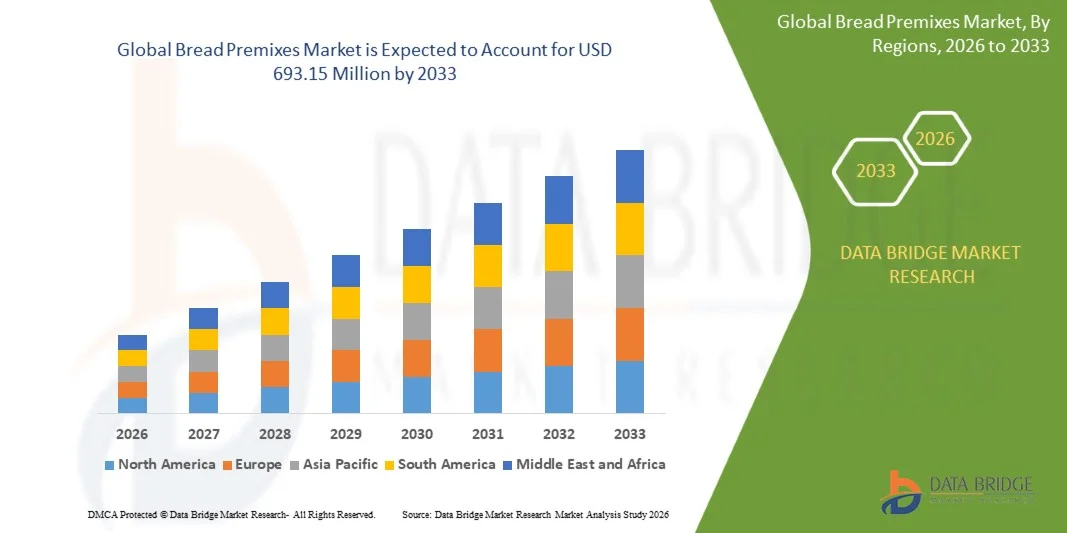
- As per Data Bridge Market Research analysis, the bread premixes market was valued at USD 415.67 million in 2025 and is projected to reach USD 693.15 million by 2033, growing at a CAGR of 6.50% from 2026 to 2033.
- The market is expanding steadily on the back of rising demand for convenient, consistent, and labour-efficient baking solutions across industrial, artisanal, and home baking channels, alongside growing consumer interest in gluten-free, organic, and clean-label bread formats.
- Bread premixes are pre-blended combinations of flour, leavening agents, functional additives, and other key ingredients formulated to simplify and standardize bread production, requiring bakers to add only water and, in most cases, yeast to produce a finished dough. Their commercial relevance continues to grow as commercial bakeries face persistent labour shortages and consistency pressures, and as ingredient suppliers extend premix technology into fast-growing categories such as gluten-free, sourdough, and ancient-grain breads that would otherwise require specialized in-house formulation expertise.
Market Size & Forecast
- Global Market Value (2025): USD 415.67 Million
- Expected Market Value (2033): USD 693.15 Million
- Forecast CAGR (2026–2033): 6.50%
- Leading Region in 2025: Europe
- Fastest Growing Region: Asia-Pacific
What are the Major Takeaways of the Bread Premixes Market?
- Europe dominated the global bread premixes market with the largest revenue share of 36.28% in 2025, supported by a deeply established artisanal and industrial bakery culture, high per-capita bread consumption, and the concentration of leading global premix and bakery ingredient suppliers headquartered in the region.
- Asia-Pacific is expected to be the fastest-growing region at a CAGR of 9.4% from 2026 to 2033, driven by rapidly expanding organized bakery chains, rising Western-style bread consumption, and growing regional investment by multinational suppliers seeking to localize premix production and flavour development.
- The complete mix segment led the type category with a 63.72% share in 2025, owing to its convenience advantage for bakeries seeking to minimize formulation complexity, labour input, and batch-to-batch variability compared with dough concentrates that require additional base ingredients.
- Gluten-free bread premix is the fastest-growing product type, projected to register a CAGR of 9.8%, reflecting rising consumer demand for gluten-free bakery options and continued supplier investment in improving the taste and texture performance of gluten-free formulations.
- The powder form segment dominated the form category with a 78.46% revenue share in 2025, favoured for its extended shelf stability, ease of storage and transport, and straightforward dosing in both industrial and small-scale bakery settings.
- Conventional premixes accounted for 82.35% of the market in 2025, but the organic segment is the fastest-growing nature category at a CAGR of 10.6%, as clean-label and organic positioning extends from finished bread products back into the premix ingredients bakers use to make them.
- The commercial & industrial bakeries segment led the market by end user with a 54.17% revenue share in 2025, reflecting the concentration of premix purchasing volume among large-scale bakery operations seeking consistency and efficiency at scale.
Report Scope and Bread Premixes Market Segmentation
|
Attributes |
Bread Premixes Key Market Insights |
|
Segments Covered |
|
|
Countries Covered |
North America
Europe
Asia-Pacific
Middle East and Africa
South America
|
|
Key Market Players |
|
|
Market Opportunities |
|
|
Value Added Data Infosets |
In addition to the insights on market scenarios such as market value, growth rate, segmentation, geographical coverage, and major players, the market reports curated by the Data Bridge Market Research also include in-depth expert analysis, pricing analysis, brand share analysis, consumer survey, demography analysis, supply chain analysis, value chain analysis, raw material/consumables overview, vendor selection criteria, PESTLE Analysis, Porter Analysis, and regulatory framework. |
What is the Key Trend in the Bread Premixes Market?
- Ingredient suppliers are increasingly using major industry trade events to launch clean-label and functional premix platforms aimed squarely at both industrial and artisan bakery customers, reflecting how central premix innovation has become to overall bakery product differentiation.
- This trend is reshaping premix development away from single-purpose formulations toward platforms that combine multiple functional benefits, such as freshness extension and nutritional enhancement, within a single product.
- For instance, in September 2025, Puratos introduced new clean-label and functional bakery premix solutions at IBIE 2025, including ancient-grain blends and freshness-extending formulations designed to support sugar reduction and improved nutritional profiles for both industrial and artisan bakers.
- Suppliers are also extending premix accessibility beyond commercial bakeries into the small business and home baking segment, responding to sustained growth in home and micro-bakery baking activity.
- For instance, in May 2025, Puratos introduced a gluten-free bread premix in Europe formulated with natural, gluten-free ingredients and aimed specifically at small bakeries and home businesses, reporting increased adoption among specialty bakery outlets following the launch.
- As suppliers continue to combine clean-label, functional, and allergen-friendly innovation within single premix platforms and extend these technologies to smaller-scale bakers, product innovation is expected to remain the primary axis of competition in the bread premixes market through the forecast period.
What are the Key Drivers of the Bread Premixes Market?
- Persistent labour shortages across the commercial baking industry are driving bakeries of all sizes toward premix solutions that reduce dependence on highly skilled, experienced bakers while maintaining consistent product quality across shifts and locations.
- Leading ingredient suppliers continue to reformulate their core bread premix ranges to remove artificial additives, directly responding to retailer and consumer pressure for simpler ingredient declarations on packaged and in-store baked goods.
- For instance, in early 2025, Kerry Group launched a reformulated clean-label premix range, removing artificial preservatives and synthetic emulsifiers from its core bread and cake premix lines sold across European and North American markets.
- Premix manufacturers are simultaneously investing in upstream production capacity to secure reliable supply of the fermentation-active and functional ingredients that underpin premix performance.
- For instance, in August 2025, Lesaffre announced a significant investment in its yeast production facility in Ghent, Belgium, incorporating fully cleanable production lines, intelligent camera-based quality control systems, and automated storage, strengthening the company’s ability to reliably supply the fermentation ingredients central to bread premix and dough performance.
- With bakery labour constraints persisting, clean-label reformulation continuing across major supplier portfolios, and manufacturers investing in upstream ingredient supply reliability, demand for bread premixes is expected to grow steadily across both industrial and artisanal bakery channels through the forecast period.
Which Factors are Challenging the Growth of the Bread Premixes Market?
- Bread premixes carry a higher per-kilogram cost than sourcing and blending individual ingredients directly, limiting adoption among smaller, cost-sensitive bakeries and in price-sensitive emerging markets.
- Replicating the taste, texture, volume, and crumb structure of traditionally made bread remains technically challenging, particularly for gluten-free, clean-label, and allergen-free formulations that reduce reliance on conventional stabilizers and emulsifiers.
- Volatile prices for wheat flour and other key raw materials create additional cost pressure across the premix supply chain, requiring manufacturers to manage formulation costs without compromising product quality and functionality.
- For instance, in March 2025, the Food and Agriculture Organization (FAO) reported that international wheat prices had increased in February 2025 due to tighter supplies and concerns over crop production in key exporting countries.
- Rising consumer preference for artisanal, scratch-made bread in premium bakery segments can discourage premix adoption, as some consumers associate premix-based products with less authentic or handcrafted production methods.
How is the Bread Premixes Market Segmented?
The bread premixes market is segmented on the basis of type, product type, form, nature, application, end user and distribution channel.
- By Type
On the basis of type, the global bread premixes market is segmented into complete mix and dough concentrates/base mix. The complete mix segment dominated the market with a 63.72% share in 2025, owing to its convenience advantage for bakeries seeking to minimize formulation complexity, labour input, and batch-to-batch variability, typically requiring only the addition of water and yeast to produce finished dough.
The dough concentrates/base mix segment is projected to grow at a CAGR of 6.1% from 2026 to 2033, supported by larger industrial bakeries and artisanal producers who prefer to retain partial formulation control while still benefiting from standardized functional ingredient blends.
- By Product Type
On the basis of product type, the global bread premixes market is segmented into white bread premix, whole wheat/multigrain premix, gluten-free premix, organic premix, and sourdough premix. The white bread premix segment dominated the market with a share of 41.85% in 2025, reflecting its status as the highest-volume bread category globally across both retail and foodservice channels.
The gluten-free premix segment is expected to witness the fastest CAGR of 9.8% from 2026 to 2033, driven by rising consumer demand for gluten-free bakery options and continued supplier investment in improving the taste, texture, and shelf-life performance of gluten-free bread formulations.
- By Form
On the basis of form, the global bread premixes market is segmented into powder and liquid/paste. The powder segment dominated the market with a share of 78.46% in 2025, favoured for its extended shelf stability, ease of storage and transport, and straightforward, accurate dosing across both industrial production lines and small-scale bakery settings.
The liquid/paste segment is expected to witness the fastest CAGR of 7.6% from 2026 to 2033, driven by rising use of liquid functional concentrates in high-speed industrial bread production lines, where liquid dosing systems improve mixing efficiency and reduce dust-related handling concerns.
- By Nature
On the basis of nature, the global bread premixes market is segmented into conventional and organic. The conventional segment dominated the market with a share of 82.35% in 2025, reflecting the broad cost and supply-chain advantages of conventional raw materials across mainstream commercial and industrial bread production.
The organic segment is expected to witness the fastest CAGR of 10.6% from 2026 to 2033, driven by the extension of clean-label and organic-certified positioning from finished bread products back into the premix ingredients bakers use, as premium and artisanal bakery brands increasingly seek full-recipe organic certification.
- By Application
On the basis of application, the global bread premixes market is segmented into loaf bread, buns & rolls, flatbreads, artisanal & specialty bread, and pizza dough. The loaf bread segment dominated the market with a share of 38.64% in 2025, reflecting its position as the highest-volume bread format consumed globally across retail, foodservice, and institutional channels.
The artisanal & specialty bread segment is expected to witness the fastest CAGR of 8.9% from 2026 to 2033, driven by premiumisation trends in bakery retail and rising consumer willingness to pay for distinctive, ancient-grain, sourdough, and regionally inspired bread varieties enabled by specialized premix formulations.
- By End User
On the basis of end user, the global bread premixes market is segmented into commercial & industrial bakeries, artisanal & craft bakeries, retail/in-store bakeries, and household/home baking. The commercial & industrial bakeries segment dominated the market with a share of 54.17% in 2025, reflecting the concentration of premix purchasing volume among large-scale bakery operations seeking production consistency and labour efficiency at scale.
The household/home baking segment is expected to witness the fastest CAGR of 8.7% from 2026 to 2033, driven by sustained growth in home baking activity and expanding retail and online availability of consumer-packaged bread premix products formulated for ease of use in domestic kitchens.
- By Distribution Channel
On the basis of distribution channel, the global bread premixes market is segmented into direct/B2B sales, supermarkets & hypermarkets, specialty & baking stores, and online retail. The direct/B2B sales segment dominated the market with a share of 68.92% in 2025, owing to the concentration of premix purchasing among commercial and industrial bakery customers who source directly from manufacturers under long-term technical supply agreements.
The online retail segment is expected to witness the fastest CAGR of 9.1% from 2026 to 2033, driven by rising home baking activity and growing consumer comfort purchasing specialty and small-batch bread premix products through e-commerce channels.
Which Region Holds the Largest Share of the Bread Premixes Market?
- Europe dominated the bread premixes market and accounted for the largest revenue share of 36.28% in 2025, supported by a deeply established artisanal and industrial bakery culture, high per-capita bread consumption across the region, and the concentration of leading global premix and bakery ingredient suppliers headquartered in Belgium, France, Germany, and Switzerland.
- The region also benefits from mature retail and foodservice bakery channels that continuously demand new flavour, nutrition, and clean-label innovation, supported by dedicated trade events that serve as primary launch platforms for new premix technologies. Sustained premiumisation of European bakery retail and steady innovation in gluten-free and organic premix formats are expected to reinforce Europe’s leadership through the forecast period.
Germany Bread Premixes Market Insight
The Germany bread premixes market holds a leading position within Europe, underpinned by the country’s large artisanal and craft bakery sector alongside a substantial industrial baking base. German consumers maintain strong demand for traditional multigrain and rye bread formats increasingly supported by premium and clean-label premix solutions. The presence of major European bakery ingredient suppliers in the region continues to support a steady pipeline of new premix formats tailored to both artisanal and industrial bakery customers.
France Bread Premixes Market Insight
The France bread premixes market is growing steadily, supported by the country’s deep-rooted artisanal bread culture and the presence of major global bakery ingredient and yeast producers headquartered domestically. French bakeries continue to balance traditional scratch-baking practices with selective use of functional premixes for consistency and efficiency, while continued upstream investment by domestic ingredient suppliers is reinforcing reliable premix and yeast supply for the broader European market.
Asia-Pacific Bread Premixes Market Insight
The Asia-Pacific bread premixes market is expected to witness the fastest growth globally, driven by rapidly expanding organized bakery chains, rising Western-style bread consumption, and growing disposable income across China, India, and Southeast Asia. Local and multinational bakery chains are increasingly using premixes to standardize product quality across expanding store networks, while ingredient suppliers continue to expand regional manufacturing and technical support capacity to serve rising demand.
China Bread Premixes Market Insight
China’s bread premixes market is expanding as bakeries seek consistent quality, shorter preparation times, and labor efficiency. Demand is supported by urbanization, growing bakery consumption, café culture, and rising interest in convenient baking solutions. Domestic manufacturers compete with international suppliers through localized formulations, competitive pricing, and product innovation. Growth opportunities are emerging in whole-grain, high-protein, clean-label, and functional premixes. However, price sensitivity, changing consumer preferences, and intense competition remain key market challenges.
India Bread Premixes Market Insight
The India bread premixes market is expanding rapidly, supported by the growth of organized bakery chains, rising urban demand for packaged and premium bread products, and increasing consumer exposure to global bakery trends. Ingredient suppliers have expanded regional technical support and localized flavour development to accelerate adoption of new premix technologies among domestic bakery manufacturers, supporting continued category growth across both industrial and artisanal bakery segments.
Which are the Top Companies in Bread Premixes Market?
The bread premixes industry is primarily led by well-established companies, including:
- Puratos Group NV (Belgium)
- Lesaffre et Compagnie (France)
- Associated British Foods plc (AB Mauri) (U.K.)
- Bakels Group (Bakels Worldwide) (Switzerland)
- Cargill, Incorporated (U.S.)
- Archer Daniels Midland Company (U.S.)
- General Mills, Inc. (U.S.)
- Kerry Group plc (Ireland)
- Dawn Food Products, Inc. (U.S.)
- Corbion N.V. (Netherlands)
- DSM-Firmenich AG (Netherlands/Switzerland)
- Oy Karl Fazer Ab (Finland)
- Nisshin Seifun Group Inc. (Japan)
- Zeelandia International BV (Netherlands)
- Ireks GmbH (Germany)
- backaldrin International The Kornspitz Company GmbH (Austria)
- CSM Bakery Solutions (U.S.)
- King Arthur Baking Company, Inc. (U.S.)
- Nestlé S.A. (Switzerland)
- Bunge Limited (U.S.)
- Allied Pinnacle Pty. Ltd. (Australia)
- Manildra Group (Australia)
- Shipton Mill Ltd (U.K.)
- Cotswold Flour Ltd (U.K.)
- BAKO Group (U.K.)
What are Latest Developments in Bread Premixes Market?
- In September 2025, Puratos introduced new clean-label and functional bakery premix solutions at IBIE 2025, including ancient-grain blends and freshness-extending formulations designed to support sugar reduction and improved nutritional profiles, addressing growing demand from both industrial and artisan bakers for healthier, high-performance baked goods.
- In August 2025, Lesaffre announced a significant investment in its yeast production plant in Ghent, Belgium, operated by Algist Bruggeman, incorporating fully cleanable production lines, intelligent camera-based quality control systems, and a fully automated intermediate storage system to strengthen supply reliability for its fermentation-based ingredients used across bread premix and dough applications.
- In early 2025, Kerry Group launched a reformulated clean-label premix range, removing artificial preservatives and synthetic emulsifiers from its core bread and cake premix lines sold across European and North American markets, in response to rising retailer and consumer demand for simplified ingredient declarations.
- In May 2025, Puratos introduced a gluten-free bread premix in Europe, formulated using natural, gluten-free ingredients and aimed specifically at small bakeries and home businesses, with the company reporting increased adoption in specialty bakery outlets since the product’s launch.
- In 2025, General Mills announced the launch of a new line of organic bread premixes aimed at health-conscious consumers, aligning with the broader industry trend toward organic and clean-label positioning and targeting a larger share of the premium segment of the bread premixes market.

- Interactive Data Analysis Dashboard
- Company Analysis Dashboard for high growth potential opportunities
- Research Analyst Access for customization & queries
- Competitor Analysis with Interactive dashboard
- Latest News, Updates & Trend analysis
- Harness the Power of Benchmark Analysis for Comprehensive Competitor Tracking
Global Bread Premixes Market, Supply Chain Analysis and Ecosystem Framework
To support market growth and help clients navigate the impact of geopolitical shifts, DBMR has integrated in-depth supply chain analysis into its Global Bread Premixes Market research reports. This addition empowers clients to respond effectively to global changes affecting their industries. The supply chain analysis section includes detailed insights such as Global Bread Premixes Market consumption and production by country, price trend analysis, the impact of tariffs and geopolitical developments, and import and export trends by country and HSN code. It also highlights major suppliers with data on production capacity and company profiles, as well as key importers and exporters. In addition to research, DBMR offers specialized supply chain consulting services backed by over a decade of experience, providing solutions like supplier discovery, supplier risk assessment, price trend analysis, impact evaluation of inflation and trade route changes, and comprehensive market trend analysis.
Data collection and base year analysis are done using data collection modules with large sample sizes. The stage includes obtaining market information or related data through various sources and strategies. It includes examining and planning all the data acquired from the past in advance. It likewise envelops the examination of information inconsistencies seen across different information sources. The market data is analysed and estimated using market statistical and coherent models. Also, market share analysis and key trend analysis are the major success factors in the market report. To know more, please request an analyst call or drop down your inquiry.
The key research methodology used by DBMR research team is data triangulation which involves data mining, analysis of the impact of data variables on the market and primary (industry expert) validation. Data models include Vendor Positioning Grid, Market Time Line Analysis, Market Overview and Guide, Company Positioning Grid, Patent Analysis, Pricing Analysis, Company Market Share Analysis, Standards of Measurement, Global versus Regional and Vendor Share Analysis. To know more about the research methodology, drop in an inquiry to speak to our industry experts.
Data Bridge Market Research is a leader in advanced formative research. We take pride in servicing our existing and new customers with data and analysis that match and suits their goal. The report can be customized to include price trend analysis of target brands understanding the market for additional countries (ask for the list of countries), clinical trial results data, literature review, refurbished market and product base analysis. Market analysis of target competitors can be analyzed from technology-based analysis to market portfolio strategies. We can add as many competitors that you require data about in the format and data style you are looking for. Our team of analysts can also provide you data in crude raw excel files pivot tables (Fact book) or can assist you in creating presentations from the data sets available in the report.













