


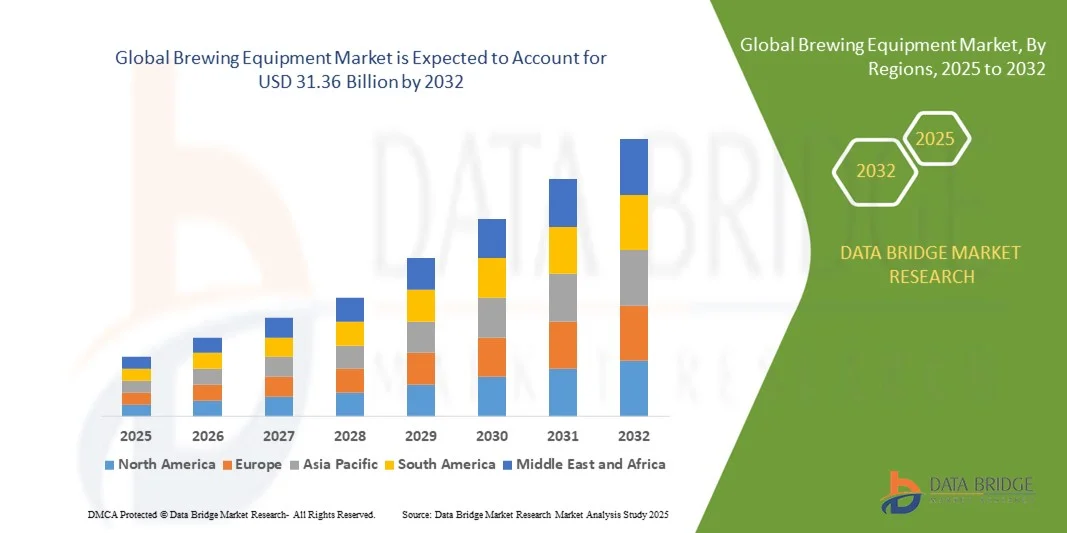
Brewing Equipment Market Size
- The global brewing equipment market size was valued at USD 18.95 billion in 2024 and is expected to reach USD 31.36 billion by 2032, at a CAGR of 6.5% during the forecast period
- The market growth is largely fueled by the increasing adoption of craft and specialty beers, rising establishment of microbreweries and brewpubs, and technological advancements in brewing equipment, which are enhancing operational efficiency and production quality in both small-scale and large-scale breweries
- Furthermore, growing demand for automated, energy-efficient, and modular brewing solutions is driving breweries to modernize their operations. These converging factors are accelerating the uptake of advanced brewing equipment, thereby significantly boosting the industry’s growth
Brewing Equipment Market Analysis
- Brewing equipment, including brewhouse systems, fermentation tanks, filtration units, and filling machinery, is increasingly essential for breweries to maintain consistent quality, optimize production processes, and meet evolving consumer preferences for craft and specialty beers
- The escalating demand for brewing equipment is primarily fueled by the growth of craft beer culture, increasing investments in brewery modernization, and the rising need for energy-efficient, automated, and scalable production solutions across residential, commercial, and regional breweries
- North America dominated the brewing equipment market in 2024, due to a well-established beer industry, rising demand for craft and specialty beers, and advanced brewery infrastructure
- Asia-Pacific is expected to be the fastest growing region in the brewing equipment market during the forecast period due to rising urbanization, growing disposable incomes, and the expansion of craft beer culture in countries such as China, Japan, and India
- Macrobrewery segment dominated the market with a market share of 82.5% in 2024, due to their large-scale production capabilities, established distribution networks, and substantial investment in advanced brewing equipment. These breweries require high-capacity machinery for efficiency and consistent output, driving demand for automated and integrated brewing solutions. The segment’s dominance is further supported by the global presence of major brands and ongoing expansion into emerging markets
Report Scope and Brewing Equipment Market Segmentation
|
Attributes |
Brewing Equipment Key Market Insights |
|
Segments Covered |
|
|
Countries Covered |
North America
Europe
Asia-Pacific
Middle East and Africa
South America
|
|
Key Market Players |
|
|
Market Opportunities |
|
|
Value Added Data Infosets |
In addition to the insights on market scenarios such as market value, growth rate, segmentation, geographical coverage, and major players, the market reports curated by the Data Bridge Market Research also include in-depth expert analysis, pricing analysis, brand share analysis, consumer survey, demography analysis, supply chain analysis, value chain analysis, raw material/consumables overview, vendor selection criteria, PESTLE Analysis, Porter Analysis, and regulatory framework. |
Brewing Equipment Market Trends
Growth of Automated and Modular Brewing Systems
- The brewing equipment market is undergoing a significant transformation driven by rapid adoption of automated and modular systems that enhance flexibility, efficiency, and precision in beer production. Breweries are increasingly focusing on maintaining consistency, optimizing resource usage, and reducing manual intervention, leading to an accelerated shift toward intelligent brewing technologies
- For instance, Alfa Laval has introduced modular brewing solutions combined with automated process control systems that enable breweries to efficiently manage operations from mashing to fermentation. These systems provide adaptability for small and large breweries alike, reflecting how automation is enhancing production scalability and process transparency across the brewing sector
- Automation in brewing equipment helps streamline critical functions such as temperature control, fermentation management, and batch monitoring, ensuring consistent quality and minimizing human error. The integration of advanced software and IoT-enabled sensors allows brewers to track production in real time, improving energy efficiency and reducing wastage throughout the brewing cycle
- In addition, modular system designs are gaining traction among craft breweries looking to expand production capacity gradually while maintaining product diversity. These reconfigurable systems allow producers to scale operations quickly in response to changing demand without overinvesting in large infrastructure from the outset
- Manufacturers are combining digital technology with hygiene-focused engineering, enabling brewers to execute automated cleaning, maintenance checks, and performance diagnostics. This fusion of technology and modular design creates an adaptable environment supporting both innovation and operational excellence across breweries of varying sizes
- The continued evolution toward automated and modular brewing equipment represents a major advancement in operational efficiency and quality assurance. As brewers pursue consistency, sustainability, and cost optimization, these systems are set to redefine industry standards and pave the way for next-generation brewing facilities worldwide
Brewing Equipment Market Dynamics
Driver
Rising Demand for Craft and Specialty Beers
- The surging popularity of craft and specialty beers is significantly driving the demand for brewing equipment across global markets. Consumers are increasingly seeking authentic, artisanal beverage experiences characterized by distinctive flavors, local ingredients, and tailored brewing methods, prompting both small-scale and established brewers to enhance production capabilities
- For instance, BrewDog PLC has continued to expand its investment in advanced brewing infrastructure to support rapid global growth in its craft beer portfolio. The company’s focus on unique recipes and diversified brewing processes demonstrates how increasing consumer interest in premium, specialty beers is stimulating equipment modernization and capacity expansion
- Rising disposable incomes, urban lifestyles, and a culture of experimentation with new tastes have propelled the global craft beer movement. Breweries are prioritizing the installation of specialized kettles, fermenters, and filtration systems designed to accommodate flexible production volumes and varied recipe profiles aligning with evolving consumer preferences
- In addition, collaborations between equipment manufacturers and breweries are facilitating innovation in compact, energy-efficient systems that cater to microbreweries and pilot plants. These partnerships are enabling smaller producers to maintain artisanal quality while scaling output in response to market demand fluctuations
- The ongoing proliferation of taprooms, brewpubs, and local breweries across major economies ensures sustained demand for technologically advanced brewing equipment. As consumers continue to favor high-quality, distinctive beer products, equipment manufacturers are positioned to benefit from a robust and expanding craft beer ecosystem globally
Restraint/Challenge
High Cost of Advanced Brewing Equipment
- The significant capital investment required for sophisticated brewing systems represents a major challenge for both new entrants and small-scale breweries. Advanced automation, precision sensors, and modular systems often come with high installation, maintenance, and integration expenses that limit accessibility for cost-sensitive producers
- For instance, GEA Group AG and Kaspar Schulz GmbH, two leading equipment manufacturers, offer high-end automated brewing machinery that ensures superior process control but comes with elevated upfront costs. Many microbreweries struggle to justify these expenditures given limited financial resources and uncertain initial production volumes
- The integration of automation technologies and IoT-based monitoring systems further adds to operational expenses due to software licensing, technician training, and regular maintenance. This financial burden can slow expansion and delay returns on investment, especially in highly competitive local markets where profit margins are narrow
- In addition, fluctuations in raw material and energy prices impact overall production budgets, restraining smaller brewers from adopting technologically advanced brewing setups. Custom storage tanks, sophisticated filtration systems, and temperature management units constitute long-term commitments that intensify financial pressure on newer market entrants
- Overcoming this cost challenge will require strategic partnerships between equipment producers, investors, and brewery operators. Leasing solutions, financing options, and modular upgrade paths are expected to support broader adoption of advanced brewing technologies, ensuring market growth while enabling innovation across both large and emerging brewery operations
Brewing Equipment Market Scope
The market is segmented on the basis of type, brewery type, mode of operation, material type, size, and distribution channel.
- By Type
On the basis of type, the brewing equipment market is segmented into brewhouse, cooling, milling, fermentation, filtration, and filling. The brewhouse segment dominated the market with the largest revenue share in 2024, driven by its critical role in the initial stages of beer production and its high capital investment compared to other equipment types. Brewers prioritize brewhouse equipment for its efficiency in mashing, lautering, and boiling processes, ensuring consistent quality and flavor. The segment’s dominance is also supported by technological advancements, including automated temperature and flow controls, which enhance operational efficiency. Compatibility with various brewery sizes and scalability further strengthens its market presence. The growing focus on energy-efficient and sustainable brewing practices is also boosting demand for advanced brewhouse systems.
The fermentation segment is anticipated to witness the fastest growth rate from 2025 to 2032, fueled by the rising preference for craft beers and specialty brews that require precise fermentation control. Fermentation tanks with integrated monitoring systems enable brewers to maintain consistency while experimenting with new flavors. Their adaptability for both small and large-scale breweries, along with innovations such as modular and temperature-controlled units, is accelerating adoption. The increasing awareness of fermentation’s impact on beer quality and the growing adoption of automated monitoring solutions are key factors driving growth in this segment.
- By Brewery Type
On the basis of brewery type, the market is segmented into microbrewery, macrobrewery, brewpubs, and regional breweries. Macrobreweries dominated the market with a share of 82.5% in 2024 due to their large-scale production capabilities, established distribution networks, and substantial investment in advanced brewing equipment. These breweries require high-capacity machinery for efficiency and consistent output, driving demand for automated and integrated brewing solutions. The segment’s dominance is further supported by the global presence of major brands and ongoing expansion into emerging markets.
Microbreweries are expected to witness the fastest growth from 2025 to 2032, driven by the surging popularity of craft beers and homegrown breweries. Small-batch brewing emphasizes quality, experimentation, and unique flavors, necessitating flexible and cost-effective equipment solutions. Innovations in modular and scalable brewing systems make it easier for microbreweries to adopt advanced technology. In addition, rising consumer interest in local and artisanal beers is propelling demand for equipment that supports diverse brewing processes.
- By Mode of Operation
Based on mode of operation, the brewing equipment market is segmented into manual, semi-automatic, and automatic systems. Automatic brewing equipment dominated the market in 2024, owing to its ability to enhance production efficiency, reduce labor costs, and maintain consistent product quality. Automatic systems provide precise control over temperature, flow, and timing, making them suitable for both large-scale and high-quality craft beer production. The segment benefits from technological advancements, including IoT-enabled monitoring, predictive maintenance, and remote operation capabilities. Breweries increasingly prefer automatic systems to optimize resource usage and comply with stringent quality standards.
Semi-automatic equipment is expected to witness the fastest growth during 2025–2032, driven by its balance of automation and operational control. Smaller and medium-sized breweries adopt semi-automatic systems to improve efficiency while retaining hands-on control over key processes. These systems are particularly attractive for brewers aiming to scale production without substantial capital investment in fully automatic machinery. Flexibility, ease of maintenance, and integration with modern brewery software contribute to the rising adoption of semi-automatic equipment.
- By Material Type
On the basis of material type, the market is segmented into copper, brass, aluminum, stainless steel, and mild steel. Stainless steel dominated the market in 2024 due to its durability, corrosion resistance, and suitability for sanitary applications. Breweries prefer stainless steel for fermentation, storage, and filtration equipment to maintain product quality and comply with hygiene standards. Its adaptability for small, mid-size, and large-scale production, combined with long-term cost-effectiveness, reinforces its market dominance.
Aluminum is expected to witness the fastest growth from 2025 to 2032, driven by its lightweight nature, ease of handling, and cost-effectiveness. Aluminum brewing equipment is increasingly adopted in smaller breweries and mobile brewing setups where portability and energy efficiency are critical. The development of anodized and coated aluminum solutions enhances durability and resistance to corrosion, further boosting its appeal. Growing interest in eco-friendly and recyclable materials is also supporting the adoption of aluminum equipment in brewing applications.
- By Size
Based on size, the brewing equipment market is segmented into small-size, mid-size, and large-size equipment. Large-size equipment dominated the market in 2024, primarily due to high-capacity breweries and macrobrewery operations that require extensive production capability. These systems provide economies of scale, consistent output, and integration with automated processes, making them essential for large-scale operations. Large-size equipment is often designed for modular expansion, allowing breweries to increase production without major infrastructure changes. The segment’s dominance is further reinforced by investments from leading breweries in emerging markets to meet growing beer consumption.
Small-size equipment is expected to witness the fastest growth from 2025 to 2032, driven by the expansion of craft breweries, microbreweries, and brewpubs. Small equipment offers flexibility for experimental batches, ease of installation, and lower capital investment. Growing consumer preference for unique and artisanal beers is encouraging startups and local brewers to adopt compact brewing solutions. Portable and modular systems also facilitate production in limited spaces, contributing to their rapid adoption.
- By Distribution Channel
On the basis of distribution channel, the market is segmented into online and offline channels. Offline channels dominated the market in 2024, supported by traditional purchase practices, the availability of technical support, and the ability for breweries to inspect equipment before purchase. Large breweries and established operators often prefer offline channels for complex or customized machinery to ensure proper installation and training. Offline sales also benefit from direct supplier relationships and post-purchase maintenance services, reinforcing their strong market share.
Online channels are expected to witness the fastest growth from 2025 to 2032, driven by digital transformation, ease of product comparison, and access to a broader range of equipment options. Online platforms enable smaller breweries and startups to purchase equipment conveniently, often at competitive prices. Integration of virtual consultations, live demos, and home delivery enhances customer confidence and adoption. The growing penetration of e-commerce and increasing awareness of online industrial marketplaces are major factors accelerating growth through this channel.
Brewing Equipment Market Regional Analysis
- North America dominated the brewing equipment market with the largest revenue share in 2024, driven by a well-established beer industry, rising demand for craft and specialty beers, and advanced brewery infrastructure
- Brewers in the region prioritize high-efficiency, automated equipment to optimize production and maintain consistent quality
- This widespread adoption is further supported by high investment capacity, technologically advanced operations, and increasing interest in energy-efficient brewing systems, establishing advanced brewing equipment as a preferred choice for both large-scale and craft breweries
U.S. Brewing Equipment Market Insight
The U.S. brewing equipment market captured the largest revenue share in 2024 within North America, fueled by the growth of microbreweries, brewpubs, and craft beer consumption. Breweries are increasingly investing in automated brewhouses, fermentation, and filtration systems to improve production efficiency and ensure consistent quality. The rising demand for scalable, modular, and energy-efficient solutions, combined with technological innovations in brewing processes, is further propelling market growth. Moreover, strong distribution networks and government support for craft breweries continue to drive equipment adoption.
Europe Brewing Equipment Market Insight
The Europe brewing equipment market is projected to grow at a substantial CAGR during the forecast period, driven by strong demand for craft and specialty beers, stringent quality regulations, and modernization of brewing facilities. Countries such as Germany, Belgium, and the Netherlands are witnessing increasing investments in automated brewing systems and energy-efficient equipment. European brewers value precision, durability, and advanced technology integration, while the growing trend of brewpubs and microbreweries is boosting demand for small to mid-size brewing equipment. Sustainability initiatives and eco-friendly practices are further encouraging adoption.
U.K. Brewing Equipment Market Insight
The U.K. brewing equipment market is expected to grow at a notable CAGR during the forecast period, driven by the rising popularity of craft beers, microbreweries, and brewpub establishments. Brewers are increasingly focusing on modernization, automation, and energy efficiency in equipment selection. The demand for versatile systems capable of producing small batches with consistent quality is fueling growth. In addition, the U.K.’s strong distribution channels and government support for small and medium breweries are accelerating the adoption of technologically advanced brewing equipment.
Germany Brewing Equipment Market Insight
The Germany brewing equipment market is projected to expand at a significant CAGR during the forecast period, fueled by the country’s rich brewing heritage, high-quality standards, and strong emphasis on technological innovation. German breweries are increasingly adopting automated brewhouse, fermentation, and filtration systems to improve production efficiency and maintain product consistency. The focus on sustainable practices, energy efficiency, and compliance with stringent regulations is further driving the adoption of modern brewing equipment. Integration with smart monitoring and control systems is becoming increasingly common.
Asia-Pacific Brewing Equipment Market Insight
The Asia-Pacific brewing equipment market is poised to grow at the fastest CAGR from 2025 to 2032, driven by rising urbanization, growing disposable incomes, and the expansion of craft beer culture in countries such as China, Japan, and India. The region is witnessing increased investments in microbreweries, regional breweries, and brewpubs, creating strong demand for small- and mid-size brewing equipment. Government initiatives promoting entrepreneurship, modernization of breweries, and development of brewing clusters are accelerating adoption. Furthermore, APAC’s emergence as a manufacturing hub for brewing equipment is making advanced solutions more accessible and affordable.
Japan Brewing Equipment Market Insight
The Japan brewing equipment market is gaining momentum due to the country’s technologically advanced brewing sector, increasing craft beer consumption, and growing interest in premium beverages. Japanese breweries prioritize compact, efficient, and automated systems that support small-batch production while maintaining consistency. The integration of brewing equipment with monitoring technologies and IoT-enabled control systems is further driving growth. In addition, Japan’s aging population is encouraging the adoption of user-friendly, energy-efficient, and safe brewing solutions for both commercial and small-scale breweries.
China Brewing Equipment Market Insight
The China brewing equipment market accounted for the largest revenue share in Asia-Pacific in 2024, supported by rapid urbanization, rising middle-class demand, and the expanding craft and regional brewery segment. Breweries are increasingly investing in automated and modular brewing systems to ensure consistent quality and high efficiency. The push towards smart breweries, development of local equipment manufacturing hubs, and availability of cost-effective brewing solutions are key factors driving market growth. Moreover, government support for modernizing beverage production facilities is accelerating adoption across the country.
Brewing Equipment Market Share
The brewing equipment industry is primarily led by well-established companies, including:
- GEA Group Aktiengesellschaft (Germany)
- KASPAR SCHULZ BRAUEREIMASCHINENFABRIK & APPARATEBAUANSTALT GMBH (Germany)
- LFA LAVAL (Sweden)
- Krones AG (Germany)
- Paul Mueller Company (U.S.)
- Praj Industries (India)
- MEURA (France)
- Della Toffola SpA (Italy)
- Criveller Group (Italy)
- XiMo, AG (Switzerland)
- Hypro (U.S.)
- Ss Brewtech (U.S.)
- ICC Northwest, Inc. (U.S.)
- GW Kent (U.K.)
- FLECKS Brauhaus Technik GmbH (Germany)
- KEG KING (Australia)
- DEUTSCHE BEVERAGE TECHNOLOGY (Germany)
- Prospero Equipment Corporation (U.S.)
- BREWBILT MANUFACTURING INC (U.S.)
- Meto Beer Equipment (Germany)
Latest Developments in Global Brewing Equipment Market
- In July 2025, Krones AG completed the USD 35 million acquisition of W.M. Sprinkman Corporation, expanding its process-technology coverage across North America. This acquisition strengthens Krones’ position in the region by providing breweries with enhanced turnkey solutions for production efficiency, automation, and high-quality output. It also enables the company to serve both large-scale and craft breweries more effectively, supporting the growing demand for modern, integrated brewing equipment in North America
- In June 2025, Diversified Metal Engineering LP acquired Accent Stainless Steel Manufacturing Group to secure turnkey capability for craft breweries. This strategic move enhances Diversified Metal’s ability to offer end-to-end brewing solutions, including fermentation, storage, and process systems. The acquisition is expected to boost adoption among small and mid-sized breweries seeking comprehensive, customizable, and efficient equipment solutions
- In September 2024, Brew Bomb Cold Brew Equipment partnered with TORR Industries Inc., following TORR’s acquisition of a controlling interest in Gunga LLC, Brew Bomb’s parent company. The collaboration combines Brew Bomb’s expertise in cold brew coffee with TORR’s advanced manufacturing and engineering capabilities. This partnership is set to foster innovation, accelerate the development of new cold coffee brewing solutions, and expand market reach in North America and beyond
- In November 2023, Ziemann Holvrieka acquired a majority stake in Künzel Maschinenbau, a German manufacturer specializing in malt management and grist mills. The acquisition enhances Ziemann’s ability to provide comprehensive brewery solutions, particularly in the brewing process’s early stages, and aligns with its strategy to broaden product offerings. This move is expected to strengthen its position in Europe’s brewing equipment market and support breweries in improving efficiency and product quality
- In March 2023, GEA Group expanded its brewing equipment portfolio by launching an advanced, modular fermentation system designed for small and mid-sized breweries. This development allows brewers to scale production efficiently, maintain consistent quality, and integrate automation and monitoring capabilities. The modular approach is expected to accelerate adoption in emerging craft beer markets and support breweries in optimizing operational efficiency

- Interactive Data Analysis Dashboard
- Company Analysis Dashboard for high growth potential opportunities
- Research Analyst Access for customization & queries
- Competitor Analysis with Interactive dashboard
- Latest News, Updates & Trend analysis
- Harness the Power of Benchmark Analysis for Comprehensive Competitor Tracking
Global Brewing Equipment Market, Supply Chain Analysis and Ecosystem Framework
To support market growth and help clients navigate the impact of geopolitical shifts, DBMR has integrated in-depth supply chain analysis into its Global Brewing Equipment Market research reports. This addition empowers clients to respond effectively to global changes affecting their industries. The supply chain analysis section includes detailed insights such as Global Brewing Equipment Market consumption and production by country, price trend analysis, the impact of tariffs and geopolitical developments, and import and export trends by country and HSN code. It also highlights major suppliers with data on production capacity and company profiles, as well as key importers and exporters. In addition to research, DBMR offers specialized supply chain consulting services backed by over a decade of experience, providing solutions like supplier discovery, supplier risk assessment, price trend analysis, impact evaluation of inflation and trade route changes, and comprehensive market trend analysis.
Data collection and base year analysis are done using data collection modules with large sample sizes. The stage includes obtaining market information or related data through various sources and strategies. It includes examining and planning all the data acquired from the past in advance. It likewise envelops the examination of information inconsistencies seen across different information sources. The market data is analysed and estimated using market statistical and coherent models. Also, market share analysis and key trend analysis are the major success factors in the market report. To know more, please request an analyst call or drop down your inquiry.
The key research methodology used by DBMR research team is data triangulation which involves data mining, analysis of the impact of data variables on the market and primary (industry expert) validation. Data models include Vendor Positioning Grid, Market Time Line Analysis, Market Overview and Guide, Company Positioning Grid, Patent Analysis, Pricing Analysis, Company Market Share Analysis, Standards of Measurement, Global versus Regional and Vendor Share Analysis. To know more about the research methodology, drop in an inquiry to speak to our industry experts.
Data Bridge Market Research is a leader in advanced formative research. We take pride in servicing our existing and new customers with data and analysis that match and suits their goal. The report can be customized to include price trend analysis of target brands understanding the market for additional countries (ask for the list of countries), clinical trial results data, literature review, refurbished market and product base analysis. Market analysis of target competitors can be analyzed from technology-based analysis to market portfolio strategies. We can add as many competitors that you require data about in the format and data style you are looking for. Our team of analysts can also provide you data in crude raw excel files pivot tables (Fact book) or can assist you in creating presentations from the data sets available in the report.













