


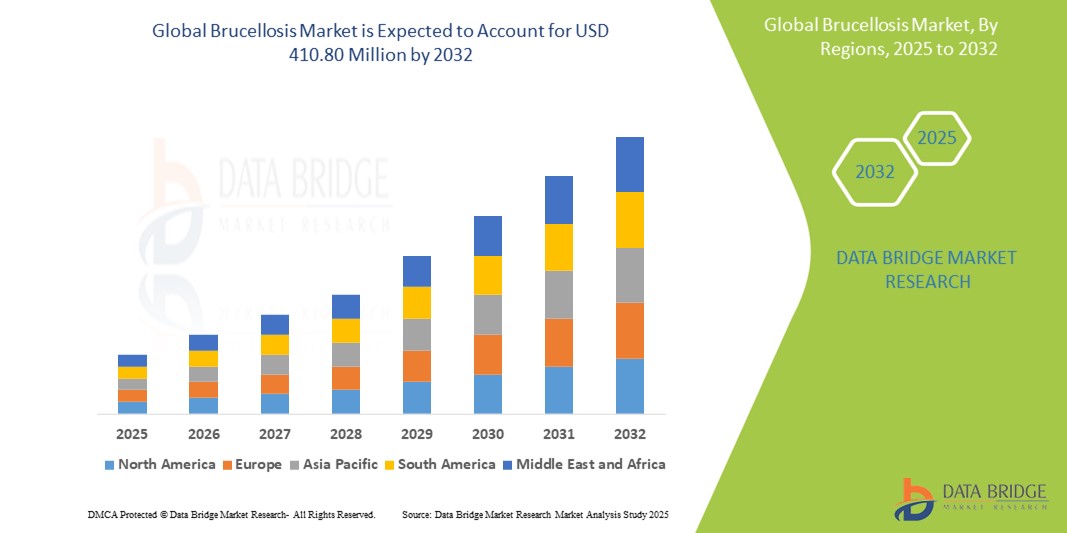
Brucellosis Market Size
- The global brucellosis market size was valued at USD 288.86 million in 2024 and is expected to reach USD 410.80 million by 2032, at a CAGR of 4.50% during the forecast period
- The market growth is largely fuelled by the increasing global incidence of brucellosis in both animals and humans, coupled with significant technological progress in diagnostic tools and vaccine development, leading to enhanced disease management and prevention efforts
- Furthermore, rising awareness among livestock owners, veterinarians, and public health authorities for effective, user-friendly, and integrated solutions for disease surveillance and control is establishing advanced diagnostics and vaccines as the modern standard for brucellosis management. These converging factors are accelerating the uptake of Brucellosis solutions, thereby significantly boosting the industry's growth
Brucellosis Market Analysis
- The brucellosis market, encompassing diagnostics, vaccines, and treatment solutions for both animal and human health, is increasingly recognized as a vital component of global public health and food safety systems. Its growth is driven by the zoonotic nature of the disease, its significant economic impact on livestock, and the growing emphasis on integrated disease control programs
- The escalating demand for effective brucellosis solutions is primarily fuelled by the widespread incidence of the disease in livestock populations, rising awareness among stakeholders about its impact on animal productivity and human health, and a growing preference for robust biosecurity measures. These converging factors are accelerating the uptake of brucellosis solutions, thereby significantly boosting the industry's growth
- North America dominated the brucellosis market with the largest revenue share of 35.4% in 2024. This is characterized by advanced animal health infrastructure, stringent regulatory frameworks for disease control, and a strong presence of key animal health companies
- Asia-Pacific is expected to be the fastest growing region in the brucellosis market during the forecast period, due to the vast livestock populations, increasing burden of the disease in many countries, and rising governmental investments in animal disease surveillance and control programs
- Medication segment dominated the brucellosis market, with a market share of 85.6% in 2024. This is driven by the established necessity of specific antibiotic regimens as the cornerstone of both human and animal brucellosis treatment, directly addressing the causative bacterial infection
Report Scope and Brucellosis Market Segmentation
|
Attributes |
Brucellosis Key Market Insights |
|
Segments Covered |
|
|
Countries Covered |
North America
Europe
Asia-Pacific
Middle East and Africa
South America
|
|
Key Market Players |
|
|
Market Opportunities |
|
|
Value Added Data Infosets |
In addition to the insights on market scenarios such as market value, growth rate, segmentation, geographical coverage, and major players, the market reports curated by the Data Bridge Market Research also include in-depth expert analysis, pricing analysis, brand share analysis, consumer survey, demography analysis, supply chain analysis, value chain analysis, raw material/consumables overview, vendor selection criteria, PESTLE Analysis, Porter Analysis, and regulatory framework. |
Brucellosis Market Trends
“Enhanced Disease Surveillance Through Advanced Technology”
- A significant and accelerating trend in the global brucellosis market is the deepening integration of advanced diagnostic platforms and digital data management systems. This fusion of technologies is significantly enhancing the efficiency and precision of disease surveillance and control efforts
- For instance, portable molecular diagnostic kits for Brucellosis seamlessly provide rapid, on-site detection, allowing for quicker identification of infected animals. Similarly, remote sensing and GPS tracking can be utilized in large livestock populations, offering a discreet solution for monitoring herd health and potential disease spread
- Advanced technological integration in diagnostics enables features such as real-time data analysis to potentially suggest outbreak hotspots and providing more intelligent alerts based on unusual epidemiological patterns. For instance, some rapid diagnostic models utilize improved antigen detection accuracy over time and can send intelligent alerts if unusual infection rates are detected in a region. Furthermore, digital data collection capabilities offer users the ease of streamlined record-keeping, allowing them to track vaccination campaigns and treatment outcomes remotely using integrated platforms
- The seamless integration of diagnostic tools with epidemiological databases and broader animal health platforms facilitates centralized control over various aspects of the disease environment. Through a single interface, users can manage vaccination schedules, track animal movements, and analyze disease prevalence, creating a unified and automated disease management experience
- This trend towards more intelligent, intuitive, and interconnected surveillance systems is fundamentally reshaping user expectations for livestock health and public safety. Consequently, companies are developing technologically enhanced brucellosis solutions with features such as automated data reporting and compatibility with broader veterinary information systems.
- The demand for brucellosis solutions that offer seamless data integration and advanced diagnostic capabilities is growing rapidly across both animal husbandry and public health sectors, as stakeholders increasingly prioritize efficient disease control and comprehensive biosecurity functionality
Brucellosis Market Dynamics
Driver
“Growing Need Due to Rising Disease Prevalence and Economic Impact”
- The increasing prevalence of brucellosis in livestock populations globally, coupled with the significant economic losses it inflicts on agricultural sectors (such as abortions, reduced milk production, infertility), is a significant driver for the heightened demand for brucellosis diagnostic tools, vaccines, and treatment solutions
- For instance, in May 2023, the Indian Council of Agricultural Research (ICAR) launched a new Brucella vaccine , aiming to bolster national brucellosis control efforts and reduce economic burden. Such advancements and strategic initiatives by key organizations are expected to drive the Brucellosis industry growth in the forecast period
- As livestock producers and public health authorities become more aware of the pervasive impact of brucellosis and seek enhanced strategies for prevention and control, advanced brucellosis solutions offer features such as improved diagnostic accuracy, effective vaccination programs, and targeted therapeutic interventions, providing a compelling approach to disease management
- Furthermore, the growing global demand for safe and high-quality animal products, along with stricter regulations on animal health and trade, are making robust brucellosis control an integral component of sustainable livestock farming, offering seamless integration with biosecurity protocols and food safety standards
- The convenience of early and reliable detection, the effectiveness of mass vaccination campaigns, and the ability to mitigate substantial financial losses are key factors propelling the adoption of brucellosis solutions across animal health and public health sectors. The trend towards integrated disease control programs and the increasing availability of effective Brucellosis options further contributes to market growth
Restraint/Challenge
“Concerns Regarding High Costs of Control and Challenges in Disease Eradication”
- Concerns surrounding the high initial and ongoing costs associated with comprehensive brucellosis control and eradication programs pose a significant challenge to broader market penetration, particularly in resource-limited regions. Implementing widespread diagnostic testing, extensive vaccination campaigns, and culling of infected animals requires substantial financial investment, raising anxieties among governments and farmers
- For instance, high-profile reports of the economic burden of brucellosis on smallholder farmers in developing countries highlight the financial hurdle to adopting comprehensive control measures. The cost of effective vaccines and diagnostic kits can be prohibitive, especially when large animal populations need to be managed
- Addressing these cost concerns through government subsidies, international aid programs, and the development of more affordable and thermostable vaccines is crucial for building widespread adoption. Organizations emphasize the long-term economic benefits of control, but the upfront investment remains a barrier. In addition, the inherent challenges in eradicating a widespread zoonotic disease, including varied Brucella strains, wildlife reservoirs, and difficulties in implementing consistent vaccination protocols across diverse geographical areas, can hinder sustained market growth
- While continuous efforts are being made to develop more cost-effective solutions and improve implementation strategies, the perceived high economic outlay for complete eradication can still hinder widespread adoption, especially for those who do not have immediate access to funding or consistent veterinary support
Brucellosis Market Scope
The Brucellosis market is segmented into five notable segments based on treatment, transmission, route of administration, end-users, and distribution channel.
- By Treatment
On the basis of treatment, the brucellosis market is segmented into medication and others. The medication segment held the largest market revenue share of 85.6% in 2024. This is driven by the established use of specific antibiotic regimens as the cornerstone of human brucellosis treatment, and the primary role of pharmacological interventions in managing animal brucellosis in conjunction with vaccines. The market also sees strong demand for effective antibiotic formulations due to the need for prolonged treatment courses and the importance of preventing relapse.
The Others segment (which might include supportive care, surgical interventions for complications, or future novel therapies) is anticipated to witness a steady growth rate from 2025 to 2032 as research progresses.
- By Transmission
On the basis of transmission, the brucellosis market is segmented into raw dairy products, inhaling contaminated air, infected blood & body fluids, and others. The raw dairy products segment held the largest market revenue share of 51.60% in 2024. This is driven by the widespread consumption of unpasteurized milk and dairy products in many endemic regions, making it a primary route of human infection from infected livestock. The market's focus on diagnostics and control measures often centers around dairy farming.
The inhaling contaminated air segment is expected to witness a noteworthy CAGR from 2025 to 2032. This is fueled by increasing awareness of occupational risks for specific groups (such as slaughterhouse workers, veterinarians, laboratory personnel) and the importance of airborne transmission in certain settings, leading to greater demand for protective measures and surveillance in these areas.
- By Route of Administration
On the basis of route of administration, the brucellosis market is segmented into oral, parenteral, and others. The oral segment held the largest market revenue share in 2024. This is driven by the fact that the primary antibiotic regimens for brucellosis treatment largely involve oral medications, making this the most common route for patients. The convenience of oral administration for prolonged treatment courses contributes to its dominance.
The parenteral segment is expected to witness a considerable CAGR from 2025 to 2032. This is favored for initial treatment of severe cases or for the administration of animal vaccines (e.g., S19, RB51), providing a reliable and often necessary alternative for specific therapeutic or prophylactic needs.
- By End-Users
On the basis of end-users, the brucellosis market is segmented into Hospitals, homecare, specialty clinics, and others. The hospitals segment accounted for the largest market revenue share in 2024. This is driven by the critical role hospitals play in the diagnosis and initial management of acute and severe human brucellosis cases, particularly where specialized infectious disease care is required.
The Specialty Clinics segment is expected to witness the fastest CAGR from 2025 to 2032. This is fueled by the growing need for specialized diagnostic and treatment services for both animal and human brucellosis outside of acute hospital settings, alongside the increasing focus on preventive veterinary medicine.
- By Distribution Channel
On the basis of distribution channel, the brucellosis market is segmented into hospital pharmacy, online pharmacy, and retail pharmacy. The hospital pharmacy segment accounted for the largest market revenue share in 2024. This is driven by the fact that initial diagnosis and prescription of medication for brucellosis often occur within a hospital setting, especially for inpatient care or during the commencement of complex antibiotic regimens.
The online pharmacy segment is expected to witness the fastest CAGR from 2025 to 2032. This is driven by the increasing digitalization of healthcare, the convenience of medication delivery for prolonged treatment courses, and the growing preference for online platforms for prescription refills, particularly in regions with expanding internet penetration.
Brucellosis Market Regional Analysis
- North America dominated the brucellosis market with a market share of 35.4% in 2024. This is driven by established disease surveillance programs, stringent animal health regulations, and the presence of significant livestock populations (particularly cattle, bison, and elk in endemic areas)
- Veterinarians, public health officials, and livestock producers in the region highly value the availability of advanced diagnostic tools, effective vaccines, and robust control strategies to mitigate the spread of brucellosis and protect both animal health and human population
- This widespread focus on disease prevention and control is further supported by strong veterinary infrastructure, ongoing research into new diagnostic methods and vaccine development, and a continuous emphasis on biosecurity measures, establishing comprehensive brucellosis management as a favored approach for animal and public health
U.S. Brucellosis Market Insight
The U.S. brucellosis market captured the largest revenue share of 75.1% in 2024, within North America. This is fueled by the robust governmental and veterinary infrastructure dedicated to animal disease control and public health surveillance. Livestock producers and health authorities in the region are increasingly prioritizing comprehensive brucellosis testing programs and targeted vaccination strategies to maintain herd health and prevent zoonotic transmission. The growing preference for advanced diagnostic methods, combined with strong support for vaccination campaigns and ongoing research into new control measures, further propels the Brucellosis industry. Moreover, the increasing integration of national animal health databases and epidemiological tracking systems is significantly contributing to the market's expansion.
Europe Brucellosis Market Insight
The Europe brucellosis market is projected to expand at a substantial CAGR throughout the forecast period, primarily driven by stringent food safety regulations and the escalating need for enhanced biosecurity in livestock farming. The historical success in controlling brucellosis in many Western European countries, coupled with ongoing vigilance against reintroduction, fosters demand for surveillance and control tools.European veterinary services are also drawn to the high standards of animal health products and the collaborative efforts in disease monitoring. The region is experiencing steady growth across livestock, public health, and research applications, with diagnostic and vaccine solutions being incorporated into both national control programs and individual farm biosecurity plans.
U.K. Brucellosis Market Insight
The U.K. brucellosis market is anticipated to grow at a noteworthy CAGR during the forecast period, driven by the country's officially brucellosis-free status (for Brucella abortus) and a strong desire for heightened vigilance and biosecurity to maintain this status. In addition, concerns regarding reintroduction of the disease from imported animals or products are encouraging both farmers and government agencies to choose robust surveillance and prevention solutions. The UK’s commitment to animal welfare and its well-developed veterinary infrastructure, alongside its emphasis on international trade standards, is expected to continue to stimulate market growth for diagnostic tests and preventive measures.
Germany Brucellosis Market Insight
The Germany brucellosis market is expected to expand at a considerable CAGR during the forecast period, fueled by increasing awareness of public health risks associated with zoonotic diseases and the demand for technologically advanced, science-backed animal health solutions. Germany’s well-developed veterinary infrastructure, combined with its emphasis on research and robust disease control programs, promotes the adoption of brucellosis diagnostics and vaccines, particularly in dairy and livestock sectors. The integration of animal health data with public health initiatives is also becoming increasingly prevalent, with a strong preference for secure, data-driven surveillance aligning with local regulatory expectations and consumer demands for safe food products.
Asia-Pacific Brucellosis Market Insight
The Asia-Pacific brucellosis market is poised to grow at the fastest CAGR of 7.9% during the forecast period of 2025 to 2032. This is driven by increasing livestock populations, rising disease incidence in key countries, and expanding awareness of zoonotic diseases in nations such as China, India, and Pakistan. The region's growing inclination towards strengthening animal health infrastructure, supported by government initiatives promoting disease control, is driving the adoption of brucellosis diagnostics and vaccines. Furthermore, as APAC emerges as a significant hub for animal health product manufacturing and research, the affordability and accessibility of brucellosis solutions are expanding to a wider livestock owner base.
Japan Brucellosis Market Insight
The Japan brucellosis market is gaining momentum due to the country’s high-tech approach to animal health, stringent import regulations, and demand for food safety. The Japanese market places a significant emphasis on public health and food safety, and the adoption of brucellosis control measures is driven by the increasing number of livestock health initiatives and integrated food supply chains. The integration of advanced diagnostics with other animal health surveillance systems is fueling growth. Moreover, Japan's focus on maintaining its high animal health status is likely to spur demand for highly accurate and effective brucellosis solutions in both domestic livestock and imported animal product sectors.
China Brucellosis Market Insight
The China brucellosis market accounted for a leading market revenue share in Asia Pacific in 2024, driven by the country's enormous livestock population, rapid expansion of animal husbandry, and high rates of technological adoption in veterinary medicine. China faces a significant burden of brucellosis in both animals and humans, making robust control measures increasingly popular. The push towards national disease eradication programs and the availability of affordable brucellosis solutions, alongside strong domestic manufacturers of vaccines and diagnostics, are key factors propelling the market in China.
Brucellosis Market Share
The Brucellosis industry is primarily led by well-established companies, including:
- Fresenius SE & Co. KGaA (Germany)
- Pfizer Inc. (U.S.)
- Viatris Inc. (U.S.)
- Novartis AG (Switzerland)
- HIKMA PHARMACEUTICALS PLC (U.K.)
- Aurobindo Pharma (India)
- AbbVie Inc. (Ireland)
- Bayer AG (Germany)
- Colorado Serum Company (U.S.)
- Indian Immunologicals Ltd. (India)
- HESTER BIOSCIENCES LIMITED (India)
- JOVAC (Jordan)
- GALVmed (Scotland)
Latest Developments in Global Brucellosis Market
- In May 2023, the Indian Council of Agricultural Research (ICAR) launched a new Brucella vaccine with improved immunity and fewer side effects for animal use. This initiative underscores the country's dedication to developing innovative and reliable disease control solutions tailored to local livestock health needs. By leveraging scientific expertise, ICAR is directly addressing regional challenges in brucellosis control and reinforcing its position in global animal health research
- In March 2023, The Pirbright Institute (UK), a leading center for animal virus research, published new findings on host immune responses to Brucella, providing insights crucial for developing more effective vaccines and diagnostics. This advancement highlights the ongoing commitment of research institutions to developing cutting-edge scientific knowledge that safeguards animal and human health, ensuring greater protection and peace of mind for agricultural communities

- Interactive Data Analysis Dashboard
- Company Analysis Dashboard for high growth potential opportunities
- Research Analyst Access for customization & queries
- Competitor Analysis with Interactive dashboard
- Latest News, Updates & Trend analysis
- Harness the Power of Benchmark Analysis for Comprehensive Competitor Tracking
Data collection and base year analysis are done using data collection modules with large sample sizes. The stage includes obtaining market information or related data through various sources and strategies. It includes examining and planning all the data acquired from the past in advance. It likewise envelops the examination of information inconsistencies seen across different information sources. The market data is analysed and estimated using market statistical and coherent models. Also, market share analysis and key trend analysis are the major success factors in the market report. To know more, please request an analyst call or drop down your inquiry.
The key research methodology used by DBMR research team is data triangulation which involves data mining, analysis of the impact of data variables on the market and primary (industry expert) validation. Data models include Vendor Positioning Grid, Market Time Line Analysis, Market Overview and Guide, Company Positioning Grid, Patent Analysis, Pricing Analysis, Company Market Share Analysis, Standards of Measurement, Global versus Regional and Vendor Share Analysis. To know more about the research methodology, drop in an inquiry to speak to our industry experts.
Data Bridge Market Research is a leader in advanced formative research. We take pride in servicing our existing and new customers with data and analysis that match and suits their goal. The report can be customized to include price trend analysis of target brands understanding the market for additional countries (ask for the list of countries), clinical trial results data, literature review, refurbished market and product base analysis. Market analysis of target competitors can be analyzed from technology-based analysis to market portfolio strategies. We can add as many competitors that you require data about in the format and data style you are looking for. Our team of analysts can also provide you data in crude raw excel files pivot tables (Fact book) or can assist you in creating presentations from the data sets available in the report.












