


Bubble Tea Market Overview
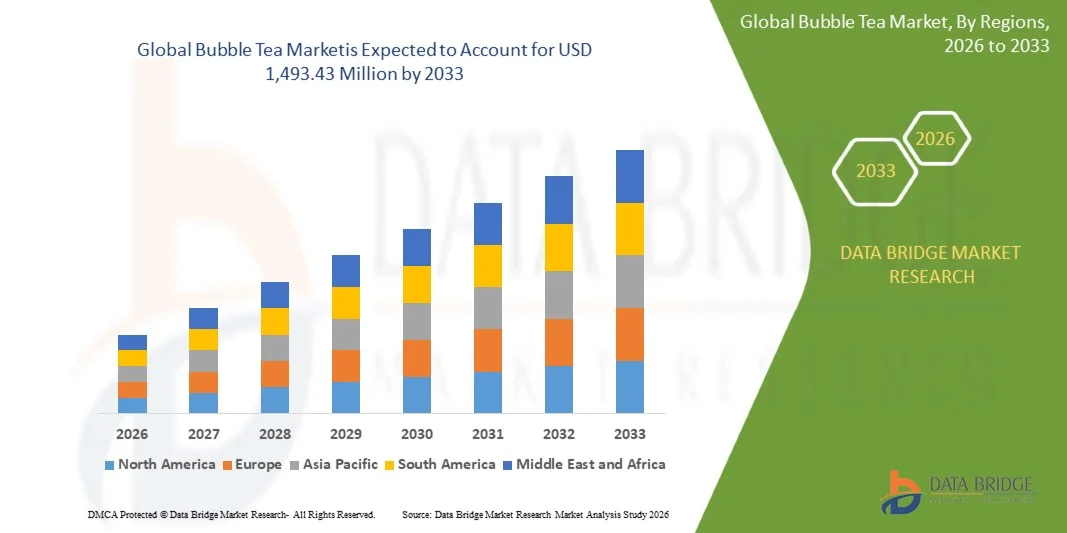
As per Data Bridge Market Research analysis, the bubble tea market was valued at USD 830.00 million in 2025 and is projected to reach USD 1,493.43 million by 2033, growing at a CAGR of 7.70% from 2026 to 2033. The market is witnessing steady expansion driven by increasing consumer preference for innovative beverages, rising demand for customizable drink options, and the growing influence of Asian food and beverage culture across international markets.
The growing popularity of functional and premium beverages, coupled with the expansion of café chains and quick-service outlets offering bubble tea, is encouraging manufacturers to introduce new flavors, healthier formulations, and plant-based ingredients. In addition, increasing adoption among younger consumers, supported by social media trends and the proliferation of online food delivery platforms, is accelerating market penetration across North America, Europe, and emerging economies in Asia-Pacific.
Market Size & Forecast
- Market Value (2025): USD 830.00 Million
- Expected Market Value (2033): USD 1,493.43 Million
- Forecast CAGR (2026–2033): 7.70%
- Leading Region in 2025: North America
- Fastest Growing Region: Asia-Pacific
Key Market Trends & Insights
- North America dominated the bubble tea market with the largest revenue share of approximately 36.1% in 2025, supported by increasing consumer demand for specialty beverages and the growing popularity of Asian-inspired food and drink products.
- Asia-Pacific bubble tea market is expected to witness the fastest growth rate from 2026 to 2033, supported by the beverage's Taiwanese origins, rising disposable incomes, and the continued expansion of regional franchise operators across countries such as China, Japan, India, and South Korea.
- The black tea segment held the largest market revenue share of approximately 43.6% in 2025, driven by its widespread use in traditional milk tea preparations, strong flavor profile, and high consumer preference across Asia-Pacific and North America. Black tea remains the preferred base for classic bubble tea offerings due to its versatility and compatibility with milk, fruit, and flavored formulations.
- The oolong tea segment is projected to register the fastest growth at a CAGR of 10.8% from 2026 to 2031, driven by increasing consumer demand for premium tea experiences and the growing popularity of authentic Taiwanese-style beverages. Rising adoption among health-conscious consumers and expanding availability in specialty tea chains are accelerating segment expansion.
- The milk-based segment held the largest market revenue share of approximately 58.5% in 2025, driven by its extensive use in conventional bubble tea products and continued consumer preference for creamy textures and indulgent beverage experiences. Milk-based formulations continue to dominate menus across major bubble tea chains due to their broad appeal and product familiarity.
- The plant-based segment is projected to register the fastest growth at a CAGR of 10.3% from 2026 to 2031, driven by increasing demand for vegan beverages, lactose-free alternatives, and sustainable food choices. Growing adoption of oat, almond, soy, and coconut milk across premium beverage offerings is supporting strong segment growth globally.
Report Scope and Bubble Tea Market Segmentation
|
Attributes |
Bubble Tea Key Market Insights |
|
Segments Covered |
|
|
Countries Covered |
North America
Europe
Asia-Pacific
Middle East and Africa
South America
|
|
Key Market Players |
|
|
Market Opportunities |
|
|
Value Added Data Infosets |
In addition to the insights on market scenarios such as market value, growth rate, segmentation, geographical coverage, and major players, the market reports curated by the Data Bridge Market Research also include in-depth expert analysis, pricing analysis, brand share analysis, consumer survey, demography analysis, supply chain analysis, value chain analysis, raw material/consumables overview, vendor selection criteria, PESTLE Analysis, Porter Analysis, and regulatory framework. |
Bubble Tea Market Trends
Trend: Rising Adoption Of Premium And Customizable Beverage Offerings
Growing consumer preference for personalized, visually appealing, and premium beverages is accelerating the adoption of bubble tea across the food and beverage industry. Beverage manufacturers and specialty tea chains are increasingly introducing innovative flavors, reduced-sugar variants, plant-based ingredients, and functional additives to enhance consumer appeal and support premiumization strategies. The strong influence of social media and rising popularity of Asian-inspired food and beverage products are further strengthening demand for bubble tea worldwide.
The rapid expansion of café chains, franchise networks, and ready-to-drink (RTD) tea products is creating sustained demand for bubble tea across Asia-Pacific, North America, and Europe. For instance, in March 2025, Mixue Group, one of the world's largest bubble tea and beverage chains, completed its Hong Kong IPO and reported operating more than 45,000 stores globally, supported by continued international expansion and growing consumer demand for affordable specialty beverages. This development reflects increasing industry investment in scalable beverage concepts that directly support demand for bubble tea.
The growing shift toward premium beverage experiences and continued investments in franchise expansion are expected to reinforce long-term demand for bubble tea, positioning manufacturers and retailers to benefit from increasing consumption of specialty tea beverages and evolving consumer preferences.
Bubble Tea Market Dynamics
Key Market Driver: Increasing Consumer Preference For Specialty And Experiential Beverages
The beverage industry continues to experience rising demand for innovative products due to their customization options, diverse flavor profiles, and strong appeal among younger consumers. Consumers are increasingly choosing bubble tea over conventional beverages, encouraging beverage manufacturers and franchise operators to expand production capacity and introduce new menu offerings that improve consumer engagement while supporting premium pricing strategies.
Major beverage companies continue investing in expansion initiatives to meet growing demand. For instance, in February 2025, Mixue Group raised approximately USD 444 million through its Hong Kong IPO and reported operating more than 45,000 stores globally, highlighting the strong consumer demand for specialty tea beverages and the increasing commercialization of bubble tea across international markets. This sustained growth in bubble tea retail networks is directly increasing demand across milk tea, fruit tea, and functional beverage applications.
As specialty beverage consumption continues to expand, manufacturers and franchise operators are expected to benefit from sustained demand driven by customization trends, increasing urbanization, and growing investments in beverage retail infrastructure.
Key Restraint/Challenge: Volatility In Raw Material Prices And Supply Chain Dependencies
Bubble tea manufacturers remain heavily dependent on tea leaves, tapioca pearls, milk products, and fruit ingredients, exposing production costs to fluctuations in agricultural commodity prices, transportation expenses, and supply chain disruptions. Variability in ingredient availability and procurement costs continues to affect manufacturing profitability and operational planning, particularly for beverage chains operating under fixed-price and franchise-based business models.
In addition, manufacturers must manage sourcing risks while maintaining consistent product quality and competitive pricing. For instance, tea prices in major producing countries have experienced periodic fluctuations due to adverse weather conditions and supply constraints, while tapioca pearl supply remains dependent on cassava production concentrated in Southeast Asia. These market conditions continue to create cost pressures across the bubble tea industry.
Despite robust market demand, raw material price volatility and ongoing procurement uncertainties are expected to remain significant restraints, increasing production costs, pressuring profit margins, and limiting long-term market stability throughout the forecast period.
Key Market Opportunity: Expansion Of Franchise Networks And Functional Beverage Innovation
Beverage companies, franchise operators, and specialty tea brands are accelerating investments in international expansion to capitalize on growing demand for premium and functional beverages. Bubble tea offers significant opportunities through healthier formulations, including low-sugar, dairy-free, and vitamin-enriched products, creating substantial long-term opportunities for manufacturers supplying innovative beverage solutions to consumers.
Leading companies are strengthening growth strategies through aggressive store expansion and product diversification. For instance, Gong Cha announced plans to expand its presence in North America through new franchise partnerships, building on its network of more than 2,100 stores across 28 countries. The company continues to focus on menu innovation and international market penetration to support long-term growth in the bubble tea category.
As consumers increasingly seek premium, customizable, and health-oriented beverages, expanding franchise networks and continued investments in product innovation are expected to create substantial long-term growth opportunities for the bubble tea market.
Bubble Tea Market Scope
The market is segmented on the basis of tea type, base ingredient type, flavour, component, distribution channel, and packaging form.
- By Tea Type
On the basis of tea type, the bubble tea market is segmented into black tea, green tea, oolong tea, and white tea. The black tea segment held the largest market revenue share of approximately 43.6% in 2025, driven by its widespread use in traditional milk tea preparations, strong flavor profile, and high consumer preference across Asia-Pacific and North America. Black tea remains the preferred base for classic bubble tea offerings due to its versatility and compatibility with milk, fruit, and flavored formulations.
The oolong tea segment is projected to register the fastest growth at a CAGR of 10.8% from 2026 to 2031, driven by increasing consumer demand for premium tea experiences and the growing popularity of authentic Taiwanese-style beverages. Rising adoption among health-conscious consumers and expanding availability in specialty tea chains are accelerating segment expansion.
- By Base Ingredient Type
On the basis of base ingredient type, the bubble tea market is segmented into milk-based and plant-based. The milk-based segment held the largest market revenue share of approximately 58.5% in 2025, driven by its extensive use in conventional bubble tea products and continued consumer preference for creamy textures and indulgent beverage experiences. Milk-based formulations continue to dominate menus across major bubble tea chains due to their broad appeal and product familiarity.
The plant-based segment is projected to register the fastest growth at a CAGR of 10.3% from 2026 to 2031, driven by increasing demand for vegan beverages, lactose-free alternatives, and sustainable food choices. Growing adoption of oat, almond, soy, and coconut milk across premium beverage offerings is supporting strong segment growth globally.
- By Flavour
On the basis of flavour, the bubble tea market is segmented into original flavour, coffee flavour, fruit flavour, chocolate flavour, and others. The original flavour segment held the largest market revenue share of an estimated 34.5% in 2025, driven by strong consumer preference for classic pearl milk tea and traditional Taiwanese beverage offerings. The segment benefits from high repeat purchases and broad availability across both established and emerging bubble tea markets.
The fruit flavour segment is projected to register the fastest growth at a CAGR of 10.6% from 2026 to 2033, driven by increasing demand for refreshing, low-dairy beverage alternatives and the introduction of innovative flavors such as mango, lychee, peach, and passion fruit. Rising popularity among younger consumers and seasonal menu innovations are accelerating segment expansion.
- By Component
On the basis of component, the bubble tea market is segmented into flavour, creamer, sweetener, liquid, tapioca pearls, and others. The tapioca pearls segment held the largest market revenue share of an estimated 29.8% in 2025, driven by their status as the defining ingredient of bubble tea and their widespread use across virtually all product variants. Tapioca pearls remain essential for product differentiation and consumer experience, supporting consistent demand across the market.
The flavour segment is projected to register the fastest growth at a CAGR of 10.4% from 2026 to 2033, driven by continuous product innovation and increasing consumer demand for personalized beverage experiences. Expanding investments in functional ingredients and premium flavor combinations are contributing to segment growth.
- By Distribution Channel
On the basis of distribution channel, the bubble tea market is segmented into supermarkets/hypermarkets, specialty stores, convenience stores, online retail, foodservice, and others. The supermarkets/hypermarkets segment held the largest market revenue share of approximately 43.7% in 2025, driven by increasing availability of ready-to-drink bubble tea products and expanding shelf space across organized retail channels. Large retailers continue to play a critical role in improving product accessibility and supporting mainstream market adoption.
The online retail segment is projected to register the fastest growth at a CAGR of 10.5% from 2026 to 2031, driven by increasing e-commerce penetration, growing demand for at-home bubble tea kits, and rising consumer preference for digital purchasing channels. Enhanced product visibility through online marketplaces is further accelerating segment expansion.
- By Packaging Form
On the basis of packaging form, the bubble tea market is segmented into PET/glass bottle, aluminum cans, pouches and sealed-cup packaging, and others. The PET/glass bottle segment held the largest market revenue share of approximately 51.6% in 2025, driven by its widespread use in ready-to-drink bubble tea products and strong consumer preference for convenient, portable packaging formats. PET and glass bottles are increasingly adopted by manufacturers seeking to expand retail distribution channels globally.
The pouches and sealed-cup packaging segment is projected to register the fastest growth at a CAGR of 10.4% from 2026 to 2031, driven by increasing demand for on-the-go consumption and improvements in packaging technology that enhance product shelf life and convenience. Growing adoption among convenience stores and foodservice outlets is supporting sustained segment growth.
Bubble Tea Market Regional Analysis
North America Bubble Tea Market Insight
North America dominated the bubble tea market with the largest revenue share of approximately 36.1% in 2025, supported by increasing consumer demand for specialty beverages and the growing popularity of Asian-inspired food and drink products. Consumers in the region highly value the customization, premium ingredients, and experiential appeal offered by bubble tea, with strong adoption among millennials and Gen Z populations. This widespread acceptance is further supported by expanding franchise networks, high disposable incomes, and the increasing availability of ready-to-drink bubble tea products across retail and foodservice channels, establishing bubble tea as a mainstream beverage category.
U.S. Bubble Tea Market Insight
The U.S. bubble tea market captured the largest revenue share in 2025 within North America, fueled by the rapid expansion of bubble tea chains and the increasing popularity of customizable beverages. Consumers are increasingly prioritizing premium and functional drink options featuring plant-based ingredients, reduced sugar, and unique flavor combinations. The growing preference for on-the-go consumption, combined with robust demand for digital ordering and delivery platforms, further propels the industry. Moreover, the increasing influence of Asian cuisine and social media trends is significantly contributing to market expansion.
Europe Bubble Tea Market Insight
The Europe bubble tea market is expected to witness the fastest growth rate from 2026 to 2033, primarily driven by growing consumer awareness of international beverage trends and the increasing demand for premium café experiences. The increase in urbanization, coupled with rising interest in healthier and customizable beverages, is fostering the adoption of bubble tea. European consumers are also drawn to the novelty and versatility these beverages offer. The region is experiencing significant growth across café chains, quick-service restaurants, and retail applications, with bubble tea increasingly being incorporated into mainstream beverage menus.
U.K. Bubble Tea Market Insight
The U.K. bubble tea market is expected to witness the fastest growth rate from 2026 to 2033, driven by the growing popularity of Asian food culture and a desire for innovative beverage experiences. In addition, increasing consumer preference for premium and Instagram-worthy drinks is encouraging both independent cafés and international franchise operators to expand their offerings. The U.K.'s strong retail and foodservice infrastructure, alongside growing acceptance of specialty beverages, is expected to continue stimulating market growth.
Germany Bubble Tea Market Insight
The Germany bubble tea market is expected to witness the fastest growth rate from 2026 to 2033, fueled by increasing demand for premium beverages and growing consumer interest in health-conscious alternatives. Germany's well-developed café culture, combined with its emphasis on product quality and innovation, promotes the adoption of bubble tea, particularly in urban centers. The introduction of vegan and reduced-sugar variants is also becoming increasingly prevalent, with a strong preference for sustainable and premium products aligning with local consumer expectations.
Asia-Pacific Bubble Tea Market Insight
The Asia-Pacific bubble tea market is expected to witness the fastest growth rate from 2026 to 2033, supported by the beverage's Taiwanese origins, rising disposable incomes, and the continued expansion of regional franchise operators across countries such as China, Japan, India, and South Korea. The region's growing inclination toward premium beverages, supported by increasing urbanization and digital food delivery adoption, is driving market growth. Furthermore, as Asia-Pacific remains the largest production and consumption hub for tea and tapioca ingredients, the affordability and accessibility of bubble tea continue to expand to a wider consumer base.
Japan Bubble Tea Market Insight
The Japan bubble tea market is expected to witness the fastest growth rate from 2026 to 2033 due to the country's strong café culture, demand for premium beverages, and preference for innovative food and drink experiences. The Japanese market places significant emphasis on quality and presentation, and the adoption of bubble tea is driven by increasing demand among younger consumers and urban populations. The integration of seasonal flavors and limited-edition offerings is fueling growth. Moreover, Japan's high concentration of specialty beverage outlets is expected to spur demand across both retail and foodservice sectors.
China Bubble Tea Market Insight
The China bubble tea market accounted for the largest market revenue share in Asia-Pacific in 2025, attributed to the country's expanding middle class, rapid urbanization, and strong consumer demand for specialty beverages. China represents one of the largest bubble tea markets globally, with leading domestic brands such as Mixue, HEYTEA, and Nayuki continuing aggressive expansion strategies. The push toward premiumization and the availability of affordable beverage options, alongside a highly developed franchise ecosystem, are key factors propelling the market in China.
Bubble Tea Market Share
The bubble tea industry is primarily led by well-established companies, including:
- Gong Cha (Taiwan)
- Chatime Group (Taiwan)
- CoCo Fresh Tea & Juice Co., Ltd. (Taiwan)
- Sharetea Holdings Ltd. (Taiwan)
- Kung Fu Tea, LLC (U.S.)
- Ten Ren's Tea Co., Ltd. (Taiwan)
- Mixue Group (China)
- HEYTEA (China)
- Nayuki Holdings Limited (China)
- Tiger Sugar International Co., Ltd. (Taiwan)
- Yifang Taiwan Fruit Tea Co., Ltd. (Taiwan)
- Lollicup USA, Inc. (U.S.)
- Boba Guys, Inc. (U.S.)
- T4 International Inc. (Taiwan)
- Xing Fu Tang International Co., Ltd. (Taiwan)
Latest Developments in Bubble Tea Market
- In June 2025, Gong Cha Korea launched the Taro Jewelry Signature Milk Tea and Taro Jewelry Signature Smoothie, expanding its premium beverage portfolio with taro foam and chewy pearl inclusions. The launch aims to capitalize on growing consumer demand for indulgent and innovative bubble tea experiences while strengthening customer engagement through limited-edition offerings. The development is expected to support premiumization trends and reinforce Gong Cha's position in the bubble tea market.
- In April 2025, Chatime Australia expanded its product portfolio by introducing espresso-based beverages, including lattes and iced long blacks that can be customized with boba pearls and cream mousse. The initiative is intended to attract older millennial consumers and diversify revenue streams beyond traditional bubble tea offerings. This development highlights the increasing convergence of coffee and bubble tea categories and is expected to broaden the market's consumer base.
- In April 2025, HTeaO launched its "HTeaO Refreshers" beverage line featuring fruit-forward, tea-based drinks blended with brewed tea, fruit syrups, and lemonade. The new range targets health-conscious consumers seeking low-caffeine and functional beverage alternatives. The launch reflects growing demand for better-for-you beverages and supports the expansion of tea-based products within the broader specialty drinks market.
- In March 2024, Simple Boba introduced a clean-label ready-to-drink (RTD) boba beverage line at Expo West featuring crystal boba made from konjac and offering a shelf life of up to 160 days. Available in Assam Black Tea, Hojicha Green Tea, and Mango Juice flavors, the products address traditional tapioca limitations in RTD applications. This innovation is expected to accelerate adoption of shelf-stable bubble tea products and expand retail distribution opportunities.
- In March 2024, Alo and Jenji launched a new ready-to-drink boba tea portfolio at IFE 2024 under the Jenji brand, featuring vegan, GMO-free products with proprietary Coco Jelly Boba pearls. Offered in aluminum and slim can formats, the products are designed to meet growing consumer demand for convenient and sustainable beverage options. The launch is expected to strengthen the RTD bubble tea segment and enhance product accessibility across international markets.

- Interactive Data Analysis Dashboard
- Company Analysis Dashboard for high growth potential opportunities
- Research Analyst Access for customization & queries
- Competitor Analysis with Interactive dashboard
- Latest News, Updates & Trend analysis
- Harness the Power of Benchmark Analysis for Comprehensive Competitor Tracking
Global Bubble Tea Market, Supply Chain Analysis and Ecosystem Framework
To support market growth and help clients navigate the impact of geopolitical shifts, DBMR has integrated in-depth supply chain analysis into its Global Bubble Tea Market research reports. This addition empowers clients to respond effectively to global changes affecting their industries. The supply chain analysis section includes detailed insights such as Global Bubble Tea Market consumption and production by country, price trend analysis, the impact of tariffs and geopolitical developments, and import and export trends by country and HSN code. It also highlights major suppliers with data on production capacity and company profiles, as well as key importers and exporters. In addition to research, DBMR offers specialized supply chain consulting services backed by over a decade of experience, providing solutions like supplier discovery, supplier risk assessment, price trend analysis, impact evaluation of inflation and trade route changes, and comprehensive market trend analysis.
Data collection and base year analysis are done using data collection modules with large sample sizes. The stage includes obtaining market information or related data through various sources and strategies. It includes examining and planning all the data acquired from the past in advance. It likewise envelops the examination of information inconsistencies seen across different information sources. The market data is analysed and estimated using market statistical and coherent models. Also, market share analysis and key trend analysis are the major success factors in the market report. To know more, please request an analyst call or drop down your inquiry.
The key research methodology used by DBMR research team is data triangulation which involves data mining, analysis of the impact of data variables on the market and primary (industry expert) validation. Data models include Vendor Positioning Grid, Market Time Line Analysis, Market Overview and Guide, Company Positioning Grid, Patent Analysis, Pricing Analysis, Company Market Share Analysis, Standards of Measurement, Global versus Regional and Vendor Share Analysis. To know more about the research methodology, drop in an inquiry to speak to our industry experts.
Data Bridge Market Research is a leader in advanced formative research. We take pride in servicing our existing and new customers with data and analysis that match and suits their goal. The report can be customized to include price trend analysis of target brands understanding the market for additional countries (ask for the list of countries), clinical trial results data, literature review, refurbished market and product base analysis. Market analysis of target competitors can be analyzed from technology-based analysis to market portfolio strategies. We can add as many competitors that you require data about in the format and data style you are looking for. Our team of analysts can also provide you data in crude raw excel files pivot tables (Fact book) or can assist you in creating presentations from the data sets available in the report.













