


Bubonic Plague Market Size
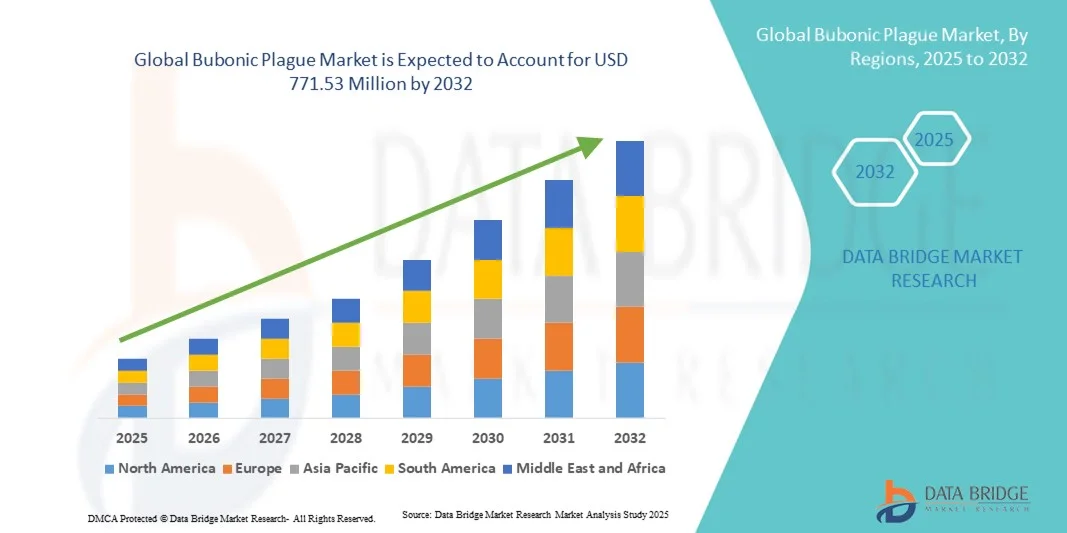
- The global bubonic plague market size was valued at USD 526.2 million in 2024 and is expected to reach USD 771.53 million by 2032, at a CAGR of 4.90% during the forecast period
- The market growth is largely fueled by increasing awareness of Bubonic Plague outbreaks and advancements in rapid diagnostic techniques, which enable timely detection and management of the disease
- Furthermore, rising investment in vaccine development, antimicrobial therapies, and public health initiatives is enhancing the availability of effective prevention and treatment options for Bubonic Plague, thereby significantly boosting the market’s growth
Bubonic Plague Market Analysis
- The Bubonic Plague market is gaining increased attention due to rising awareness of infectious diseases, improved surveillance systems, and the need for effective diagnostic and therapeutic interventions in both endemic and non-endemic regions
- The escalating demand for bubonic plague management solutions is primarily fueled by increased prevalence in certain regions, growing public health initiatives, and rising investment in rapid diagnostic testing and treatment strategies
- North America dominated the bubonic plague market with the largest revenue share of 37.8% in 2024, driven by advanced healthcare infrastructure, well-established disease surveillance systems, and strong government and institutional support. The U.S. leads the region, supported by rapid diagnostic capabilities, ongoing research initiatives, and the presence of specialized infectious disease centers
- Asia-Pacific is expected to be the fastest-growing region in the bubonic plague market during the forecast period, due to increasing urbanization, rising healthcare investments, enhanced access to diagnostic facilities, and growing awareness about plague prevention and treatment in countries such as China, India, and Indonesia
- The Antibiotics segment dominated the bubonic plague market with the largest market revenue share of 76.4% in 2024, driven by their proven efficacy as the primary therapeutic intervention for Bubonic Plague
Report Scope and Bubonic Plague Market Segmentation
|
Attributes |
Bubonic Plague Key Market Insights |
|
Segments Covered |
|
|
Countries Covered |
North America
Europe
Asia-Pacific
Middle East and Africa
South America
|
|
Key Market Players |
|
|
Market Opportunities |
|
|
Value Added Data Infosets |
In addition to the insights on market scenarios such as market value, growth rate, segmentation, geographical coverage, and major players, the market reports curated by the Data Bridge Market Research also include in-depth expert analysis, pricing analysis, brand share analysis, consumer survey, demography analysis, supply chain analysis, value chain analysis, raw material/consumables overview, vendor selection criteria, PESTLE Analysis, Porter Analysis, and regulatory framework. |
Bubonic Plague Market Trends
Advancement In Diagnostic Technologies and The Development of Targeted Therapeutic Interventions
- A significant and accelerating trend in the global bubonic plague market is the advancement in diagnostic technologies and the development of targeted therapeutic interventions. Rapid diagnostic tests, such as polymerase chain reaction (PCR) assays and immunoassays, are enabling healthcare providers to detect Yersinia pestis infections more swiftly and accurately, which is crucial for timely treatment and outbreak control
- For instance, companies like Roche and Abbott Laboratories are at the forefront of providing diagnostic solutions that can identify plague infections within hours, facilitating prompt administration of antibiotics and reducing mortality rates. Similarly, pharmaceutical companies such as Sanofi and Gilead Sciences are engaged in the development of vaccines and novel antimicrobial agents aimed at preventing and treating plague, thereby enhancing public health preparedness
- The integration of digital surveillance systems and public health initiatives is further bolstering the market's growth. Governments and international organizations are implementing enhanced monitoring and reporting mechanisms to detect and respond to plague outbreaks more effectively. This proactive approach is driving demand for advanced diagnostic tools, vaccines, and therapeutic treatments
- Moreover, regional collaborations and research partnerships are accelerating the development of innovative solutions. Collaborations between academic institutions, government agencies, and private companies are fostering the exchange of knowledge and resources, leading to the rapid advancement of plague-related research and the introduction of new products into the market
- This convergence of technological innovation, public health strategy, and collaborative research is transforming the global bubonic plague market. The emphasis on rapid diagnostics, effective treatments, and coordinated response efforts is enhancing the global capacity to manage and mitigate the impact of plague, thereby reshaping the landscape of infectious disease control
Bubonic Plague Market Dynamics
Driver
Increasing Awareness of Infectious Disease Outbreaks
- The increasing awareness of infectious disease outbreaks and the potential severity of plague infections is a significant driver for the growing demand for diagnostics, vaccines, and therapeutics in the global bubonic plague market
- For instance, in 2024, Roche and Abbott Laboratories advanced their rapid diagnostic test offerings for Yersinia pestis, enabling detection within hours and facilitating timely treatment. Such initiatives by key companies are expected to accelerate market growth in the forecast period
- As public health authorities and healthcare providers focus on early detection and containment, rapid diagnostics, antibiotic therapies, and preventive vaccines provide essential tools for managing outbreaks, reducing mortality, and protecting vulnerable populations
- Furthermore, the integration of plague monitoring systems with regional disease surveillance programs and international health initiatives is enhancing the speed and efficiency of outbreak response, reinforcing the importance of reliable diagnostic and therapeutic solutions
- The growing emphasis on research collaborations, government-supported healthcare initiatives, and increasing funding for rare infectious diseases is expanding access to vaccines, advanced antibiotics, and public health resources. The trend toward strengthening public health infrastructure and improving global preparedness further contributes to the market’s growth trajectory
Restraint/Challenge
Concerns Regarding Limited Access to Rapid Diagnostics, Effective Antibiotics, And Vaccines
- Concerns surrounding the limited access to rapid diagnostics, effective antibiotics, and vaccines pose a significant challenge to broader management and control of bubonic plague outbreaks. Since plague can progress rapidly if untreated, delays in diagnosis or treatment can lead to higher mortality, limiting confidence in healthcare systems in some regions
- For instance, outbreaks in remote or under-resourced areas have highlighted the challenges of timely detection and treatment, making some public health authorities hesitant to fully rely on existing infrastructure for containment
- Addressing these barriers through enhanced distribution of diagnostic kits, training of healthcare personnel, and the availability of effective antibiotic and vaccine stockpiles is crucial for improving disease management and building trust in public health measures. Companies and organizations such as Roche, Sanofi, and Abbott Laboratories emphasize rapid detection solutions, preventive vaccines, and effective antibiotic therapies to strengthen outbreak preparedness. Additionally, the relatively high cost of advanced diagnostic tools and limited availability of vaccines in endemic regions can be a barrier to widespread adoption and utilization, particularly in developing countries
- While costs and accessibility are gradually improving, the perception of limited treatment options can still hinder effective management, especially in areas with sporadic outbreaks or low healthcare infrastructure.
- Overcoming these challenges through improved global distribution networks, affordable diagnostic and treatment options, and public awareness campaigns will be vital for sustained market growth and better control of bubonic plague
Bubonic Plague Market Scope
The market is segmented on the basis of Diagnosis, Treatment, End-User, and Distribution Channel.
- By Diagnosis
On the basis of diagnosis, the Bubonic Plague market is segmented into Blood Culture, Sputum Culture, Lymph Node Culture, and Chest X-Ray. The Blood Culture segment dominated the largest market revenue share of 41.5% in 2024, driven by its high diagnostic accuracy, early detection capability, and widespread use in clinical laboratories. Blood culture tests are considered the gold standard for detecting Yersinia pestis infections, allowing for timely intervention and treatment. Hospitals and diagnostic centers prefer this method due to its ability to detect bacteremia reliably and provide actionable results for clinicians. Additionally, automation in blood culture systems has enhanced speed and efficiency, supporting large-scale testing during outbreaks. The segment also benefits from regulatory approvals and inclusion in national infectious disease guidelines. Continuous research and development are improving detection speed, sensitivity, and compatibility with molecular confirmatory tests. Blood culture is widely used in endemic regions and outbreak-prone areas due to its effectiveness in early detection. Skilled personnel, standardized procedures, and global clinical trust make this method the dominant diagnostic approach. Government initiatives for infectious disease monitoring and funding for laboratory expansion further reinforce market leadership. Overall, the reliability, clinical acceptance, and comprehensive detection capabilities contribute to the segment’s leading position.
The Sputum Culture segment is expected to witness the fastest CAGR of 22.3% from 2025 to 2032, attributed to its non-invasive nature and increasing use in respiratory infection diagnosis. Sputum culture enables clinicians to detect pneumonic manifestations of Bubonic Plague, particularly in patients presenting with pulmonary symptoms. Rising awareness of early diagnosis and patient-friendly procedures is driving adoption in hospitals and outpatient clinics. Expansion of diagnostic lab networks and improved access to healthcare in semi-urban and rural areas are also supporting growth. Integration with rapid molecular tests for confirmatory results is boosting utilization. Technological improvements in culture media, incubation systems, and sample handling are enhancing sensitivity and turnaround time. Sputum culture is increasingly used in public health monitoring, research studies, and outbreak management programs. Awareness campaigns educating healthcare professionals on proper sputum collection and testing techniques support market expansion. The segment benefits from growing surveillance programs and government-funded initiatives in endemic countries. High patient compliance and accessibility make sputum culture suitable for mass testing scenarios. Adoption in outpatient settings and emergency clinics is rising due to its convenience and efficiency. The combination of non-invasive procedures, technological advancements, and increased healthcare access drives the strong CAGR over the forecast period.
- By Treatment
On the basis of treatment, the Bubonic Plague market is segmented into Antibiotics and Vaccines. The Antibiotics segment dominated the largest market revenue share of 76.4% in 2024, driven by their proven efficacy as the primary therapeutic intervention for Bubonic Plague. Established antibiotics such as streptomycin, gentamicin, and doxycycline are widely used in hospitals and clinics to manage severe infections. Early administration of antibiotics significantly reduces mortality rates and prevents disease progression to septicemic or pneumonic forms. Global availability, inclusion in treatment protocols, and government stockpiling programs support sustained demand. Hospitals and healthcare providers prefer antibiotics due to their fast-acting nature, clinical trust, and cost-effectiveness. Antibiotics also play a critical role in outbreak containment and post-exposure prophylaxis. Clinical guidelines emphasize prompt initiation and correct dosing, further driving adoption. Ongoing research addresses drug-resistant strains and dosing optimization. Government support, public health initiatives, and hospital readiness programs contribute to maintaining market dominance. Overall, the established efficacy and clinical reliability position antibiotics as the cornerstone of Bubonic Plague treatment.
The Vaccines segment is expected to witness the fastest CAGR of 18.5% from 2025 to 2032, fueled by growing government and public health initiatives for prevention in high-risk populations. Research into safe and effective vaccines is expanding, with recombinant and live-attenuated candidates under development. Vaccination campaigns target endemic areas, laboratory personnel, and military populations, driving adoption. Rising awareness about prophylactic measures and epidemic preparedness supports growth. Clinical trials and collaborations with global health organizations increase vaccine availability and credibility. Technological advancements improve immunogenicity, safety, and storage conditions. Vaccines are increasingly integrated into national infectious disease prevention programs. Cold chain logistics, scalable manufacturing, and funding from international health agencies support expansion. Hospitals and clinics serve as primary vaccination points, enhancing access. Government-backed initiatives provide subsidized or free vaccines in high-risk regions. Improved vaccine accessibility, increasing outbreak awareness, and rising demand for preventive solutions collectively drive the segment’s rapid CAGR.
- By End-User
On the basis of end-user, the Bubonic Plague market is segmented into Hospitals, Clinics, and Others. The Hospitals segment dominated the largest market revenue share of 62.7% in 2024, due to the availability of specialized infectious disease departments, diagnostic laboratories, and trained personnel. Hospitals provide comprehensive management, including diagnostics, inpatient care, antibiotics, and vaccines. Emergency response readiness and outbreak preparedness programs make hospitals the first choice for severe cases. Centralized treatment, clinical expertise, and patient monitoring systems reinforce dominance. Hospitals often participate in research and clinical trials, contributing to disease management strategies. Government support for hospital infrastructure and disease surveillance strengthens their role. Advanced equipment and laboratory networks improve diagnostic accuracy and treatment outcomes. Hospitals maintain direct access to antibiotics and vaccines, ensuring timely treatment. Structured protocols, trained healthcare staff, and patient education programs enhance adoption. Coordination with public health authorities facilitates rapid containment. Hospitals’ reputation, accessibility, and comprehensive services sustain dominance in the end-user segment.
The Clinics segment is expected to witness the fastest CAGR of 21.0% from 2025 to 2032, driven by the expansion of outpatient facilities, growing awareness of early detection, and increased access to healthcare in semi-urban and rural areas. Clinics offer diagnostic tests, vaccinations, and initial treatment for mild or suspected cases. Their proximity to local communities ensures timely intervention and monitoring. Rapid diagnostic test adoption in clinics supports early detection, while lower operational costs make services more accessible. Government-funded outreach programs and public health campaigns leverage clinic networks to increase coverage. Clinics also act as referral points to hospitals, maintaining continuity of care. Integration of telemedicine and mobile health units improves service delivery. Expansion of private clinics and chain facilities enhances availability in urban and suburban regions. Patient-friendly procedures, convenience, and lower costs encourage utilization. Training programs for clinic staff improve diagnosis and treatment quality. Growing health awareness and localized care strategies drive segment growth. Clinics’ ability to provide community-level healthcare makes them the fastest-growing end-user segment.
- By Distribution Channel
On the basis of distribution channel, the market is segmented into Hospital Pharmacy, Retail Pharmacy, and Others. The Hospital Pharmacy segment dominated the largest market revenue share of 58.9% in 2024, due to direct access to antibiotics, vaccines, and supportive care medications for inpatients. Hospital pharmacies maintain controlled stock, coordinate with clinicians, and adhere to treatment protocols. They ensure quick access during outbreaks and emergency situations. Centralized inventory systems and integration with hospital records streamline dispensing. Regulatory compliance, trained pharmacists, and quality control enhance reliability. Hospital pharmacies often collaborate with manufacturers to secure supply chains. Hospitals maintain priority access to high-demand medications. Emergency preparedness and outbreak response reinforce dominance. Availability of critical drugs, patient counseling, and adherence to clinical guidelines support adoption. Hospitals provide integrated treatment solutions and ensure timely administration. The combination of accessibility, oversight, and clinical integration sustains market leadership.
The Retail Pharmacy segment is expected to witness the fastest CAGR of 19.7% from 2025 to 2032, fueled by increasing public access to antibiotics, awareness campaigns, and expansion of private pharmacy networks. Retail pharmacies provide convenient options for outpatient prescriptions and early treatment. The rise of e-pharmacies enhances reach in urban and semi-urban areas. Public health initiatives promote use of retail channels for prophylaxis and minor treatment. Chain pharmacies and community outlets support rapid distribution of medications. Accessibility, convenience, and growing awareness contribute to adoption. Retail pharmacies are increasingly involved in vaccination programs and patient education. Supply chain improvements and partnerships with healthcare providers ensure reliability. Patients benefit from proximity, flexible hours, and quick service. Integration with insurance and health schemes encourages uptake. Retail pharmacy growth is further supported by government-backed campaigns in endemic areas. Rising demand for early intervention and preventive measures drives segment CAGR over the forecast period.
Bubonic Plague Market Regional Analysis
- North America dominated the bubonic plague market with the largest revenue share of 37.8% in 2024
- Driven by advanced healthcare infrastructure, well-established disease surveillance systems, and strong government and institutional support
- Rapid diagnostic capabilities, specialized infectious disease centers, and ongoing research initiatives in the U.S. further strengthen the region’s market position
U.S. Bubonic Plague Market Insight
The U.S. bubonic plague market captured the largest revenue share in 2024 within North America, fueled by sophisticated public health systems, comprehensive outbreak management programs, and proactive surveillance strategies. The presence of advanced laboratories, ongoing clinical research, and collaboration between government agencies and academic institutions ensures timely detection and effective treatment. Additionally, federal and state-level funding for infectious disease monitoring and epidemic preparedness supports market expansion.
Europe Bubonic Plague Market Insight
The Europe bubonic plague market is projected to expand at a substantial CAGR throughout the forecast period, primarily driven by well-developed healthcare infrastructure, stringent public health regulations, and increased awareness of plague prevention measures. Urbanization and enhanced access to diagnostic facilities encourage timely detection and management. The region is experiencing growth across public health programs, hospitals, and community clinics, supporting the containment and treatment of bubonic plague cases.
U.K. Bubonic Plague Market Insight
The U.K. bubonic plague market is anticipated to grow at a noteworthy CAGR during the forecast period, supported by strong public health initiatives, investment in rapid diagnostic systems, and heightened focus on infectious disease preparedness. Government campaigns for disease awareness and prevention, along with widespread healthcare accessibility, contribute to the market’s growth.
Germany Bubonic Plague Market Insight
The Germany bubonic plague market is expected to expand at a considerable CAGR during the forecast period, fueled by increasing awareness about infectious diseases, robust healthcare systems, and a focus on epidemiological surveillance. Germany’s well-developed medical infrastructure, combined with emphasis on early detection and rapid treatment, drives the adoption of advanced diagnostic and containment measures.
Asia-Pacific Bubonic Plague Market Insight
The Asia-Pacific bubonic plague market is poised to grow at the fastest CAGR from 2025 to 2032, driven by increasing urbanization, rising healthcare investments, enhanced access to diagnostic facilities, and growing awareness about plague prevention and treatment in countries such as China, India, and Indonesia. Public health campaigns, government support for epidemic monitoring, and improved healthcare infrastructure are major growth enablers.
Japan Bubonic Plague Market Insight
The Japan bubonic plague market is gaining momentum due to advanced healthcare facilities, rapid urbanization, and strong public health awareness. The country’s emphasis on epidemic preparedness, rapid diagnostic capabilities, and healthcare innovation is fueling market growth. National initiatives for infectious disease prevention further support timely detection and treatment.
China Bubonic Plague Market Insight
The China bubonic plague market accounted for the largest market revenue share in Asia-Pacific in 2024, attributed to the country’s expanding healthcare infrastructure, rising public awareness, and enhanced access to diagnostic and treatment facilities. Government initiatives for epidemic preparedness, coupled with urbanization and strong public health programs, are key factors propelling the market in China.
Bubonic Plague Market Share
The Bubonic Plague industry is primarily led by well-established companies, including:
- Sanofi (France)
- Camber Pharmaceuticals, Inc. (U.S.)
- Dr. Reddy’s Laboratories Ltd. (India)
- Pfizer Inc. (U.S.)
- GSK Plc. (U.K.)
- Moderna (U.S.)
- Chembio Diagnostics, Inc. (U.S.)
- Hyundai Pharm (South Korea)
- Bharat Biotech (India)
- Centers for Disease Control and Prevention (CDC) – Research & Diagnostics (U.S.)
- Valneva SE (France)
- Inovio Pharmaceuticals (U.S.)
Latest Developments in Global Bubonic Plague Market
- In April 2024, the Russian state regulator granted marketing authorization for a single subcutaneous dose microencapsulated molecular plague vaccine (PMMM). This vaccine comprises recombinant F1 and V antigens and is designed to enhance immunogenicity and stability, addressing concerns over antimicrobial resistance and the need for effective prophylaxis against
- In December 2024, researchers discovered a 3,290-year-old Egyptian mummy with molecular evidence of Yersinia pestis, suggesting the presence of bubonic plague in ancient Egypt. This finding provides new insights into the historical spread of the disease and its impact on ancient populations
- In August 2025, health officials in New Mexico confirmed the first human case of plague in the state for 2025. A 43-year-old man from Valencia County contracted the disease, highlighting ongoing surveillance and the importance of public health preparedness in endemic areas

- Interactive Data Analysis Dashboard
- Company Analysis Dashboard for high growth potential opportunities
- Research Analyst Access for customization & queries
- Competitor Analysis with Interactive dashboard
- Latest News, Updates & Trend analysis
- Harness the Power of Benchmark Analysis for Comprehensive Competitor Tracking
Data collection and base year analysis are done using data collection modules with large sample sizes. The stage includes obtaining market information or related data through various sources and strategies. It includes examining and planning all the data acquired from the past in advance. It likewise envelops the examination of information inconsistencies seen across different information sources. The market data is analysed and estimated using market statistical and coherent models. Also, market share analysis and key trend analysis are the major success factors in the market report. To know more, please request an analyst call or drop down your inquiry.
The key research methodology used by DBMR research team is data triangulation which involves data mining, analysis of the impact of data variables on the market and primary (industry expert) validation. Data models include Vendor Positioning Grid, Market Time Line Analysis, Market Overview and Guide, Company Positioning Grid, Patent Analysis, Pricing Analysis, Company Market Share Analysis, Standards of Measurement, Global versus Regional and Vendor Share Analysis. To know more about the research methodology, drop in an inquiry to speak to our industry experts.
Data Bridge Market Research is a leader in advanced formative research. We take pride in servicing our existing and new customers with data and analysis that match and suits their goal. The report can be customized to include price trend analysis of target brands understanding the market for additional countries (ask for the list of countries), clinical trial results data, literature review, refurbished market and product base analysis. Market analysis of target competitors can be analyzed from technology-based analysis to market portfolio strategies. We can add as many competitors that you require data about in the format and data style you are looking for. Our team of analysts can also provide you data in crude raw excel files pivot tables (Fact book) or can assist you in creating presentations from the data sets available in the report.












