


What is the Building Analytics Market Size and Overview?
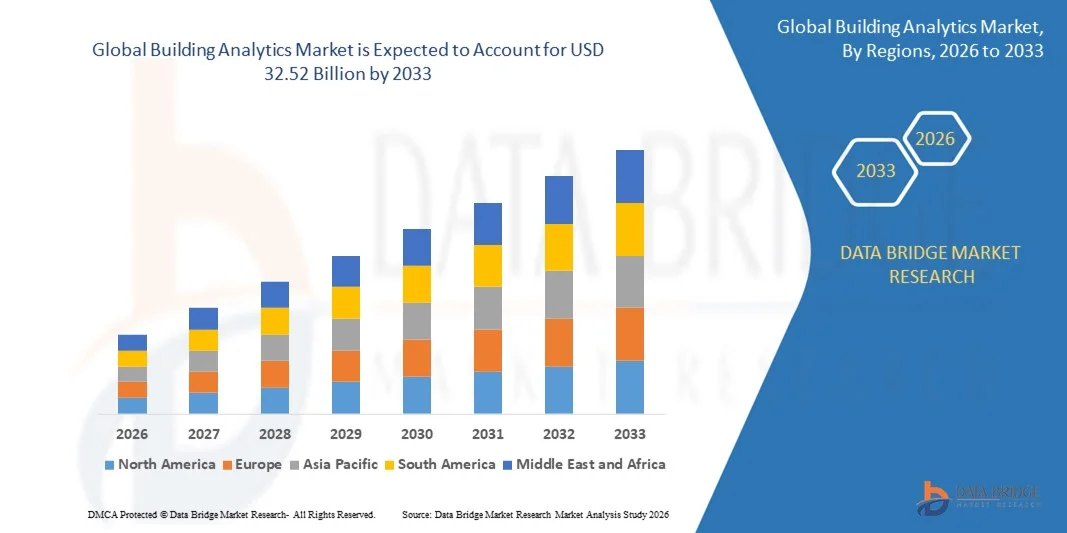
- The global building analytics market size was valued at USD 11.67 billion in 2025 and is expected to reach USD 32.52 billion by 2033, at a CAGR of 13.67% during the forecast period
- Surging demand of energy efficient systems, reduction of operational cost, rising preferences of smart homes, increasing penetration of business intelligence in developing economies will likely to accelerate the growth of the building analytics market
Market Size & Forecast
- Global Market Value (2025): USD 11.67 billion
- Expected Market Value (2033): USD 32.52 billion
- Forecast CAGR (2026–2033): 13.67%
What are the Major Takeaways of Building Analytics Market?
- Initiatives by the government along with prevalence of incentives will further boost various opportunities that will lead to the growth of the building analytics market in the above mentioned forecast period
- High cost of implementation will act as market restraints for building analytics in the above mentioned forecasted period
- North America dominated the building analytics market with the largest revenue share of 42.3% in 2025, driven by the high adoption of advanced analytics platforms, strong IT infrastructure, and the presence of leading technology providers across the U.S. and Canada
- Asia-Pacific is projected to witness the fastest growth rate of 11.2% during 2026–2033, driven by rapid urbanization, rising industrialization, and growing adoption of smart building solutions across China, Japan, India, and South Korea
- The Energy Management segment dominated the market with a revenue share of 32.8% in 2025, driven by the growing demand to optimize energy consumption, reduce operational costs, and enhance sustainability across commercial and industrial facilities
Report Scope and Building Analytics Market Segmentation
|
Attributes |
Building Analytics Key Market Insights |
|
Segments Covered |
|
|
Countries Covered |
North America
Europe
Asia-Pacific
Middle East and Africa
South America
|
|
Key Market Players |
|
|
Market Opportunities |
|
|
Value Added Data Infosets |
In addition to the insights on market scenarios such as market value, growth rate, segmentation, geographical coverage, and major players, the market reports curated by the Data Bridge Market Research also include in-depth expert analysis, pricing analysis, brand share analysis, consumer survey, demography analysis, supply chain analysis, value chain analysis, raw material/consumables overview, vendor selection criteria, PESTLE Analysis, Porter Analysis, and regulatory framework. |
What is the Key Trend in the Building Analytics Market?
Rising Integration of AI and IoT for Real-Time Building Performance Optimization
- The building analytics market is witnessing a major trend toward the integration of AI, IoT sensors, and advanced data analytics platforms to optimize energy consumption, operational efficiency, and occupant comfort. These solutions enable facility managers to monitor and control building systems in real-time, improving sustainability and reducing operational costs
- For instance, Johnson Controls and Honeywell International have introduced AI-driven Building Analytics solutions that combine predictive maintenance, energy management, and fault detection to optimize HVAC, lighting, and energy usage across commercial and industrial facilities
- The growing adoption of smart buildings and connected infrastructure is accelerating demand for predictive and data-driven analytics platforms that enhance efficiency and reduce energy waste
- Facility managers are increasingly deploying AI-powered dashboards and sensor networks to dynamically adjust building operations, ensuring energy optimization and occupant comfort simultaneously
- The rising focus on sustainability, carbon neutrality, and regulatory compliance is driving adoption of cloud-based and scalable analytics platforms
- As the global emphasis on energy efficiency and smart buildings grows, AI-driven Building Analytics solutions will remain a defining trend shaping future market development
What are the Key Drivers of Building Analytics Market?
- Increasing energy efficiency regulations and sustainability goals are primary drivers of the Building Analytics market, pushing commercial and industrial facilities to adopt intelligent monitoring and optimization solutions
- For instance, in 2025, Schneider Electric implemented predictive analytics and AI-enabled energy management systems across corporate campuses to optimize energy use and lower operational costs
- Rising demand for smart buildings, IoT-enabled infrastructure, and integration of renewable energy systems has driven widespread adoption of Building Analytics platforms
- Technological advancements in cloud computing, edge analytics, and machine learning are enabling more precise, predictive, and actionable insights for facility management
- Increasing interest in cost savings, improved occupant comfort, and proactive maintenance is motivating organizations to invest in advanced analytics solutions
- As adoption grows across commercial, industrial, and government facilities, the Building Analytics market is expected to witness sustained growth fueled by innovation and compliance initiatives
Which Factor is Challenging the Growth of the Building Analytics Market?
- High implementation costs, integration complexity, and limited IT infrastructure in older buildings remain major challenges for Building Analytics adoption
- For instance, during 2024–2025, several mid-sized enterprises delayed analytics integration due to expensive retrofitting and software deployment costs
- Data privacy and cybersecurity concerns also restrict the full-scale deployment of cloud-based analytics platforms in certain regions
- Competition from legacy building management systems and local solution providers leads to price pressure and lower adoption in cost-sensitive markets
- The need for skilled personnel to operate and maintain AI-enabled analytics systems adds to operational challenges
- To overcome these hurdles, market players are focusing on scalable SaaS solutions, modular deployment models, and strategic partnerships to enhance accessibility, reduce costs, and ensure secure, efficient analytics implementation
How is the Building Analytics Market Segmented?
The market is segmented on the basis of application, component, deployment, organisation size, and building type.
- By Application
On the basis of application, the building analytics market is segmented into Fault Detection and Monitoring, Energy Management, Security Management, Emergency Management, Parking Management, Operations Management, Elevators and Escalators Management, Network Management, and Others. The Energy Management segment dominated the market with a revenue share of 32.8% in 2025, driven by the growing demand to optimize energy consumption, reduce operational costs, and enhance sustainability across commercial and industrial facilities. Advanced analytics platforms enable predictive energy optimization, automated control of HVAC, lighting, and renewable energy integration, ensuring significant cost and energy savings.
The Fault Detection and Monitoring segment is projected to grow at the fastest CAGR during 2026–2033, fueled by the rising adoption of IoT sensors and AI-based monitoring tools to detect anomalies, prevent downtime, and ensure operational efficiency. Increasing regulations and corporate sustainability initiatives are driving investments across both segments.
- By Component
On the basis of component, the building analytics market is segmented into Software and Services. The Software segment dominated the market with a 57.4% revenue share in 2025, attributed to the increasing deployment of cloud-based analytics platforms, predictive AI models, and visualization dashboards for energy, security, and operational optimization. Software solutions enable facility managers to monitor and analyze building performance, integrate IoT devices, and implement real-time decision-making.
The Services segment is anticipated to grow at the fastest CAGR from 2026 to 2033, driven by rising demand for professional implementation, consulting, managed services, and ongoing support to ensure seamless integration, continuous monitoring, and maintenance of analytics solutions. Outsourced services allow organizations to leverage expertise without heavy capital investments while ensuring efficiency and compliance.
- By Deployment
Based on deployment, the building analytics market is segmented into Cloud and On-Premise. The Cloud segment dominated the market with a 61.2% revenue share in 2025, due to its scalability, cost-efficiency, remote accessibility, and rapid deployment capabilities. Cloud-based platforms support centralized monitoring, predictive analytics, and integration with IoT ecosystems across multiple facilities.
The On-Premise segment is expected to grow at the fastest CAGR during 2026–2033, fueled by demand from highly secure facilities and regions with strict data privacy regulations where local deployment ensures data sovereignty. Hybrid deployment options are also emerging, offering flexibility for enterprises seeking both security and scalability.
- By Organisation Size
On the basis of organization size, the building analytics market is segmented into Small and Medium Enterprises (SME) and Large Enterprises. Large Enterprises dominated the market with a revenue share of 65.1% in 2025, owing to their ability to invest in comprehensive building analytics platforms for multi-location operations, energy optimization, and predictive maintenance. SMEs are increasingly adopting cost-effective, cloud-based solutions to gain insights into energy usage, maintenance requirements, and operational efficiency.
The SME segment is projected to grow at the fastest CAGR from 2026 to 2033, supported by the rising availability of affordable SaaS platforms, remote monitoring services, and managed analytics solutions that lower entry barriers and improve ROI for smaller organizations.
- By Building Type
On the basis of building type, the building analytics market is segmented into Manufacturing Facilities, Residential Buildings, Commercial Buildings, Public Places, Government Buildings, and Others. Commercial Buildings dominated the market with a revenue share of 38.5% in 2025, driven by high energy consumption, operational complexity, and the need for efficiency and sustainability in offices, malls, and hospitals.
Manufacturing Facilities are anticipated to witness the fastest CAGR during 2026–2033, fueled by growing adoption of predictive maintenance, real-time monitoring, and energy optimization solutions to reduce downtime, improve productivity, and meet stringent safety and regulatory compliance requirements. The rising trend of smart factories and Industry 4.0 adoption continues to propel analytics deployment in industrial settings.
Which Region Holds the Largest Share of the Building Analytics Market?
- North America dominated the building analytics market with the largest revenue share of 42.3% in 2025, driven by the high adoption of advanced analytics platforms, strong IT infrastructure, and the presence of leading technology providers across the U.S. and Canada. Increasing demand for energy optimization, predictive maintenance, and integrated building management solutions in commercial and industrial facilities has accelerated market penetration
- Enterprises in the region are investing heavily in cloud-based and on-premise analytics solutions to enhance operational efficiency, reduce energy costs, and comply with stringent regulatory standards. The growing trend of smart buildings, IoT integration, and sustainability initiatives further strengthens regional dominance
- Supportive government policies and incentives promoting energy efficiency, digital infrastructure modernization, and sustainability continue to position North America as the global leader in the Building Analytics market
U.S. Building Analytics Market Insight
The U.S. represents the largest contributor to the North American building analytics market, supported by its advanced IT infrastructure, high adoption of IoT-enabled building systems, and presence of key analytics solution providers such as IBM, Schneider Electric, and Honeywell. Organizations are increasingly leveraging predictive analytics and AI-based platforms to optimize energy management, enhance security, and improve occupant comfort. Large-scale commercial, institutional, and industrial facilities are driving demand for cloud-managed analytics and real-time monitoring solutions. Continuous innovation, integration of smart sensors, and investment in energy-efficient technologies are reinforcing the U.S.’s leadership within the regional market.
Canada Building Analytics Market Insight
Canada contributes steadily to the North American building analytics market, supported by increasing investments in smart building solutions and energy management systems. Organizations are adopting predictive maintenance and cloud-based analytics platforms to optimize operational efficiency and reduce carbon footprint. Rising awareness of sustainability, energy efficiency mandates, and green building certifications are boosting demand across commercial and public facilities. Collaborative initiatives between solution providers, government agencies, and research institutions are fostering innovation in smart analytics platforms, reinforcing Canada’s stable growth within the regional market.
Asia-Pacific Building Analytics Market Insight
Asia-Pacific is projected to witness the fastest growth rate of 11.2% during 2026–2033, driven by rapid urbanization, rising industrialization, and growing adoption of smart building solutions across China, Japan, India, and South Korea. Expansion of commercial and residential infrastructure, along with government initiatives supporting energy efficiency and green building programs, is boosting demand for analytics solutions. Local IT infrastructure providers and global vendors are increasingly deploying cloud-managed and AI-driven platforms to optimize energy, security, and operational management across facilities. The rising adoption of IoT sensors, digital monitoring, and predictive maintenance is expected to propel Asia-Pacific as the fastest-growing market.
China Building Analytics Market Insight
China represents a key contributor to the Asia-Pacific building analytics market, supported by its rapid urban development and expansion of commercial, industrial, and residential facilities. Adoption of AI-based energy management, fault detection, and predictive maintenance platforms is growing rapidly. Government incentives for smart cities and sustainability programs, along with partnerships between domestic and global solution providers, are strengthening the market. Investments in green building certifications and energy-efficient facility operations are further accelerating China’s growth in both cloud and on-premise building analytics deployments.
India Building Analytics Market Insight
India is emerging as a high-growth market in Asia-Pacific, driven by increasing construction of commercial and industrial infrastructure and rising demand for energy-efficient solutions. Government initiatives such as “Smart Cities Mission” and renewable energy policies are fostering the adoption of predictive analytics, cloud-based energy management, and smart facility monitoring platforms. OEMs and service providers are integrating advanced IoT sensors, AI-driven analytics, and digital monitoring solutions to improve operational efficiency, reduce energy costs, and enhance sustainability. Continuous investments in technology and growing interest in smart buildings are supporting India’s rapid expansion in the Building Analytics market.
Europe Building Analytics Market Insight
Europe holds a significant share in the global building analytics market, driven by the presence of advanced IT infrastructure and sustainability-focused regulations in countries such as Germany, U.K., France, and the Netherlands. Enterprises are adopting energy management, fault detection, and security monitoring solutions to improve operational efficiency and comply with strict EU energy and environmental standards. Growing interest in smart cities, renewable energy integration, and IoT-enabled building systems is supporting regional adoption. Europe continues to be a hub for innovation in cloud and AI-driven building analytics platforms.
Germany Building Analytics Market Insight
Germany leads the European building analytics market, supported by strong industrial infrastructure, stringent energy efficiency regulations, and technological expertise in AI-based facility management. Enterprises are investing in predictive maintenance, energy optimization, and smart monitoring systems across manufacturing plants, commercial facilities, and public buildings. Advanced R&D capabilities, collaboration with analytics solution providers, and government incentives for green buildings strengthen Germany’s market leadership.
U.K. Building Analytics Market Insight
The U.K. market is expanding steadily, driven by the adoption of cloud-based and AI-powered analytics solutions for commercial buildings, government facilities, and smart city initiatives. Focus on energy efficiency, sustainability compliance, and smart infrastructure modernization is boosting adoption across SMEs and large enterprises. The integration of IoT devices, AI-driven monitoring, and predictive maintenance solutions is enhancing operational performance and supporting long-term market growth.
Which are the Top Companies in Building Analytics Market?
The building analytics industry is primarily led by well-established companies, including:
- Schneider Electric (France)
- Johnson Controls (Ireland)
- IBM Corporation (U.S.)
- Honeywell International Inc. (U.S.)
- Siemens AG (Germany)
- GENERAL ELECTRIC (U.S.)
- BuildingIQ (Australia)
- ICONICS, Inc. (U.S.)
- CopperTree Analytics (Canada)
- Delta Electronics, Inc. (Taiwan)
- ENGIE Impact (France)
- GridPoint (U.S.)
- BuildingLogiX (U.S.)
- Crestron Electronics, Inc. (U.S.)
- Lucid (U.S.)
- Senseware, Inc. (U.S.)
- PointGrab Inc. (Israel)
- KGS Buildings, Inc. (U.S.)
- Verdigris Technologies, Inc. (U.S.)
- Lutron Electronics Co., Inc. (U.S.)
What are the Recent Developments in Global Building Analytics Market?
- In November 2024, Johnson Controls announced significant enhancements to the AI capabilities in its OpenBlue Enterprise Manager, strengthening the OpenBlue digital ecosystem which encompasses a variety of digital tools. These improvements are expected to accelerate digital transformation and operational efficiency across enterprises
- In May 2024, Honeywell launched the Forge Performance for Utilities platform, integrating AI-powered solutions with digital twin and machine learning capabilities to enhance predictive maintenance. The platform aims to improve grid reliability and efficiently balance energy supply and demand, supporting smarter utility management

- Interactive Data Analysis Dashboard
- Company Analysis Dashboard for high growth potential opportunities
- Research Analyst Access for customization & queries
- Competitor Analysis with Interactive dashboard
- Latest News, Updates & Trend analysis
- Harness the Power of Benchmark Analysis for Comprehensive Competitor Tracking
Data collection and base year analysis are done using data collection modules with large sample sizes. The stage includes obtaining market information or related data through various sources and strategies. It includes examining and planning all the data acquired from the past in advance. It likewise envelops the examination of information inconsistencies seen across different information sources. The market data is analysed and estimated using market statistical and coherent models. Also, market share analysis and key trend analysis are the major success factors in the market report. To know more, please request an analyst call or drop down your inquiry.
The key research methodology used by DBMR research team is data triangulation which involves data mining, analysis of the impact of data variables on the market and primary (industry expert) validation. Data models include Vendor Positioning Grid, Market Time Line Analysis, Market Overview and Guide, Company Positioning Grid, Patent Analysis, Pricing Analysis, Company Market Share Analysis, Standards of Measurement, Global versus Regional and Vendor Share Analysis. To know more about the research methodology, drop in an inquiry to speak to our industry experts.
Data Bridge Market Research is a leader in advanced formative research. We take pride in servicing our existing and new customers with data and analysis that match and suits their goal. The report can be customized to include price trend analysis of target brands understanding the market for additional countries (ask for the list of countries), clinical trial results data, literature review, refurbished market and product base analysis. Market analysis of target competitors can be analyzed from technology-based analysis to market portfolio strategies. We can add as many competitors that you require data about in the format and data style you are looking for. Our team of analysts can also provide you data in crude raw excel files pivot tables (Fact book) or can assist you in creating presentations from the data sets available in the report.













