


What is the Buildtech Textiles Market Size and Growth Rate?
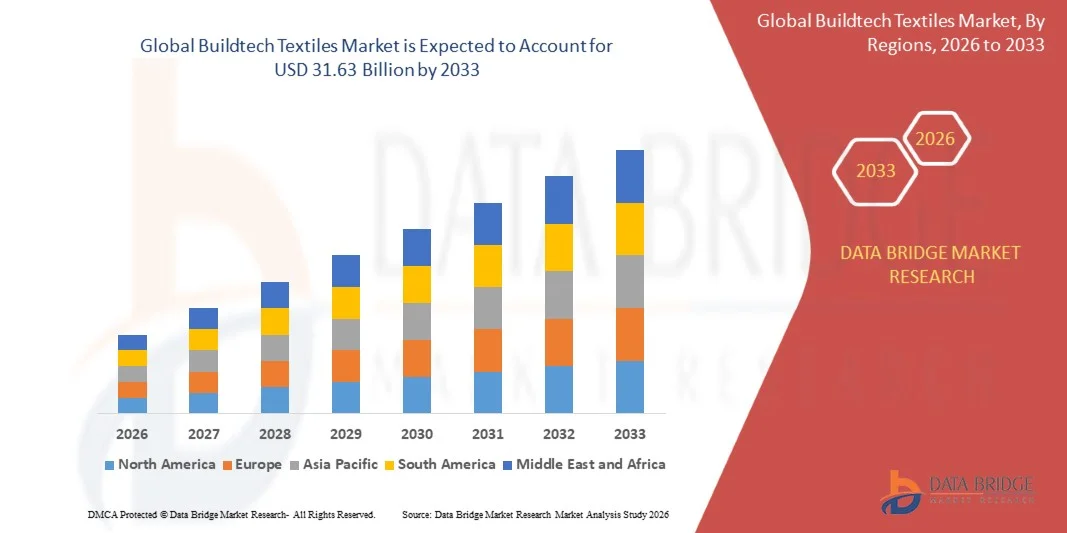
- As per Data Bridge Market Research analysis, the global buildtech textiles market is valued at USD 20.30 billion in 2025 and is projected to reach USD 31.63 billion by 2033, growing at a CAGR of 5.70% from 2026 to 2033.
- The market registers steady growth driven by rising awareness among builders regarding the use of sound-absorbing and heat insulation materials that are sustainable and durable, alongside increasing investments in infrastructure and commercial construction.
- Urban infrastructure expansion and fire safety codes force builders to replace conventional materials with engineered construction fabrics that meet stricter durability requirements. Changes in government regulations regarding reducing greenhouse gas emissions and promoting the development of energy-efficient and zero-energy buildings continue to complement market growth, positioning sustainability-focused manufacturers for long-term competitive advantage.
Market Size & Forecast
- Global Market Value (2025): USD 20.30 Billion
- Expected Market Value (2033): USD 31.63 Billion
- Forecast CAGR (2026–2033): 5.70%
What are the Major Takeaways of the Buildtech Textiles Market?
- Asia-Pacific dominates the global buildtech textiles market as the largest revenue-generating region in 2025, valued at USD 5.98 billion, driven by rapid infrastructure development and increasing emphasis on sustainable construction practices across developing economies.
- Asia-Pacific also registers the fastest growth among regions, with China expected to record the highest country-level CAGR from 2026 to 2033, reflecting the country's expanding domestic construction and infrastructure investment.
- The woven fabrics segment leads the market with the largest share of 25.42% in 2025, driven by its established use across concrete reinforcement, roofing membranes, and tensile architecture applications requiring high tensile strength.
- The composites segment registers the fastest CAGR of 8.24% from 2026 to 2033, driven by rising demand for lightweight, high-strength reinforcement materials in commercial and infrastructure construction projects.
- The polyester segment leads the market with the largest share of 28.12% in 2025, reflecting its established use across roofing, waterproofing, and geotextile applications owing to its durability and cost-effectiveness.
- The nylon segment registers a CAGR of 5.2% from 2026 to 2033, driven by its high tensile strength, high elasticity, and excellent resistance to abrasion in demanding structural applications.
- The water repellent segment leads the market with the largest share of 22.12% in 2025, driven by widespread requirements for waterproof and crack-resistant properties across roofing and building envelope applications.
- The flame retardant segment registers the fastest CAGR of 8.10% from 2026 to 2033, driven by stricter urban fire safety codes forcing builders to replace conventional materials with engineered fabrics that meet stringent durability requirements.
Report Scope and Buildtech Textiles Market Segmentation
|
Attributes |
Buildtech Textiles Key Market Insights |
|
Segments Covered |
|
|
Countries Covered |
North America
Europe
Asia-Pacific
Middle East and Africa
South America
|
|
Key Market Players |
|
|
Market Opportunities |
|
|
Value Added Data Infosets |
In addition to the insights on market scenarios such as market value, growth rate, segmentation, geographical coverage, and major players, the market reports curated by the Data Bridge Market Research also include import export analysis, production capacity overview, production consumption analysis, price trend analysis, climate change scenario, supply chain analysis, value chain analysis, raw material/consumables overview, vendor selection criteria, PESTLE Analysis, Porter Analysis, and regulatory framework. |
What is the Key Trend in the Buildtech Textiles Market?
- Leading technical textile manufacturers continue to pursue acquisitions that expand their coated fabric and building material portfolios.
- In September 2024, Freudenberg Performance Materials completed the acquisition of the core business of Heytex Group in Germany and China, subsequently merging the acquired business with its existing Mehler business to create a new combined brand, MehlerHeytex, strengthening its coated technical textiles capabilities for construction and architectural applications.
- Manufacturers continue to develop bio-based upholstery and structural solutions with expanding renewable content certification.
- In May 2024, Serge Ferrari Group continued expanding its bio-based upholstery solution, now containing 47% bio-based content and holding USDA approval, combining fire resistance compliance, five-year durability warranty, and sustainability credentials for architectural and building applications.
- Manufacturers continue to expand their presence in emerging construction markets through direct engagement with regional building material buyers.
- In February 2024, Serge Ferrari Group participated in the Big 5 Construct Saudi exhibition in Riyadh, engaging directly with regional construction and building material buyers to expand its presence across the Gulf Cooperation Council construction market.
- As leading manufacturers continue to pursue coated fabric acquisitions, expand bio-based material portfolios, and engage directly with emerging construction markets, the global buildtech textiles market sustains steady growth across both mature and rapidly developing infrastructure economies.
What are the Key Drivers of the Buildtech Textiles Market?
- Rising awareness among builders regarding sound-absorbing and heat insulation materials that are sustainable and durable continues to drive product demand across commercial and residential construction.
- In September 2024, Freudenberg Performance Materials' acquisition of Heytex Group's core business and its subsequent merger into the new MehlerHeytex brand illustrates continued manufacturer investment in expanding coated technical textile capabilities to meet rising construction sector demand.
- Increasing investments in infrastructure and commercial construction continue to fuel product demand across both developed and emerging markets.
- The change in government regulations regarding reducing greenhouse gas emissions and promoting the development of energy-efficient and zero-energy buildings continues to complement market growth and drive adoption of engineered construction fabrics.
- Integration of smart textiles with embedded sensors for real-time structural monitoring continues to expand the addressable market for advanced buildtech textile applications.
- With infrastructure and commercial construction investment continuing to rise and government regulations continuing to tighten around building energy efficiency, the global buildtech textiles market remains a durable growth category within the broader technical textiles and construction materials landscape.
Which Factors are Challenging the Growth of the Buildtech Textiles Market?
- Wide variance in published market size estimates across industry analysts, ranging from under USD 3 billion to over USD 111 billion for comparable base years, reflects the inherent difficulty in precisely defining and measuring the category given differing scope definitions across product types and applications.
- Raw material price volatility for polyester, polypropylene, and glass fiber inputs continues to create cost pressure for manufacturers across the industry.
- In September 2026, polyester prices in India's man-made textile sector increased by approximately ₹20 per kg, creating additional cost pressure for manufacturers. Industry representatives attributed the increase to raw-material market conditions and called for measures to improve price monitoring and reduce input-cost pressure.
- The technical complexity of achieving both fire resistance compliance and bio-based content certification requires substantial ongoing research and development investment from manufacturers seeking to meet evolving green building standards.
- Intensifying competition among established European manufacturers and emerging Asian producers continues to pressure pricing and margins across the industry.
- In June 2026, a scientific review highlighted the continuing technical challenge of developing bio-based flame-retardant textile materials that simultaneously provide effective fire protection and sustainability benefits. The research examined different bio-based flame-retardant materials, their functionalization, thermal performance, and application requirements, reflecting the ongoing technical development needed for sustainable fire-resistant textiles.
- The combination of definitional ambiguity across the category, raw material cost volatility, and intensifying competitive pricing pressure continues to create headwinds for the buildtech textiles market, even as sustained infrastructure and green building investment supports long-term category growth.
How is the Buildtech Textiles Market Segmented?
The global buildtech textiles market is segmented on the basis of product type, fiber type, coating and treatment, application, end-use industry, sales channel, and sustainability profile.
- By Product Type
On the basis of product type, the global buildtech textiles market is segmented into woven fabrics, nonwoven fabrics, knitted fabrics, composites, and others. The woven fabrics segment leads the market with the largest share of 25.42% in 2025, driven by its established use across concrete reinforcement, roofing membranes, and tensile architecture applications requiring high tensile strength.
The composites segment registers the fastest CAGR of 8.24% from 2026 to 2033, driven by rising demand for lightweight, high-strength reinforcement materials in commercial and infrastructure construction projects.
- By Fiber Type
On the basis of fiber type, the global buildtech textiles market is segmented into polyester, polypropylene, nylon, glass fiber, and others. The polyester segment leads the market with the largest share of 28.12% in 2025, reflecting its established use across roofing, waterproofing, and geotextile applications owing to its durability and cost-effectiveness.
The nylon segment registers a CAGR of 5.2% from 2026 to 2033, driven by its high tensile strength, high elasticity, and excellent resistance to abrasion in demanding structural applications.
- By Coating and Treatment
On the basis of coating and treatment, the global buildtech textiles market is segmented into flame retardant, water repellent, antimicrobial, UV resistant, and others. The water repellent segment leads the market with the largest share of 22.12% in 2025, driven by widespread requirements for waterproof and crack-resistant properties across roofing and building envelope applications.
The flame retardant segment registers the fastest CAGR of 8.10% from 2026 to 2033, driven by stricter urban fire safety codes forcing builders to replace conventional materials with engineered fabrics that meet stringent durability requirements.
- By Application
On the basis of application, the global buildtech textiles market is segmented into concrete reinforcement, roofing & insulation, interior construction, geotextiles & geomembranes, and noise prevention. The concrete reinforcement segment leads the market with the largest share of 32.11% in 2025, driven by widespread use in permanent and temporary structural applications requiring crack resistance and durability.
The roofing & insulation segment registers the fastest CAGR of 8.2% from 2026 to 2033, driven by rising demand for lightweight, breathable insulation fabrics improving thermal and sound insulation performance in residential and commercial construction.
- By End-Use Industry
On the basis of end-use industry, the global buildtech textiles market is segmented into commercial construction, residential construction, infrastructure, transportation, and others. The commercial construction segment leads the market with the largest share of 29.01% in 2025, driven by increasing demand for office spaces and their aesthetic appeal requirements across developing and developed economies.
The infrastructure segment registers the fastest CAGR of 8.80% from 2026 to 2033, driven by increasing investments in civil engineering structures and infrastructure development projects globally.
- By Sales Channel
On the basis of sales channel, the global buildtech textiles market is segmented into direct/OEM and distributors & retailers. The distributors & retailers segment leads the market with the largest share of 58.20% in 2025, reflecting the important role of regional partners in reaching construction contractors and building material suppliers.
The direct/OEM segment registers the fastest CAGR of 6.66% from 2026 to 2033, supported by continued large-account relationships between leading manufacturers and major construction firms.
- By Sustainability Profile
On the basis of sustainability profile, the global buildtech textiles market is segmented into conventional and recycled/bio-based. The conventional segment leads the market with the largest share of 62.13% in 2025, reflecting its continued widespread use across mass-market construction applications.
The recycled/bio-based segment registers the fastest CAGR of 7.81% from 2026 to 2033, driven by government regulations promoting energy-efficient and zero-energy buildings and reducing greenhouse gas emissions.
Which Region Holds the Largest Share of the Buildtech Textiles Market?
- Asia-Pacific dominates the global buildtech textiles market as the largest revenue-generating region in 2025, driven by rapid urbanization, infrastructure development, and increasing emphasis on sustainable construction practices across developing economies.
- The region benefits from expanding domestic manufacturing capacity, rising government infrastructure investment, and growing adoption of energy-efficient building standards. Continued expansion of commercial and residential construction activity reinforces Asia-Pacific's leadership position in the global market.
China Buildtech Textiles Market Insight
The China buildtech textiles market registers the highest country-level growth rate globally from 2026 to 2033, reflecting the country's expanding domestic construction and infrastructure investment alongside growing adoption of engineered construction fabrics across commercial and residential building projects.
Germany Buildtech Textiles Market Insight
The Germany buildtech textiles market remains anchored by the strong domestic presence of leading manufacturers, including Freudenberg Performance Materials and Verseidag-Indutex, reinforced by the September 2024 acquisition of Heytex Group's core business and its integration into the new MehlerHeytex brand.
France Buildtech Textiles Market Insight
The France buildtech textiles market benefits from the domestic presence of Serge Ferrari Group, a leading global manufacturer of flexible composite membranes for building applications, reinforced by the company's continued bio-based material innovation and expansion into emerging construction markets, including its February 2024 participation in the Big 5 Construct Saudi exhibition.
U.S. Buildtech Textiles Market Insight
The U.S. buildtech textiles market continues to grow steadily, supported by the domestic presence of leading manufacturers including DuPont, Owens Corning, Hexcel, and 3M, alongside sustained infrastructure and commercial construction investment across the country.
India Buildtech Textiles Market Insight
The India buildtech textiles market continues to expand, supported by the domestic presence of SRF Limited and growing infrastructure investment across the country's rapidly urbanizing commercial and residential construction sectors.
Which are the Top Companies in the Buildtech Textiles Market?
The global buildtech textiles industry is primarily led by well-established technical textile and construction materials companies, including:
- Serge Ferrari Group (France)
- Freudenberg Performance Materials SE & Co. KG (Germany)
- DuPont de Nemours, Inc. (U.S.)
- Toray Industries, Inc. (Japan)
- Saint-Gobain S.A. (France)
- Owens Corning (U.S.)
- Verseidag-Indutex GmbH (Germany)
- Ahlstrom Oyj (Finland)
- SKAPS Industries (U.S.)
- SRF Limited (India)
- Officine Maccaferri S.p.A. (Italy)
- TenCate Geosynthetics (Netherlands)
- Hexcel Corporation (U.S.)
- 3M Company (U.S.)
- Sika AG (Switzerland)
- BASF SE (Germany)
- Propex Operating Company, LLC (U.S.)
- Solmax International Inc. (Canada)
- GKD Gebr. Kufferath AG (Germany)
- Low & Bonar (Freudenberg Group) (U.K.)
What are the Latest Developments in the Buildtech Textiles Market?
- In September 2024, Freudenberg Performance Materials completed the acquisition of the core business of Heytex Group in Germany and China, subsequently merging it with its existing Mehler business to create a new combined brand, MehlerHeytex.
- In May 2024, Serge Ferrari Group continued expanding its bio-based upholstery solution, now containing 47% bio-based content and holding USDA approval, combining fire resistance compliance and a five-year durability warranty.
- In February 2024, Serge Ferrari Group participated in the Big 5 Construct Saudi exhibition in Riyadh, engaging directly with regional construction and building material buyers to expand its presence across the Gulf Cooperation Council construction market.
- In November 2025, Freudenberg Group reported total sales of USD 13,383.3 million for fiscal year 2025, with technical textiles remaining among the company's core market segments despite weaker demand in certain core end markets, including automotive.
- In March 2025, leading manufacturers continued to develop smart textiles with embedded sensors for real-time structural monitoring, alongside growing adoption of nanotechnology to enhance material durability and functionality.

- Interactive Data Analysis Dashboard
- Company Analysis Dashboard for high growth potential opportunities
- Research Analyst Access for customization & queries
- Competitor Analysis with Interactive dashboard
- Latest News, Updates & Trend analysis
- Harness the Power of Benchmark Analysis for Comprehensive Competitor Tracking
Global Buildtech Textiles Market, Supply Chain Analysis and Ecosystem Framework
To support market growth and help clients navigate the impact of geopolitical shifts, DBMR has integrated in-depth supply chain analysis into its Global Buildtech Textiles Market research reports. This addition empowers clients to respond effectively to global changes affecting their industries. The supply chain analysis section includes detailed insights such as Global Buildtech Textiles Market consumption and production by country, price trend analysis, the impact of tariffs and geopolitical developments, and import and export trends by country and HSN code. It also highlights major suppliers with data on production capacity and company profiles, as well as key importers and exporters. In addition to research, DBMR offers specialized supply chain consulting services backed by over a decade of experience, providing solutions like supplier discovery, supplier risk assessment, price trend analysis, impact evaluation of inflation and trade route changes, and comprehensive market trend analysis.
Data collection and base year analysis are done using data collection modules with large sample sizes. The stage includes obtaining market information or related data through various sources and strategies. It includes examining and planning all the data acquired from the past in advance. It likewise envelops the examination of information inconsistencies seen across different information sources. The market data is analysed and estimated using market statistical and coherent models. Also, market share analysis and key trend analysis are the major success factors in the market report. To know more, please request an analyst call or drop down your inquiry.
The key research methodology used by DBMR research team is data triangulation which involves data mining, analysis of the impact of data variables on the market and primary (industry expert) validation. Data models include Vendor Positioning Grid, Market Time Line Analysis, Market Overview and Guide, Company Positioning Grid, Patent Analysis, Pricing Analysis, Company Market Share Analysis, Standards of Measurement, Global versus Regional and Vendor Share Analysis. To know more about the research methodology, drop in an inquiry to speak to our industry experts.
Data Bridge Market Research is a leader in advanced formative research. We take pride in servicing our existing and new customers with data and analysis that match and suits their goal. The report can be customized to include price trend analysis of target brands understanding the market for additional countries (ask for the list of countries), clinical trial results data, literature review, refurbished market and product base analysis. Market analysis of target competitors can be analyzed from technology-based analysis to market portfolio strategies. We can add as many competitors that you require data about in the format and data style you are looking for. Our team of analysts can also provide you data in crude raw excel files pivot tables (Fact book) or can assist you in creating presentations from the data sets available in the report.













