


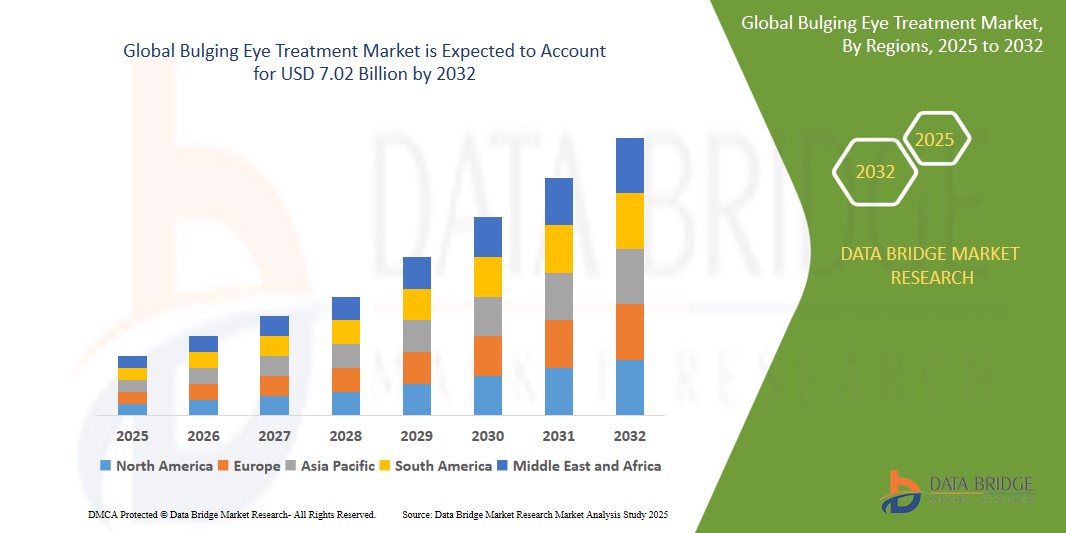
Bulging Eye Treatment Market Size
- The Global Bulging Eye Treatment Market size was valued at USD 4.68 billion in 2024 and is expected to reach USD 7.02 million by 2032, at a CAGR of 5.20% during the forecast period
- This growth is driven by factors such as the increasing prevalence of thyroid eye disease and other underlying conditions, growing awareness and early diagnosis of eye disorders, and rising demand for effective, minimally invasive treatment options
Bulging Eye Treatment Market Analysis
-
Bulging eye is also referred to as proptosis which is a severe condition of the eye described by swelling of one or both eyes socket because of the inflammation of tissue behind and around the eye. This trigger pushes the cornea forward and makes it more problematic for the eyes to lubricant and get moist
-
The demand for Bulging Eye Treatment is significantly driven by the rising incidence of thyroid eye disease and other orbital disorders, increasing awareness through public health initiatives, and technological advancements in diagnostics and minimally invasive treatment options.
- North America is expected to dominate the Bulging Eye Treatment market with a share of 36.4%, attributed to its advanced healthcare infrastructure, high adoption of cutting-edge therapeutic technologies, and the strong presence of key pharmaceutical and medical device companies.
- Asia-Pacific is projected to be the fastest-growing region in the Bulging Eye Treatment market during the forecast period, driven by rapid expansion of healthcare facilities, rising awareness of eye-related disorders, and increasing patient volumes undergoing ophthalmic evaluations and interventions.
- The medication segment is expected to lead the market with a share of 34.5%, due to its widespread clinical use, cost-effectiveness, and familiarity among healthcare providers. While emerging surgical and radiological interventions are gaining traction, medical management—especially corticosteroids and immunosuppressants—remains the cornerstone of treatment due to its effectiveness in reducing inflammation and managing symptoms in the majority of cases
Report Scope and Bulging Eye Treatment Market Segmentation
|
Attributes |
Bulging Eye Treatment Key Market Insights |
|
Segments Covered |
|
|
Countries Covered |
North America
Europe
Asia-Pacific
Middle East and Africa
South America
|
|
Key Market Players |
|
|
Market Opportunities |
|
|
Value Added Data Infosets |
In addition to the insights on market scenarios such as market value, growth rate, segmentation, geographical coverage, and major players, the market reports curated by the Data Bridge Market Research also include import export analysis, production capacity overview, production consumption analysis, price trend analysis, climate change scenario, supply chain analysis, value chain analysis, raw material/consumables overview, vendor selection criteria, PESTLE Analysis, Porter Analysis, and regulatory framework. |
Bulging Eye Treatment Market Trends
“Increasing Adoption of Minimally Invasive and Biologic Therapies for Bulging Eye Management”
-
One prominent trend in Bulging Eye Treatment is the increasing adoption of minimally invasive and biologic therapies for managing thyroid eye disease and related orbital disorders
- This shift is driven by the growing need for targeted treatments that offer symptom relief with fewer side effects, especially in chronic or autoimmune-related eye conditions like Graves' orbitopathy
- For instance, Tepezza (teprotumumab-trbw) by Horizon Therapeutics has gained attention as the first FDA-approved biologic treatment for thyroid eye disease, offering a non-surgical option that significantly reduces eye bulging and improves quality of life.
- This trend is significantly transforming the treatment landscape by reducing reliance on invasive surgeries, enabling earlier intervention, and improving patient outcomes through precision medicine.
- The Bulging Eye Treatment market is poised for sustained growth, fueled by advancements in biologic drug development, increasing patient awareness, and the global push for less invasive, more effective therapeutic alternatives. As clinical adoption of novel therapies expands, this trend is expected to reshape long-term management strategies for orbital disorders.
Bulging Eye Treatment Market Dynamics
Driver
“Growing Prevalence of Thyroid Eye Disease and Autoimmune Disorders Driving Treatment Demand”
- The growing prevalence of thyroid eye disease and other autoimmune disorders is significantly driving the demand for more effective and tailored treatments in the Bulging Eye Treatment Market.
- As the incidence of thyroid eye disease (TED) increases, there is a rising need for therapies that can address the unique challenges of bulging eyes, including inflammation, tissue swelling, and visual impairments
- Increased awareness and early diagnosis of TED are driving a greater demand for targeted therapies, which are less invasive than traditional surgical options. These advances have led to improved patient outcomes and the ability to manage symptoms more effectively at earlier stages of the disease
For instance,
- biologic treatments like Tepezza (teprotumumab-trbw) have become a game-changer for TED management. As the first FDA-approved treatment for TED, it offers a non-surgical approach that helps reduce eye bulging, improve visual acuity, and alleviate discomfort, significantly enhancing quality of life for patients.
- This driver reflects the increasing need for specialized treatments tailored to autoimmune-related eye conditions, paving the way for more innovative, patient-friendly, and cost-effective solutions in the market. As the prevalence of TED continues to rise globally, the demand for advanced treatments that reduce reliance on invasive procedures is expected to further fuel market growth
Opportunity
“Expanding Market Opportunities in Emerging Economies Due to Improved Healthcare Access and Rising Awareness of Thyroid Eye Disease”
- The increasing healthcare access and rising awareness of thyroid eye disease (TED) in emerging economies are creating significant opportunities for expanding the Bulging Eye Treatment Market. Strategic partnerships between pharmaceutical companies, healthcare providers, and local governments are helping to improve the availability and adoption of advanced treatment options
- These collaborations are driving the development of more accessible, cost-effective, and region-specific therapies for TED, making it easier for patients in emerging markets to receive timely care. This includes the integration of biologic therapies and minimally invasive treatment options into clinical practice
- As the demand for effective TED treatments grows in these regions, the need for affordable, high-quality therapies becomes essential. Partnerships enable the rapid introduction of innovative treatments, allowing healthcare systems to address unmet needs while improving patient outcomes
For instance,
- Horizon Therapeutics' partnerships with healthcare providers in countries like India and Brazil have facilitated the availability of its biologic therapy Tepezza in these emerging markets, enabling patients with TED to access cutting-edge treatment options for managing eye bulging and associated symptoms.
The rise in strategic collaborations between pharmaceutical companies and healthcare providers presents a significant growth opportunity for the Bulging Eye Treatment market, making advanced therapies more accessible and improving patient outcomes in regions with previously limited treatment options.
Restraint/Challenge
“High Treatment Costs and Limited Insurance Coverage Hindering Market Growth”
- The high cost of Bulging Eye Treatment therapies and associated medical devices presents a significant challenge for the market, especially in developing regions. These treatments, which are essential for managing thyroid eye disease and other eye disorders, can be prohibitively expensive, limiting access to advanced care.
- Biologic therapies, advanced imaging systems, and surgical equipment required for bulging eye management can cost tens of thousands to hundreds of thousands of dollars, depending on the type and complexity of the treatment or technology. This financial burden often deters healthcare facilities in resource-constrained areas from adopting the latest treatment methods.
- The substantial costs associated with these advanced therapies and diagnostic tools can prevent smaller hospitals and clinics with limited budgets from upgrading their equipment. As a result, they may continue relying on older, less effective treatment options, creating a barrier to the adoption of the most efficient, minimally invasive therapies.
For instance,
- In several developing countries, smaller hospitals are still using traditional surgical methods and older imaging technologies due to the high upfront cost of newer biologic treatments and imaging systems.
- As a result, these financial constraints contribute to disparities in the availability of advanced eye treatment options, hindering market growth and limiting access to optimal care in certain regions
Bulging Eye Treatment Market Scope
The market is segmented on the basis of treatment, drugs, medication type, route of administration and end users.
|
Segmentation |
Sub-Segmentation |
|
By Treatment |
|
|
By Drugs |
|
|
By Medication Type |
|
|
By Route of Administration |
|
|
By Route of Administration |
|
In 2025, the Medication is projected to dominate the market with a largest share in treatment segment
The Medication segment is expected to dominate the Bulging Eye Treatment market with the largest share of 34.5% in 2025 due to its widespread clinical adoption, cost-effectiveness, and procedural familiarity among ophthalmologists and clinicians. Despite the development of newer therapies such as biologics and surgical interventions, corticosteroids and immunosuppressants remain the first-line treatment for conditions like thyroid eye disease due to their proven effectiveness, ease of use, and lower cost. Their long-established role in managing symptoms such as inflammation and bulging continues to solidify their dominant position in the marke.
The Corticosteroids is expected to account for the largest share during the forecast period in drug segment
In 2025, the Corticosteroids segment is expected to dominate the market due to their effectiveness in reducing inflammation and managing symptoms of thyroid eye disease (TED). These treatments are widely adopted for their cost-effectiveness, non-invasive nature, and procedural familiarity among ophthalmologists. Corticosteroids, unlike more invasive surgical options, offer a safer, flexible, and less risky alternative for managing eye bulging and other TED symptoms. Their established clinical use and long-standing track record in improving patient outcomes continue to drive their prominence in the market, especially in the management of moderate-to-severe TED cases.
Bulging Eye Treatment Market Regional Analysis
“North America Holds the Largest Share in the Bulging Eye Treatment Market”
-
North America dominates the Bulging Eye Treatment market with a share of 36.4%, driven by advanced healthcare infrastructure, the widespread adoption of cutting-edge treatment options, and the strong presence of key pharmaceutical and medical device companies
- The U.S. holds a significant share of 78.3%, driven by the high demand for effective therapies for thyroid eye disease (TED), the presence of advanced biologic treatments, and increasing patient access to specialized care. The country's robust healthcare system, coupled with high levels of healthcare expenditure, supports the growth of this segment
- The presence of leading companies such as Horizon Therapeutics, Tepezza (teprotumumab-trbw), and Alcon, alongside continuous advancements in biologic and surgical treatments, continues to drive innovation in TED management. Moreover, significant investments in research and development (R&D) ensure ongoing improvements in treatment options, further enhancing the market's expansion.
- The growing prevalence of thyroid eye disease, along with rising patient awareness and a shift toward minimally invasive treatments, continues to support the market's growth in North America. As healthcare standards improve, the demand for more effective, patient-friendly therapies will continue to rise, solidifying North America's dominant position in the market.
“Asia-Pacific is Projected to Register the Highest CAGR in the Bulging Eye Treatment Market”
-
The Asia-Pacific region is expected to witness the highest growth rate in the Bulging Eye Treatment market, driven by rapid improvements in healthcare infrastructure, increasing awareness of thyroid eye disease (TED), and rising patient volumes seeking treatment.
- Countries such as China, India, and Japan are emerging as key markets for TED treatment options due to the increasing prevalence of thyroid disorders and the growing demand for advanced, non-invasive therapies. Rising awareness campaigns and early diagnosis initiatives are fueling the adoption of biologic treatments and minimally invasive techniques in these regions.
- Japan, with its highly developed medical infrastructure, remains a critical market for innovative TED therapies. The country continues to lead in the adoption of cutting-edge biologics and treatment technologies, improving the effectiveness and efficiency of TED management.
- The growing focus on healthcare expansion and the rising number of TED cases is expected to drive the demand for advanced treatments, making the Asia-Pacific region the fastest-growing market for bulging eye treatments and related therapies
Bulging Eye Treatment Market Share
The market competitive landscape provides details by competitor. Details included are company overview, company financials, revenue generated, market potential, investment in research and development, new market initiatives, global presence, production sites and facilities, production capacities, company strengths and weaknesses, product launch, product width and breadth, application dominance. The above data points provided are only related to the companies' focus related to market.
The Major Market Leaders Operating in the Market Are:
- Horizon Therapeutics plc (U.S.)
- Santen Pharmaceutical Co., Ltd (Japan)
- Bausch Health (Canada)
- Kala Pharmaceuticals (U.S.)
- Pharmos Corp (U.S.)
- Akorn, Incorporated (U.S.)
- Novartis AG (Switzerland)
- ALLERGAN (U.S.)
- Eyevance Pharmaceuticals LLC (U.S.)
- Noveome Biotherapeutics, Inc (U.S.)
- OCUNEXUS THERAPEUTICS, INC (U.S.)
- Alcon (Switzerland)
- Merck & Co., Inc (U.S.)
- Pfizer Inc (U.S.)
- Bristol-Myers Squibb Company (U.S.)
- Sanofi (France)
- Sun Pharmaceutical Industries Ltd. (India)
- GlaxoSmithKline Plc. (U.K.)
- Lupin Pharmaceuticals Inc. (India)
- Bayer AG (Germany)
Latest Developments in Global Bulging Eye Treatment Market
- In April 2025, Avulux migraine glasses, developed with optical technology to manage photophobia, joined the FDA-funded CTIP pediatric medical device accelerator program in the U.S.
- In November 2024, Novoxel Inc. launched Tixel i in the U.S. after FDA clearance. This two-minute Thermo-Mechanical Action treatment significantly reduced dry eye symptoms for patients with Meibomian Gland Dysfunction.

- Interactive Data Analysis Dashboard
- Company Analysis Dashboard for high growth potential opportunities
- Research Analyst Access for customization & queries
- Competitor Analysis with Interactive dashboard
- Latest News, Updates & Trend analysis
- Harness the Power of Benchmark Analysis for Comprehensive Competitor Tracking
Data collection and base year analysis are done using data collection modules with large sample sizes. The stage includes obtaining market information or related data through various sources and strategies. It includes examining and planning all the data acquired from the past in advance. It likewise envelops the examination of information inconsistencies seen across different information sources. The market data is analysed and estimated using market statistical and coherent models. Also, market share analysis and key trend analysis are the major success factors in the market report. To know more, please request an analyst call or drop down your inquiry.
The key research methodology used by DBMR research team is data triangulation which involves data mining, analysis of the impact of data variables on the market and primary (industry expert) validation. Data models include Vendor Positioning Grid, Market Time Line Analysis, Market Overview and Guide, Company Positioning Grid, Patent Analysis, Pricing Analysis, Company Market Share Analysis, Standards of Measurement, Global versus Regional and Vendor Share Analysis. To know more about the research methodology, drop in an inquiry to speak to our industry experts.
Data Bridge Market Research is a leader in advanced formative research. We take pride in servicing our existing and new customers with data and analysis that match and suits their goal. The report can be customized to include price trend analysis of target brands understanding the market for additional countries (ask for the list of countries), clinical trial results data, literature review, refurbished market and product base analysis. Market analysis of target competitors can be analyzed from technology-based analysis to market portfolio strategies. We can add as many competitors that you require data about in the format and data style you are looking for. Our team of analysts can also provide you data in crude raw excel files pivot tables (Fact book) or can assist you in creating presentations from the data sets available in the report.












