


What is the Bulk Acoustic Wave Sensors Market Size and Overview?
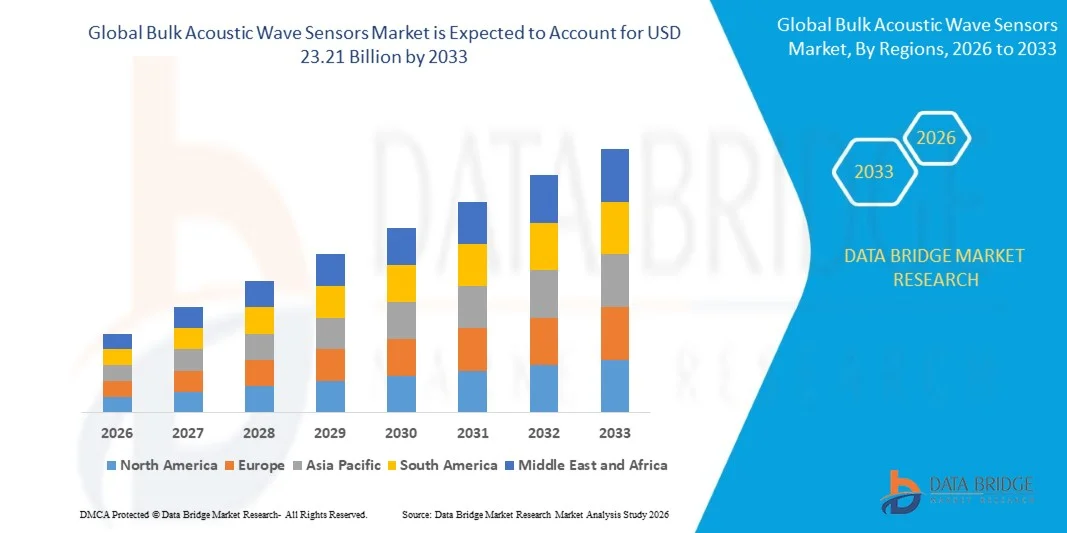
As per Data Bridge Market Research Analysis the global bulk acoustic wave sensors market was valued at USD 8.49 billion in 2025 and is projected to reach USD 23.21 billion by 2033, growing at a CAGR of 13.4% from 2026 to 2033. The market is experiencing consistent growth driven by increasing demand for high-frequency RF filtering technologies, rapid expansion of 5G and Wi-Fi 6E/7 networks, and rising adoption of miniaturized sensing solutions across consumer electronics, automotive, and industrial applications. Continuous advancements in MEMS-based acoustic wave technologies and growing semiconductor integration are further accelerating market expansion across global regions.
The increasing demand for high-performance communication systems, combined with the rapid proliferation of connected devices and IoT ecosystems, is significantly driving the adoption of bulk acoustic wave sensors. These sensors are increasingly used for precise frequency control, signal filtering, and environmental sensing in advanced electronic systems, enabling improved performance, reduced interference, and enhanced energy efficiency across multiple end-use industries.
Market Size & Forecast
- Global Market Value (2025): USD 8.49 Billion
- Expected Market Value (2033): USD 23.21 Billion
- Forecast CAGR (2026–2033): 13.4%
- Leading Region in 2025: Asia-Pacific
- Fastest Growing Region: North America
Key Market Trends & Insights
- Asia-Pacific dominated the global bulk acoustic wave sensors market with the largest revenue share of 45.5% in 2025, supported by strong presence of semiconductor manufacturing hubs, expanding consumer electronics production, and rapid deployment of advanced wireless communication infrastructure across the region
- The Film Bulk Acoustic Resonator (FBAR) segment led the market with a 46.8% share in 2025, driven by its superior frequency control, compact size, and high sensitivity in wireless communication systems
- North America is expected to be the fastest-growing region at a CAGR of 13.3% from 2026 to 2033, fueled by increasing deployment of 5G communication networks, rising demand for advanced healthcare diagnostics, and growing adoption of IoT-enabled sensing technologies
- Shear Bulk Acoustic Wave (S-BAW) are the fastest-growing product type, projected to register a CAGR of 14.2% from 2026 to 2033, supported by rising demand for highly accurate liquid and biochemical sensing applications
- The Aluminum Nitride (AlN) segment dominated the raw material category with a 39.6% revenue share in 2025, led by its excellent piezoelectric properties, high thermal conductivity, and compatibility with semiconductor manufacturing processes
- Temperature accounted for 34.4% of the market in 2025, preferred by extensive utilization of acoustic wave sensors in industrial automation, automotive systems, and consumer electronics for accurate thermal monitoring
- The chemical segment is the fastest-growing sensing parameter category, with a CAGR of 15.1% from 2026 to 2033, driven by increasing demand for real-time chemical detection and environmental monitoring systems
Report Scope and Global Bulk Acoustic Wave Sensors Market Segmentation
|
Attributes |
Bulk Acoustic Wave Sensors Key Market Insights |
|
Segments Covered |
|
|
Countries Covered |
North America
Europe
Asia-Pacific
Middle East and Africa
South America
|
|
Key Market Players |
|
|
Market Opportunities |
|
|
Value Added Data Infosets |
In addition to the insights on market scenarios such as market value, growth rate, segmentation, geographical coverage, and major players, the market reports curated by the Data Bridge Market Research also include in-depth expert analysis, geographically represented company-wise production and capacity, network layouts of distributors and partners, detailed and updated price trend analysis and deficit analysis of supply chain and demand. |
What is the Key Trend in the Bulk Acoustic Wave Sensors Market?
Trend: Growing Use of BAW Filters in 5G and Wi-Fi 6E/7 Systems
Bulk Acoustic Wave sensors are witnessing strong demand growth due to rapid expansion of next-generation wireless communication networks. Increasing deployment of 5G infrastructure and Wi-Fi 6E/7-enabled devices is driving extensive use of BAW-based RF filters for high-frequency signal control, low insertion loss, and improved network efficiency. Rising adoption of smartphones, IoT devices, and connected industrial systems is further strengthening the integration of acoustic wave technologies in advanced electronics.
Companies such as Broadcom and Qorvo are widely deploying FBAR/BAW filter technologies in RF front-end modules used in 5G smartphones and wireless infrastructure, significantly supporting market expansion.
Bulk Acoustic Wave Sensors Market Dynamics
Key Market Driver: Rising Demand for High-Frequency RF Signal Processing
The increasing need for efficient high-frequency signal processing in modern communication and sensing systems is a major driver for the Bulk Acoustic Wave Sensors market. These sensors enable precise frequency filtering, stable signal transmission, and reduced interference in compact electronic devices. Rapid growth in telecom infrastructure, automotive connectivity systems, and industrial IoT platforms is further accelerating adoption of BAW-based technologies.
Broadcom has extensively commercialized FBAR-based BAW filters in smartphones and RF modules, enabling improved performance in 5G communication networks and high-speed wireless applications across global markets.
Key Restraint/Challenge: High Fabrication Cost and Complex Manufacturing
A key challenge in the Bulk Acoustic Wave Sensors market is the high cost and technical complexity associated with fabrication and wafer-level manufacturing processes. Production of BAW devices requires advanced thin-film deposition, precision lithography, and strict material control, which increases overall manufacturing costs and limits scalability for new entrants. The requirement for highly specialized semiconductor facilities further adds to capital intensity and production constraints.
Companies such as Akoustis Technologies and Resonant Inc. have highlighted these manufacturing challenges in scaling advanced XBAW and RF filter technologies for mass-market deployment, reflecting the broader industry limitation in cost-efficient production.
Key Market Opportunity: Rising Integration in Healthcare Biosensing and Diagnostic Applications
The expanding use of bulk acoustic wave technology in biosensing and healthcare diagnostics presents a significant market opportunity. BAW sensors are increasingly being used for real-time biological detection, chemical sensing, and medical monitoring due to their high sensitivity and accuracy in detecting minute mass changes. Growing demand for point-of-care diagnostics and wearable health monitoring devices is accelerating adoption across medical applications.
AWSensors and Biolin Scientific are actively utilizing quartz crystal microbalance and acoustic wave sensing technologies in biochemical analysis and biosensing platforms, supporting broader integration of acoustic wave technologies in healthcare and life sciences applications.
How is the Bulk Acoustic Wave Sensors Market Segmented?
The bulk acoustic wave sensors market is segmented on the basis of product type, raw material, sensing parameter, and end-user.
- By Product Type
On the basis of product type, the global Bulk Acoustic Wave Sensors market is segmented into Film Bulk Acoustic Resonator (FBAR), Shear Bulk Acoustic Wave (S-BAW), Longitudinal Bulk Acoustic Wave (L-BAW), and Lamb Wave. The Film Bulk Acoustic Resonator (FBAR) segment dominated the market with the largest share of 46.8% in 2025, driven by its superior frequency control, compact size, and high sensitivity in wireless communication systems. FBAR sensors are extensively utilized in smartphones, 5G infrastructure, and advanced RF filtering applications due to their capability to operate efficiently at high frequencies. Increasing adoption of connected consumer electronics and IoT devices is further strengthening demand for FBAR-based sensing technologies. The segment also benefits from continuous advancements in miniaturized semiconductor integration and wafer-level packaging technologies. Strong investments in next-generation communication infrastructure continue to reinforce its dominant position in the market
The Shear Bulk Acoustic Wave (S-BAW) segment is projected to register the fastest growth at a CAGR of 14.2% from 2026 to 2033, driven by rising demand for highly accurate liquid and biochemical sensing applications. S-BAW sensors provide enhanced sensitivity in viscous environments, making them highly suitable for healthcare diagnostics, chemical detection, and industrial process monitoring. Growing expansion of biosensor technologies and wearable medical devices is accelerating adoption across healthcare and life science sectors. Advancements in piezoelectric materials and MEMS fabrication are improving sensor reliability and operational stability. Increasing focus on real-time monitoring and precision sensing solutions across industrial and medical applications is significantly supporting segment expansion
- By Raw Material
On the basis of raw material, the global Bulk Acoustic Wave Sensors market is segmented into Aluminum Nitride (AlN), Zinc Oxide (ZnO), Lead Zirconium Titanate (PZT), SiO2, Lithium Niobate (LiNbO3), Lithium Tantalate (LiTaO3), Silicon Carbide (SiC), Gallium Arsenide (GaAs), Langasite (LGS), Polyvinylidene Fluoride (PVDF), and Others. The Aluminum Nitride (AlN) segment dominated the market with the largest share of 39.6% in 2025, supported by its excellent piezoelectric properties, high thermal conductivity, and compatibility with semiconductor manufacturing processes. AlN-based sensors are widely preferred in RF communication systems and high-frequency sensing applications due to their operational stability and low acoustic losses. The material also supports efficient miniaturization required for compact electronic devices and wireless modules. Rising deployment of 5G-enabled devices and advanced telecommunication infrastructure is significantly increasing demand for AlN-based acoustic sensors. Continuous innovations in thin-film deposition technologies are further enhancing segment growth and commercial adoption
The Lithium Niobate (LiNbO3) segment is projected to register the fastest growth at a CAGR of 13.7% from 2026 to 2033, driven by its superior electromechanical coupling efficiency and high-frequency signal processing capabilities. LiNbO3 materials are increasingly utilized in advanced sensing systems requiring precise acoustic wave propagation and low signal distortion. Growing adoption in telecommunications, aerospace electronics, and medical diagnostic equipment is accelerating market expansion. Advancements in photonic integration and hybrid acoustic-electronic systems are further improving material utilization across next-generation devices. Increasing focus on high-performance sensing solutions for emerging wireless and industrial applications is supporting strong segment growth globally
- By Sensing Parameter
On the basis of sensing parameter, the global Bulk Acoustic Wave Sensors market is segmented into temperature, pressure, chemical, humidity, and others. The Temperature segment dominated the market with the largest share of 34.4% in 2025, driven by extensive utilization of acoustic wave sensors in industrial automation, automotive systems, and consumer electronics for accurate thermal monitoring. Temperature sensing applications require high precision, rapid response time, and operational stability, which significantly favor bulk acoustic wave technologies. Rising integration of smart sensing systems in electric vehicles, industrial equipment, and wireless devices is further supporting demand growth. The segment also benefits from increasing deployment of predictive maintenance solutions across manufacturing and energy sectors. Continuous advancements in high-temperature resistant sensor materials are reinforcing its leading market position
The Chemical segment is projected to register the fastest growth at a CAGR of 15.1% from 2026 to 2033, driven by increasing demand for real-time chemical detection and environmental monitoring systems. Bulk acoustic wave chemical sensors offer high sensitivity and rapid detection capabilities for gases, toxins, and volatile compounds across industrial and healthcare applications. Growing concerns regarding industrial emissions, workplace safety, and environmental pollution are significantly accelerating adoption. Advancements in nanomaterial coatings and selective sensing technologies are improving detection accuracy and operational efficiency. Rising investments in smart laboratories, healthcare diagnostics, and industrial safety infrastructure are strongly contributing to segment expansion
- By End-User
On the basis of end-user, the global Bulk Acoustic Wave Sensors market is segmented into telecommunications, consumer electronics, automotive, healthcare, aerospace & defense, industrial, and others. The Telecommunications segment dominated the market with the largest share of 41.3% in 2025, driven by widespread deployment of bulk acoustic wave sensors in RF filters, signal processing modules, and high-frequency communication systems. Rapid expansion of 5G networks and increasing global demand for high-speed wireless connectivity are significantly boosting adoption across telecommunication infrastructure. These sensors enable improved signal integrity, reduced interference, and enhanced network performance in advanced communication devices. Strong penetration of smartphones, connected devices, and IoT ecosystems is further supporting market demand. Continuous investment in next-generation wireless technologies continues to strengthen the segment’s dominant position globally
The Healthcare segment is projected to register the fastest growth at a CAGR of 14.8% from 2026 to 2033, driven by increasing adoption of acoustic wave sensing technologies in medical diagnostics, biosensors, and wearable healthcare devices. Bulk acoustic wave sensors provide highly accurate and real-time monitoring capabilities for biological and chemical analysis applications. Growing demand for portable diagnostic systems and personalized healthcare solutions is accelerating deployment across hospitals and research laboratories. Advancements in microfabrication technologies and biocompatible materials are improving sensor precision and operational reliability. Rising healthcare digitalization and expansion of remote patient monitoring systems are significantly supporting long-term segment growth
Which Region Holds the Largest Share of the Bulk Acoustic Wave Sensors Market?
Asia-Pacific dominated the bulk acoustic wave sensors market and accounted for the largest revenue share of 45.5% in 2025, the strong presence of semiconductor manufacturing hubs, expanding consumer electronics production, and rapid deployment of advanced wireless communication infrastructure across the region. The market benefits from increasing integration of bulk acoustic wave sensors in smartphones, IoT devices, automotive electronics, and industrial automation systems. Rising investments in 5G infrastructure, MEMS technologies, and high-frequency RF components are significantly accelerating regional market expansion. Strong government support for semiconductor localization and electronics manufacturing is further reinforcing Asia-Pacific’s leadership in the global market
China Bulk Acoustic Wave Sensors Market Insight
China held the largest share in the Asia-Pacific Bulk Acoustic Wave Sensors market in 2025, supported by its dominant semiconductor manufacturing ecosystem and extensive production of smartphones, telecommunication equipment, and connected electronic devices. The country has established large-scale electronics supply chains and wafer fabrication facilities that enable high-volume integration of acoustic wave sensors in advanced communication systems. Strong domestic demand for 5G-enabled devices, industrial automation equipment, and automotive electronics is further supporting market growth. In addition, increasing investments in domestic semiconductor innovation and RF component manufacturing are strengthening China’s leading position in the global sensor industry.
India Bulk Acoustic Wave Sensors Market Insight
India is witnessing the fastest growth in the Asia-Pacific region, driven by rapid expansion of consumer electronics manufacturing, increasing deployment of 5G infrastructure, and rising adoption of smart devices across industrial and commercial sectors. Growing government initiatives supporting semiconductor fabrication and electronics localization are significantly contributing to market development. Rising integration of acoustic wave sensors in automotive electronics, wearable healthcare devices, and wireless communication systems is further accelerating demand. In addition, increasing investments in IoT technologies, industrial automation, and digital connectivity infrastructure are supporting long-term market growth across the country.
Europe Bulk Acoustic Wave Sensors Market Insight
The Europe Bulk Acoustic Wave Sensors market is expanding steadily, supported by increasing demand for high-performance sensing technologies across automotive, aerospace, healthcare, and industrial automation industries. Strong adoption of advanced RF communication systems and precision sensing technologies is significantly contributing to regional market expansion. The region is also witnessing rising investments in electric vehicles, connected mobility systems, and Industry 4.0 infrastructure, which are increasing deployment of acoustic wave sensors. In addition, growing focus on semiconductor innovation and high-frequency wireless technologies is strengthening the market outlook across Europe.
Germany Bulk Acoustic Wave Sensors Market Insight
Germany accounted for the largest share in the Europe Bulk Acoustic Wave Sensors market in 2025, driven by its strong automotive electronics industry, advanced industrial automation ecosystem, and extensive adoption of precision sensing technologies. The country has a well-established semiconductor and manufacturing infrastructure supporting integration of acoustic wave sensors in electric vehicles, factory automation systems, and wireless communication equipment. Rising deployment of Industry 4.0 technologies and smart manufacturing platforms is further supporting market demand. In addition, increasing investments in automotive connectivity and advanced RF communication systems are reinforcing Germany’s leading market position.
U.K. Bulk Acoustic Wave Sensors Market Insight
The U.K. market is supported by growing adoption of advanced sensing technologies in telecommunications, healthcare devices, aerospace electronics, and industrial monitoring systems. Increasing demand for high-frequency communication infrastructure and connected electronic devices is accelerating utilization of bulk acoustic wave sensors across the country. The market is also benefiting from rising investments in medical diagnostics, wearable healthcare technologies, and defense communication systems. In addition, expansion of semiconductor research activities and wireless innovation programs is further supporting market growth.
North America Bulk Acoustic Wave Sensors Market Insight
North America is projected to grow at the fastest CAGR of 13.3% from 2026 to 2033, driven by increasing deployment of 5G communication networks, rising demand for advanced healthcare diagnostics, and growing adoption of IoT-enabled sensing technologies. Strong investments in semiconductor innovation, aerospace electronics, and next-generation wireless infrastructure are significantly supporting market expansion across the region. Increasing utilization of bulk acoustic wave sensors in automotive safety systems, defense communication platforms, and industrial automation applications is further accelerating adoption. In addition, rising focus on miniaturized high-frequency sensors and precision monitoring technologies is boosting long-term regional market growth.
U.S. Bulk Acoustic Wave Sensors Market Insight
The U.S. accounted for the largest share in the North America Bulk Acoustic Wave Sensors market in 2025, supported by strong semiconductor innovation capabilities and extensive adoption of advanced sensing technologies across telecommunications, aerospace, healthcare, and automotive sectors. The country benefits from significant deployment of acoustic wave sensors in 5G infrastructure, wireless communication modules, medical diagnostic devices, and industrial monitoring systems. Growing investments in defense electronics, AI-enabled connected devices, and smart manufacturing technologies are further strengthening market demand. In addition, increasing focus on high-performance RF components and advanced semiconductor fabrication is reinforcing the U.S. leadership position in the regional market.
Which are the Top Companies in Bulk Acoustic Wave Sensors Market?
The bulk acoustic wave sensors industry is primarily led by well-established companies, including:
- Sorex Sensors (U.K.)
- Teledyne Defense Electronics (U.S.)
- Broadcom (U.S.)
- Taiyo Yuden Co., Ltd. (Japan)
- Qorvo, Inc. (U.S.)
- Nihon Dempa Kogyo Co., Ltd. (Japan)
- Quartz Pro Sweden AB (Sweden)
- Fortiming Corporation (China)
- Texas Instruments Incorporated (U.S.)
- Balluff GmbH (Germany)
- Akoustis Technologies, Inc. (U.S.)
- AWSensors (Spain)
- MACOM Technology Solutions Holdings, Inc. (U.S.)
- Biolin Scientific (Sweden)
- Resonant Inc. (U.S.)
- Murata Manufacturing Co., Ltd. (Japan)
- TDK Corporation (Japan)
- Skyworks Solutions, Inc. (U.S.)
- Infineon Technologies AG (Germany)
- Kyocera Corporation (Japan)
What are Latest Developments in Bulk Acoustic Wave Sensors Market?
- In August 2024, Akoustis Technologies received an additional $13 million purchase order from an existing Tier-1 customer for its XBAW® RF filters utilized in Wi-Fi access point applications. The development significantly strengthened the commercial adoption of bulk acoustic wave filter technologies across next-generation wireless communication infrastructure. Increasing deployment of Wi-Fi 7 networks and high-speed enterprise connectivity solutions is accelerating demand for advanced RF filtering technologies capable of supporting higher frequencies and lower signal interference. The order also reinforced the company’s market presence in high-performance acoustic wave solutions and highlighted expanding opportunities for BAW technologies in connected devices and networking systems
- In July 2024, Akoustis Technologies secured $8 million in volume orders from a Tier-1 customer for Wi-Fi 6E and Wi-Fi 7 access point programs utilizing its XBAW bulk acoustic wave filters. The agreement accelerated large-scale commercialization of advanced BAW filter technologies within wireless networking and broadband communication applications. Growing global demand for faster data transmission, improved connectivity reliability, and high-frequency signal processing is significantly supporting adoption of acoustic wave technologies. The development also strengthened industry confidence in BAW-based RF components for next-generation wireless infrastructure and enterprise networking systems
- In May 2024, Akoustis Technologies completed the rollout of updated XBAW manufacturing designs across its bulk acoustic wave filter portfolio to improve production scalability, operational efficiency, and RF performance capabilities. The advancement enhanced manufacturing consistency and enabled higher-volume deployment of advanced acoustic wave technologies across wireless communication applications. The updated filter architecture also improved performance optimization for high-frequency connectivity systems supporting 5G and Wi-Fi technologies. The development contributed to broader technological innovation and strengthened competitive positioning within the global bulk acoustic wave sensors market
- In April 2024, Akoustis Technologies launched two new 2.4 GHz XBAW RF filters developed for Wi-Fi automotive and enterprise access point applications. The product launch strengthened integration of bulk acoustic wave technologies in advanced automotive connectivity systems and industrial wireless networking environments requiring improved signal stability and reduced interference. Increasing deployment of connected vehicles, smart mobility platforms, and high-speed enterprise networks is driving strong demand for reliable high-frequency RF filtering technologies. The launch further expanded the company’s product portfolio supporting next-generation wireless communication infrastructure and IoT connectivity applications
- In January 2024, Qorvo announced the acquisition of Anokiwave to expand its advanced RF semiconductor and beamforming technology portfolio utilized in 5G, satellite communication, and wireless infrastructure systems. The acquisition strengthened Qorvo’s capabilities in high-frequency RF front-end integration and advanced acoustic wave-related technologies supporting next-generation communication platforms. Rising demand for faster wireless connectivity, satellite broadband services, and advanced radar systems is significantly accelerating innovation across the bulk acoustic wave ecosystem. The development also enhanced competitive growth opportunities and technological advancement within the global BAW sensors and RF semiconductor market

- Interactive Data Analysis Dashboard
- Company Analysis Dashboard for high growth potential opportunities
- Research Analyst Access for customization & queries
- Competitor Analysis with Interactive dashboard
- Latest News, Updates & Trend analysis
- Harness the Power of Benchmark Analysis for Comprehensive Competitor Tracking
Global Bulk Acoustic Wave Sensors Market, Supply Chain Analysis and Ecosystem Framework
To support market growth and help clients navigate the impact of geopolitical shifts, DBMR has integrated in-depth supply chain analysis into its Global Bulk Acoustic Wave Sensors Market research reports. This addition empowers clients to respond effectively to global changes affecting their industries. The supply chain analysis section includes detailed insights such as Global Bulk Acoustic Wave Sensors Market consumption and production by country, price trend analysis, the impact of tariffs and geopolitical developments, and import and export trends by country and HSN code. It also highlights major suppliers with data on production capacity and company profiles, as well as key importers and exporters. In addition to research, DBMR offers specialized supply chain consulting services backed by over a decade of experience, providing solutions like supplier discovery, supplier risk assessment, price trend analysis, impact evaluation of inflation and trade route changes, and comprehensive market trend analysis.
Data collection and base year analysis are done using data collection modules with large sample sizes. The stage includes obtaining market information or related data through various sources and strategies. It includes examining and planning all the data acquired from the past in advance. It likewise envelops the examination of information inconsistencies seen across different information sources. The market data is analysed and estimated using market statistical and coherent models. Also, market share analysis and key trend analysis are the major success factors in the market report. To know more, please request an analyst call or drop down your inquiry.
The key research methodology used by DBMR research team is data triangulation which involves data mining, analysis of the impact of data variables on the market and primary (industry expert) validation. Data models include Vendor Positioning Grid, Market Time Line Analysis, Market Overview and Guide, Company Positioning Grid, Patent Analysis, Pricing Analysis, Company Market Share Analysis, Standards of Measurement, Global versus Regional and Vendor Share Analysis. To know more about the research methodology, drop in an inquiry to speak to our industry experts.
Data Bridge Market Research is a leader in advanced formative research. We take pride in servicing our existing and new customers with data and analysis that match and suits their goal. The report can be customized to include price trend analysis of target brands understanding the market for additional countries (ask for the list of countries), clinical trial results data, literature review, refurbished market and product base analysis. Market analysis of target competitors can be analyzed from technology-based analysis to market portfolio strategies. We can add as many competitors that you require data about in the format and data style you are looking for. Our team of analysts can also provide you data in crude raw excel files pivot tables (Fact book) or can assist you in creating presentations from the data sets available in the report.













