


What is the Bulk Container Packaging Market Size and Growth Rate?
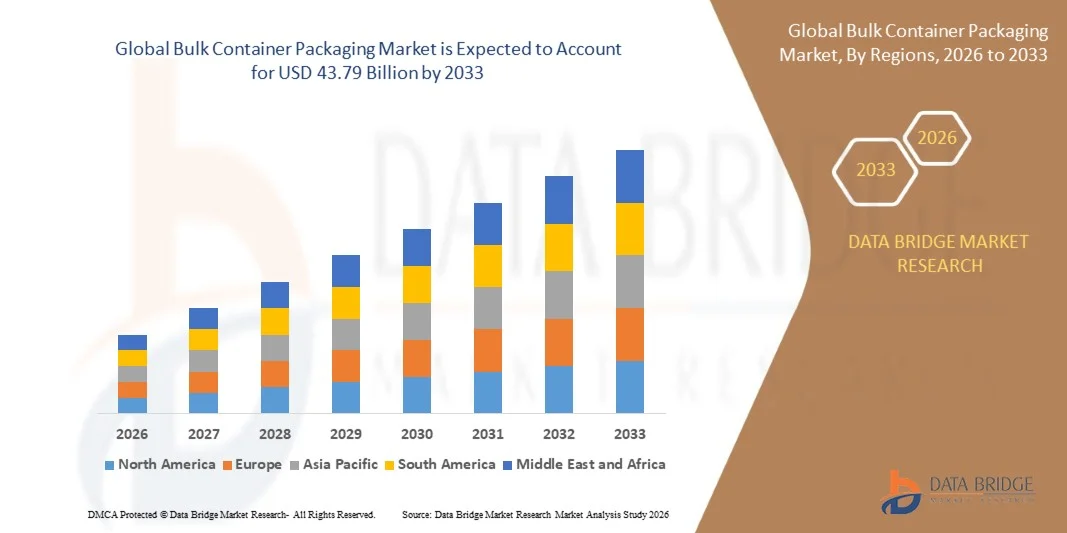
- As per Data Bridge Market Research analysis, the bulk container packaging market was valued at USD 25.30 billion in 2025 and is projected to reach USD 43.79 billion by 2033, growing at a CAGR of 7.10% from 2026 to 2033.
- The market is experiencing consistent growth driven by rising global trade and industrialization, increasing demand for cost-effective bulk transportation, and expanding applications across chemicals, food and beverages, pharmaceuticals, agriculture, and industrial manufacturing.
- The increasing movement of bulk liquids, powders, and granular materials across global supply chains, combined with the need to reduce transportation, handling, and packaging costs, is compelling manufacturers and end users to adopt advanced bulk container solutions. Intermediate bulk containers, flexitanks, flexible intermediate bulk containers, and material handling containers are gaining adoption by providing efficient storage, higher payload capacity, product protection, and improved supply-chain efficiency.
Market Size & Forecast
- Global Market Value (2025): USD 25.30 Billion
- Expected Market Value (2033): USD 43.79 Billion
- Forecast CAGR (2026–2033): 7.10%
- Leading Region in 2025: North America
- Fastest Growing Region: Asia Pacific
What are the Major Takeaways of the Bulk Container Packaging Market?
- North America dominated the bulk container packaging market with the largest revenue share of 38.2% in 2025, supported by strong chemical and agricultural exports, established manufacturing infrastructure, and increasing demand for efficient and sustainable bulk transportation solutions.
- Asia-Pacific is expected to be the fastest-growing region at a CAGR of 6.8% from 2026 to 2033, fueled by rapid manufacturing expansion, increasing global exports, and rising demand for bulk packaging across chemicals, food & beverages, pharmaceuticals, and agriculture.
- The bulk containers segment led the market with a 42.5% share in 2025, driven by their extensive use for transporting and storing large volumes of liquids, powders, chemicals, food ingredients, and industrial materials.
- Flexitanks are the fastest-growing product type, projected to register a CAGR of 13.5%, reflecting the surge in demand for efficient transportation of non-hazardous bulk liquids.
- The plastic segment dominated the material type category with a 62.8% revenue share in 2025, led by its lightweight characteristics, durability, chemical resistance, and versatility across different bulk packaging formats
- Intermediate bulk containers accounted for 35% of the market share in 2025, preferred by their ability to efficiently transport and store liquids, semi-solids, powders, and granulated materials.
- The powder & granule packaging segment is the fastest-growing application category, with a CAGR of 5%, driven by expanding transportation of chemicals, fertilizers, food ingredients, minerals, pharmaceuticals, and construction materials
Report Scope and Bulk Container Packaging Market Segmentation
|
Attributes |
Bulk Container Packaging Key Market Insights |
|
Segments Covered |
|
|
Countries Covered |
North America
Europe
Asia-Pacific
Middle East and Africa
South America
|
|
Key Market Players |
|
|
Market Opportunities |
|
|
Value Added Data Infosets |
In addition to the insights on market scenarios such as market value, growth rate, segmentation, geographical coverage, and major players, the market reports curated by the Data Bridge Market Research also include import export analysis, production capacity overview, production consumption analysis, price trend analysis, climate change scenario, supply chain analysis, value chain analysis, raw material/consumables overview, vendor selection criteria, PESTLE Analysis, Porter Analysis, and regulatory framework. |
What is the Key Trend in the Bulk Container Packaging Market?
- Sustainable and circular bulk packaging solutions are increasingly being adopted as manufacturers and users prioritize reusable, reconditioned, recyclable, and lower-carbon IBCs and bulk containers to reduce packaging waste and environmental impact.
- For instance, in October 2025, SCHÜTZ highlighted its Green Layer IBC packaging system, which incorporates recycled material and supports a closed material cycle, demonstrating the industry's shift toward recycled-content and more sustainable bulk-container packaging.
- The shift toward reusable IBCs and reconditioning programs is strengthening as companies seek to extend container lifecycles, reduce virgin-material consumption, and lower total packaging costs across industrial supply chains.
- Collapsible and foldable bulk containers are gaining traction because they reduce empty-return transportation requirements, improve warehouse utilization, and lower logistics costs while supporting reusable packaging models.
- Food-grade, aseptic, and barrier-enabled IBCs are increasingly being developed for sensitive products requiring contamination protection, oxygen control, longer shelf life, and compliance with stringent food and pharmaceutical requirements.
- For instance, in July 2026, Ellsey’s Vinegar and WERIT UK expanded a circular reusable IBC model involving collection, inspection, cleaning, refurbishment, and reuse; more than 2,000 IBCs are in use across their network, transporting several million liters of vinegar annually.
- Digital tracking and smart-container technologies are emerging in bulk packaging, with RFID, digital identification, and monitoring capabilities being integrated to improve asset visibility, traceability, inventory management, and container lifecycle control.
What are the Key Drivers of the Bulk Container Packaging Market?
- The rapid expansion of global trade and industrialization is increasing demand for high-capacity packaging solutions that enable efficient, safe, and cost-effective transportation of chemicals, food ingredients, pharmaceuticals, agricultural products, and industrial materials.
- For instance, in January 2025, Mauser Packaging Solutions expanded its Haiyan, China facility with new state-of-the-art equipment for manufacturing UN-certified IBCs, specifically targeting growing demand from the chemical, food, and additives industries and strengthening bulk-packaging capacity in Asia.
- Chemical & petrochemical industries are major consumers of IBCs, drums, and flexitanks because bulk containers provide efficient handling, product protection, regulatory compliance, and economical transportation of hazardous and non-hazardous materials.
- The growing international movement of food-grade liquids and ingredients is accelerating flexitank and specialized IBC adoption, particularly for edible oils, juices, dairy products, wine, and other bulk food commodities requiring hygienic transportation.
- For instance, in September 2024, Greif opened a new IBC manufacturing facility in Pasir Gudang, Malaysia, using advanced blow-molding and cage-line technologies to expand production capacity for IBCs serving the food, chemicals, lubricants, flavors, and fragrances industries, demonstrating investment in bulk-container infrastructure to meet growing industrial demand.
- Pharmaceutical and high-value chemical applications are further stimulating demand for aseptic, barrier, and contamination-controlled bulk containers that provide improved product integrity during long-distance transportation and storage.
Which Factors are Challenging the Growth of the Bulk Container Packaging Market?
- Advanced Volatility in plastic resin, steel, and other raw-material prices can increase manufacturing costs for IBCs, drums, flexitanks, and bulk containers, putting pressure on manufacturers' margins and end-user purchasing costs.
- For instance, in March 2026, Pact Group warned of unprecedented disruptions in global resin supply chains, with suppliers invoking force majeure and rapidly increasing resin prices, demonstrating how petroleum-linked raw-material volatility can raise costs for plastic bulk-container packaging.
- Stringent regulatory and safety requirements increase testing, certification, inspection, and compliance costs, particularly for containers used to transport hazardous chemicals and other regulated materials.
- The need to meet UN, ADR, food-contact, pharmaceutical, and chemical-compatibility standards can increase product-development complexity and limit the materials and designs manufacturers can use across different markets.
- Cross-contamination risks in reusable containers can restrict adoption in food, pharmaceutical, and chemical applications because previous-product residues require specialized cleaning, sanitization, inspection, and traceability before containers can be reused.
- For instance, In April 2026, packaging manufacturers in India reported plastic packaging costs rising by 40–50%, with imported raw materials and supply-chain disruptions contributing to higher input costs, illustrating the impact of raw-material price volatility on packaging producers.
- Cleaning and wastewater-management requirements can further increase operating costs for reusable IBC systems because cleaning processes may generate wastewater containing chemical residues, elevated pH, and suspended solids that require appropriate treatment before disposal.
How is the Bulk Container Packaging Market Segmented?
The bulk container packaging market is segmented on the basis of product type, material type, container type, application, and end-use.
- By Product Type
On the basis of product type, the bulk container packaging market is segmented into flexitanks, bulk containers, bulk container liners, and others. The bulk containers segment dominated the market with 42.5% share in 2025, owing to their extensive use for transporting and storing large volumes of liquids, powders, chemicals, food ingredients, and industrial materials. Bulk containers provide higher capacity and efficient handling compared with conventional small-format packaging. Their stackability, durability, and compatibility with automated material-handling systems further support adoption across industrial supply chains. Increasing international trade in bulk commodities is encouraging manufacturers to use standardized containers that can be efficiently transported by road, rail, and sea. Growing emphasis on reusable packaging is also strengthening demand for rigid and intermediate bulk container solutions.
The flexitanks segment is projected to register the fastest growth at 13.5% CAGR from 2026 to 2033, driven by increasing demand for efficient transportation of non-hazardous bulk liquids. Flexitanks can convert standard shipping containers into high-capacity liquid transportation systems, eliminating the need for dedicated tank infrastructure. Their lightweight construction enables higher payload efficiency while reducing handling and transportation costs. Growing international trade in edible oils, beverages, liquid food ingredients, and selected chemicals is creating additional demand. Improvements in multilayer films, liner strength, valves, and contamination-control technologies are further improving product reliability.
- By Material Type
On the basis of material type, the market is segmented into plastic, metal, paper & paperboard, wood, fiber, and others. The plastic segment dominated the market with 62.8% share in 2025, owing to its lightweight characteristics, durability, chemical resistance, and versatility across different bulk packaging formats. Plastic is extensively used in IBCs, flexitanks, liners, and other bulk containers because it can be molded into different shapes and configurations. High-density polyethylene and polypropylene are particularly suitable for applications requiring strength and resistance to moisture and chemicals. Plastic containers can also be reused and reconditioned, supporting circular packaging models. Their relatively low transportation weight helps reduce logistics costs compared with heavier metal alternatives.
The paper & paperboard segment is expected to witness strong growth at 5% CAGR during the forecast period, supported by increasing demand for recyclable and renewable packaging materials in suitable dry-bulk applications. Paper-based bulk packaging can provide lower material weight and improved recyclability for selected products. Growing sustainability requirements from brand owners and industrial customers are encouraging the development of higher-strength paper-based bulk containers. Advances in barrier coatings and multilayer paper structures are improving resistance to moisture and product contamination. Increasing demand for environmentally preferable packaging in food, agricultural, and industrial applications is creating additional opportunities.
- By Container Type
On the basis of container type, the market is segmented into flexible bulk containers, rigid bulk containers, and intermediate bulk containers. The intermediate bulk containers (IBCs) segment dominated the market with 35% share in 2025, supported by their ability to efficiently transport and store liquids, semi-solids, powders, and granulated materials. IBCs generally provide capacities substantially higher than drums while remaining easier to handle than large fixed tanks. Their standardized dimensions facilitate palletized handling, stacking, forklift movement, and transportation. Reusable IBCs are particularly attractive to chemical, food, pharmaceutical, and industrial manufacturers seeking to reduce packaging consumption. The availability of rigid plastic, composite, and metal IBC designs enables users to select containers according to product characteristics and regulatory requirements.
The flexible bulk containers segment is expected to experience the fastest growth at 5.6% CAGR through 2033, supported by increasing adoption of flexible intermediate bulk containers and other flexible solutions for dry bulk materials. Flexible containers provide high-volume capacity while requiring comparatively little storage space when empty. Their collapsible nature can reduce reverse-logistics and warehouse requirements, improving supply-chain efficiency. FIBCs are extensively used for powders, granules, agricultural commodities, minerals, chemicals, construction materials, and food ingredients. Improvements in woven polypropylene, liner technology, discharge systems, and contamination protection are expanding their application range. Increasing demand for lightweight and cost-efficient bulk transportation solutions is expected to continue supporting rapid segment expansion.
- By Application
On the basis of application, the market is segmented into liquid bulk packaging, dry bulk packaging, and powder & granule packaging. The liquid bulk packaging segment dominated the market with 50% share in 2025, driven by extensive transportation of chemicals, food ingredients, beverages, oils, lubricants, and pharmaceutical liquids. Flexitanks, rigid IBCs, and specialized bulk containers enable companies to move large quantities of liquid products efficiently. These solutions can reduce dependence on smaller drums and bottles while improving loading and unloading efficiency. Demand is also supported by international trade in edible oils, juices, wine, and other liquid commodities. Improvements in aseptic liners and barrier technologies are expanding the suitability of bulk liquid packaging for sensitive products.
The powder & granule packaging segment is expected to register strong growth at 5% CAGR during the forecast period, supported by expanding transportation of chemicals, fertilizers, food ingredients, minerals, pharmaceuticals, and construction materials. FIBCs and specialized liners provide efficient containment for products that require protection against moisture, contamination, and material loss. Their lightweight construction enables large quantities of material to be transported with relatively low packaging weight. Improved discharge systems allow controlled emptying into processing and production equipment. Demand for pharmaceutical-grade and food-grade bulk bags is also expanding as manufacturers require higher levels of cleanliness and product protection.
- By End-Use
On the basis of end-use, the market is segmented into industrial chemicals, petroleum and lubricants, food and beverages, paints, inks and dyes, pharmaceuticals, and others. The industrial chemicals segment dominated the market with 38.5% share in 2025, owing to extensive requirements for safe and efficient transportation of chemicals in liquid, powder, and granular forms. IBCs, bulk containers, liners, and flexitanks are widely used across chemical manufacturing and distribution networks. Their ability to provide controlled handling and protection against leakage and contamination makes them suitable for a broad range of chemical products. The expansion of chemical production and cross-border trade is generating sustained demand for bulk packaging. Regulatory requirements for hazardous-material transportation are also encouraging the use of certified and specialized container systems.
The pharmaceuticals segment is projected to witness the fastest growth at 7.0% CAGR through 2033, supported by increasing demand for hygienic and contamination-controlled bulk transportation of pharmaceutical ingredients and liquid formulations. Pharmaceutical manufacturers increasingly require packaging with high cleanliness, traceability, compatibility, and product-protection characteristics. Aseptic IBCs, specialized liners, and high-barrier materials are expanding the range of bulk packaging suitable for sensitive pharmaceutical products. Growth in biologics, active pharmaceutical ingredients, and pharmaceutical manufacturing is creating additional demand for specialized bulk-container solutions. Stringent quality and regulatory requirements are encouraging suppliers to develop certified packaging with improved integrity and traceability.
Which Region Holds the Largest Share of the Bulk Container Packaging Market?
- North America dominated the bulk container packaging market with the largest revenue share of 38.2% in 2025, supported by strong chemical and agricultural exports, established manufacturing infrastructure, and increasing demand for efficient and sustainable bulk transportation solutions.
- The region also benefits from stringent regulations promoting recyclable and reusable packaging, high adoption of IBCs and flexitanks, and extensive use of bulk containers across chemical, food and beverage, pharmaceutical, and petroleum industries. The United States represents the major contributor to regional demand, while growing agricultural and industrial trade continues to strengthen North America's position in the global market.
U.S. Bulk Container Packaging Market Insight
The U.S. bulk container packaging market is witnessing strong growth due to rising demand for efficient transportation and storage solutions across chemical, food and beverage, pharmaceutical, agricultural, and industrial sectors. The country’s mature manufacturing and logistics ecosystem, along with increasing adoption of reusable IBCs, flexitanks, and specialized bulk containers, is driving demand across diverse applications. In addition, growing emphasis on sustainable packaging, container reconditioning, and reducing transportation costs is accelerating adoption among manufacturers, exporters, and distributors.
Asia-Pacific Bulk Container Packaging Market Insight
The Asia-Pacific bulk container packaging market is expected to witness rapid growth, driven by expanding manufacturing activities, increasing international trade, and rising demand for bulk transportation solutions across countries such as China, India, and Japan. Growing chemical production, agricultural exports, food processing, and pharmaceutical manufacturing are supporting regional market expansion. In addition, increasing investments in logistics infrastructure, growing adoption of reusable containers, and demand for lightweight and cost-effective packaging solutions are accelerating bulk container adoption across industrial sectors.
Japan Bulk Container Packaging Market Insight
The Japan bulk container packaging market is witnessing consistent growth due to rising demand for efficient industrial packaging, advanced manufacturing, and sustainable logistics solutions. Chemical manufacturers, food processors, pharmaceutical companies, and industrial suppliers are increasingly adopting high-quality IBCs, bulk containers, and specialized liners for transportation and storage. Moreover, increasing integration of reusable packaging systems, advanced material technologies, and stringent product-quality requirements are further contributing to market growth.
China Bulk Container Packaging Market Insight
The China bulk container packaging market is growing rapidly, driven by expanding manufacturing, increasing chemical production, and rising international trade in industrial and agricultural products. Growing adoption of plastic IBCs, flexitanks, and flexible bulk containers across chemical, food and beverage, pharmaceutical, and agricultural applications is significantly boosting market demand. In addition, rising investments in logistics infrastructure, increasing focus on sustainable packaging, and rapid expansion of export-oriented industries are positioning China as one of the fastest-growing markets for bulk container packaging globally.
U.K. Bulk Container Packaging Market Insight
The U.K. bulk container packaging market is experiencing steady growth, supported by rising adoption of reusable and sustainable packaging solutions across chemical, food and beverage, pharmaceutical, and industrial applications. Increasing investments in circular packaging systems and growing demand for efficient bulk transportation solutions are contributing to market growth. Furthermore, integration of recyclable materials, container reconditioning, and improved tracking technologies is enhancing packaging efficiency and sustainability, positioning the U.K. as a key market for advanced bulk container packaging solutions.
Germany Bulk Container Packaging Market Insight
The Germany bulk container packaging market is expanding steadily due to the country’s strong chemical manufacturing base, advanced industrial capabilities, and increasing adoption of sustainable packaging technologies. Chemical companies, food manufacturers, pharmaceutical producers, and industrial suppliers are increasingly utilizing IBCs, bulk containers, and liners for efficient product transportation and storage. Continuous advancements in recyclable materials, reusable packaging systems, and container reconditioning, along with strong focus on resource efficiency and circular economy practices, are further driving market growth in Germany.
Which are the Top Companies in Bulk Container Packaging Market?
The bulk container packaging industry is primarily led by well-established companies, including:
- Greif (U.S.)
- Mauser Packaging Solutions (U.S.)
- SCHÜTZ GmbH & Co. KGaA (Germany)
- WERIT Kunststoffwerke W. Schneider GmbH & Co. KG (Germany)
- LC Packaging (Netherlands)
- Mondi plc (U.K.)
- ORBIS Corporation (U.S.)
- Snyder Industries (U.S.)
- Global-Pak, Inc. (U.S.)
- United Bags, Inc. (U.S.)
- Rishi FIBC Solutions Pvt Ltd. (India)
- Kanpur Plastipack Limited (India)
- Pyramid Technoplast Ltd (India)
- Time Technoplast Limited (India)
- Emmbi Industries Limited (India)
- Conitex Sonoco (U.S.)
- Bulk Lift International, LLC (U.S.)
- Hoover Ferguson Group, Inc. (U.S.)
- Schoeller Allibert (Netherlands)
- Pact Group Holdings Ltd (Australia)
What are Latest Developments in Bulk Container Packaging Market?
- In March 2025, SCHÜTZ introduced the Ecobulk SX-D-OV IBC at the European Coatings Show in Germany. The new double-wall IBC is designed for transporting flammable and combustible liquids, combining fire and leakage protection with convenient bottom discharge through an outlet valve. The product targets sensitive applications in paints, coatings, chemicals, and other industries where safety and efficient handling are critical.
- In March 2025, SCHÜTZ introduced a new recycled-plastic frame pallet for IBCs at the European Coatings Show. The pallet is designed for automated warehouses and conveyor systems, provides improved cleanliness and chemical resistance, and is manufactured from recycled plastic obtained through SCHÜTZ's closed-loop system. The development demonstrates the industry's movement toward more sustainable and automation-compatible bulk-container handling solutions.
- In January 2025, Greif highlighted its GCUBE Flex IBC as a new packaging solution for food and pharmaceutical applications, featuring an enhanced aseptic liner, oxygen-permeation barrier, and flexible two-layer polypropylene outer bag. The design supports both top and bottom filling while maintaining aseptic integrity, addressing the need for hygienic bulk transportation of sensitive products.
- In January 2025, SCHÜTZ announced the ECOBULK IBC production partnership with National Plastic Factory Company in Saudi Arabia, under which 1,000-liter ECOBULK IBCs will be produced locally for Saudi Arabia and the wider GCC region. The planned facility expands SCHÜTZ's regional production network and targets chemical, oil and lubricant, food, and other industrial applications
- In March 2024, Greif and CDF Corporation launched the redesigned GCUBE IBC Flex for transporting highly sensitive liquid products under sterile conditions. The IBC incorporates an enhanced Form-Fit aseptic liner that improves product evacuation and automatically conforms to the container during filling. It is targeted at food and beverage, flavors and fragrances, lubricants, and pharmaceutical applications.

- Interactive Data Analysis Dashboard
- Company Analysis Dashboard for high growth potential opportunities
- Research Analyst Access for customization & queries
- Competitor Analysis with Interactive dashboard
- Latest News, Updates & Trend analysis
- Harness the Power of Benchmark Analysis for Comprehensive Competitor Tracking
Global Bulk Container Packaging Market, Supply Chain Analysis and Ecosystem Framework
To support market growth and help clients navigate the impact of geopolitical shifts, DBMR has integrated in-depth supply chain analysis into its Global Bulk Container Packaging Market research reports. This addition empowers clients to respond effectively to global changes affecting their industries. The supply chain analysis section includes detailed insights such as Global Bulk Container Packaging Market consumption and production by country, price trend analysis, the impact of tariffs and geopolitical developments, and import and export trends by country and HSN code. It also highlights major suppliers with data on production capacity and company profiles, as well as key importers and exporters. In addition to research, DBMR offers specialized supply chain consulting services backed by over a decade of experience, providing solutions like supplier discovery, supplier risk assessment, price trend analysis, impact evaluation of inflation and trade route changes, and comprehensive market trend analysis.
Data collection and base year analysis are done using data collection modules with large sample sizes. The stage includes obtaining market information or related data through various sources and strategies. It includes examining and planning all the data acquired from the past in advance. It likewise envelops the examination of information inconsistencies seen across different information sources. The market data is analysed and estimated using market statistical and coherent models. Also, market share analysis and key trend analysis are the major success factors in the market report. To know more, please request an analyst call or drop down your inquiry.
The key research methodology used by DBMR research team is data triangulation which involves data mining, analysis of the impact of data variables on the market and primary (industry expert) validation. Data models include Vendor Positioning Grid, Market Time Line Analysis, Market Overview and Guide, Company Positioning Grid, Patent Analysis, Pricing Analysis, Company Market Share Analysis, Standards of Measurement, Global versus Regional and Vendor Share Analysis. To know more about the research methodology, drop in an inquiry to speak to our industry experts.
Data Bridge Market Research is a leader in advanced formative research. We take pride in servicing our existing and new customers with data and analysis that match and suits their goal. The report can be customized to include price trend analysis of target brands understanding the market for additional countries (ask for the list of countries), clinical trial results data, literature review, refurbished market and product base analysis. Market analysis of target competitors can be analyzed from technology-based analysis to market portfolio strategies. We can add as many competitors that you require data about in the format and data style you are looking for. Our team of analysts can also provide you data in crude raw excel files pivot tables (Fact book) or can assist you in creating presentations from the data sets available in the report.













