


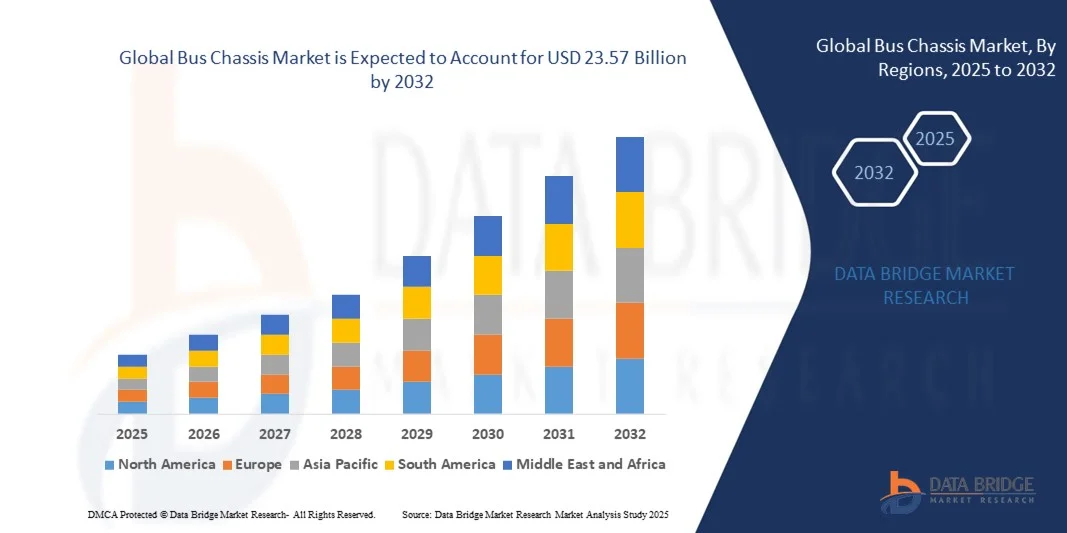
Bus Chassis Market Size
- The global bus chassis market size was valued at USD 18.32 billion in 2024 and is expected to reach USD 23.57 billion by 2032, at a CAGR of 3.20% during the forecast period
- The market growth is largely fuelled by the increasing demand for public transportation solutions driven by rapid urbanization and rising population density
- Growing government initiatives promoting sustainable and efficient mass transit systems are also contributing to market expansion
Bus Chassis Market Analysis
- The global bus chassis market is witnessing steady growth, supported by rising investments in the public transport sector and increasing adoption of electric and hybrid buses
- Technological advancements in chassis design, such as lightweight materials and improved structural strength for better fuel efficiency and passenger safety, are enhancing market competitiveness
- North America dominated the global bus chassis market with the largest revenue share of 38.75% in 2024, driven by rising investments in public transportation infrastructure and the increasing adoption of electric and hybrid buses
- Asia-Pacific region is expected to witness the highest growth rate in the global bus chassis market, driven by increasing urban population, expansion of public transport networks, and growing adoption of electric and hybrid bus chassis across emerging economies
- The Public Transit Bus Chassis segment held the largest market revenue share in 2024, driven by the rising demand for efficient urban mobility solutions and growing investments in public transportation infrastructure. Increasing government initiatives to modernize city bus fleets and promote low-emission vehicles have further boosted the adoption of advanced public transit chassis systems
Report Scope and Bus Chassis Market Segmentation
|
Attributes |
Bus Chassis Key Market Insights |
|
Segments Covered |
|
|
Countries Covered |
North America
Europe
Asia-Pacific
Middle East and Africa
South America
|
|
Key Market Players |
|
|
Market Opportunities |
|
|
Value Added Data Infosets |
In addition to the market insights such as market value, growth rate, market segments, geographical coverage, market players, and market scenario, the market report curated by the Data Bridge Market Research team includes in-depth expert analysis, import/export analysis, pricing analysis, production consumption analysis, and pestle analysis. |
Bus Chassis Market Trends
Integration of Electric and Hybrid Powertrains in Bus Chassis
- The growing integration of electric and hybrid powertrains into bus chassis is redefining the global market as public and private transportation systems move toward cleaner mobility solutions. Manufacturers are increasingly designing chassis that support battery-electric, plug-in hybrid, and hydrogen fuel cell technologies to meet stringent emission norms and sustainability goals. This integration is positioning electric and hybrid chassis as a key component in reducing fleet emissions and operational costs worldwide
- The shift toward electrification is encouraging the use of lightweight materials such as aluminum and high-strength steel to offset battery weight and enhance efficiency. This design evolution improves vehicle range and overall performance while maintaining structural integrity and passenger safety. Furthermore, the use of composite materials is gaining momentum, contributing to longer chassis lifespans and reduced maintenance need
- The rising adoption of zero-emission buses in urban areas is driving OEMs to invest in modular chassis platforms that can accommodate multiple propulsion systems. Such flexibility reduces production costs and accelerates the transition toward eco-friendly public transport fleets. Modular designs also simplify maintenance and enable fleet operators to adapt quickly to evolving technology standards without replacing the entire vehicle structure
- For instance, in 2024, Volvo Buses introduced an advanced electric chassis platform designed for both city and intercity applications, offering improved range and enhanced energy recovery systems. The launch strengthened the company’s global position in sustainable bus manufacturing. Similar initiatives by leading OEMs such as Daimler and BYD are reshaping competitive dynamics through innovation in battery integration and scalable chassis solutions
- While electrification is transforming the bus chassis landscape, the trend’s success depends on advancements in charging infrastructure, battery technology, and fleet operator readiness. Continuous R&D and government support will be essential to scale adoption across both developed and emerging regions. Moreover, partnerships between OEMs, component suppliers, and energy providers will play a pivotal role in creating a stable ecosystem for sustainable public mobility
Bus Chassis Market Dynamics
Driver
Increasing Government Investments in Public Transport Infrastructure
- Governments worldwide are investing heavily in the modernization and expansion of public transport systems to reduce congestion and carbon emissions. The development of new urban mobility networks and replacement of aging bus fleets are directly fuelling the demand for advanced bus chassis. These efforts are not only creating economic opportunities but also enhancing accessibility and connectivity in both urban and rural regions
- The focus on sustainability and energy efficiency is prompting authorities to allocate funds toward electric and hybrid buses, creating a strong demand pipeline for chassis compatible with next-generation propulsion systems. Major infrastructure programs are integrating electric bus corridors and smart transport hubs, further accelerating chassis innovation and deployment. Such initiatives reflect a long-term shift toward low-carbon, high-efficiency transportation models
- Several regional and municipal transit agencies are offering financial incentives, tax rebates, and procurement programs to encourage OEMs to manufacture eco-friendly buses. These initiatives are strengthening domestic production and accelerating fleet electrification. In addition, public-private collaborations are fostering technology transfer and boosting investment in local assembly plants, generating employment and economic growth
- For instance, in 2023, the Indian government launched a national electric bus program under its “PM-eBus Sewa” initiative, aimed at deploying 10,000 electric buses across major cities, significantly boosting the demand for compatible chassis models. Similar large-scale initiatives are being implemented in Europe and Southeast Asia to promote zero-emission transport infrastructure. This has resulted in strong market momentum for both local and global bus chassis manufacturers
- While growing infrastructure investments are supporting market growth, efficient coordination between OEMs, policymakers, and fleet operators will be critical to ensure timely implementation and long-term sustainability. Harmonizing regulations, standardizing components, and improving aftersales service infrastructure remain essential to achieving operational efficiency and reliability. Governments are also focusing on lifecycle cost reduction through localized supply chains and energy-efficient designs
Restraint/Challenge
High Manufacturing Costs and Limited Charging Infrastructure
- The production of advanced bus chassis, particularly those designed for electric and hybrid applications, involves high material and technology costs. The integration of battery packs, control systems, and lightweight components raises overall manufacturing expenses, posing challenges for cost-sensitive markets. This makes it difficult for small manufacturers to compete with established global players that have stronger financial and technological capabilities
- In several developing regions, inadequate charging infrastructure and limited access to maintenance facilities hinder the large-scale adoption of electric buses. This restricts demand for high-end chassis platforms optimized for electrified transport. The absence of standardized charging protocols and grid capacity issues further slow deployment in emerging economies, delaying the shift toward sustainable transport
- Small and mid-sized OEMs often face difficulties in balancing performance and affordability due to the rising cost of raw materials and the need for advanced engineering capabilities. This limits competition and slows innovation in the market. High dependency on imported electronic components and powertrain technologies also creates supply chain vulnerabilities that impact production continuity
- For instance, in 2024, multiple local bus manufacturers in Latin America reported project delays due to the unavailability of cost-effective electric chassis and insufficient fast-charging networks to support deployment. Similar constraints are being observed in parts of Africa and Southeast Asia, where charging station coverage remains minimal, and import tariffs increase vehicle costs. This situation underscores the urgent need for regional infrastructure investment and financing solutions
- While high manufacturing costs and infrastructure gaps remain key challenges, industry collaboration, technological standardization, and public-private partnerships will play a crucial role in overcoming these restraints and unlocking the full potential of the bus chassis market. Accelerating R&D in modular chassis design, improving component localization, and adopting cost-efficient production techniques will help manufacturers expand profitability while maintaining quality and performance standards
Bus Chassis Market Scope
The market is segmented on the basis of bus type, bus axle, chassis frame, and type of propulsion.
- By Bus Type
On the basis of bus type, the bus chassis market is segmented into Public Transit Bus Chassis, Private Transit Bus Chassis, Corporate Bus Chassis, School and College Bus Chassis, and Special Purpose Bus Chassis. The Public Transit Bus Chassis segment held the largest market revenue share in 2024, driven by the rising demand for efficient urban mobility solutions and growing investments in public transportation infrastructure. Increasing government initiatives to modernize city bus fleets and promote low-emission vehicles have further boosted the adoption of advanced public transit chassis systems.
The Electric Public Transit Bus Chassis subsegment is expected to witness the fastest growth rate from 2025 to 2032, supported by electrification policies, emission reduction targets, and favorable financing models for urban fleet replacement. The growing preference for environmentally sustainable and cost-effective transportation solutions continues to accelerate this segment’s expansion.
- By Bus Axle
On the basis of bus axle, the market is segmented into Single Axle Bus Chassis and Multi Axle Bus Chassis. The Single Axle Bus Chassis segment dominated the market in 2024 due to its widespread use in city and intercity buses, offering better maneuverability, lower maintenance costs, and fuel efficiency. Its suitability for short- and medium-distance routes makes it a preferred choice for public and private operators.
The Multi Axle Bus Chassis segment is expected to witness the fastest growth rate from 2025 to 2032, fuelled by rising demand for high-capacity and long-distance buses. Increasing intercity travel and growing adoption of luxury and premium coaches with enhanced comfort and load-bearing capability are key factors driving this segment.
- By Chassis Frame
On the basis of chassis frame, the bus chassis market is segmented into Ladder Frame Bus Chassis and Tubular Space Bus Chassis. The Ladder Frame Bus Chassis segment accounted for the largest market share in 2024, primarily due to its robust design, cost-effectiveness, and wide adoption across standard and heavy-duty buses. It remains a preferred choice among manufacturers owing to its structural reliability and ease of maintenance.
The Tubular Space Bus Chassis segment is anticipated to witness significant growth between 2025 and 2032, driven by increasing demand for lightweight and high-performance designs that enhance fuel efficiency and passenger safety. The shift toward advanced materials and modular construction techniques is further strengthening the adoption of tubular frame designs in premium and electric bus categories.
- By Type of Propulsion
On the basis of propulsion type, the market is segmented into Diesel Engine, CNG, and Electric. The Diesel Engine segment held the dominant market share in 2024, supported by its established infrastructure, proven reliability, and cost-efficiency in long-haul applications. Despite growing environmental concerns, diesel chassis continue to serve a large share of conventional bus fleets globally.
The Electric segment is expected to witness the fastest growth rate from 2025 to 2032, driven by global initiatives toward carbon neutrality and rapid advancements in battery technology. Government incentives, fleet electrification programs, and declining battery costs are accelerating the adoption of electric bus chassis, especially in urban transit and smart mobility projects.
Bus Chassis Market Regional Analysis
- North America dominated the global bus chassis market with the largest revenue share of 38.75% in 2024, driven by rising investments in public transportation infrastructure and the increasing adoption of electric and hybrid buses
- Fleet operators in the region are prioritizing modern, fuel-efficient, and low-emission bus chassis to meet stringent government regulations and sustainability targets
- The market is further supported by well-developed road infrastructure, high urbanization rates, and growing demand for reliable and technologically advanced bus fleets across both public and private sectors
U.S. Bus Chassis Market Insight
The U.S. bus chassis market captured the largest revenue share in 2024 within North America, fueled by modernization programs for urban transit systems and the increasing replacement of aging bus fleets. The shift toward electric and hybrid buses, coupled with government incentives for low-emission transport, is driving demand for advanced chassis platforms. Furthermore, the growing adoption of smart mobility solutions and fleet management systems is accelerating the market’s expansion.
Europe Bus Chassis Market Insight
The Europe bus chassis market is expected to witness the fastest growth rate from 2025 to 2032, primarily driven by stringent emission norms, the increasing adoption of electric buses, and urbanization trends. Governments across the region are actively promoting sustainable public transport solutions, which is boosting the demand for advanced and energy-efficient bus chassis. The market is seeing strong growth in both city transit and long-distance coach applications.
U.K. Bus Chassis Market Insight
The U.K. bus chassis market is expected to witness significant growth from 2025 to 2032, driven by public initiatives to modernize bus fleets and a rising focus on low-emission transportation. Urban mobility projects and fleet electrification programs are further encouraging the adoption of next-generation bus chassis. In addition, the country’s robust automotive and manufacturing sector supports local production and deployment of advanced chassis systems.
Germany Bus Chassis Market Insight
The Germany bus chassis market is expected to witness notable growth from 2025 to 2032, fueled by strong government incentives for electric buses and the push for sustainable urban transport. Germany’s well-established automotive industry, coupled with its focus on R&D and innovation, is promoting the production of advanced, energy-efficient bus chassis. Integration with smart mobility systems and electric propulsion technologies is becoming increasingly prevalent in both public and commercial fleets.
Asia-Pacific Bus Chassis Market Insight
The Asia-Pacific bus chassis market is expected to witness the fastest growth rate from 2025 to 2032, driven by rapid urbanization, rising government investments in public transport, and increasing demand for electric and hybrid buses. Countries such as China, Japan, and India are witnessing strong adoption of modern chassis platforms for city transit, intercity, and corporate bus fleets. Furthermore, the region’s emergence as a manufacturing hub for bus components is enhancing the affordability and availability of advanced chassis solutions.
Japan Bus Chassis Market Insight
The Japan bus chassis market is expected to witness significant growth from 2025 to 2032 due to the country’s focus on energy-efficient public transport and advanced automotive technologies. The adoption of electric and hybrid bus chassis is increasing, supported by urban mobility initiatives and rising demand for smart, low-emission fleets. Japan’s emphasis on reliability, safety, and compact urban designs is further driving the deployment of advanced chassis platforms.
China Bus Chassis Market Insight
The China bus chassis market accounted for the largest revenue share in Asia-Pacific in 2024, attributed to rapid urbanization, expansion of public transport networks, and rising adoption of electric buses. Strong government support for low-emission fleets, combined with a growing domestic automotive manufacturing base, is driving market growth. The focus on smart city projects and modernization of intercity and corporate bus fleets is further boosting the demand for advanced bus chassis platforms.
Bus Chassis Market Share
The Bus Chassis industry is primarily led by well-established companies, including:
• Tata Motors (India)
• Daimler AG (Germany)
• Scania (Sweden)
• Eicher Motors Limited (India)
• AB Volvo (Sweden)
• Ashok Leyland (India)
• Mithra Motors Private Limited (India)
• SML Isuzu Ltd (India)
• ALF Engineering Pvt Ltd (India)
• Popular Tata (India)
• Dongfeng Motor Company (China)
• Hinduja Group (U.K.)
• Volkswagen AG (Germany)

- Interactive Data Analysis Dashboard
- Company Analysis Dashboard for high growth potential opportunities
- Research Analyst Access for customization & queries
- Competitor Analysis with Interactive dashboard
- Latest News, Updates & Trend analysis
- Harness the Power of Benchmark Analysis for Comprehensive Competitor Tracking
Data collection and base year analysis are done using data collection modules with large sample sizes. The stage includes obtaining market information or related data through various sources and strategies. It includes examining and planning all the data acquired from the past in advance. It likewise envelops the examination of information inconsistencies seen across different information sources. The market data is analysed and estimated using market statistical and coherent models. Also, market share analysis and key trend analysis are the major success factors in the market report. To know more, please request an analyst call or drop down your inquiry.
The key research methodology used by DBMR research team is data triangulation which involves data mining, analysis of the impact of data variables on the market and primary (industry expert) validation. Data models include Vendor Positioning Grid, Market Time Line Analysis, Market Overview and Guide, Company Positioning Grid, Patent Analysis, Pricing Analysis, Company Market Share Analysis, Standards of Measurement, Global versus Regional and Vendor Share Analysis. To know more about the research methodology, drop in an inquiry to speak to our industry experts.
Data Bridge Market Research is a leader in advanced formative research. We take pride in servicing our existing and new customers with data and analysis that match and suits their goal. The report can be customized to include price trend analysis of target brands understanding the market for additional countries (ask for the list of countries), clinical trial results data, literature review, refurbished market and product base analysis. Market analysis of target competitors can be analyzed from technology-based analysis to market portfolio strategies. We can add as many competitors that you require data about in the format and data style you are looking for. Our team of analysts can also provide you data in crude raw excel files pivot tables (Fact book) or can assist you in creating presentations from the data sets available in the report.













