


Bus Flooring Market Size
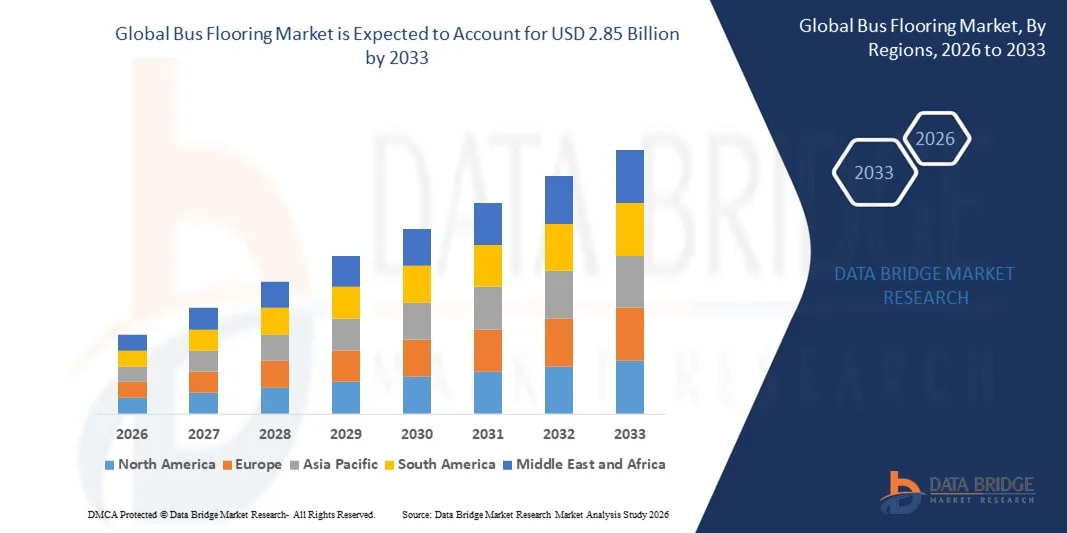
- The global bus flooring market size was valued at USD 1.46 billion in 2025 and is expected to reach USD 2.85 billion by 2033, at a CAGR of 8.69% during the forecast period
- The market growth is largely fuelled by the increasing demand for public transport and intercity buses, rising focus on passenger comfort and safety, and growing adoption of durable, lightweight, and eco-friendly flooring materials
- The adoption of advanced flooring solutions, such as anti-slip, fire-resistant, and easy-to-clean materials, is driving replacement and refurbishment in existing bus fleets
Bus Flooring Market Analysis
- The market is witnessing growing innovation in materials, including vinyl, rubber, and composite flooring, to enhance durability, aesthetics, and passenger comfort
- Rising urbanization and expansion of public transport networks in emerging economies are creating significant opportunities for bus flooring manufacturers
- North America dominated the global bus flooring market with the largest revenue share of 38.75% in 2025, driven by growing investments in public transport infrastructure, modernization of fleets, and increasing adoption of safety-compliant and eco-friendly flooring solutions
- Asia-Pacific region is expected to witness the highest growth rate in the global bus flooring market, driven by expanding public and private bus fleets, government initiatives supporting sustainable materials, and increasing demand for modern and durable flooring solutions
- The Anti-Slip segment held the largest market revenue share in 2025, driven by rising focus on passenger safety, compliance with transport regulations, and increasing adoption in public and private bus fleets. Anti-slip flooring enhances passenger confidence and minimizes accidents during transit
Report Scope and Bus Flooring Market Segmentation
|
Attributes |
Bus Flooring Key Market Insights |
|
Segments Covered |
|
|
Countries Covered |
North America
Europe
Asia-Pacific
Middle East and Africa
South America
|
|
Key Market Players |
|
|
Market Opportunities |
|
|
Value Added Data Infosets |
In addition to the market insights such as market value, growth rate, market segments, geographical coverage, market players, and market scenario, the market report curated by the Data Bridge Market Research team includes in-depth expert analysis, import/export analysis, pricing analysis, production consumption analysis, and pestle analysis. |
Bus Flooring Market Trends
Rise of Advanced and Eco-Friendly Flooring Solutions in Buses
- The growing adoption of advanced and eco-friendly bus flooring solutions is transforming the passenger transport landscape by enhancing durability, safety, and comfort. Modern flooring materials such as vinyl, rubber, and composite offer slip resistance, fire-retardant properties, and chemical resistance, ensuring compliance with safety standards. This leads to improved passenger satisfaction, lower maintenance costs, and longer service life for fleet operators
- The increasing focus on lightweight and sustainable materials is accelerating the adoption of modular and recyclable flooring systems. These solutions are particularly effective in reducing vehicle weight, improving fuel efficiency, and supporting government initiatives on green transportation. Manufacturers are also emphasizing low-VOC, non-toxic, and environmentally friendly materials to align with sustainability goals and reduce environmental impact
- The affordability and ease of installation of modern bus flooring systems are making them attractive for both new fleet deployments and retrofitting older buses. Operators benefit from reduced downtime, longer service life, simplified cleaning processes, and improved operational efficiency. The availability of pre-fabricated modular panels further streamlines installation and minimizes labor requirements
- For instance, in 2023, several public transport operators in Europe upgraded their fleets with anti-slip vinyl and rubber flooring, reporting improved passenger safety, reduced maintenance expenses, enhanced ride comfort, and positive feedback from commuters. The implementation also supported compliance with updated regulatory safety standards and increased fleet longevity
- While innovative flooring solutions are gaining traction, their impact depends on continued product development, compliance with regulatory standards, and cost-effectiveness. Manufacturers must focus on durable, sustainable, and customizable solutions, incorporating features such as noise reduction, thermal insulation, and antimicrobial properties, to fully capitalize on this growing demand
Bus Flooring Market Dynamics
Driver
Rising Demand for Safe, Durable, and Eco-Friendly Flooring Solutions
- The increasing emphasis on passenger safety and comfort is pushing bus operators and governments to invest in high-quality flooring solutions. Features such as slip resistance, fire retardancy, shock absorption, and chemical resistance are becoming critical for compliance with safety regulations, driving market growth and customer trust
- Operators are increasingly aware of the financial and operational benefits of durable and easy-to-maintain flooring, including reduced repair costs, longer lifespan, and lower total cost of ownership. This awareness is driving the adoption of premium flooring solutions across both public and private transport sectors, enhancing fleet performance and passenger satisfaction
- Government initiatives promoting eco-friendly materials and sustainable transport solutions are encouraging the use of recyclable, low-emission, and non-toxic flooring materials. Such regulations and incentives are accelerating investment in green and innovative flooring technologies, supporting fleet modernization and environmental compliance
- For instance, in 2022, several European cities introduced incentives for bus operators to adopt recyclable rubber and composite flooring, boosting market demand for sustainable solutions. These programs also encouraged suppliers to innovate in lightweight, durable, and environmentally friendly materials, further driving market expansion
- While rising safety and sustainability awareness is driving the market, there is still a need to ensure affordability, ease of installation, and widespread adoption among smaller operators to sustain growth. Integrating advanced features such as modularity, slip resistance, and thermal insulation can help address operational challenges and increase market penetration
Restraint/Challenge
High Cost of Premium Flooring Solutions and Installation Limitations
- The high price of advanced and eco-friendly bus flooring solutions, including modular vinyl, rubber, and composite materials, makes them less accessible to small-scale operators or budget-constrained fleets. Cost remains a key barrier to widespread adoption, especially in emerging markets where procurement budgets are limited
- In many regions, a lack of skilled personnel and proper installation infrastructure limits the effective deployment of advanced flooring systems. Improper installation can lead to reduced durability, compromised safety performance, and increased maintenance requirements, impacting adoption rates and operational efficiency
- Supply chain constraints and limited availability of high-quality flooring materials in remote areas further restrict market penetration. Operators may rely on conventional materials, which are less durable, less safe, and require frequent replacement, leading to higher lifetime costs and lower passenger satisfaction
- For instance, in 2023, fleet operators in Southeast Asia reported delays in upgrading bus flooring due to high material costs, limited installation expertise, and inconsistent supply of premium flooring products. These barriers slowed fleet modernization and limited the adoption of eco-friendly solutions
- While technological improvements continue, addressing cost and installation challenges remains crucial. Market players must focus on modular, easy-to-install, and cost-effective flooring solutions, while also providing training and support for installation to bridge accessibility gaps and maximize long-term market potential
Bus Flooring Market Scope
The market is segmented on the basis of flooring, material, application, and distribution channel
- By Flooring
On the basis of flooring, the bus flooring market is segmented into Anti-Slip and Standard. The Anti-Slip segment held the largest market revenue share in 2025, driven by rising focus on passenger safety, compliance with transport regulations, and increasing adoption in public and private bus fleets. Anti-slip flooring enhances passenger confidence and minimizes accidents during transit.
The Standard flooring segment is expected to witness the fastest growth rate from 2026 to 2033, fueled by its cost-effectiveness, ease of installation, and suitability for areas such as luggage compartments, engine chambers, and non-passenger zones. Standard flooring is increasingly adopted in budget bus fleets and retrofit projects.
- By Material
On the basis of material, the bus flooring market is segmented into Aluminum, Compreg, Bamboo, Plywood, PVC, Rubber, and Plastic. Rubber flooring held the largest market revenue share in 2025, driven by its durability, anti-slip properties, and low maintenance requirements, making it ideal for high-traffic passenger areas.
PVC and Bamboo flooring segments are expected to witness the fastest growth rate from 2026 to 2033, fueled by their lightweight nature, eco-friendly features, and increasing adoption in modern and sustainable bus designs.
- By Application
On the basis of application, the market is segmented into Car Boots, Floors in Buses, Tramways, Trucks, Vans, Tractors, Luggage Hatches, Engine Chambers, Bus Decker, and WC Flooring in Tourist Coaches. Floors in Buses accounted for the largest share in 2025, driven by expansion of urban transport networks and replacement of aging flooring in public transport fleets.
WC Flooring in Tourist Coaches is expected to witness the fastest growth rate from 2026 to 2033, fueled by rising demand for comfort, luxury features, and hygienic solutions in long-distance buses and tour coaches.
- By Distribution Channel
On the basis of distribution channel, the market is segmented into Original Equipment Manufacturer (OEM) and Aftermarket. The OEM segment held the largest market share in 2025, driven by integration of flooring solutions in new bus manufacturing, ensuring compliance with safety and quality standards.
The Aftermarket segment is expected to witness the fastest growth rate from 2026 to 2033, fueled by increasing refurbishment and retrofitting of existing buses with durable, eco-friendly, and advanced flooring solutions.
Bus Flooring Market Regional Analysis
- North America dominated the global bus flooring market with the largest revenue share of 38.75% in 2025, driven by growing investments in public transport infrastructure, modernization of fleets, and increasing adoption of safety-compliant and eco-friendly flooring solutions
- Operators and fleet managers in the region highly value the durability, slip resistance, and fire-retardant properties of modern bus flooring, which enhance passenger safety, reduce maintenance costs, and improve overall operational efficiency
- This widespread adoption is further supported by high disposable incomes, robust public transport networks, and growing awareness of sustainable and low-maintenance flooring materials, establishing advanced bus flooring as a preferred solution for both public and private fleets
U.S. Bus Flooring Market Insight
The U.S. bus flooring market captured the largest revenue share in 2025 within North America, fueled by increasing investments in fleet modernization and the adoption of durable, anti-slip, and eco-friendly materials. Operators are prioritizing passenger safety, fuel efficiency, and ease of maintenance. The growing trend of retrofitting aging buses with modern flooring systems, coupled with government regulations on safety and sustainability, is significantly contributing to market growth.
Europe Bus Flooring Market Insight
The Europe bus flooring market is expected to witness the fastest growth rate from 2026 to 2033, primarily driven by stringent safety standards, the need for durable and eco-friendly materials, and modernization of public transport fleets. Increasing urbanization and the adoption of innovative, low-emission flooring solutions are fostering market expansion across both public and private bus operators. Flooring upgrades in buses, coaches, and trams are becoming a critical aspect of fleet refurbishment.
U.K. Bus Flooring Market Insight
The U.K. bus flooring market is expected to witness the fastest growth rate from 2026 to 2033, driven by rising safety awareness, government initiatives promoting eco-friendly materials, and demand for high-quality, low-maintenance flooring solutions. Public transport operators are increasingly incorporating anti-slip and modular flooring in new buses and retrofitting older vehicles to enhance passenger safety and comfort.
Germany Bus Flooring Market Insight
The Germany bus flooring market is expected to witness the fastest growth rate from 2026 to 2033, fueled by advanced transportation infrastructure, regulatory safety mandates, and increasing focus on eco-friendly and recyclable materials. Integration of modular and fire-retardant flooring solutions in buses and coaches is becoming prevalent, supporting sustainability goals while ensuring long-term durability and low maintenance costs.
Asia-Pacific Bus Flooring Market Insight
The Asia-Pacific bus flooring market is expected to witness the fastest growth rate from 2026 to 2033, driven by rapid urbanization, rising disposable incomes, and fleet modernization in countries such as China, Japan, and India. The growing adoption of eco-friendly, lightweight, and durable flooring materials, supported by government initiatives for sustainable public transport, is expanding market opportunities across both new and existing fleets.
Japan Bus Flooring Market Insight
The Japan bus flooring market is expected to witness the fastest growth rate from 2026 to 2033, owing to advanced urban transit systems, increasing focus on passenger safety, and demand for durable and easy-to-maintain flooring solutions. Fleet operators are incorporating modular, anti-slip, and fire-retardant materials in buses and coaches, enhancing passenger comfort and compliance with safety standards.
China Bus Flooring Market Insight
The China bus flooring market accounted for the largest revenue share in Asia-Pacific in 2025, attributed to rapid urbanization, expansion of public transport networks, and increasing focus on durable, eco-friendly, and cost-effective flooring solutions. The country’s fleet modernization programs, coupled with strong domestic manufacturing capabilities for advanced flooring materials, are driving adoption across buses, coaches, and other commercial vehicles.
Bus Flooring Market Share
The Bus Flooring industry is primarily led by well-established companies, including:
• Shri Ram Panels (India)
• Wonder Floor (India)
• Ergis S.A. (Poland)
• Forbo Flooring Systems (Switzerland)
• Responsive Industries Ltd (India)
• Gerflor DLW GmbH (Germany)
• nora systems GmbH (Germany)
• TKflor (India)
• Jiangyin Xinkete Composite Material Technology Co., Ltd (China)
• MarvelVinyls (India)
• Alloy Steel & Castings (India)
• Altro Floors (U.K.)
• Motorindia (India)
• Martyn Industrials (India)
• SRP Industries, LLC (U.S.)
• K.D. Trading Company (India)
• Premier Polyfilm Limited (India)
• Whittle Flooring Company Limited (U.K.)
• Archanalok Trading Co. (India)

- Interactive Data Analysis Dashboard
- Company Analysis Dashboard for high growth potential opportunities
- Research Analyst Access for customization & queries
- Competitor Analysis with Interactive dashboard
- Latest News, Updates & Trend analysis
- Harness the Power of Benchmark Analysis for Comprehensive Competitor Tracking
Data collection and base year analysis are done using data collection modules with large sample sizes. The stage includes obtaining market information or related data through various sources and strategies. It includes examining and planning all the data acquired from the past in advance. It likewise envelops the examination of information inconsistencies seen across different information sources. The market data is analysed and estimated using market statistical and coherent models. Also, market share analysis and key trend analysis are the major success factors in the market report. To know more, please request an analyst call or drop down your inquiry.
The key research methodology used by DBMR research team is data triangulation which involves data mining, analysis of the impact of data variables on the market and primary (industry expert) validation. Data models include Vendor Positioning Grid, Market Time Line Analysis, Market Overview and Guide, Company Positioning Grid, Patent Analysis, Pricing Analysis, Company Market Share Analysis, Standards of Measurement, Global versus Regional and Vendor Share Analysis. To know more about the research methodology, drop in an inquiry to speak to our industry experts.
Data Bridge Market Research is a leader in advanced formative research. We take pride in servicing our existing and new customers with data and analysis that match and suits their goal. The report can be customized to include price trend analysis of target brands understanding the market for additional countries (ask for the list of countries), clinical trial results data, literature review, refurbished market and product base analysis. Market analysis of target competitors can be analyzed from technology-based analysis to market portfolio strategies. We can add as many competitors that you require data about in the format and data style you are looking for. Our team of analysts can also provide you data in crude raw excel files pivot tables (Fact book) or can assist you in creating presentations from the data sets available in the report.













