


What is the Busbar Trunking Market Size and Growth Rate?
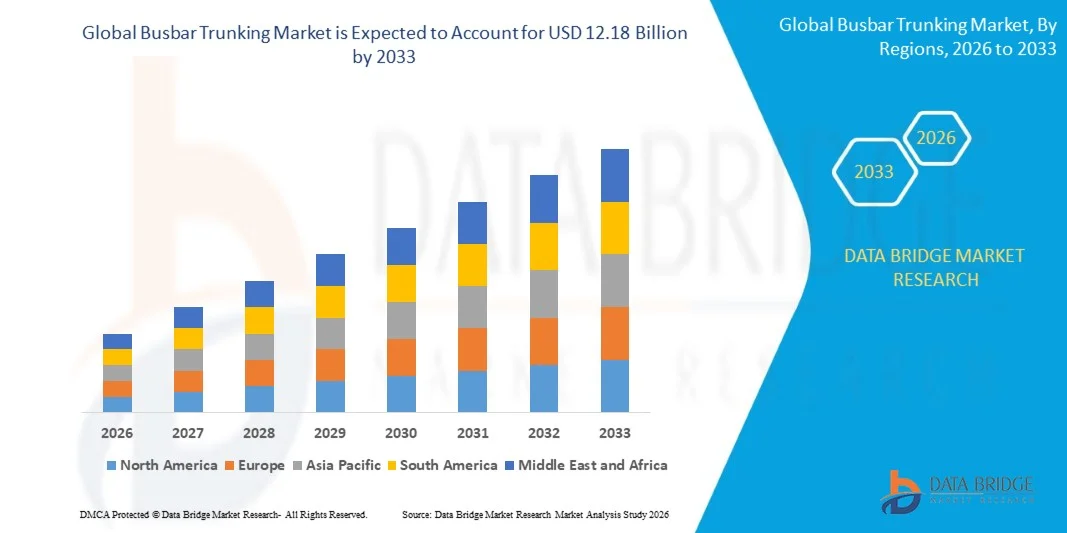
As per Data Bridge Market Research Analysis, the busbar trunking market was valued at USD 7.20 billion in 2025 and is projected to reach USD 12.18 billion by 2033, growing at a CAGR of 6.80% from 2026 to 2033. Market growth is supported by rapid data center construction, high-rise commercial development, industrial automation, grid modernization, renewable-energy integration, and the need for compact and efficient power distribution. Project owners are increasingly selecting modular busbar systems where conventional cable networks would require more space, longer installation time, and extensive rewiring during future expansion.
A busbar trunking system distributes electrical power through insulated copper or aluminum conductors installed inside a protective enclosure. The modular system can include straight lengths, elbows, feeder sections, tap-off units, metering, monitoring, and protection devices for buildings, factories, data centers, transport facilities, and utility installations. Copper systems remain important for compact high-current applications, while aluminum systems are gaining demand where lower weight and capital cost are priorities. Medium- and high-power products serve industrial and mission-critical facilities, whereas lighting and low-power ranges support retail, offices, warehouses, and smaller commercial sites.
Market Size & Forecast
- Market Value (2025): USD 7.20 Billion
- Expected Market Value (2034): USD 12.18 Billion
- Forecast CAGR (2025-2034): 6.80%
- Leading Region: Asia Pacific
- Fastest-Growing Region: North America
What are the Major Takeaways of Busbar Trunking Market?
- Asia-Pacific dominated the busbar trunking market with the largest revenue share of approximately 35.68% in 2025, supported by rapid urbanization, expanding industrialization, increasing construction activities, and large-scale infrastructure investments across China, India, Japan, and Southeast Asia.
- North America busbar trunking market is expected to witness the fastest growth rate from 2026 to 2033, supported by strong investments in data centers, commercial infrastructure, industrial automation, and power distribution modernization.
- The copper segment held the largest market revenue share of 64.56% in 2024 driven by its superior electrical conductivity, high current density, mechanical strength, and reliable thermal performance in demanding power-distribution applications. Copper systems are preferred in data centers, high-rise buildings, industrial plants, hospitals, and other space-constrained facilities where energy efficiency, compact dimensions, and long-term reliability are critical.
- The aluminum segment is projected to register the fastest growth at a CAGR of 7.60% during the forecast period, driven by increasing demand for lighter and more cost-effective systems across residential, public-infrastructure, commercial, and light-industrial projects. Lower weight simplifies transport and installation, while ongoing copper-price volatility is encouraging project owners to evaluate aluminum busbar trunking where conductor size and system design can accommodate its electrical characteristics.
- The medium power segment held the largest market revenue share of 29.50% in 2024 driven by its broad use across industrial facilities, infrastructure projects, data centers, and large commercial buildings. Medium power systems generally cover approximately 800 A to 2,500 A and provide a practical balance between current capacity, modular expansion, installation space, and project cost.
- The lighting segment is projected to register the fastest growth at a CAGR of approximately 10.5% during the forecast period, driven by increasing demand for compact, flexible, and easily reconfigurable lighting distribution in offices, retail centers, warehouses, hospitals, educational facilities, and high-rise buildings. The ability to relocate or add lighting circuits without extensive rewiring supports faster fit-outs and changing tenant requirements.
Report Scope and Busbar Trunking Market Segmentation
|
Attributes |
Busbar Trunking Market Key Market Insights |
|
Segments Covered |
|
|
Countries Covered |
North America
Europe
Asia-Pacific
Middle East and Africa
South America
|
|
Key Market Players |
|
|
Market Opportunities |
|
|
Value Added Data Infosets |
In addition to the insights on market scenarios such as market value, growth rate, segmentation, geographical coverage, and major players, the market reports curated by the Data Bridge Market Research also include in-depth expert analysis, geographically represented company-wise production and capacity, network layouts of distributors and partners, detailed and updated price trend analysis and deficit analysis of supply chain and demand. |
What is the Key Trend in the Busbar Trunking Market?
Trend: Growing Adoption Of Intelligent And Digitally Monitored Power Distribution Systems
The increasing demand for flexible, energy-efficient, and space-saving electrical distribution infrastructure is accelerating the adoption of intelligent busbar trunking systems across data centers, commercial buildings, hospitals, airports, manufacturing facilities, and high-rise developments. Modern busbar systems are increasingly integrated with digital monitoring capabilities such as branch-level metering, temperature sensing, load monitoring, breaker status tracking, and predictive maintenance functions, enabling facility operators to improve power management, operational efficiency, and system reliability.
The rapid expansion of AI-driven data centers, cloud computing infrastructure, industrial automation, electric vehicle manufacturing facilities, and smart buildings is further strengthening demand for modular and digitally connected power distribution solutions. For instance, Siemens continues to expand its SIVACON 8PS busbar trunking portfolio, offering digitally enabled power distribution systems with powerline communication technology, digital-twin planning capabilities, and scalable solutions designed for buildings, industrial facilities, data centers, and electromobility applications. This development highlights the industry's transition from conventional cable-based distribution systems toward intelligent, monitored, and easily reconfigurable electrical infrastructure.
The growing emphasis on digital monitoring, predictive maintenance, energy optimization, and modular electrical architecture is expected to reinforce long-term demand for intelligent busbar trunking systems across mission-critical facilities and rapidly evolving infrastructure projects throughout the forecast period.
What are the Key Drivers of Busbar Trunking Market?
Key Market Driver: Rising Expansion Of Data Centers, Industrial Facilities, And Commercial Infrastructure
The market is primarily driven by increasing demand for safe, efficient, and scalable power distribution systems capable of supporting growing electrical loads across modern infrastructure projects. Data centers, semiconductor manufacturing facilities, electric vehicle plants, automated warehouses, hospitals, airports, and commercial buildings require power distribution networks that offer high current-carrying capacity, rapid installation, energy monitoring, and future expansion flexibility.
Manufacturers are actively increasing production capacity to address rising market demand. For instance, in March 2025, ABB announced a USD 120 million investment in U.S. low-voltage electrification manufacturing, including a new facility in Selmer, Tennessee, that will produce busway and bus plug products for data centers, industrial facilities, commercial buildings, and utility infrastructure projects. The investment reflects growing industry demand for advanced busbar trunking systems as facility electrification and power density continue to increase globally.
As investments in digital infrastructure, industrial automation, and commercial construction continue to expand, demand for busbar trunking systems is expected to remain strong, supported by their ability to provide compact design, lower energy losses, simplified installation, and scalable power distribution capabilities.
Key Restraint/Challenge: High Initial Installation Costs And Complex Engineering Requirements
A significant challenge for the market is the higher upfront cost associated with busbar trunking systems compared to traditional cable-based electrical distribution solutions. Project-specific requirements such as custom routing, fire-resistant enclosures, high short-circuit ratings, metered tap-off units, and specialized installation procedures can increase overall project costs. In addition, fluctuations in copper and aluminum prices continue to impact manufacturing expenses and procurement planning.
Installation and system reliability also depend heavily on detailed engineering, proper joint alignment, torque control, structural coordination, and commissioning procedures. For instance, Schneider Electric’s Canalis KT installation guidelines emphasize detailed requirements for handling, support spacing, inspection, joint assembly, and commissioning to ensure safe and reliable operation of high-power busbar systems. These technical requirements illustrate the complexity associated with large-scale busbar trunking deployments.
Despite strong long-term benefits, higher capital investment, engineering complexity, raw material price volatility, and installation requirements are expected to remain key challenges, particularly for cost-sensitive projects and smaller commercial developments.
Key Market Opportunity: Growing Demand From AI Data Centers, EV Charging Infrastructure, And Renewable Energy Projects
Significant growth opportunities are emerging from high-density AI data centers, renewable energy installations, battery storage facilities, industrial electrification projects, and electric vehicle charging infrastructure. These applications require compact, scalable, and high-capacity power distribution systems capable of supporting rapidly changing load requirements and future expansion.
For instance, Eaton introduced its EV Charging Busway solution, which combines overhead busway systems with modular Level 2 EV charging units for fleet operations, commercial parking facilities, and last-mile delivery networks. The plug-and-play design enables charging stations to be easily added, relocated, or expanded as fleet requirements evolve, demonstrating the increasing versatility of busbar technology beyond conventional building power distribution applications.
As investments in AI infrastructure, renewable energy, electric mobility, industrial modernization, and smart buildings continue to accelerate, demand for digitally monitored and scalable busbar trunking systems is expected to create substantial long-term growth opportunities for manufacturers offering advanced power distribution technologies and value-added lifecycle services.
How is the Busbar Trunking Market Segmented?
The busbar trunking market is segmented on the basis of conductor, power rating, application.
- By Conductor
On the basis of conductor, the busbar trunking market is segmented into copper and aluminum. The copper segment held the largest market revenue share of 64.56% in 2024 driven by its superior electrical conductivity, high current density, mechanical strength, and reliable thermal performance in demanding power-distribution applications. Copper systems are preferred in data centers, high-rise buildings, industrial plants, hospitals, and other space-constrained facilities where energy efficiency, compact dimensions, and long-term reliability are critical.
The aluminum segment is projected to register the fastest growth at a CAGR of 7.60% during the forecast period, driven by increasing demand for lighter and more cost-effective systems across residential, public-infrastructure, commercial, and light-industrial projects. Lower weight simplifies transport and installation, while ongoing copper-price volatility is encouraging project owners to evaluate aluminum busbar trunking where conductor size and system design can accommodate its electrical characteristics.
- By Power Rating
On the basis of power rating, the busbar trunking market is segmented into lighting, low power, medium power, and high power. The medium power segment held the largest market revenue share of 29.50% in 2024 driven by its broad use across industrial facilities, infrastructure projects, data centers, and large commercial buildings. Medium power systems generally cover approximately 800 A to 2,500 A and provide a practical balance between current capacity, modular expansion, installation space, and project cost.
The lighting segment is projected to register the fastest growth at a CAGR of approximately 10.5% during the forecast period, driven by increasing demand for compact, flexible, and easily reconfigurable lighting distribution in offices, retail centers, warehouses, hospitals, educational facilities, and high-rise buildings. The ability to relocate or add lighting circuits without extensive rewiring supports faster fit-outs and changing tenant requirements.
- By Application
On the basis of application, the busbar trunking market is segmented into industrial, commercial, and utility. The commercial segment held the largest market revenue share of 39.60% in 2024 driven by extensive adoption in high-rise buildings, shopping centers, hospitals, hotels, offices, educational facilities, and data centers. Commercial projects value compact electrical risers, faster installation, modular tap-off points, and the ability to modify power distribution as floor layouts and tenant requirements change.
The commercial segment is also projected to register the fastest growth at a CAGR of 10.3% during the forecast period, driven by rapid urban infrastructure expansion, smart-building investment, data-center construction, and rising demand for energy-efficient and monitored power distribution. Increasing use of digital metering, modular fit-outs, and high-density electrical systems is accelerating segment expansion.
Which Region Holds the Largest Share of the Busbar Trunking Market?
Asia-Pacific Busbar Trunking Market Insight
Asia-Pacific dominated the busbar trunking market with the largest revenue share of approximately 35.68% in 2025, supported by rapid urbanization, expanding industrialization, increasing construction activities, and large-scale infrastructure investments across China, India, Japan, and Southeast Asia. The growing number of data centers, manufacturing facilities, airports, hospitals, and commercial buildings is significantly increasing demand for efficient electrical distribution systems. Government initiatives supporting industrial growth, smart city development, and power infrastructure modernization are further accelerating market expansion throughout the region.
Japan Busbar Trunking Market Insight
The Japan busbar trunking market is expected to witness the fastest growth rate from 2026 to 2033 due to increasing investments in advanced manufacturing, semiconductor production, renewable energy integration, and smart commercial infrastructure. The country's focus on energy efficiency, disaster-resilient infrastructure, and digital transformation is encouraging adoption of intelligent electrical distribution systems. In addition, the expansion of data centers and automated industrial facilities is creating new growth opportunities for busbar trunking manufacturers.
China Busbar Trunking Market Insight
The China busbar trunking market accounted for the largest market revenue share in Asia-Pacific in 2025, attributed to the country's massive industrial base, rapid urban development, and substantial investments in data centers, renewable energy, transportation infrastructure, and commercial construction projects. China remains one of the world's largest markets for electrical distribution equipment, supported by strong government investments in smart cities, industrial modernization, and energy infrastructure. The growing deployment of high-capacity power distribution systems across manufacturing plants, commercial complexes, and hyperscale data centers continues to drive significant market growth in the country.
North America Busbar Trunking Market Insight
North America busbar trunking market is expected to witness the fastest growth rate from 2026 to 2033, supported by strong investments in data centers, commercial infrastructure, industrial automation, and power distribution modernization. The increasing need for reliable, space-efficient, and scalable electrical distribution systems across mission-critical facilities is driving widespread adoption of busbar trunking solutions. Growing investments in hyperscale data centers, renewable energy projects, and electrification initiatives further strengthen market demand across the region.
U.S. Busbar Trunking Market Insight
The U.S. busbar trunking market captured the largest revenue share in 2025 within North America, driven by rapid expansion of AI data centers, cloud computing facilities, advanced manufacturing plants, and commercial construction projects. Increasing investments in low-voltage electrification infrastructure, energy-efficient buildings, and electric vehicle manufacturing facilities are supporting market growth. The adoption of intelligent power distribution systems with integrated monitoring and energy management capabilities is further accelerating demand across industrial and commercial sectors.
Europe Busbar Trunking Market Insight
The Europe busbar trunking market is expected to witness the fastest growth rate from 2026 to 2033, primarily driven by stringent energy-efficiency regulations, increasing industrial electrification, and growing investments in smart buildings and renewable energy infrastructure. Rising focus on sustainable construction and modernization of aging electrical infrastructure is encouraging the deployment of advanced busbar systems. The region is also experiencing increasing demand from data centers, transportation facilities, healthcare institutions, and manufacturing plants seeking efficient and flexible power distribution solutions.
U.K. Busbar Trunking Market Insight
The U.K. busbar trunking market is expected to witness the fastest growth rate from 2026 to 2033, driven by rising investments in data center construction, commercial real estate developments, and renewable energy projects. The increasing adoption of modular electrical infrastructure in smart buildings and industrial facilities is supporting market expansion. Furthermore, growing emphasis on energy optimization, electrical safety, and building automation systems is encouraging wider implementation of intelligent busbar trunking solutions throughout the country.
Germany Busbar Trunking Market Insight
The Germany busbar trunking market is expected to witness the fastest growth rate from 2026 to 2033, fueled by strong industrial manufacturing activity, factory automation investments, and the country's leadership in industrial electrification initiatives. Germany's advanced automotive, machinery, and semiconductor industries require highly reliable power distribution systems capable of supporting high electrical loads and future expansion requirements. Growing adoption of Industry 4.0 technologies and smart factory infrastructure is further contributing to market growth.
Which are the Top Companies in Busbar Trunking Market?
The busbar trunking industry is primarily led by well-established companies, including:
- Schneider Electric SE (France)
- Siemens AG (Germany)
- ABB Ltd. (Switzerland)
- Eaton Corporation plc (Ireland)
- Legrand SA (France)
- Anord Mardix Ltd. (U.K.)
- EAE Elektrik A.S. (Turkiye)
- C&S Electric Limited (India)
- Larsen & Toubro Limited (India)
- Godrej & Boyce Manufacturing Company Limited (India)
- Pogliano Busbar S.r.l. (Italy)
- Naxso S.r.l. (Italy)
- DBTS Industries Sdn. Bhd. (Malaysia)
- Rittal GmbH & Co. KG (Germany)
What are Latest Developments in Busbar Trunking Market?
- In March 2025, ABB announced a USD 120 million investment to expand U.S. low-voltage electrification manufacturing. The company allocated USD 80 million for a new Selmer, Tennessee facility that will produce busway and bus plug products for data centers, factories, high-rise residential buildings, and commercial facilities, while a further USD 40 million will expand circuit-breaker capacity in Mississippi. The development strengthens regional supply for growing North American power-distribution demand.
- In October 2025, Schneider Electric published an updated Canalis KTA catalogue for high-power busbar trunking from 800 A to 5,000 A. The updated documentation supports design, selection, installation, and future expansion of modular power distribution across large commercial, industrial, and infrastructure facilities, reflecting continued product standardization and technical support for complex busbar projects.
- In 2024, Legrand published the technical specification for its XCP-HP copper 2,500 A prefabricated busbar system. The system provides IP55 or optional IP65 protection, multiple conductor configurations, high short-circuit withstand capability, and installation flexibility for heavy-duty commercial, industrial, and data-center applications. The development illustrates continued innovation in compact high-current distribution systems.

- Interactive Data Analysis Dashboard
- Company Analysis Dashboard for high growth potential opportunities
- Research Analyst Access for customization & queries
- Competitor Analysis with Interactive dashboard
- Latest News, Updates & Trend analysis
- Harness the Power of Benchmark Analysis for Comprehensive Competitor Tracking
Global Busbar Trunking Market, Supply Chain Analysis and Ecosystem Framework
To support market growth and help clients navigate the impact of geopolitical shifts, DBMR has integrated in-depth supply chain analysis into its Global Busbar Trunking Market research reports. This addition empowers clients to respond effectively to global changes affecting their industries. The supply chain analysis section includes detailed insights such as Global Busbar Trunking Market consumption and production by country, price trend analysis, the impact of tariffs and geopolitical developments, and import and export trends by country and HSN code. It also highlights major suppliers with data on production capacity and company profiles, as well as key importers and exporters. In addition to research, DBMR offers specialized supply chain consulting services backed by over a decade of experience, providing solutions like supplier discovery, supplier risk assessment, price trend analysis, impact evaluation of inflation and trade route changes, and comprehensive market trend analysis.
Data collection and base year analysis are done using data collection modules with large sample sizes. The stage includes obtaining market information or related data through various sources and strategies. It includes examining and planning all the data acquired from the past in advance. It likewise envelops the examination of information inconsistencies seen across different information sources. The market data is analysed and estimated using market statistical and coherent models. Also, market share analysis and key trend analysis are the major success factors in the market report. To know more, please request an analyst call or drop down your inquiry.
The key research methodology used by DBMR research team is data triangulation which involves data mining, analysis of the impact of data variables on the market and primary (industry expert) validation. Data models include Vendor Positioning Grid, Market Time Line Analysis, Market Overview and Guide, Company Positioning Grid, Patent Analysis, Pricing Analysis, Company Market Share Analysis, Standards of Measurement, Global versus Regional and Vendor Share Analysis. To know more about the research methodology, drop in an inquiry to speak to our industry experts.
Data Bridge Market Research is a leader in advanced formative research. We take pride in servicing our existing and new customers with data and analysis that match and suits their goal. The report can be customized to include price trend analysis of target brands understanding the market for additional countries (ask for the list of countries), clinical trial results data, literature review, refurbished market and product base analysis. Market analysis of target competitors can be analyzed from technology-based analysis to market portfolio strategies. We can add as many competitors that you require data about in the format and data style you are looking for. Our team of analysts can also provide you data in crude raw excel files pivot tables (Fact book) or can assist you in creating presentations from the data sets available in the report.













