


Business Spend Software Market Overview
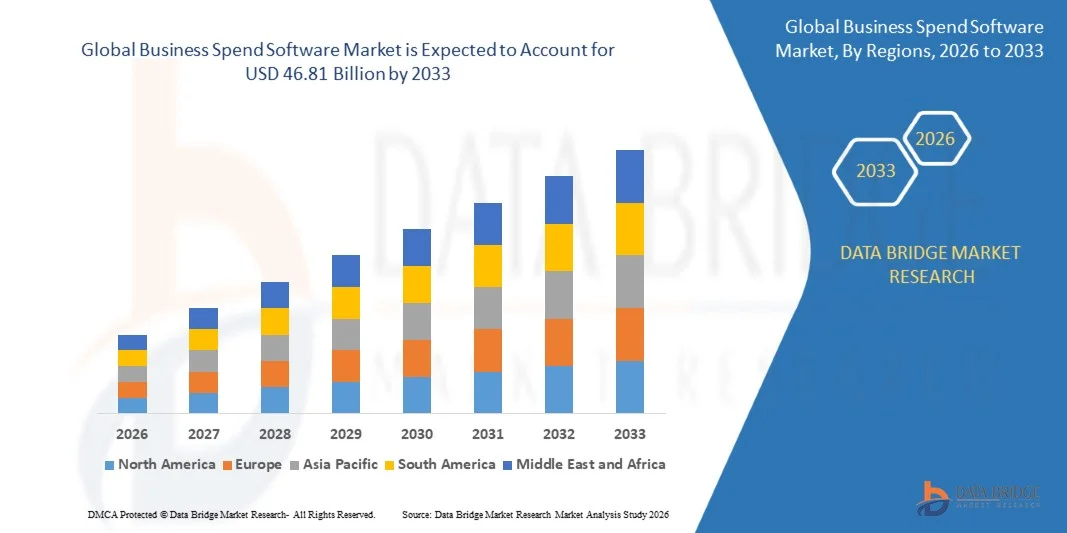
As per Data Bridge Market Research analysis The business spend software market was valued at USD 21.06 billion in 2025 and is projected to reach USD 46.81 billion by 2033, growing at a CAGR of 10.50% from 2026 to 2033. The market is witnessing steady expansion driven by increasing enterprise focus on cost optimization, improved financial transparency, and automation of procurement and expense management processes. Growing digital transformation across finance and accounting functions, along with rising adoption of cloud-based financial management solutions, is further accelerating market growth.
Organizations across industries are under pressure to gain real-time visibility into corporate spending, reduce maverick expenses, and strengthen compliance with internal and regulatory policies. Business spend software solutions are increasingly being deployed to streamline procurement, supplier management, invoicing, and expense tracking in a unified digital ecosystem. The integration of advanced analytics, AI-driven forecasting, and ERP system compatibility is enabling enterprises to make data-driven spending decisions, enhance operational efficiency, and improve overall financial governance.
Market Size & Forecast
- Global Market Value (2025): USD 21.06 Billion
- Expected Market Value (2033): USD 46.81 Billion
- Forecast CAGR (2026–2033): 10.50%
- Leading Region in 2025: North America
- Fastest Growing Region: Asia Pacific
Key Market Trends & Insights
- North America dominated the global business spend software market with the largest revenue share of 36.42% in 2025, supported by high enterprise digital maturity, strong ERP adoption, and early deployment of AI-driven financial automation tools.
- The Travel and Expense Management segment led the market with a 38.27% share in 2025, driven by its critical role in controlling employee-driven expenditures across large and distributed enterprises.
- Asia-Pacific is expected to be the fastest-growing region at a CAGR of 8.1% from 2026 to 2033, fueled by rapid SME digitization, expanding fintech ecosystems, and rising adoption of automated procurement solutions in countries such as India, China, and Singapore.
- Spend Analysis are the fastest-growing solution type, projected to register a CAGR of 8.4%, reflecting the surge in demand for data-driven financial decision-making and procurement optimization.
- The Large Enterprises segment dominated the enterprises category with a 57.94% revenue share in 2025, led by their complex organizational structures, global procurement networks, and higher spending volumes.
- On-Cloud accounted for 62.15% of the market, preferred by its scalability, flexibility, and lower upfront infrastructure costs.
- The Direct Spending segment is the fastest-growing type category, with a CAGR of 8.1%, driven by increasing focus on supply chain optimization and production cost efficiency.
Report Scope and Business Spend Software Market Segmentation
|
Attributes |
Business Spend Software Key Market Insights |
|
Segments Covered |
|
|
Countries Covered |
North America · U.S. · Canada · Mexico Europe · Germany · France · U.K. · Netherlands · Switzerland · Belgium · Russia · Italy · Spain · Turkey · Rest of Europe Asia-Pacific · China · Japan · India · South Korea · Singapore · Malaysia · Australia · Thailand · Indonesia · Philippines · Rest of Asia-Pacific Middle East and Africa · Saudi Arabia · U.A.E. · South Africa · Egypt · Israel · Rest of Middle East and Africa South America · Brazil · Argentina · Rest of South America |
|
Key Market Players |
· SAP SE (Germany) · Coupa Software Inc. (U.S.) · Oracle (U.S.) · Workday, Inc. (U.S.) · Infor (U.S.) · Ivalua Inc. (U.S.) · JAGGAER (U.S.) · Basware (Finland) · Proactis Holdings Plc (U.K.) · Medius (Sweden) · GEP (U.S.) · Zycus Inc. (U.S.) · Expensify, Inc. (U.S.) · Zoho Corporation Pvt. Ltd. (India) · Emburse, Inc. (U.S.) · Tipalti Inc. (U.S.) · Procurify Technologies Inc. (Canada) · Rydoo (Belgium) · Precoro Inc. (U.S.) · Airbase Inc. (U.S.) |
|
Market Opportunities |
· Rapid adoption among SMEs in emerging economies · Expansion of AI-driven autonomous spend management · Growing demand for unified financial ecosystems |
|
Value Added Data Infosets |
In addition to the market insights such as market value, growth rate, market segments, geographical coverage, market players, and market scenario, the market report curated by the Data Bridge Market Research team includes in-depth expert analysis, import/export analysis, pricing analysis, production consumption analysis, and pestle analysis. |
Business Spend Software Market Trends
Trend: Expansion of AI-Driven Spend Intelligence & Automation
Enterprises are increasingly shifting toward AI-powered business spend software to automate end-to-end financial operations, including invoice processing, expense categorization, supplier management, and procurement approvals. These platforms use machine learning to continuously analyze large volumes of transactional data, identify spending inefficiencies, and flag anomalies such as duplicate invoices or policy violations. The integration of predictive analytics is also enabling CFOs and finance teams to improve budgeting accuracy, forecast future cash outflows, and optimize working capital allocation. In addition, the rise of cloud-native and API-first architectures is allowing seamless integration with ERP systems, banking networks, and accounting tools, creating a unified financial ecosystem with real-time visibility and control across global operations.
For instance, companies such as SAP Concur and Coupa are deploying AI-driven capabilities to automate expense audits, detect fraudulent claims, and streamline approval workflows, significantly reducing manual effort and improving compliance accuracy across multinational enterprises.
Business Spend Software Market Dynamics
Key Market Driver: Rising Demand for Enterprise Cost Control & Financial Transparency
The increasing pressure on organizations to optimize costs and improve financial discipline is a major driver for the adoption of business spend software. Enterprises are operating in an environment of tighter budgets, inflationary pressures, and heightened shareholder expectations, which is pushing them to gain granular visibility into all categories of spending. As a result, organizations are replacing fragmented spreadsheets and manual approval processes with centralized digital platforms that provide real-time tracking of procurement, travel expenses, vendor payments, and operational expenditures. Furthermore, the shift toward remote and hybrid work models has increased the need for cloud-based systems that allow finance teams to monitor and control spending across geographically dispersed teams, ensuring policy compliance and reducing unauthorized expenditures.
For instance, multinational enterprises are implementing integrated spend management ecosystems that consolidate procurement, expense reporting, and supplier payments into a single dashboard, enabling CFOs to enforce standardized spending policies across all global subsidiaries while improving decision-making speed and financial accountability.
Key Restraint/Challenge: Data Security Concerns & Complex System Integration
One of the major challenges limiting widespread adoption of business spend software is the growing concern around data security, particularly because these platforms handle highly sensitive financial, supplier, and employee expenditure data. Organizations must comply with strict data protection regulations such as GDPR and regional financial governance frameworks, making security a top priority. In addition, many enterprises operate on legacy ERP and accounting systems that are not easily compatible with modern cloud-based spend platforms, leading to complex and time-consuming integration processes. The customization required to align spend software with existing financial workflows often increases implementation costs and extends deployment timelines, especially for large global organizations with multiple subsidiaries and reporting structures.
For instance, enterprises adopting global spend management solutions often need multi-layer integration with systems such as SAP ERP, Oracle Financials, and regional banking APIs, requiring extensive IT coordination, phased deployment strategies, and continuous system optimization to ensure smooth interoperability and data consistency.
Key Market Opportunity: Expansion of AI-Driven Autonomous Finance & Embedded Spend Ecosystems
The increasing convergence of artificial intelligence, fintech infrastructure, and enterprise software is creating a strong opportunity for autonomous finance and intelligent spend management platforms. Businesses are moving toward fully automated financial ecosystems where AI not only tracks and analyzes spending but also executes procurement decisions, optimizes vendor selection, and dynamically manages budgets in real time. In addition, the rise of embedded finance is enabling spend management capabilities to be integrated directly into ERP systems, banking apps, and enterprise workflows, reducing fragmentation and improving financial control. This evolution is particularly significant for SMEs and mid-market companies, which are seeking scalable, low-cost digital solutions to achieve enterprise-grade financial governance without heavy IT investment.
For instance, platforms such as Brex and Ramp are expanding AI-based corporate card and spend automation solutions that provide real-time budgeting controls, automated expense categorization, and intelligent approval workflows, enabling companies to streamline financial operations and improve cash flow visibility.
Business Spend Software Market Scope
The business spend software market is segmented on the basis of solution, enterprises, deployment, type, and end use.
- By Solution
On the basis of solution, the business spend software market is segmented into procure to pay, travel and expense management, spend analysis, contract management, and others. The Travel and Expense Management segment dominated the market with a 38.27% share in 2025, owing to its critical role in controlling employee-driven expenditures across large and distributed enterprises. Organizations are increasingly prioritizing automation of expense reporting, reimbursement workflows, and policy enforcement to reduce operational leakage and improve financial compliance. This segment benefits from high-frequency transactional data, making it a key focus area for digitization and AI-based optimization. Integration with corporate card systems and mobile-based expense tracking is further enhancing adoption. The rising prevalence of remote and hybrid work models has increased the need for real-time visibility into employee spending. Continuous regulatory pressure for audit-ready financial records is also reinforcing its dominance across industries.
The Spend Analysis segment is projected to grow at the fastest CAGR of 8.4% from 2026 to 2033, driven by increasing demand for data-driven financial decision-making and procurement optimization. Enterprises are leveraging advanced analytics tools to identify cost-saving opportunities, supplier inefficiencies, and budget deviations across complex organizational structures. AI and machine learning are enabling granular categorization of spending patterns and predictive forecasting of future expenditures. Growing emphasis on strategic sourcing and supply chain optimization is further boosting adoption. Organizations are also using spend analysis to enhance negotiation power with vendors and improve contract efficiency. Expansion of cloud-based analytics platforms is accelerating accessibility across enterprises of all sizes.
- By Enterprises
On the basis of enterprises, the market is segmented into Large Enterprises and SMEs. The Large Enterprises segment dominated the market with a 57.94% share in 2025, due to their complex organizational structures, global procurement networks, and higher spending volumes. These organizations require integrated platforms to manage multi-departmental budgets, cross-border transactions, and compliance requirements. Large enterprises are early adopters of AI-enabled automation and ERP-integrated financial ecosystems. Their ability to invest in full-suite solutions enables broader deployment across procurement, expense, and contract management functions. Increasing focus on cost governance and financial transparency further strengthens adoption. Strong vendor partnerships and long-term enterprise contracts support sustained dominance.
The SMEs segment is expected to grow at the fastest CAGR of 7.9% from 2026 to 2033, driven by rapid digital transformation and increasing availability of affordable cloud-based solutions. SMEs are transitioning from manual spreadsheets to automated spend management platforms to improve financial visibility and operational efficiency. Subscription-based pricing models are making advanced financial tools more accessible to smaller organizations. Rising fintech ecosystem support and government-led digitalization initiatives are further accelerating adoption. SMEs are increasingly using these platforms to optimize cash flow and streamline procurement processes. Growing awareness of cost control benefits is significantly contributing to segment expansion.
- By Deployment
On the basis of deployment, the market is segmented into On-Cloud and On-Premise. The On-Cloud segment dominated the market with a 62.15% share in 2025, driven by its scalability, flexibility, and lower upfront infrastructure costs. Cloud-based spend management platforms enable real-time financial visibility across geographically distributed teams. They also support faster deployment cycles and continuous software updates without heavy IT intervention. Integration with AI analytics, ERP systems, and banking APIs is more seamless in cloud environments. Increasing remote work adoption is further strengthening demand for cloud accessibility. Enhanced cybersecurity frameworks are improving trust and accelerating enterprise adoption.
The On-Premise segment is expected to grow at a CAGR of 5.9% from 2026 to 2033, primarily driven by organizations with strict data governance, regulatory, and security requirements. Industries such as BFSI and government continue to prefer on-premise deployment due to greater control over sensitive financial data. However, high maintenance costs, limited scalability, and slower upgrade cycles are restricting broader adoption. Legacy system dependencies also sustain its relevance in traditional enterprises. Despite slower growth compared to cloud solutions, it remains critical for organizations prioritizing internal infrastructure control. Hybrid deployment models are emerging as a transitional approach for some organizations.
- By Type
On the basis of type, the market is segmented into Indirect spending, direct spending, and MRO spending. The Indirect Spending segment dominated the market with a 46.18% share in 2025, driven by the high volume and frequency of non-production-related expenditures such as travel, IT services, utilities, and office operations. Enterprises are increasingly focusing on optimizing indirect costs to improve profitability and operational efficiency. Automation of procurement workflows is enhancing transparency and reducing manual intervention in this category. Integration with expense management systems allows better control over discretionary spending. Centralized procurement strategies are further strengthening adoption across global enterprises.
The Direct Spending segment is expected to grow at the fastest CAGR of 8.1% from 2026 to 2033, driven by increasing focus on supply chain optimization and production cost efficiency. Manufacturers are adopting advanced procurement platforms to manage raw materials and production inputs more effectively. Real-time supplier collaboration and demand forecasting are improving procurement accuracy. Integration with ERP and supply chain management systems is enhancing operational visibility. Growing global manufacturing digitization and Industry 4.0 adoption are further accelerating demand.
- By End Use
On the basis of end use, the market is segmented into BFSI, IT and telecom, energy, healthcare, manufacturing, and others. The BFSI segment dominated the market with a 31.64% share in 2025, driven by stringent regulatory compliance requirements, high transaction volumes, and strong focus on financial governance. Financial institutions require advanced spend visibility tools to ensure audit readiness and operational transparency. Automation of procurement and expense workflows is widely adopted in this sector to minimize financial risk. Strong digital transformation initiatives and AI-based fraud detection systems further reinforce adoption. Increasing complexity of financial operations supports sustained dominance.
The Manufacturing segment is projected to grow at the fastest CAGR of 8.3% from 2026 to 2033, driven by increasing adoption of digital procurement systems and supply chain optimization tools. Manufacturers are focusing on reducing operational costs and improving raw material procurement efficiency. Integration of spend platforms with industrial ERP systems is enhancing production planning accuracy. Industry 4.0 adoption is accelerating digital transformation across factories. Rising demand for real-time supplier visibility and cost optimization is further boosting growth.
Business Spend Software Market Regional Analysis
North America dominated the global business spend software market with the largest revenue share of 36.42% in 2025, supported by high enterprise digital maturity, strong ERP adoption, and early deployment of AI-driven financial automation tools. The region also benefits from increasing investments in AI-driven procurement automation, stringent financial compliance requirements, and growing demand for real-time spend visibility across large enterprises. Rising integration of spend management solutions with ERP, banking, and fintech ecosystems is further accelerating adoption across industries. Increasing focus on cost optimization, financial transparency, and intelligent business process automation continues to strengthen North America’s leadership position in the global market.
U.S. Business Spend Software Market Insight
The U.S. business spend software market is witnessing strong growth due to rising investments in financial automation, procurement digitization, and enterprise cost optimization initiatives. The country’s mature technology ecosystem, along with increasing adoption of AI-powered, cloud-based, and data-driven spend management platforms, is driving demand across large enterprises and SMEs. In addition, growing emphasis on regulatory compliance, financial transparency, and real-time expense visibility is accelerating software adoption across finance, procurement, and accounting functions.
Europe Business Spend Software Market Insight
The Europe business spend software market remains a major contributor to global revenue, driven by strong digital transformation initiatives, regulatory compliance requirements, and high demand for automated financial management solutions. The widespread use of spend management platforms across procurement, expense tracking, and supplier management processes is supporting market expansion across the region. Increasing investments in AI-powered analytics technologies, coupled with strict financial governance standards and a highly digitalized business environment, continue to enhance the adoption of business spend software throughout Europe.
U.K. Business Spend Software Market Insight
The U.K. business spend software market is experiencing steady growth, supported by rising adoption of digital finance solutions, procurement automation, and cloud-based expense management platforms. Increasing investments in advanced financial technology infrastructure and growing demand for cost-effective, compliance-focused spend management solutions are contributing to market growth. Furthermore, integration of AI, predictive analytics, and workflow automation technologies is improving financial control and operational efficiency, positioning the U.K. as a key innovation hub in the business spend software industry.
Germany Business Spend Software Market Insight
The Germany business spend software market is expanding steadily due to the country’s strong industrial base, advanced enterprise technology adoption, and increasing implementation of next-generation financial management solutions. Manufacturing companies, financial institutions, and multinational enterprises are increasingly utilizing spend software for procurement optimization, supplier management, and cost control activities. Continuous advancements in cloud computing, AI integration, and business analytics technologies, along with strong emphasis on operational efficiency and compliance, are further driving market growth in Germany.
Asia-Pacific Business Spend Software Market Insight
The Asia-Pacific business spend software market is expected to witness rapid growth, driven by increasing enterprise digitalization, expanding SME adoption, and rising investments in financial technology infrastructure across countries such as China, India, and Japan. Growing awareness regarding cost optimization, increasing adoption of cloud-based spend management solutions, and rising demand for scalable and efficient financial control platforms are supporting regional market expansion. In addition, the growing presence of multinational corporations and accelerating digital transformation initiatives are driving software adoption across commercial and industrial sectors.
Japan Business Spend Software Market Insight
The Japan business spend software market is witnessing consistent growth due to rising investments in financial automation technologies, enterprise digital transformation, and operational efficiency initiatives. Large corporations, manufacturing enterprises, and financial institutions are increasingly adopting advanced spend management platforms for procurement optimization, expense control, and financial planning purposes. Moreover, increasing integration of AI-powered analytics technologies and the country’s focus on productivity enhancement and business process modernization are further contributing to market growth.
China Business Spend Software Market Insight
The China business spend software market is growing rapidly, driven by increasing enterprise digitalization, expanding cloud infrastructure, and rising government support for business technology modernization. Growing adoption of AI-enabled and cloud-based spend management platforms across manufacturing, technology, and financial sectors is significantly boosting market demand. In addition, rising investments in enterprise software, increasing awareness regarding financial transparency, and rapid technological advancements are positioning China as one of the fastest-growing markets for business spend software globally.
Business Spend Software Market Share
The business spend software industry is primarily led by well-established companies, including:
- SAP SE (Germany)
- Coupa Software Inc. (U.S.)
- Oracle (U.S.)
- Workday, Inc. (U.S.)
- Infor (U.S.)
- Ivalua Inc. (U.S.)
- JAGGAER (U.S.)
- Basware (Finland)
- Proactis Holdings Plc (U.K.)
- Medius (Sweden)
- GEP (U.S.)
- Zycus Inc. (U.S.)
- Expensify, Inc. (U.S.)
- Zoho Corporation Pvt. Ltd. (India)
- Emburse, Inc. (U.S.)
- Tipalti Inc. (U.S.)
- Procurify Technologies Inc. (Canada)
- Rydoo (Belgium)
- Precoro Inc. (U.S.)
- Airbase Inc. (U.S.)
Latest Developments in Business Spend Software Market
- In March 2025, SAP announced the debut of Joule, its generative AI copilot, in SAP Concur solutions during SAP Concur Fusion 2025, enabling automated expense report preparation, intelligent travel planning, and AI-assisted employee support. The innovation is designed to streamline travel and expense management while reducing manual effort and improving compliance, reinforcing SAP’s leadership in AI-powered business spend management
- In February 2025, SAP introduced new innovations across its spend management portfolio, including the general availability of SAP Spend Control Tower with AI-enabled spend classification and supplier insights. The update strengthens enterprise visibility into spending, procurement, and supplier management by providing a unified source of financial and supplier data for strategic decision-making
- In October 2024, Brex and Navan launched BrexPay for Navan, an integrated business travel and payment solution that combines corporate card capabilities with travel management into a unified workflow. The joint solution simplifies travel payments, reduces reconciliation complexity, and improves expense management for global enterprises with distributed workforces
- In June 2024, Brex launched new digital banking products for startups, expanding its unified spend management platform by integrating banking, corporate cards, expense management, bill pay, treasury, and travel booking into a single financial ecosystem. The launch enables businesses to centralize financial operations while improving cash management and spend visibility
- In April 2024, SAP introduced multiple AI-powered enhancements across its spend management portfolio, including generative AI capabilities for SAP Ariba, ExpenseIt, Concur Request, and supplier discovery solutions. These enhancements automate procurement, travel expense processing, supplier sourcing, and financial workflows, helping organizations improve efficiency and optimize enterprise spending

- Interactive Data Analysis Dashboard
- Company Analysis Dashboard for high growth potential opportunities
- Research Analyst Access for customization & queries
- Competitor Analysis with Interactive dashboard
- Latest News, Updates & Trend analysis
- Harness the Power of Benchmark Analysis for Comprehensive Competitor Tracking
Data collection and base year analysis are done using data collection modules with large sample sizes. The stage includes obtaining market information or related data through various sources and strategies. It includes examining and planning all the data acquired from the past in advance. It likewise envelops the examination of information inconsistencies seen across different information sources. The market data is analysed and estimated using market statistical and coherent models. Also, market share analysis and key trend analysis are the major success factors in the market report. To know more, please request an analyst call or drop down your inquiry.
The key research methodology used by DBMR research team is data triangulation which involves data mining, analysis of the impact of data variables on the market and primary (industry expert) validation. Data models include Vendor Positioning Grid, Market Time Line Analysis, Market Overview and Guide, Company Positioning Grid, Patent Analysis, Pricing Analysis, Company Market Share Analysis, Standards of Measurement, Global versus Regional and Vendor Share Analysis. To know more about the research methodology, drop in an inquiry to speak to our industry experts.
Data Bridge Market Research is a leader in advanced formative research. We take pride in servicing our existing and new customers with data and analysis that match and suits their goal. The report can be customized to include price trend analysis of target brands understanding the market for additional countries (ask for the list of countries), clinical trial results data, literature review, refurbished market and product base analysis. Market analysis of target competitors can be analyzed from technology-based analysis to market portfolio strategies. We can add as many competitors that you require data about in the format and data style you are looking for. Our team of analysts can also provide you data in crude raw excel files pivot tables (Fact book) or can assist you in creating presentations from the data sets available in the report.













