


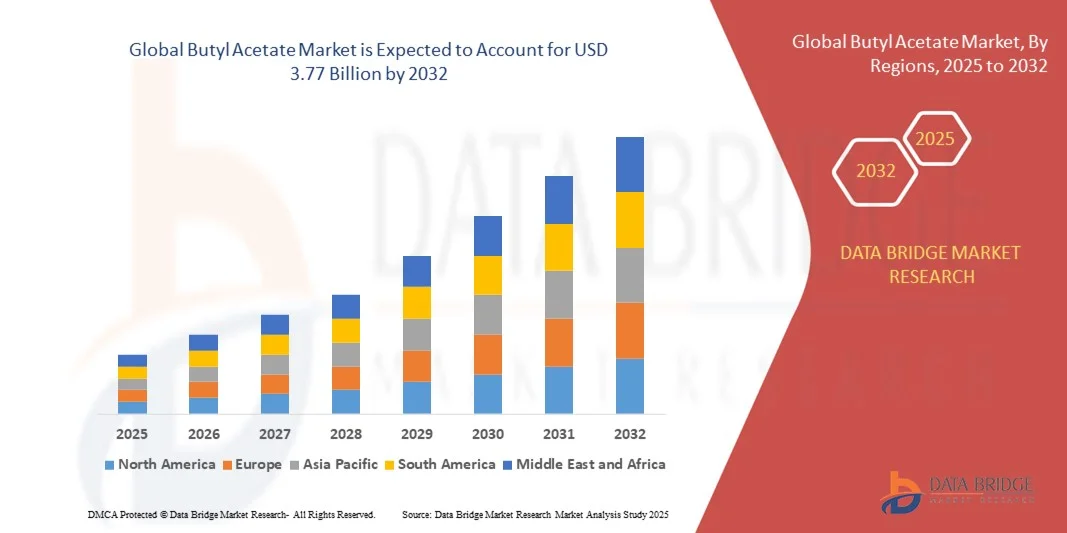
Butyl Acetate Market Size
- The global butyl acetate market size was valued at USD 2.88 billion in 2024 and is expected to reach USD 3.77 billion by 2032, at a CAGR of 3.4% during the forecast period
- The market growth is largely fuelled by the increasing demand from end-use industries such as paints & coatings, adhesives, and printing inks, where butyl acetate is widely used as a solvent
- Growing industrialization and urbanization, particularly in emerging economies, are driving demand for high-performance coatings and adhesives, further boosting butyl acetate consumption
Butyl Acetate Market Analysis
- The market is witnessing steady growth due to the widespread use of butyl acetate as a solvent in industries requiring quick-drying, high-quality finishes
- Its applications across paints, coatings, printing inks, and adhesives are expanding as manufacturers focus on improving product performance and efficiency
- Asia-Pacific dominated the butyl acetate market with the largest revenue share of 42.3% in 2024, driven by rapid industrialization, urbanization, and rising demand from paints, coatings, adhesives, and pharmaceuticals industries
- North America region is expected to witness the highest growth rate in the global butyl acetate market, driven by technological advancements, higher adoption of eco-friendly solvents, and increasing awareness of solvent performance in industrial and construction applications
- The Paints & Coatings segment held the largest market revenue share in 2024, driven by its widespread use as a high-performance solvent that improves drying time, finish quality, and overall coating performance. Paints and coatings manufacturers prefer butyl acetate for its compatibility with a wide range of resins and compliance with VOC regulations
Report Scope and Butyl Acetate Market Segmentation
|
Attributes |
Butyl Acetate Key Market Insights |
|
Segments Covered |
|
|
Countries Covered |
North America
Europe
Asia-Pacific
Middle East and Africa
South America
|
|
Key Market Players |
|
|
Market Opportunities |
|
|
Value Added Data Infosets |
In addition to the insights on market scenarios such as market value, growth rate, segmentation, geographical coverage, and major players, the market reports curated by the Data Bridge Market Research also include import export analysis, production capacity overview, production consumption analysis, price trend analysis, climate change scenario, supply chain analysis, value chain analysis, raw material/consumables overview, vendor selection criteria, PESTLE Analysis, Porter Analysis, and regulatory framework. |
Butyl Acetate Market Trends
Increasing Demand from Paints, Coatings, and Adhesives Industries
- The growing demand for high-performance paints, coatings, and adhesives is driving the butyl acetate market, as it serves as an effective solvent that improves drying time, finish quality, and overall product performance. Its compatibility with a wide range of resin systems makes it a preferred choice among manufacturers
- Rapid industrialization and urbanization in developing regions are accelerating consumption, particularly in construction, automotive, and consumer goods sectors, where superior coating performance is essential. In addition, increasing replacement and maintenance activities in developed regions are contributing to steady demand
- The shift toward eco-friendly and low-VOC formulations is further supporting market growth, as manufacturers prefer butyl acetate for its balance of performance and environmental compliance. Rising consumer preference for sustainable and safe household products is also boosting adoption
- For instance, in 2023, several leading coating manufacturers in Europe adopted butyl acetate-based formulations to comply with stringent VOC regulations while maintaining high-quality finishes. These implementations also helped companies reduce environmental penalties and strengthen their sustainability credentials
- While demand is rising, market growth depends on continued innovation in low-emission and specialty solvent formulations to meet evolving regulatory and industrial needs. Investments in R&D for bio-based or greener butyl acetate alternatives are expected to further propel market expansion
Butyl Acetate Market Dynamics
Driver
Rising Industrial and Construction Activities Worldwide
- Expanding industrial production and urban development are increasing the need for paints, coatings, and adhesives, which are major end-uses of butyl acetate. This trend is further reinforced by infrastructure modernization programs in emerging economies
- Manufacturers are increasingly investing in high-performance solvent systems to improve product efficiency, durability, and drying characteristics, boosting butyl acetate consumption. The demand for premium finishes in automotive and electronics coatings is also contributing to growth
- Government initiatives promoting infrastructure development and industrial growth further accelerate demand across commercial and residential construction projects. Public-private partnerships and urban housing projects are driving large-scale procurement of paints and adhesives containing butyl acetate
- For instance, in 2022, Asia-Pacific witnessed a surge in infrastructure projects, leading to a notable increase in butyl acetate demand in coatings and adhesive applications. Countries such as India and China led the growth due to rapid urbanization and industrial expansion
- While industrialization is driving market expansion, volatility in raw material costs and regulatory compliance remain factors that could impact growth. Supply chain disruptions and energy price fluctuations also pose challenges to manufacturers
Restraint/Challenge
Fluctuating Raw Material Prices and Environmental Regulations
- The butyl acetate market faces challenges from fluctuating prices of feedstock chemicals, such as acetic acid and butanol, which can affect production costs and profit margins. Price instability may lead to uncertainty in long-term supply contracts for downstream industries
- Strict environmental regulations on volatile organic compounds (VOCs) in paints, coatings, and adhesives are pressuring manufacturers to reduce solvent usage or switch to alternative formulations. Non-compliance can result in fines, product recalls, or restricted market access
- Limited availability of low-VOC compliant butyl acetate in certain regions can restrict market penetration and hinder adoption in eco-sensitive projects. Manufacturers may need to invest in localized production or alternative sourcing strategies to overcome supply gaps
- For instance, in 2023, several U.S. coating manufacturers reported reformulation challenges due to VOC limits, affecting production timelines and costs. This also prompted some companies to explore hybrid solvent systems to balance compliance and performance
- Addressing cost volatility and regulatory compliance is crucial for market stakeholders to ensure sustainable growth and meet evolving industrial demands. Collaboration with raw material suppliers, investment in greener alternatives, and continuous process optimization are key strategies
Butyl Acetate Market Scope
The market is segmented on the basis of application and end-use industry.
- By Application
On the basis of application, the butyl acetate market is segmented into Paints & Coatings, Pharmaceuticals, Perfumery & Flavours, Plasticizers, Electricals, and Others. The Paints & Coatings segment held the largest market revenue share in 2024, driven by its widespread use as a high-performance solvent that improves drying time, finish quality, and overall coating performance. Paints and coatings manufacturers prefer butyl acetate for its compatibility with a wide range of resins and compliance with VOC regulations.
The Pharmaceuticals segment is expected to witness the fastest growth rate from 2025 to 2032, driven by increasing demand for high-purity solvents in drug formulations, laboratory applications, and other medicinal uses. Butyl acetate is valued for its low toxicity, chemical stability, and effectiveness in producing consistent, high-quality pharmaceutical products.
- By End Use Industry
On the basis of end-use industry, the butyl acetate market is segmented into Automotive, Homebuilding, and Others. The Automotive segment dominated in 2024, propelled by the demand for durable and aesthetic coatings, adhesives, and sealants used in vehicles.
The Homebuilding segment is expected to witness the fastest growth rate from 2025 to 2032, driven by increasing construction activities, urbanization, and the adoption of high-performance paints and coatings for residential and commercial projects.
Butyl Acetate Market Regional Analysis
- Asia-Pacific dominated the butyl acetate market with the largest revenue share of 42.3% in 2024, driven by rapid industrialization, urbanization, and rising demand from paints, coatings, adhesives, and pharmaceuticals industries
- The region’s growing automotive, construction, and perfumery sectors are further boosting consumption, supported by expanding chemical manufacturing infrastructure and cost-competitive production
- Rising disposable incomes, government initiatives promoting industrial growth, and increasing awareness of low-VOC, eco-friendly solvents are contributing to strong adoption of butyl acetate across multiple industries
China Butyl Acetate Market Insight
The China butyl acetate market accounted for the largest revenue share in APAC in 2024, fueled by rapid industrial expansion, urban development, and high consumption in automotive, construction, and pharmaceutical sectors. Domestic production capabilities and affordable pricing are supporting widespread adoption, while environmental compliance efforts are driving the demand for low-VOC formulations.
Japan Butyl Acetate Market Insight
The Japan butyl acetate market is expected to witness the fastest growth rate from 2025 to 2032 due to the country’s advanced industrial base, high-tech manufacturing, and demand for performance coatings, adhesives, and specialty pharmaceuticals. Manufacturers favor butyl acetate for its low toxicity, chemical stability, and efficiency in high-quality applications. Growth is further supported by an aging population that demands reliable consumer products and industrial quality standards.
North America Butyl Acetate Market Insight
North America is expected to witness the fastest growth rate from 2025 to 2032, driven by strong demand from paints, coatings, adhesives, and perfumery applications. The U.S. captured the largest market share in the region in 2024, fueled by industrial expansion, infrastructure projects, and the need for high-performance, low-VOC solvents. Advanced manufacturing infrastructure and high-quality standards further encourage adoption across industrial and consumer sectors.
Europe Butyl Acetate Market Insight
Europe is expected to witness the fastest growth rate from 2025 to 2032, driven by stringent regulations on VOCs, adoption of eco-friendly solvents, and increasing construction and automotive activities. Germany and the U.K. are leading the market, with manufacturers leveraging butyl acetate for high-performance coatings, adhesives, and specialty applications that meet environmental and quality standards. Urbanization and industrial modernization continue to foster demand.
Germany Butyl Acetate Market Insight
Germany is expected to witness the fastest growth rate from 2025 to 2032 due to strong industrial infrastructure, focus on sustainable manufacturing, and growing automotive and electrical sectors. Demand for low-VOC, high-performance solvents and eco-friendly industrial processes is driving adoption. Integration of butyl acetate in advanced coating and adhesive applications is further boosting market growth.
U.K. Butyl Acetate Market Insight
The U.K. market is expected to witness the fastest growth rate from 2025 to 2032, fueled by increasing construction projects, growing industrial activity, and adoption of performance-oriented coatings, adhesives, and perfumery formulations. Heightened awareness of environmental compliance and solvent safety encourages widespread use of butyl acetate. Robust retail and e-commerce channels also support market penetration.
Butyl Acetate Market Share
The Butyl Acetate industry is primarily led by well-established companies, including:
- BASF SE (Germany)
- Dow (U.S.)
- Petroliam Nasional Berhad (PETRONAS) (Malaysia)
- Eastman Chemical Company (U.S.)
- Celanese Corporation (U.S.)
- INEOS (U.K.)
- Yangtze River Acetyls Co Ltd (China)
- Thermo Fisher Scientific (U.S.)
- Yip’s Chemical Holdings Limited (Hong Kong)
- Alfa Aesar (U.S.)
- Mitsubishi Chemical Holding Corporation (Japan)
- Sasol Limited (South Africa)
- Solventis (Germany)
- Shatabdi Chemicals (P) Ltd. (India)

- Interactive Data Analysis Dashboard
- Company Analysis Dashboard for high growth potential opportunities
- Research Analyst Access for customization & queries
- Competitor Analysis with Interactive dashboard
- Latest News, Updates & Trend analysis
- Harness the Power of Benchmark Analysis for Comprehensive Competitor Tracking
Global Butyl Acetate Market, Supply Chain Analysis and Ecosystem Framework
To support market growth and help clients navigate the impact of geopolitical shifts, DBMR has integrated in-depth supply chain analysis into its Global Butyl Acetate Market research reports. This addition empowers clients to respond effectively to global changes affecting their industries. The supply chain analysis section includes detailed insights such as Global Butyl Acetate Market consumption and production by country, price trend analysis, the impact of tariffs and geopolitical developments, and import and export trends by country and HSN code. It also highlights major suppliers with data on production capacity and company profiles, as well as key importers and exporters. In addition to research, DBMR offers specialized supply chain consulting services backed by over a decade of experience, providing solutions like supplier discovery, supplier risk assessment, price trend analysis, impact evaluation of inflation and trade route changes, and comprehensive market trend analysis.
Data collection and base year analysis are done using data collection modules with large sample sizes. The stage includes obtaining market information or related data through various sources and strategies. It includes examining and planning all the data acquired from the past in advance. It likewise envelops the examination of information inconsistencies seen across different information sources. The market data is analysed and estimated using market statistical and coherent models. Also, market share analysis and key trend analysis are the major success factors in the market report. To know more, please request an analyst call or drop down your inquiry.
The key research methodology used by DBMR research team is data triangulation which involves data mining, analysis of the impact of data variables on the market and primary (industry expert) validation. Data models include Vendor Positioning Grid, Market Time Line Analysis, Market Overview and Guide, Company Positioning Grid, Patent Analysis, Pricing Analysis, Company Market Share Analysis, Standards of Measurement, Global versus Regional and Vendor Share Analysis. To know more about the research methodology, drop in an inquiry to speak to our industry experts.
Data Bridge Market Research is a leader in advanced formative research. We take pride in servicing our existing and new customers with data and analysis that match and suits their goal. The report can be customized to include price trend analysis of target brands understanding the market for additional countries (ask for the list of countries), clinical trial results data, literature review, refurbished market and product base analysis. Market analysis of target competitors can be analyzed from technology-based analysis to market portfolio strategies. We can add as many competitors that you require data about in the format and data style you are looking for. Our team of analysts can also provide you data in crude raw excel files pivot tables (Fact book) or can assist you in creating presentations from the data sets available in the report.













